Why are my plants not growing? If your plant has been sitting in the same pot for weeks or months with little new growth, you are probably wondering what went wrong.
You may be watering regularly, giving fertilizer occasionally and placing the plant where you think it should receive enough sunlight. Yet the plant may still look exactly the same—or worse, its leaves may become pale, weak or damaged.
Slow growth can be frustrating, but it does not always mean that your plant is unhealthy.
Plants naturally grow at different speeds depending on their species, season, age and growing conditions. A young tomato plant in active growth can develop much faster than a snake plant, for example.
However, when a plant is consistently producing little or no new growth, it is worth checking its growing conditions.
The problem could be something as simple as insufficient light or incorrect watering. In other cases, the growing medium may have poor drainage, the pot may be too small, nutrients may be limited, or pests and diseases may be affecting the plant.
And there is one common mistake that many gardeners make:
They immediately add more fertilizer.
Fertilizer is important when a plant needs additional nutrients, but it cannot compensate for every plant-care problem. If the roots are waterlogged or the plant is receiving almost no light, adding extra fertilizer is unlikely to solve the underlying issue.
In this guide, we will look at 10 common reasons why plants are not growing, along with practical ways to identify and correct each problem.
Whether you grow vegetables on an Indian terrace, flowering plants on a balcony, indoor plants in your living room or ornamental plants in containers, these checks can help you understand what your plant actually needs.
Table of Contents
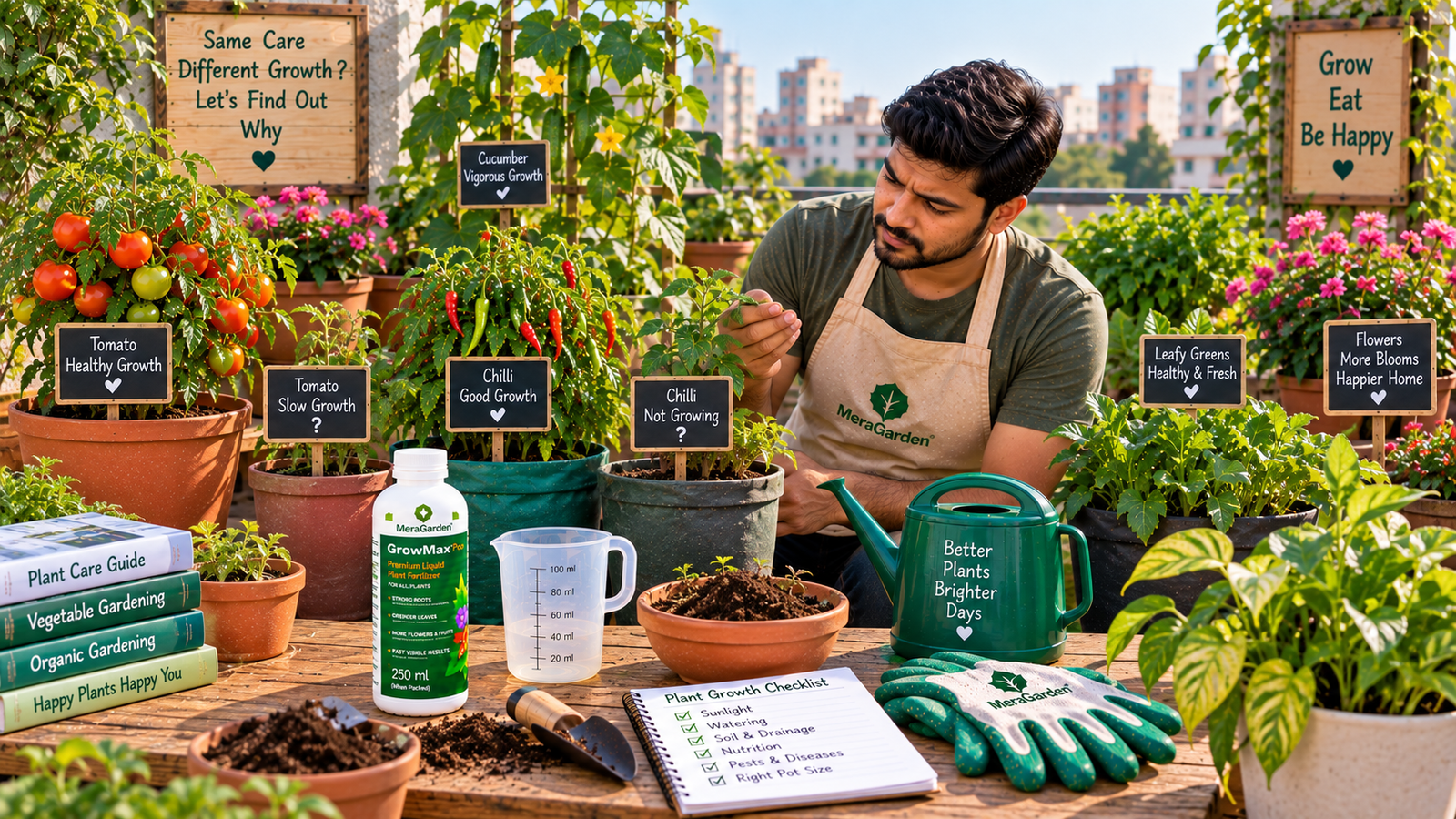
Reasons 1–2: Start With Light and Water
1. Your Plant May Not Be Getting Enough Light
One of the first things to check when a plant is not growing is light.
Light provides the energy plants need for photosynthesis. If a plant receives insufficient light for its requirements, growth can become slow, weak or stretched.
This problem is especially common with indoor plants.
A plant may look perfectly healthy when purchased from a nursery because it was grown under suitable lighting conditions. After bringing it home, however, it may be placed several metres away from a window where the available light is much lower.
Similarly, terrace gardeners sometimes place plants behind walls, shade screens or taller plants that block sunlight.
Signs of insufficient light
Look for:
- Very slow new growth
- Long, weak stems
- Pale or smaller leaves
- Leaves becoming widely spaced
- Few flowers
- Poor fruit development
- Plant leaning toward a light source
Different plants require different amounts and types of light, so avoid assuming that every plant needs strong direct sunlight.
How to fix the problem
First identify the plant’s light requirements.
Then move it gradually to a more suitable location if necessary.
For outdoor vegetables such as tomatoes and chillies, adequate sunlight is particularly important for strong vegetative growth and productive flowering.
For indoor plants, bright indirect light may be more appropriate depending on the species.
Don’t increase fertilizer simply because growth is slow if the plant isn’t receiving enough light.
2. Incorrect Watering Can Stop Plant Growth
Water is essential for plant growth, but both too much and too little water can cause problems.
Many gardeners follow a fixed schedule such as “water every morning” without checking the actual condition of the growing medium.
That approach can be problematic because water requirements change with:
- Plant type
- Pot size
- Weather
- Temperature
- Humidity
- Sunlight
- Growing medium
- Plant growth stage
A container exposed to hot Indian summer conditions can dry much faster than an indoor pot.
On the other hand, an indoor plant kept in a cool room may stay moist for several days.
Too little water
When a plant repeatedly becomes too dry, it may struggle to maintain healthy growth.
Possible signs include:
- Wilting
- Dry soil
- Crispy leaf edges
- Drooping foliage
- Leaf drop
- Slow new growth
Too much water
Constantly wet growing conditions can also interfere with healthy roots.
Possible signs include:
- Yellow leaves
- Soft or weak growth
- Persistent wet soil
- Poor root health
- Leaf drop
- Slow growth despite frequent watering
Better watering practice
Instead of watering simply because it is a particular day, check the growing medium and understand your plant’s requirements.
For container plants, drainage is particularly important.
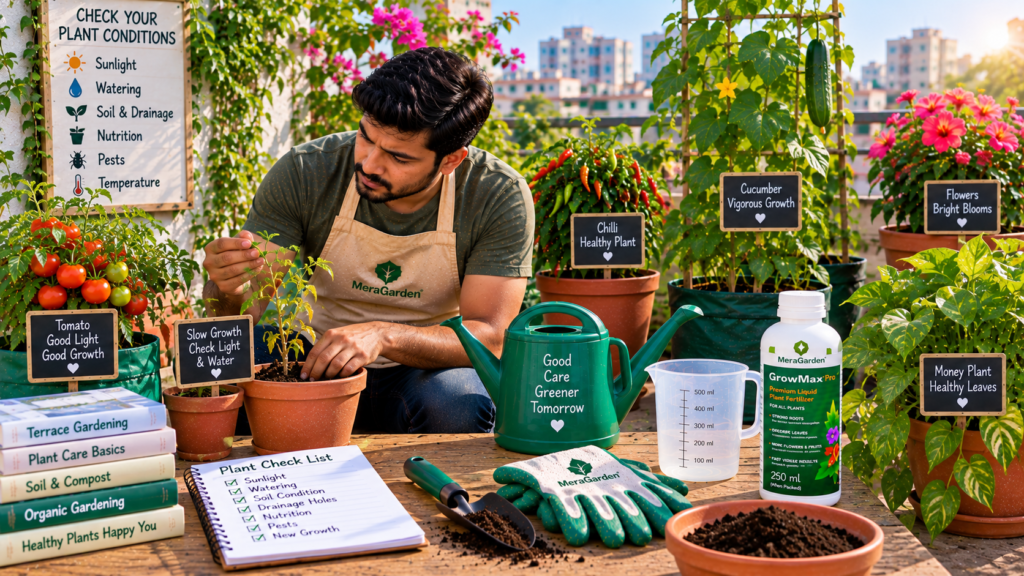
Reasons 3–5: Check Roots, Soil and Nutrition
3. Poor Drainage May Be Restricting Root Growth
Healthy roots are the foundation of healthy plants.
Even when you water correctly, a container with poor drainage can create problems.
If excess water cannot escape, the growing medium can remain saturated for too long. Roots need oxygen as well as moisture, so constantly waterlogged conditions can reduce root health and ultimately affect the plant’s ability to grow.
Check your container
Make sure:
- The pot has drainage holes.
- The holes are not blocked.
- Excess water can escape.
- The pot is not sitting permanently in standing water.
- The growing medium is not heavily compacted.
This is particularly important for balcony and terrace gardening because containers have limited root space.
What about grow bags?
Grow bags can work very well for vegetables, but they also need suitable drainage and an appropriate growing medium.
If your vegetable plant is not growing despite regular watering and feeding, check the root environment before adding more fertilizer.
4. Your Growing Medium May Not Be Suitable
The quality of the growing medium has a major influence on plant development.
A plant may receive enough water and fertilizer but still grow poorly if the root environment is unsuitable.
A good container-growing medium needs to provide an appropriate balance of:
- Moisture
- Air
- Drainage
- Root support
- Nutrient availability
Over time, some growing media can become compacted or lose their desirable structure.
Signs of an unsuitable growing medium
You may notice:
- Water sitting on the surface
- Water running straight through without properly wetting the medium
- Very hard or compacted soil
- Roots filling the container
- Poor drainage
- Extremely rapid drying
If the growing medium is unsuitable, simply increasing fertilizer may not help.
Improve the root environment first
Depending on the plant and situation, improving the growing medium, drainage or container may be more useful than adding additional plant food.
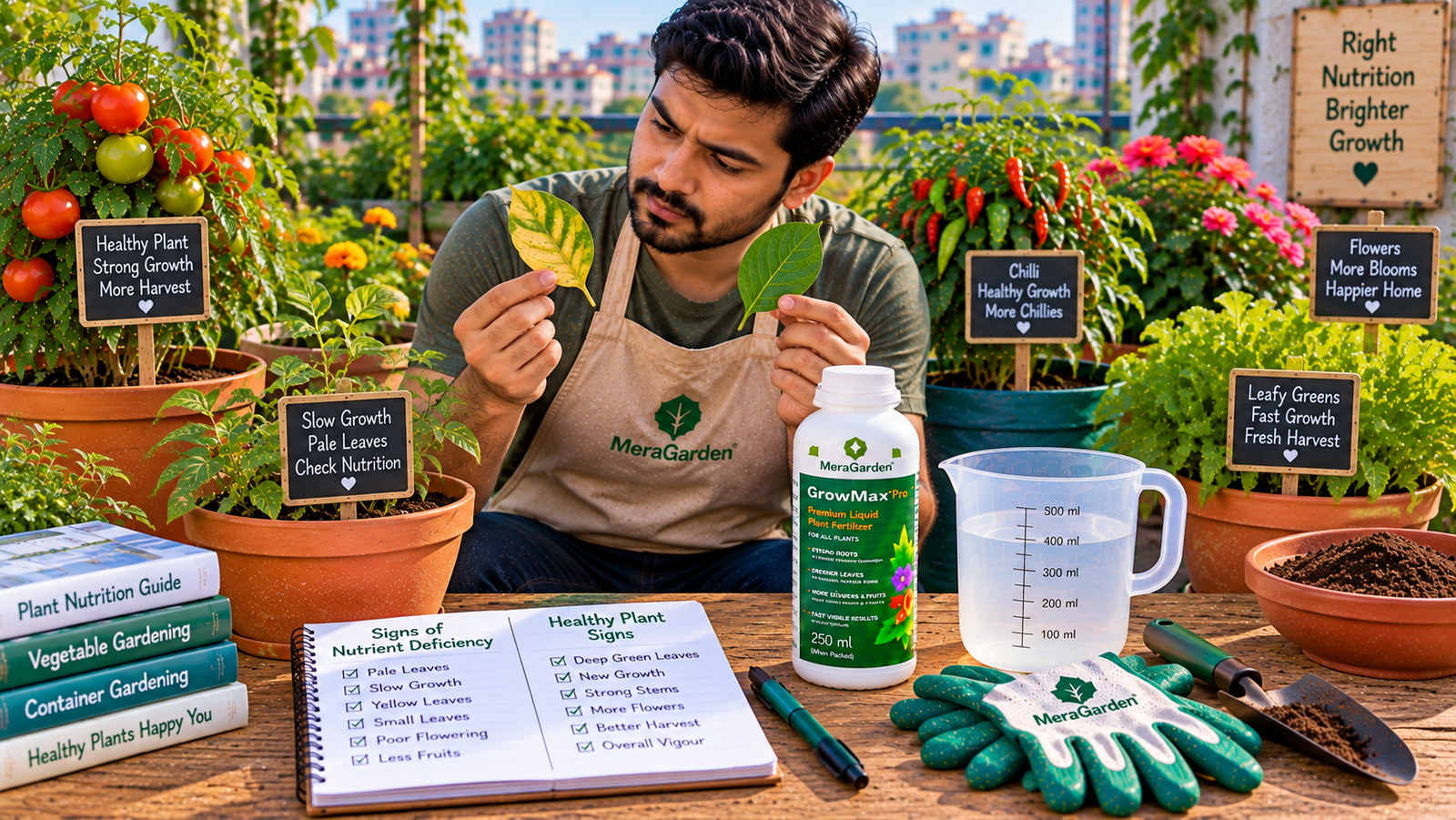
5. The Plant May Not Be Receiving Enough Nutrients
Another common reason for slow growth is limited nutrient availability.
Plants require nutrients for healthy development. Nitrogen, phosphorus and potassium are major nutrients, while plants also require smaller amounts of several other nutrients.
Container plants can be particularly dependent on regular nutrient management because their roots are restricted to a relatively small amount of growing medium.
Nutrients can become depleted as plants grow and as water moves through the container.
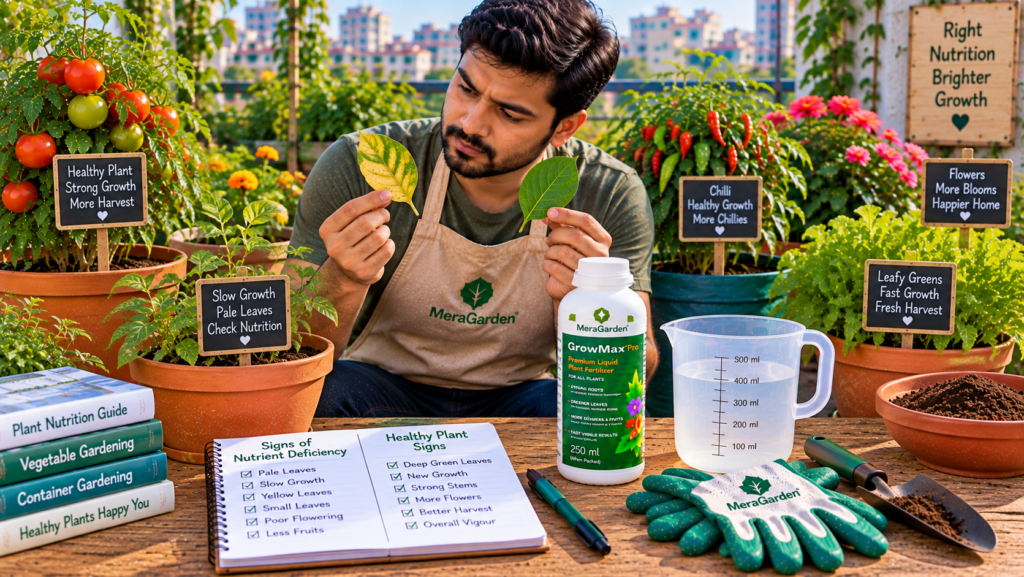
Possible signs of nutritional problems
Depending on the nutrient involved, you may see:
- Pale or yellow leaves
- Small new leaves
- Weak growth
- Poor flowering
- Poor fruit development
- Older leaves changing colour
- Overall lack of vigour
However, it is important to understand that slow growth alone does not prove nutrient deficiency.
Watering, light, root health and temperature should also be considered.
Don’t over-fertilize
One of the biggest mistakes is assuming:
“If a little fertilizer helps, more fertilizer will help even more.”
That is not a safe gardening principle.
Excessive fertilizer can cause problems, particularly in containers where salts can accumulate.
If nutrition is genuinely limiting growth, use an appropriate fertilizer according to its product instructions.
Reasons 6–7: Look at Temperature, Pests and Plant Development
6. Temperature or Seasonal Conditions May Be Slowing Growth
Plants respond strongly to temperature.
A plant that grows quickly during its preferred season may slow down when temperatures become too high or too low.
This is particularly relevant for gardeners in India, where conditions can change dramatically between summer, monsoon and winter.
Heat stress
During extremely hot weather, plants may reduce growth as they struggle with heat and water stress.
Container plants can experience even greater temperature fluctuations because pots and grow bags can heat up quickly in direct sunlight.
Cold stress
Some plants also slow down considerably when temperatures fall below their preferred range.
This doesn’t necessarily mean the plant is dying.
It may simply be growing more slowly because environmental conditions are less suitable.
What should you do?
Avoid making major changes based solely on the speed of growth.
Consider:
- Current season
- Plant species
- Temperature
- Sun exposure
- Water availability
- Humidity
- Wind exposure
Understanding the natural growth cycle of your plant can prevent unnecessary fertilization.
7. Pests and Diseases May Be Affecting Growth
Sometimes a plant has enough water, light and nutrients but still does not grow because pests or disease are interfering with its health.
Small pests can damage young leaves and shoots, reducing the plant’s ability to produce healthy new growth.
Look carefully at:
- Undersides of leaves
- New shoots
- Leaf joints
- Stems
- Flowers
- Growing tips
Watch for:
- Tiny insects
- Sticky residue
- Webbing
- Holes
- Spots
- Distorted leaves
- Curling
- Discoloured new growth
Why early inspection matters
A small pest problem can be easier to manage than a severe infestation.
Regularly inspect your plants rather than waiting until the damage becomes obvious.
And remember: fertilizer is not a pesticide or disease treatment.
If pests or disease are responsible for poor growth, they need to be addressed separately.
8. The Pot May Be Too Small or the Roots May Be Crowded
Container plants eventually use the space available to their roots.
If a plant has been growing in the same container for a long time, the root system may become crowded.
This can restrict access to water, air and nutrients.
Possible signs of a root-bound plant
Look for:
- Roots circling around the inside of the pot
- Roots coming out of drainage holes
- Growing medium drying extremely quickly
- Plant becoming unstable
- Little new growth despite reasonable care
- Water passing through the container unusually quickly
However, don’t automatically repot every slow-growing plant.
Some plants naturally prefer being slightly root-bound, while others benefit from additional space.
Research the requirements of the specific plant before changing containers.
9. You May Be Expecting Growth During a Naturally Slow Period
Not every plant grows continuously at the same speed.
This is one of the easiest factors to overlook.
A plant may appear to “stop growing” because its natural growth rate has slowed due to:
- Seasonal changes
- Dormancy
- Low temperatures
- Heat stress
- Recent transplanting
- Flowering or fruit production
- Recovery after pruning
- Recovery after environmental stress
For example, a plant that has recently been transplanted may temporarily focus on establishing its roots rather than producing large amounts of new foliage.
Similarly, mature plants may not produce rapid visible growth every week.
Before changing your care routine
Ask:
Is the plant actually unhealthy, or is it simply growing at its normal rate?
Compare the plant’s current condition with its expected growth pattern.
This simple question can prevent unnecessary watering, repotting and fertilization.
10. The Plant May Need Better Overall Care, Not Just More Fertilizer
Plant growth depends on several factors working together.
Think of plant growth as a system:
Light + Water + Roots + Growing Medium + Temperature + Nutrition + Pest Management = Healthy Growth
If one major part of that system is failing, increasing another part may not solve the problem.
For example:
Poor light + more fertilizer
Usually not the right solution.
Waterlogged roots + more water
Likely to make the problem worse.
Pest infestation + fertilizer
Doesn’t address the pest problem.
Healthy roots + suitable light + appropriate watering + nutrient deficiency
This is a situation where appropriate fertilization may be useful.
This is why diagnosing the cause is more important than simply searching for the “strongest” fertilizer.
Give Your Plants the Right Support
If your plants are not growing, don’t immediately assume they need more fertilizer.
Check the light. Check the water. Check the roots. Check the growing medium. Check for pests. Then consider nutrition.
When your plants genuinely need additional nutrients, a suitable liquid fertilizer can become part of a consistent plant-care routine.
Grow Better. Bloom Bigger.
How to Use Liquid Fertilizer for Slow-Growing Plants
If you have checked the major environmental factors and believe your plant needs additional nutrition, use fertilizer carefully.
Step 1: Identify the Plant
First determine what you are growing.
The nutritional needs of a tomato plant may differ from those of a snake plant, peace lily, rose or leafy vegetable.
Knowing the plant helps you understand its expected growth pattern and feeding requirements.
Step 2: Check the Growing Conditions
Before fertilizing, check:
- Light
- Water
- Drainage
- Root condition
- Growing medium
- Temperature
- Pest activity
If one of these is clearly causing the growth problem, correct it first.
Step 3: Check Whether Feeding Is Appropriate
A plant under severe stress may not benefit from immediate fertilization.
For example, if the growing medium is completely waterlogged, improving drainage should take priority.
If the plant is extremely dry, restore appropriate moisture first.
Step 4: Read the Product Label
Always follow the current fertilizer label.
Check the recommended:
- Dilution
- Quantity
- Frequency
- Application method
- Suitable plants
- Safety instructions
Never invent or increase the dosage.
Step 5: Measure the Fertilizer
Use a proper measuring container.
Accurate measurement helps you maintain a consistent dilution and prevents accidental over-application.
Step 6: Dilute With Water
Mix the measured fertilizer with the recommended quantity of water according to the product label.
Do not apply concentrated fertilizer directly to the roots unless the product specifically instructs you to do so.
Step 7: Apply and Monitor
Apply the diluted fertilizer as directed.
Then continue observing the plant over time.
Look for:
- New leaves
- New shoots
- Greener foliage
- Stronger growth
- Flower development
- Fruit development
Don’t repeatedly increase the fertilizer quantity just because you don’t see an immediate change.
Plant growth takes time.
Liquid Fertilizer vs Granular Fertilizer for Slow-Growing Plants
Gardeners often ask whether liquid fertilizer or granular fertilizer is better when plants are not growing.
The answer depends on the plant, growing medium and fertilizer product.
| Feature | Liquid Fertilizer | Granular Fertilizer |
|---|---|---|
| Application | Mixed with water and applied as directed | Applied in dry form |
| Convenience | Easy to measure and dilute | Convenient for planned applications |
| Availability | Generally faster acting | Release varies by product |
| Container gardening | Often particularly convenient | Can also be useful |
| Measurement | Dilution needs careful measurement | Quantity needs careful measurement |
| Best approach | Follow label instructions | Follow label instructions |
| Main mistake to avoid | Using too strong a solution | Applying too much |
Liquid fertilizers can be particularly convenient for container plants because nutrients are delivered in a form that can be applied with water.
However, neither type is automatically the answer to every slow-growth problem.
If the plant is not receiving enough light, has poor drainage or is suffering from pests, changing fertilizer type will not necessarily solve the problem.
GrowMax Pro for Plants That Need Additional Nutrition
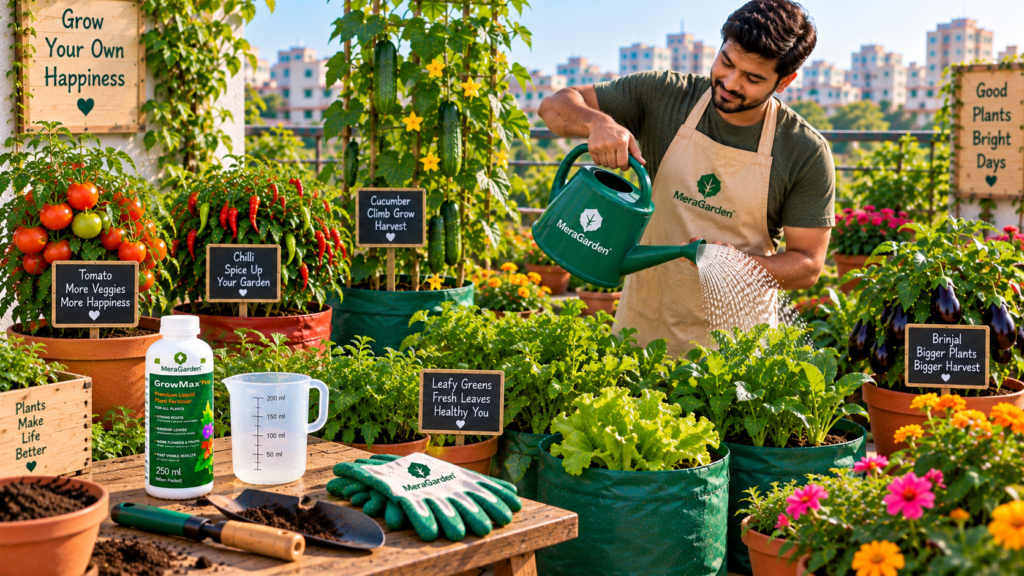
MeraGarden GrowMax Pro Liquid Plant Fertilizer can be used as part of a plant nutrition routine when additional feeding is appropriate.
GrowMax Pro is a chemical-based liquid fertilizer marketed as suitable for all plants, with product claims focused on strong roots, greener leaves, more flowers and fruits and fast visible results.
For home gardeners growing plants in containers, pots, grow bags, balconies and terraces, a liquid fertilizer can be convenient because it can be measured and diluted before application.
But there is an important point:
GrowMax Pro should not be treated as a universal cure for slow growth.
If your plant is not growing because of:
- Poor sunlight
- Overwatering
- Underwatering
- Poor drainage
- Root problems
- Extreme temperature
- Pest infestation
- Disease
- Unsuitable growing medium
then fertilizer alone may not solve the problem.
First identify and correct the underlying issue.
If the plant needs additional nutrition, use GrowMax Pro according to its current product label.
Why correct measurement matters
Liquid fertilizers are concentrated products, so measuring and diluting them correctly is important.
Do not estimate the dosage.
Do not assume that a stronger solution will make plants grow faster.
Do not apply concentrated fertilizer directly to plants unless the product label specifically instructs you to do so.
For container gardeners
Potted plants have a limited root environment. As plants grow and are watered regularly, nutrients available in the growing medium can become limited.
A suitable fertilizer can therefore be useful as part of a planned nutrition routine.
The goal is not to feed plants as much as possible.
The goal is to provide appropriate nutrition at the appropriate time.
Help Your Plants Grow Better
Your plants don’t necessarily need more fertilizer.
They need the right care.
Check their light, water, roots, growing medium, temperature and overall health. When additional nutrition is appropriate, make it part of a consistent feeding routine.
Grow Better. Bloom Bigger.
Conclusion
If you are asking, “Why are my plants not growing?”, don’t panic and don’t immediately reach for more fertilizer.
There can be many reasons for slow plant growth.
The first things to check are light and watering. Then inspect the roots, drainage and growing medium. After that, consider nutrient availability, temperature, pests and the plant’s natural growth cycle.
The 10 common reasons covered in this guide are:
- Insufficient light
- Incorrect watering
- Poor drainage
- Unsuitable growing medium
- Nutrient deficiency
- Temperature or seasonal stress
- Pests and diseases
- Crowded or root-bound conditions
- Naturally slow growth periods
- Poor overall plant-care balance
The most important lesson is that slow growth is a symptom, not a diagnosis.
A yellow leaf, small plant or lack of new shoots doesn’t automatically tell you what the problem is.
Look at the whole growing environment.
If nutrition is genuinely limited, an appropriate liquid fertilizer such as MeraGarden GrowMax Pro can be incorporated into your routine according to the product label.
But remember:
Healthy plants don’t come from fertilizer alone.
They need suitable light, correct watering, healthy roots, good growing media, appropriate temperature, protection from pests and adequate nutrition.
Give your plants the right conditions first—and then give them the nutritional support they actually need.
FAQs
1. Why are my plants not growing?
Plants may stop or slow down because of insufficient light, incorrect watering, poor drainage, unsuitable growing media, nutrient deficiency, temperature stress, pests, diseases or naturally slow growth periods.
2. Why is my plant growing very slowly?
Slow growth can be normal for some plants, particularly during certain seasons. However, environmental problems such as low light, poor watering, root stress or insufficient nutrients can also reduce growth.
3. Does fertilizer make plants grow faster?
Fertilizer can support plant growth when nutrients are limiting. However, fertilizer cannot compensate for problems such as insufficient light, waterlogging, poor drainage or pest infestation.
4. Should I add more fertilizer if my plant is not growing?
Not automatically. First check light, watering, drainage, roots, growing medium, temperature and pests. If nutrition is genuinely limited, use fertilizer according to the product label.
5. Can overwatering stop plant growth?
Yes. Excessively wet growing conditions can stress roots and interfere with healthy plant development. Check the moisture level and drainage before watering again.
6. Can lack of sunlight cause slow plant growth?
Yes. Plants need appropriate light for photosynthesis and growth. If a plant receives less light than it requires, growth can become weak or slow.
7. How do I know if my plant needs fertilizer?
Look at the entire plant rather than relying on one symptom. Slow growth combined with signs consistent with nutrient deficiency may indicate a nutritional problem, but watering, light and root conditions should also be checked.
8. Can GrowMax Pro help slow-growing plants?
GrowMax Pro can provide nutritional support when a plant needs additional fertilizer. However, slow growth has many possible causes, so correct environmental problems first and use GrowMax Pro according to its current product label.
9. Is liquid fertilizer better than granular fertilizer?
Neither is universally better. Liquid fertilizer is often convenient for container plants and can be fast acting, while granular products can provide nutrients in different release patterns. Follow the instructions for the specific product.
10. Why are my vegetable plants not growing?
Vegetable plants may grow slowly because of inadequate sunlight, incorrect watering, poor drainage, unsuitable containers, limited nutrients, temperature stress, pests or unsuitable growing media.
11. Why are my plants growing leaves but not getting bigger?
The plant may be receiving conditions that support some foliage production but not optimal overall development. Check light, root space, nutrition, watering and the plant’s natural growth pattern.
12. Can a small pot stop plant growth?
A pot that restricts the root system can eventually limit growth for some plants. Check whether roots are tightly circling the container or emerging from drainage holes before deciding to repot.
13. How often should I fertilize slow-growing plants?
There is no universal frequency. It depends on the plant, growing medium, season and fertilizer product. Follow the current product label and avoid increasing frequency simply because growth appears slow.
14. Should I fertilize a stressed plant?
First identify the stress. If the plant is suffering from severe dryness, waterlogging, root damage, pests or unsuitable temperature, correct that problem before considering additional fertilizer.
15. How can I make my plants grow healthier?
Provide suitable light, appropriate watering, good drainage, healthy growing media, sufficient root space, suitable temperature, pest management and appropriate nutrition. Regularly inspecting plants can help identify problems early.
Must Read
- How Often Should You Fertilize Plants? 7 Easy Rules for Healthy Growth
- How Often Should You Fertilize Plants? Complete Fertilizer Schedule
- What Is NPK Fertilizer? 7 Easy Tips for Healthy Plants
- Best Liquid Fertilizer for Plants: Complete Guide for Home Gardeners
- How to Use Liquid Fertilizer for Plants: 7 Easy Steps for Better Growth
- Best Organic Fertilizers for Plants: 7 Natural Options for Healthy Growth
- Best Fertilizer for Indoor Plants in India: 7 Easy Tips for Healthy Growth
- Best Fertilizer for Flowering Plants in India: 7 Top Options
- Best Fertilizer for Plants: 7 Smart Tips to Avoid Common Mistakes
- 5 Signs Your Plants May Need Fertilizer
- How Much Liquid Fertilizer Should You Use for Plants?
- 7 Benefits of Liquid Fertilizer for Plants: Grow Healthier Plants Faster
- 7 Benefits of Liquid Fertilizer for Plants: A Simple Guide for Healthy Growth
- Best Fertilizer for Peace Lily: 7 Powerful Tips for Beautiful Blooms and Avoiding Common Mistakes
- Best Fertilizer for Spider Plant: 7 Powerful Tips for Lush Growth and Avoiding Common Mistakes
- Liquid Fertilizer vs Granular Fertilizer: Which Is Better? 7 Key Differences for Home Gardeners
- Liquid Fertilizer vs Organic Fertilizer: 7 Powerful Pros, Cons & the Best Choice for Your Plants
- How to Choose the Right Fertilizer for Your Plants: 7 Smart Tips to Avoid Common Mistakes
- 5 Positive Signs Your Plants Need Fertilizer — Avoid These Warning Symptoms for Healthier Growth
- How to Grow Peace Lilies
- How To Grow Houseplants