Why are my plant leaves turning yellow? This is one of the most common questions asked by home gardeners.
You may notice one or two yellow leaves at the bottom of your plant and wonder whether something is seriously wrong. Sometimes, an occasional older leaf naturally becomes yellow and drops as part of the plant’s normal growth cycle. However, when many leaves start turning yellow, especially within a short period, it usually means the plant is experiencing some kind of stress.
The difficult part is that yellow leaves do not have only one cause.
Too much water, too little water, poor drainage, insufficient light, temperature stress, nutrient deficiency, root problems and pests can all contribute to unhealthy foliage. The RHS notes that yellowing can have several causes, including watering problems, unsuitable light, temperature changes, overpotting and nutrient issues.
This means you should not immediately assume that your plant needs more fertilizer.
In fact, adding fertilizer without identifying the underlying problem can sometimes make the situation worse. A better approach is to inspect the leaves, growing medium, roots, light conditions and overall plant health before deciding what action to take.
This guide explains 7 important causes and solutions for yellow leaves, particularly for plants grown in pots, balconies, indoor spaces and Indian home gardens.
Table of Contents
1. Too Much Water Can Turn Plant Leaves Yellow
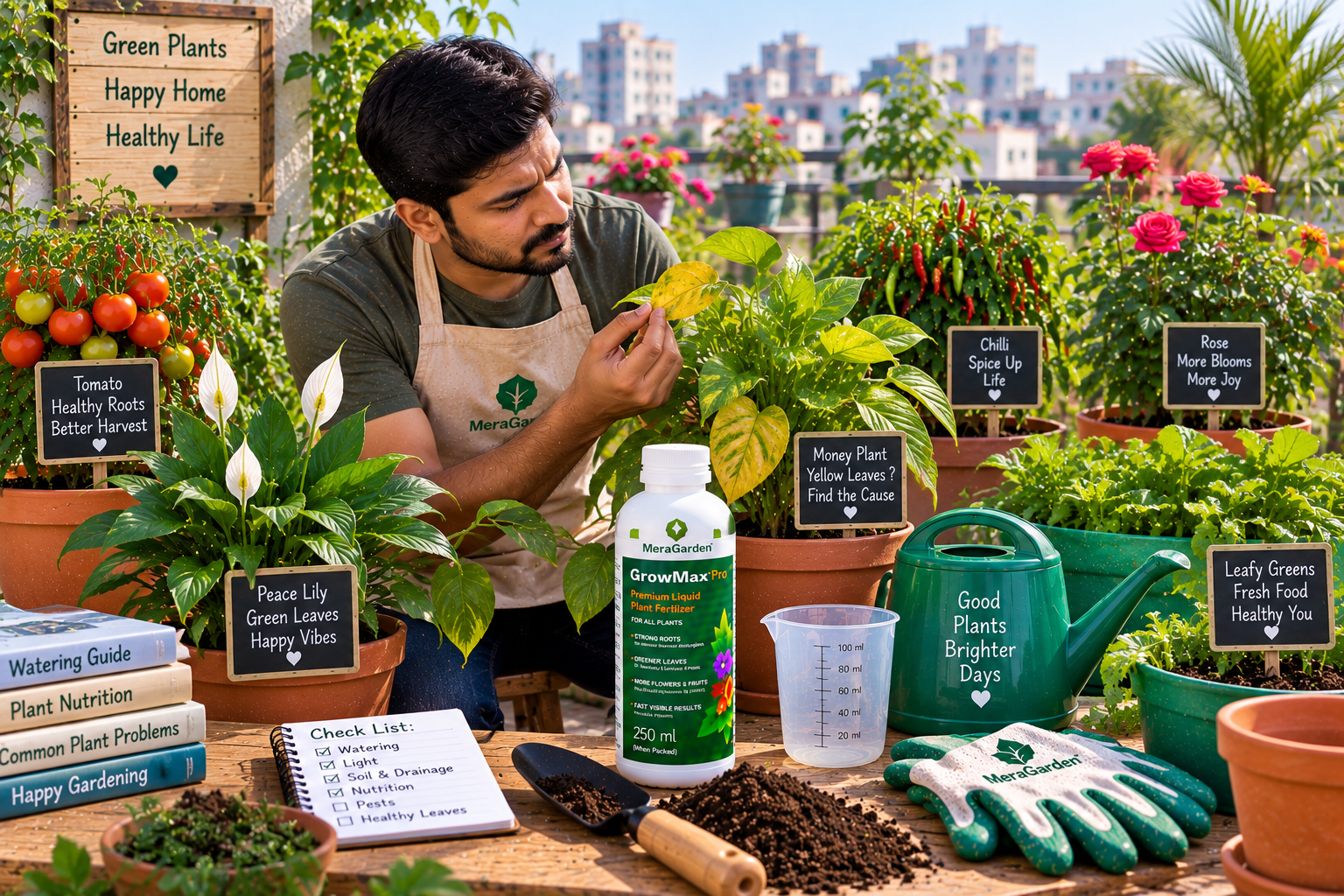
One of the first things to check when plant leaves turn yellow is watering.
Many gardeners assume that more water means healthier plants. But roots need both water and air. When the growing medium remains saturated for too long, the roots may become stressed and unable to function properly.
As root health declines, the plant may show symptoms such as yellowing leaves, wilting or leaf drop.
This can be particularly common in containers because excess water may remain around the roots when drainage is poor.
The RHS identifies overwatering and waterlogging among common causes of yellowing and other plant-health problems.
How to check for overwatering
Before watering again:
- Touch the growing medium a few centimetres below the surface.
- Check whether it is still wet.
- Make sure the pot has drainage holes.
- Check that excess water can escape freely.
- Look for a constantly soggy or unpleasant-smelling growing medium.
- If practical, inspect the roots for signs of poor health.
If the soil is already very wet, adding more water is unlikely to help.
How to fix it
Allow the growing medium to reach an appropriate moisture level for that particular plant before watering again. Improve drainage if necessary and avoid leaving pots sitting in standing water.
Remember that different plants have different water requirements. A cactus, tomato plant and peace lily should not automatically receive the same watering routine.
2. Underwatering Can Also Cause Yellow Leaves
Interestingly, the opposite problem can also cause yellow foliage.
If a plant does not receive enough water, it can become stressed. Older leaves may yellow and eventually drop, while the plant may also show wilting, dry growing media and crispy leaf edges.
The RHS recommends checking the moisture of the growing medium rather than simply watering according to a fixed calendar.
This is especially important in Indian conditions.
During hot summer weather, plants growing on balconies and terraces can lose water quickly because containers heat up and exposed plants experience higher evaporation.
Signs that underwatering may be involved
Look for:
- Very dry growing medium
- Wilting leaves
- Drooping foliage
- Dry or crispy leaf edges
- Yellowing of older leaves
- Very rapid drying of the pot
- Poor new growth
How to fix underwatering
Water thoroughly when the plant actually needs it, allowing excess water to drain from the container.
However, do not respond to dry soil by creating a permanent cycle of excessive watering. The goal is appropriate moisture, not constantly wet soil.
For container plants, check moisture regularly because small pots and grow bags can dry out faster than larger containers.
3. Poor Drainage and Root Stress May Be the Real Problem
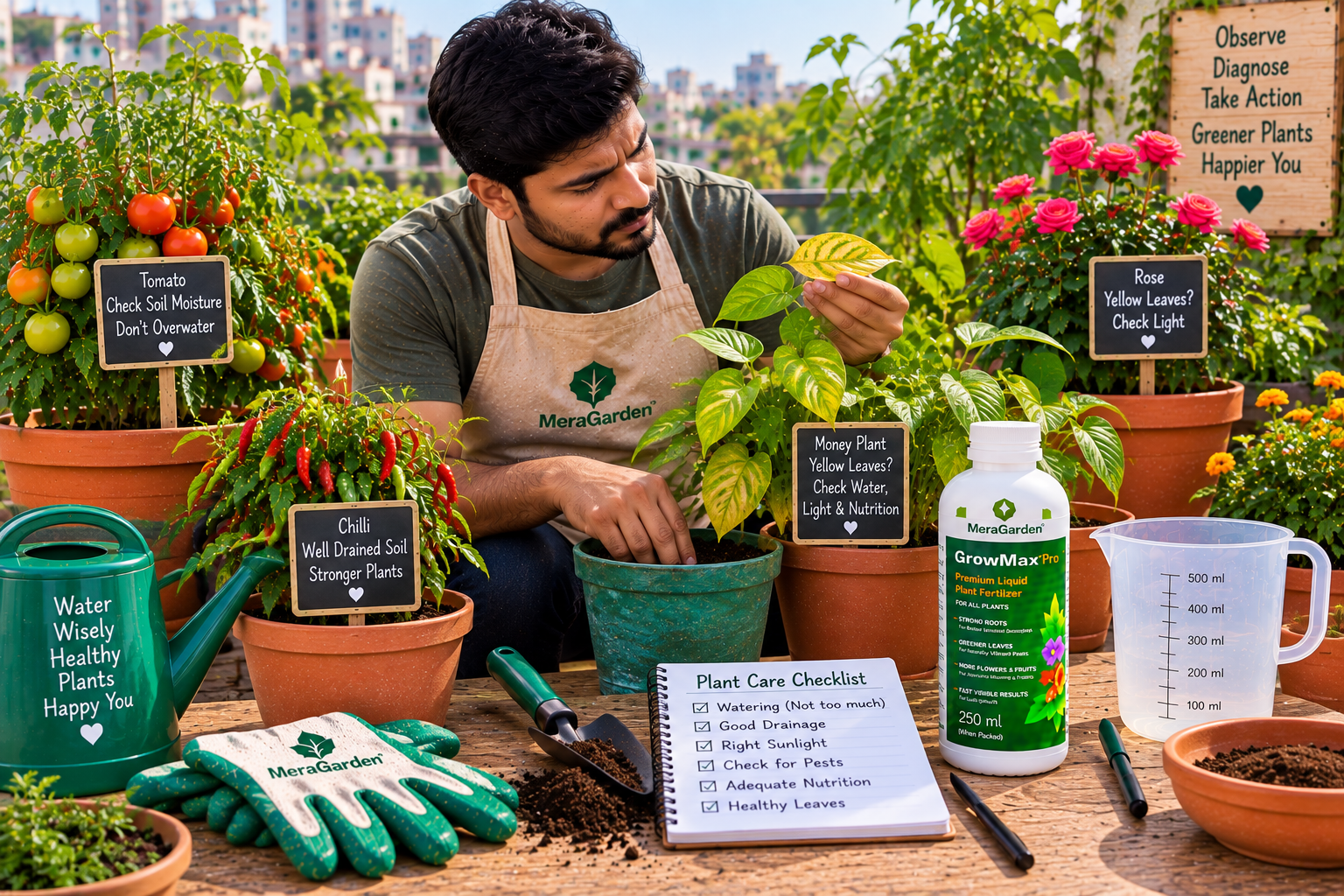
Sometimes gardeners blame watering when the real issue is drainage.
You may be watering your plant at a reasonable frequency, but if the pot cannot drain properly, the roots can still remain too wet.
This is why checking the container itself is important.
Check these things:
- Does the pot have drainage holes?
- Are the holes blocked?
- Is the container sitting directly on a surface that prevents drainage?
- Does water remain in the saucer?
- Is the growing medium compacted?
- Is the container much larger than the plant needs?
The RHS recommends checking root and growing-medium conditions when diagnosing yellow leaves because several different problems can produce similar symptoms.
Why roots matter
Healthy roots are essential because they absorb water and nutrients.
If roots are continuously stressed by waterlogging or unsuitable growing conditions, simply adding fertilizer may not solve the problem.
For potted plants, good drainage is therefore just as important as selecting a suitable fertilizer.
4. Insufficient or Excessive Light Can Change Leaf Colour
Light is another major factor that gardeners sometimes overlook.
Plants need light for photosynthesis, and different plants have different light requirements.
If a plant receives too little light, growth can become weak and foliage may become pale. The RHS notes that inadequate light can be associated with pale foliage, poor growth and yellowing of lower leaves in some houseplants.
At the same time, too much intense direct sunlight can cause leaf damage in plants that prefer filtered or lower light.
Consider the plant’s location
Ask yourself:
- Has the plant recently been moved?
- Is it receiving very little natural light?
- Is it suddenly exposed to strong afternoon sun?
- Is another plant blocking the light?
- Is the plant indoors far away from a window?
- Has the season changed?
A plant that was comfortable in one location may struggle after being moved.
A simple solution
Research the light requirements of the specific plant and adjust its position gradually where necessary.
Do not assume that every yellow leaf is a fertilizer problem.
5. Nutrient Deficiency Can Cause Yellow Leaves
Now we come to one of the most important causes: nutrient deficiency.
Plants require a range of nutrients for healthy growth. Nitrogen, phosphorus and potassium are major nutrients, while elements such as magnesium, calcium, sulphur, iron, manganese and others are also important.
When nutrients become unavailable or depleted, leaves can lose their healthy green colour.
For example, nitrogen deficiency can result in pale yellow leaves, often beginning with older foliage. The RHS also points out that plants growing in containers can show nutrient deficiency when available nutrients are depleted.
But there is an important warning
Yellow leaves do not automatically mean nutrient deficiency.
Water stress, waterlogging, poor light and root problems can produce similar symptoms.
That is why diagnosis matters.
When fertilizer may help
If your plant has suitable light, appropriate watering, healthy roots and a suitable growing medium, but still shows signs consistent with nutrient deficiency, feeding may be appropriate.
For container plants, nutrients can become limited over time because the plant has access to a relatively small volume of growing medium.
A suitable fertilizer can help replenish nutrients when used according to its label instructions.
6. Feeding at the Right Time Can Support Healthier New Growth
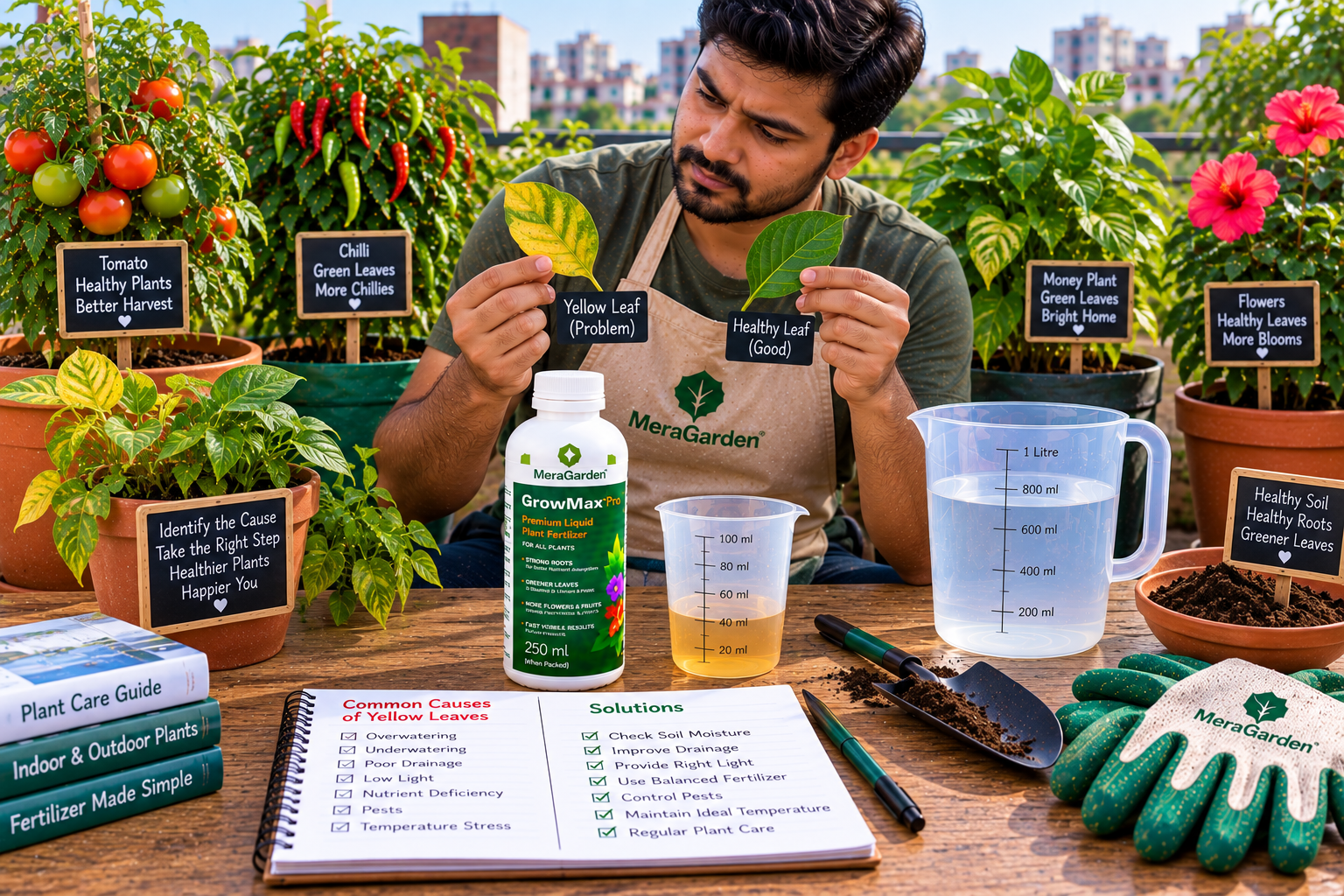
Once watering, drainage, light and other environmental conditions have been checked, appropriate feeding can become part of a healthy plant-care routine.
A plant needs nutrients throughout its growth cycle, although its requirements can vary depending on the species and growth stage.
The RHS recommends feeding plants when appropriate and notes that container plants may require feeding because nutrients can become depleted.
For example, actively growing plants may have greater nutritional needs than plants experiencing a dormant or slow-growth period.
Don’t use fertilizer as a universal cure
This is extremely important.
If the actual problem is:
- Overwatering
- Poor drainage
- Root damage
- Insufficient light
- Excessive heat
- Cold stress
- Pest infestation
then fertilizer alone will not necessarily correct the problem.
First improve the growing conditions.
Then consider feeding if the plant actually needs additional nutrients.
Why liquid fertilizer can be convenient
Liquid fertilizers are useful for many container-growing situations because they can be mixed with water and applied directly according to the product instructions.
The RHS notes that liquid fertilizers are generally faster acting and are particularly useful for container plants.
7. A Consistent Plant-Care Routine Helps Prevent Yellow Leaves
The best way to deal with yellow leaves is not always to treat the symptom after it appears.
A better strategy is to develop a simple plant health-check routine.
Once a week, inspect your plants.
Check the leaves
Look for:
- Yellowing
- Brown edges
- Spots
- Holes
- Curling
- Wilting
- New growth
Check the growing medium
Ask:
- Is it too wet?
- Is it extremely dry?
- Does water drain properly?
- Has the medium become compacted?
Check the environment
Consider:
- Light
- Temperature
- Air movement
- Humidity
- Recent location changes
Check the roots when necessary
If the plant continues to decline despite apparently good care, examining the roots may provide useful information.
This systematic approach can prevent you from repeatedly adding water or fertilizer without understanding the actual problem.
Help Your Plants Grow Healthier
Yellow leaves can be frustrating, but the solution often starts with understanding what your plant actually needs.
If watering, drainage and light are under control and your plant needs additional nutrition, a suitable liquid fertilizer can become part of your regular plant-care routine.
Give your plants better nutritional support with MeraGarden GrowMax Pro.
Grow Better. Bloom Bigger.
How to Use Liquid Fertilizer When Plant Leaves Are Yellow
Before using any fertilizer, remember one important rule:
Do not fertilize a severely stressed plant without first checking the cause of the yellowing.
If the plant is suffering from waterlogging, root damage or another environmental problem, correct that issue first.
Once feeding is appropriate, follow these steps.
Step 1: Identify the Plant
Different plants have different nutritional and environmental requirements.
Identify whether you are caring for a:
- Tomato
- Chilli
- Cucumber
- Brinjal
- Money plant
- Peace lily
- Rose
- Snake plant
- Spider plant
- Other vegetable, flowering or indoor plant
Step 2: Check the Growing Medium
Before feeding, make sure the growing medium is in an appropriate moisture condition.
Avoid applying fertilizer to a severely dry or waterlogged root environment.
The RHS recommends paying attention to growing conditions before relying on feeding as the solution.
Step 3: Read the Fertilizer Label
Always check the current product label for:
- Recommended dilution
- Application method
- Suitable plants
- Application frequency
- Storage instructions
- Safety instructions
Never guess the dosage.
Step 4: Measure the Fertilizer Carefully
Use a suitable measuring container rather than estimating the quantity by eye.
Accurate measurement helps you follow the manufacturer’s recommended dilution consistently.
Step 5: Dilute as Directed
Mix the measured fertilizer with the required amount of water according to the product label.
Do not assume that using a stronger solution will produce faster results.
More fertilizer is not automatically better.
Step 6: Apply to the Growing Medium
Apply the properly diluted solution according to the product’s directions.
Avoid pouring concentrated fertilizer directly onto the plant or root area.
Step 7: Continue Monitoring
After feeding, continue observing:
- New leaf colour
- New growth
- Flowering
- Overall plant vigour
- Soil moisture
- Any further yellowing
If yellowing continues, reassess the plant instead of repeatedly increasing fertilizer.
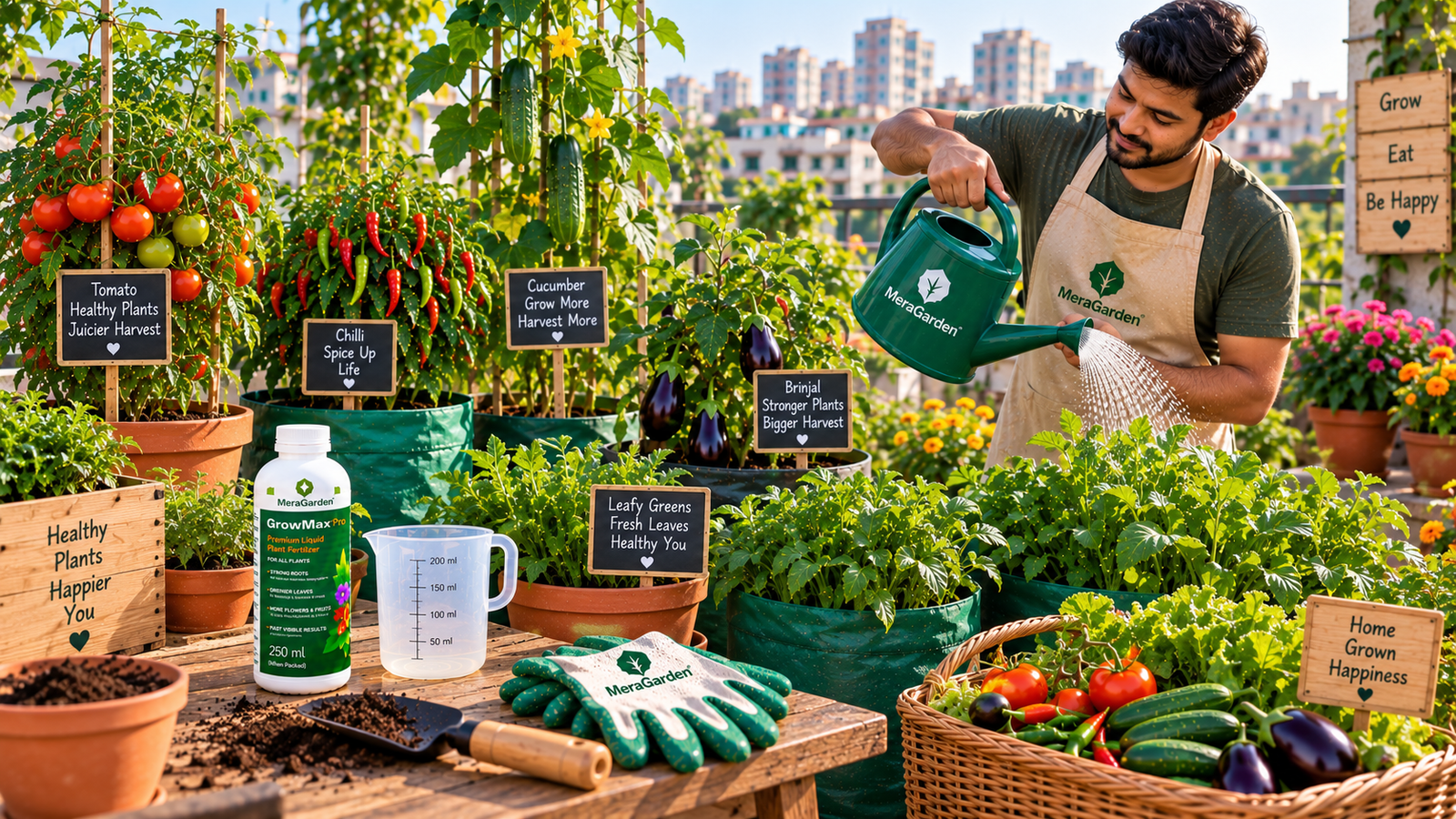
Liquid Fertilizer vs Other Solutions for Yellow Leaves
When plant leaves turn yellow, gardeners often ask whether they should use liquid fertilizer, granular fertilizer or simply change their watering routine.
The correct choice depends on the cause.
| Approach | Best Used For | Main Advantage | Important Consideration |
|---|---|---|---|
| Correct watering | Underwatering or watering imbalance | Addresses moisture stress | Avoid both extremes |
| Improved drainage | Waterlogged containers | Protects root health | Check drainage holes and growing medium |
| Better light | Light-related yellowing | Improves growing conditions | Match light to plant requirements |
| Liquid fertilizer | Appropriate nutrient supplementation | Convenient and generally fast acting | Follow label dilution |
| Granular fertilizer | Longer-term nutrient supply where appropriate | Can provide nutrients over time | Application and release vary by product |
| Repotting | Root-bound or unsuitable growing medium | Provides fresh growing space/media | Only when actually necessary |
The important lesson is that fertilizer is only one part of plant care.
If yellow leaves are caused by excess water, moving the plant to a brighter location, or improving drainage may be more useful than adding nutrients.
GrowMax Pro: Liquid Plant Fertilizer for Regular Plant Nutrition
If you have checked the major environmental causes and your plants need nutritional support, MeraGarden GrowMax Pro Liquid Plant Fertilizer can be considered as part of your plant-care routine.
GrowMax Pro is a chemical-based liquid fertilizer marketed for all plants. Its product positioning focuses on supporting strong roots, greener leaves, more flowers and fruits, and fast visible results.
For gardeners growing vegetables, flowers and ornamental plants in containers, a liquid fertilizer can be convenient because it can be measured and diluted before application.
However, it is important to use GrowMax Pro responsibly.
Don’t use fertilizer simply because a leaf is yellow
A yellow leaf may be caused by:
- Too much water
- Too little water
- Poor drainage
- Poor light
- Temperature stress
- Root problems
- Nutrient deficiency
- Pests or disease
Therefore, identify the likely cause first.
If nutrition is the issue, use GrowMax Pro according to its current product label rather than guessing the dosage.
Why container gardeners may find liquid fertilizer useful
Container plants have a limited volume of growing medium. Over time, available nutrients can decline, particularly when plants are actively growing and being watered regularly.
A suitable liquid fertilizer can therefore be a practical part of a planned feeding routine when additional nutrients are needed.
The RHS also notes that potted plants can show nutrient deficiencies when nutrients become depleted.
MeraGarden GrowMax Pro is designed to make liquid plant feeding simple and convenient—when used according to the label.
Give Yellowing Plants the Right Care
Don’t treat every yellow leaf with more fertilizer.
Check first. Correct the growing conditions. Then feed when appropriate.
If your plant needs additional nutrition, choose a suitable fertilizer and use it correctly.
Grow Better. Bloom Bigger.
Conclusion
So, why are my plant leaves turning yellow?
There isn’t one universal answer.
Yellow leaves can be caused by excessive watering, underwatering, poor drainage, insufficient or unsuitable light, nutrient deficiency, root stress and other growing problems. The RHS also highlights that several different problems can produce similar yellowing symptoms, making it important to look at the whole plant rather than focusing on the leaf colour alone.
The best approach is to diagnose the problem step by step.
Start with water.
Then check drainage and roots.
Next look at light and temperature.
After that, consider whether the plant is receiving adequate nutrients.
If the plant genuinely needs additional nutrition, a suitable liquid fertilizer can be incorporated into its care routine according to the product label.
Most importantly, don’t panic when you see one yellow leaf. An occasional older leaf can naturally yellow and fall. But if yellowing is widespread or continues to increase, investigate the growing conditions before simply adding more fertilizer.
With proper watering, suitable light, good drainage, appropriate nutrition and regular observation, many common plant-care problems can be identified early and corrected before they become serious.
FAQs
1. Why are my plant leaves turning yellow?
Yellow leaves can have several causes, including overwatering, underwatering, poor drainage, insufficient light, temperature stress and nutrient deficiency. The pattern of yellowing and the plant’s growing conditions can help identify the likely cause.
2. Should I remove yellow leaves?
If a leaf is completely yellow, damaged or dying, removing it can improve the plant’s appearance and allow you to focus on healthy growth. However, don’t remove large amounts of partially green foliage unnecessarily.
3. Can overwatering cause yellow leaves?
Yes. Overwatering and waterlogged growing conditions can cause yellowing and other signs of poor plant health. Check the moisture level and drainage before watering again.
4. Can underwatering cause yellow leaves?
Yes. Underwatering can cause stress, wilting and yellowing, particularly in older leaves. Check the growing medium before deciding whether the plant needs water.
5. Do yellow leaves always mean fertilizer deficiency?
No. Yellow leaves can result from many different problems. Watering, drainage, light and root conditions should be checked before assuming the plant needs fertilizer.
6. Can lack of nitrogen cause yellow leaves?
Yes. Nitrogen deficiency can cause pale yellow foliage and poor growth, with older leaves often affected first.
7. Can too much fertilizer cause yellow leaves?
Excessive fertilization can damage plants and interfere with nutrient balance. Always follow the fertilizer manufacturer’s recommended application instructions rather than assuming more fertilizer will produce faster growth.
8. Why are my potted plant leaves turning yellow?
Potted plants have limited growing space and a limited amount of growing medium. Watering problems, poor drainage, insufficient light and depleted nutrients can all contribute to yellowing.
9. How often should I fertilize a plant with yellow leaves?
There is no single schedule for every plant. First identify the cause of yellowing. If nutrient deficiency is suspected and feeding is appropriate, follow the fertilizer label for dosage and frequency.
10. Is liquid fertilizer good for yellow leaves?
Liquid fertilizer can be useful when yellowing is caused by an appropriate nutrient deficiency. It will not fix yellowing caused by overwatering, poor drainage, unsuitable light or root problems.
11. Can GrowMax Pro be used on plants with yellow leaves?
GrowMax Pro can be used as a liquid plant fertilizer when additional nutrition is appropriate. However, yellow leaves do not automatically mean fertilizer is needed. Identify the cause first and follow the current GrowMax Pro product label for application instructions.
12. Should I fertilize a severely wilted plant?
It is better to identify the reason for severe wilting first. If the plant is suffering from extreme dryness, waterlogging or root problems, correcting the growing conditions should take priority over feeding.
13. Why are only the older leaves turning yellow?
Older leaves can naturally yellow and drop as plants mature. However, yellowing of older leaves can also occur with nutrient deficiency or watering stress, so check the overall condition of the plant.
14. Why are my leaves yellow but the veins are green?
Yellow tissue with greener veins can sometimes indicate chlorosis associated with nutrient availability. However, similar symptoms can have different causes, so consider the plant species, growing medium, watering and other conditions before choosing a treatment.
15. How can I prevent yellow leaves in my plants?
Create a consistent care routine: provide suitable light, water according to the plant’s needs, maintain good drainage, use appropriate growing media, monitor pests and provide nutrients when necessary.
Must Read
- How Often Should You Fertilize Plants? 7 Easy Rules for Healthy Growth
- How Often Should You Fertilize Plants? Complete Fertilizer Schedule
- What Is NPK Fertilizer? 7 Easy Tips for Healthy Plants
- Best Liquid Fertilizer for Plants: Complete Guide for Home Gardeners
- How to Use Liquid Fertilizer for Plants: 7 Easy Steps for Better Growth
- Best Organic Fertilizers for Plants: 7 Natural Options for Healthy Growth
- Best Fertilizer for Indoor Plants in India: 7 Easy Tips for Healthy Growth
- Best Fertilizer for Flowering Plants in India: 7 Top Options
- Best Fertilizer for Plants: 7 Smart Tips to Avoid Common Mistakes
- 5 Signs Your Plants May Need Fertilizer
- How Much Liquid Fertilizer Should You Use for Plants?
- 7 Benefits of Liquid Fertilizer for Plants: Grow Healthier Plants Faster
- 7 Benefits of Liquid Fertilizer for Plants: A Simple Guide for Healthy Growth
- Best Fertilizer for Peace Lily: 7 Powerful Tips for Beautiful Blooms and Avoiding Common Mistakes
- Best Fertilizer for Spider Plant: 7 Powerful Tips for Lush Growth and Avoiding Common Mistakes
- Liquid Fertilizer vs Granular Fertilizer: Which Is Better? 7 Key Differences for Home Gardeners
- Liquid Fertilizer vs Organic Fertilizer: 7 Powerful Pros, Cons & the Best Choice for Your Plants
- How to Choose the Right Fertilizer for Your Plants: 7 Smart Tips to Avoid Common Mistakes
- 5 Positive Signs Your Plants Need Fertilizer — Avoid These Warning Symptoms for Healthier Growth
- How to Grow Peace Lilies
- How To Grow Houseplants