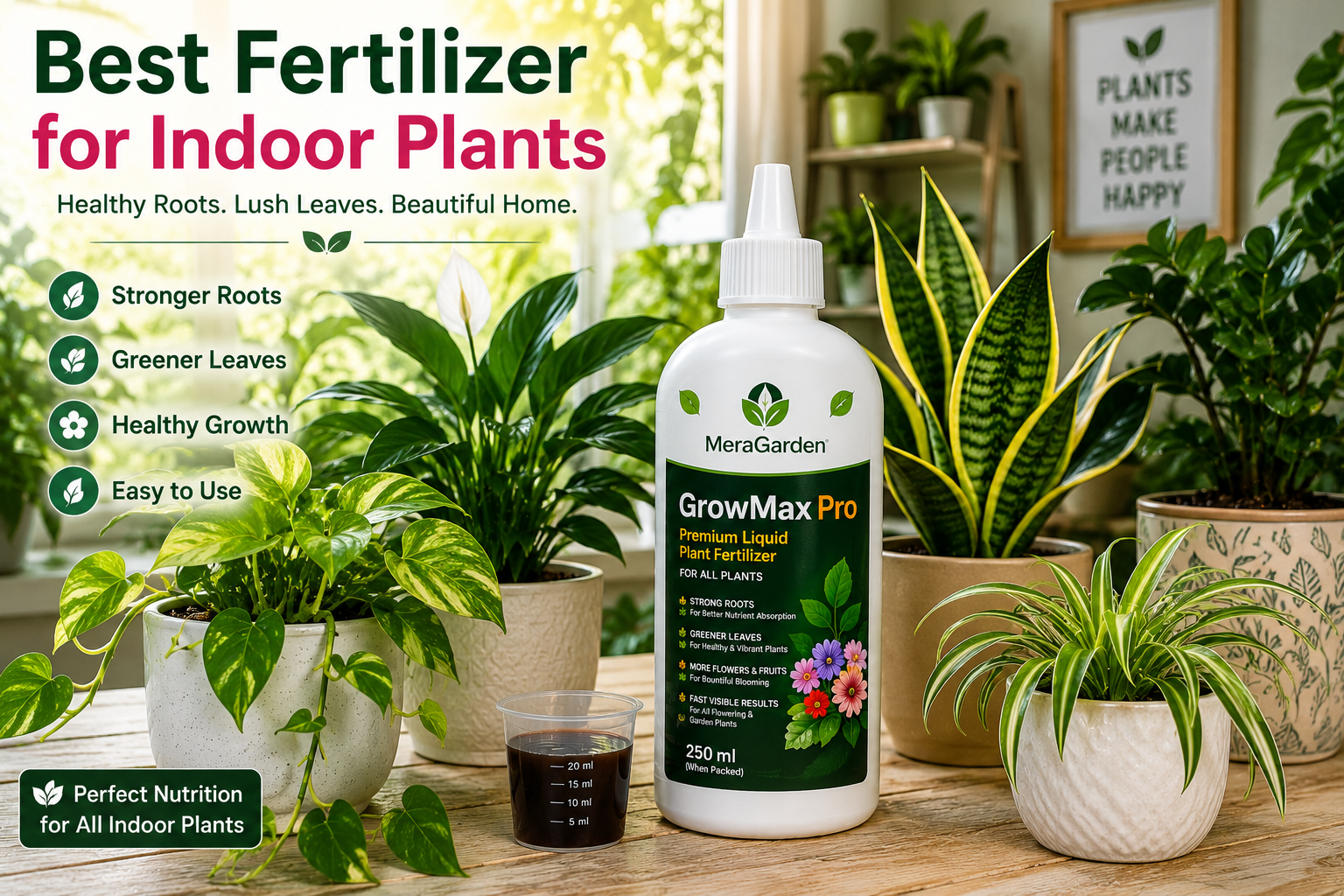
Indoor plants can make your home feel greener, fresher, and more inviting. Plants such as money plants, peace lilies, spider plants, snake plants, pothos, palms, and other houseplants are popular because they can grow well in pots and indoor spaces.
However, keeping indoor plants healthy is not only about watering them regularly. Plants also need nutrients for healthy roots, new leaves, and overall growth.
Choosing the best fertilizer for indoor plants can make plant care easier, but using the wrong fertilizer or applying too much can cause problems.
In this guide, you will learn how to choose fertilizer for indoor plants, when to fertilize, how liquid fertilizer works, and how to avoid common mistakes.
Table of Contents
What Do Indoor Plants Need to Grow?
Indoor plants need several basic things to remain healthy:
- Light
- Water
- Air circulation
- Suitable soil
- Appropriate temperature
- Essential plant nutrients
Light provides the energy plants need for photosynthesis, while water helps transport nutrients throughout the plant.
Nutrients are also important because plants use them for processes such as leaf development, root growth, and overall plant health.
The exact nutritional requirement varies from one plant to another.
For example, a fast-growing foliage plant may have different needs from a slow-growing plant such as a snake plant.
Why Do Indoor Plants Need Fertilizer?
Potting soil contains nutrients, but those nutrients can gradually become depleted as a plant continues to grow.
This is particularly relevant for plants that have remained in the same container for a long time.
Fertilizer can supplement nutrients when the plant needs additional feeding.
However, fertilizer is not a replacement for proper light, watering, drainage, and suitable soil.
If an indoor plant is struggling because of poor light or overwatering, simply adding more fertilizer may not solve the problem.
A healthy indoor plant generally needs:
- Appropriate light
- Well-draining soil
- Proper watering
- Adequate nutrients
- Enough space for root development
That is why fertilizer should be considered one part of a complete indoor plant-care routine.
What Is the Best Fertilizer for Indoor Plants?
There is no single fertilizer that is automatically the best for every indoor plant.
The right choice depends on:
- Plant type
- Growth stage
- Nutrient requirements
- Potting mix
- Growing conditions
- Fertilizer formulation
For many home gardeners, a balanced liquid plant fertilizer can be convenient because it can be diluted with water and applied according to the product instructions.
Liquid fertilizers can also be useful when you want an easy feeding routine for multiple potted plants.
Important:
Always check the fertilizer label for the recommended dilution rate and application frequency.
Do not assume that using more fertilizer will produce faster growth.
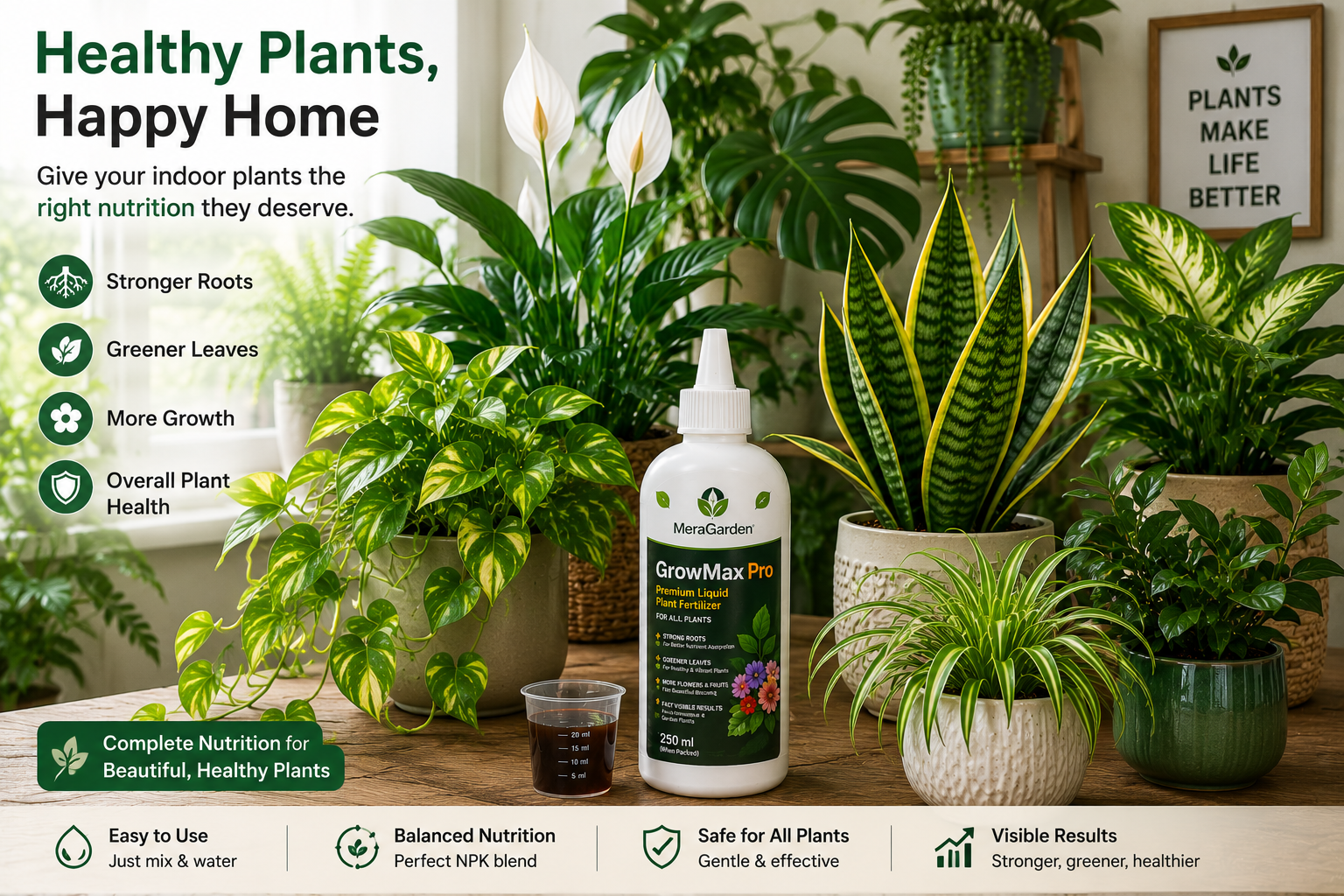
Give Your Indoor Plants the Nutrition They Need
If you are looking for an easy liquid plant fertilizer for your home garden, MeraGarden GrowMax Pro is designed for convenient feeding of garden and indoor plants.
Liquid Fertilizer vs Granular Fertilizer
Both liquid and granular fertilizers can be useful, but they work differently.
| Feature | Liquid Fertilizer | Granular Fertilizer |
|---|---|---|
| Application | Usually diluted with water | Applied to soil |
| Convenience | Easy to mix and apply | Easy to measure and spread |
| Feeding routine | Often suitable for scheduled feeding | Depends on formulation |
| Indoor plants | Convenient for potted plants | Can also be used when appropriate |
| Dosage | Must follow label | Must follow label |
For indoor gardeners, liquid fertilizer can be particularly convenient because plants are usually grown in containers where accurate application is important.
7 Tips for Choosing Fertilizer for Indoor Plants
1. Identify Your Plant
Before buying fertilizer, identify the plant you are growing.
A money plant, peace lily, spider plant, and snake plant may have different growth patterns and nutritional needs.
Knowing your plant helps you choose a suitable feeding routine.
2. Check the NPK Numbers
NPK refers to three major plant nutrients:
- N — Nitrogen
- P — Phosphorus
- K — Potassium
Nitrogen is associated with vegetative growth and healthy foliage.
Phosphorus plays important roles in plant energy processes and root and reproductive development.
Potassium supports several physiological processes and overall plant health.
The best NPK ratio depends on the plant and its growing conditions.
For this reason, don’t choose a fertilizer simply because the numbers look higher.
3. Choose a Fertilizer Suitable for Potted Plants
Indoor plants are usually grown in containers with a limited amount of potting mix.
This means fertilizer should be applied carefully.
A fertilizer specifically intended for plants and used according to its label can make feeding easier.
Avoid randomly mixing multiple fertilizers unless the product instructions specifically allow it.
4. Consider the Plant’s Growth Stage
Plants don’t necessarily need the same amount of feeding throughout the year.
During active growth, many plants may benefit from regular feeding.
During slower growth periods, fertilizer requirements may decrease.
Observe your plant rather than following a rigid schedule that ignores its growth.
5. Don’t Ignore Light
This is one of the most important indoor gardening tips.
Fertilizer cannot compensate for inadequate light.
If a plant is receiving very little light, adding more fertilizer may not produce the expected results.
Before increasing fertilizer, check whether the plant is receiving appropriate light for its species.
6. Follow the Product Label
Every fertilizer formulation can have different instructions.
Always check:
- Recommended dilution
- Application frequency
- Suitable plants
- Application method
- Storage instructions
- Safety precautions
Following the label is safer than guessing the dosage.
7. Start Carefully
If you are using a fertilizer for the first time, avoid applying more than recommended.
More fertilizer does not automatically mean more growth.
Overfertilization can cause salt buildup in the potting mix and may damage plant roots.
Best Fertilizer for Common Indoor Plants
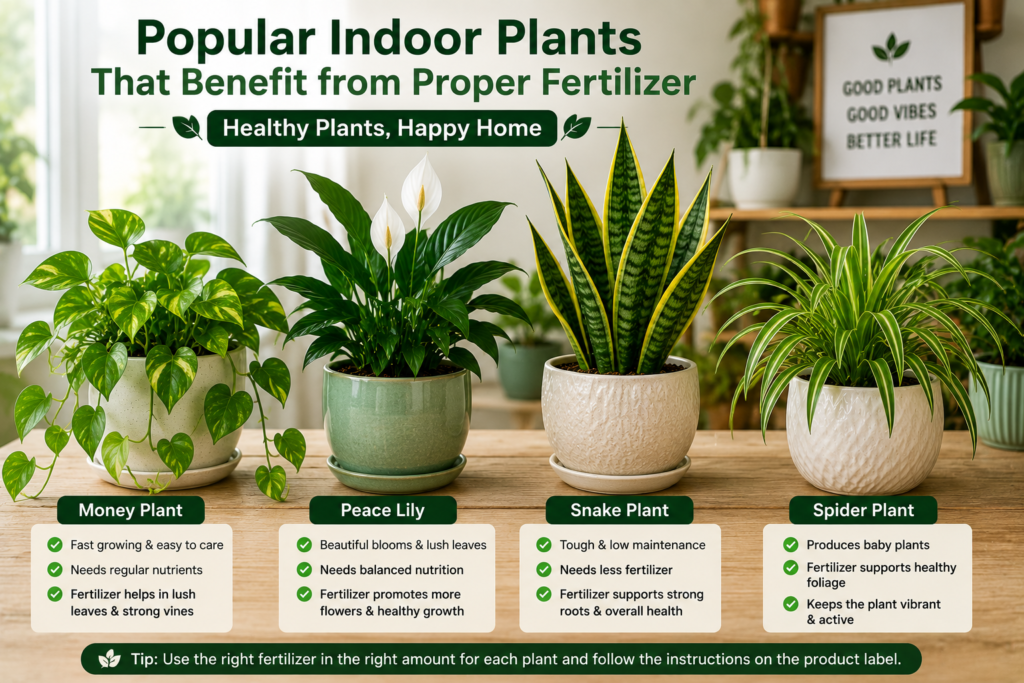
Different indoor plants have different characteristics.
Money Plant
Money plants such as pothos are popular indoor plants because they are generally easy to maintain.
A suitable plant fertilizer can be included in their regular care routine during active growth.
Avoid excessive feeding.
Peace Lily
Peace lilies are known for their attractive foliage and flowers.
They need suitable light, moisture, and nutrition to maintain healthy growth.
Use fertilizer according to the product instructions and avoid feeding a stressed or severely dehydrated plant.
Snake Plant
Snake plants are relatively slow-growing compared with many other houseplants.
They generally do not need frequent heavy feeding.
Overwatering is often a bigger concern than underfertilizing, so always maintain proper drainage.
Spider Plant
Spider plants can produce plenty of foliage and may benefit from appropriate feeding during active growth.
A diluted liquid fertilizer can be convenient when used according to the label.
Areca Palm
Areca palms can benefit from suitable nutrition when grown in containers.
However, fertilizer should be combined with appropriate light, watering, humidity, and soil conditions.
How Often Should You Fertilize Indoor Plants?
There is no universal feeding schedule for every indoor plant.
The appropriate frequency depends on:
- Fertilizer formulation
- Plant species
- Plant size
- Growth rate
- Potting mix
- Season
- Indoor growing conditions
Some products are designed for frequent diluted applications, while others may be intended for less frequent use.
A simple rule:
Follow the fertilizer manufacturer’s recommended application schedule.
Avoid increasing the frequency simply because your plant is growing slowly.
Slow growth can also be caused by insufficient light, unsuitable temperature, root problems, pests, or watering issues.
How to Apply Liquid Fertilizer to Indoor Plants
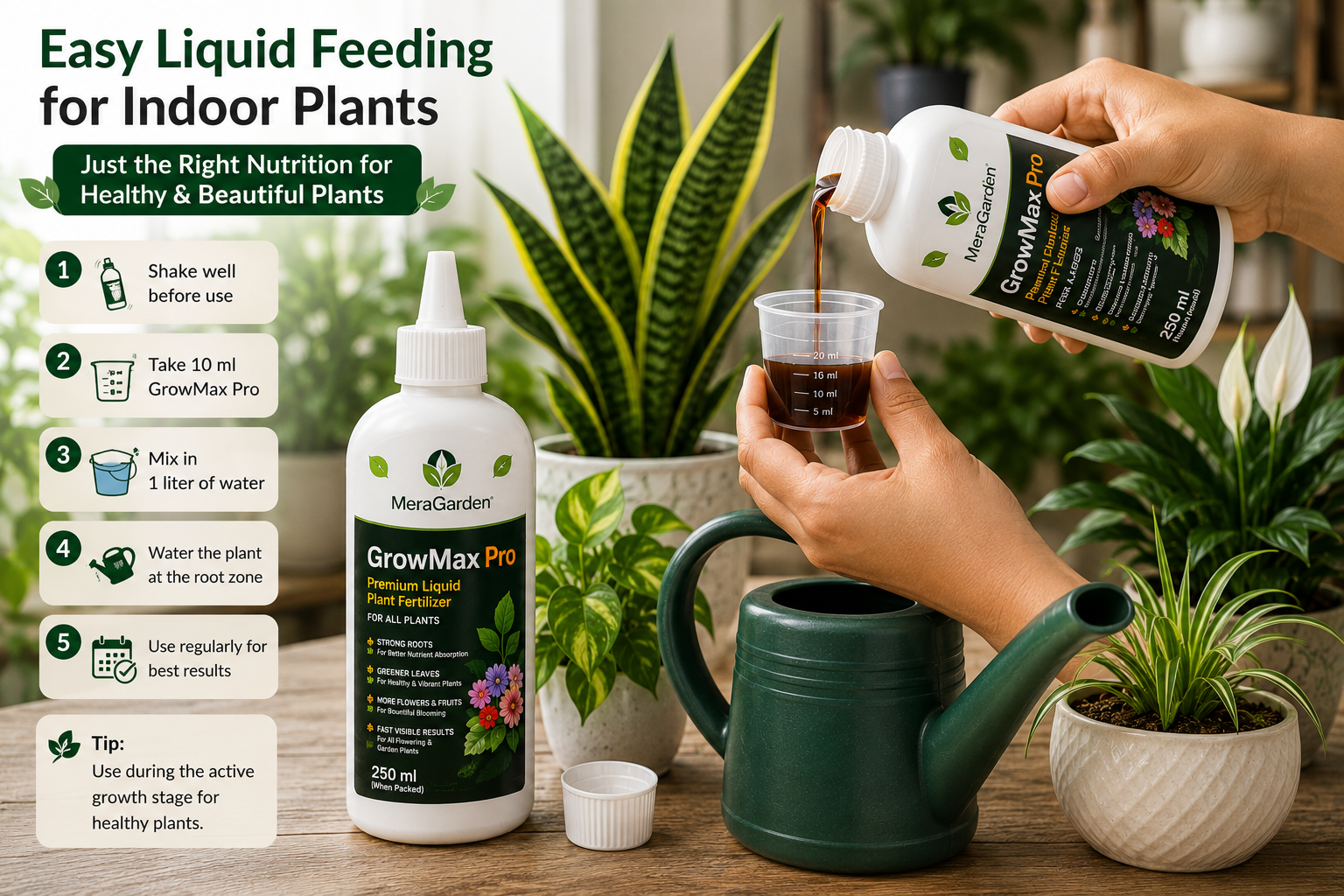
If you are using liquid fertilizer, follow these steps.
Step 1: Check the Label
Read the recommended dilution rate before mixing the fertilizer.
Step 2: Measure the Fertilizer
Use the recommended amount rather than estimating it.
Step 3: Dilute With Water
Mix the fertilizer with the recommended quantity of water.
Step 4: Apply to the Soil
Apply the diluted fertilizer around the soil/root zone according to the product instructions.
Step 5: Continue Normal Plant Care
After feeding, continue providing appropriate light and water.
Do not increase the concentration to try to achieve faster results.
Looking for an Easy Liquid Plant Fertilizer?
For gardeners who prefer a simple liquid feeding routine, MeraGarden GrowMax Pro can be considered as part of an overall indoor and home-garden plant-care routine.
Common Indoor Plant Fertilizer Mistakes
Mistake 1: Using Too Much Fertilizer
More fertilizer does not always mean faster growth.
Excess fertilizer can lead to nutrient imbalance and salt accumulation in the growing medium.
Mistake 2: Fertilizing a Severely Stressed Plant
If a plant is suffering from severe dehydration, root problems, pest infestation, or other stress, adding fertilizer may not solve the underlying issue.
First identify the problem.
Mistake 3: Ignoring the Fertilizer Label
Different products have different concentrations.
Never copy the dosage from another fertilizer.
Mistake 4: Fertilizing Too Frequently
Applying fertilizer more often than recommended can increase the risk of overfertilization.
Stick to the manufacturer’s instructions.
Mistake 5: Forgetting About Drainage
Poor drainage can cause waterlogging and root problems.
Even the best fertilizer cannot compensate for unhealthy roots caused by poor growing conditions.
Can You Overfertilize Indoor Plants?
Yes.
Overfertilization can cause problems such as:
- Leaf-tip burn
- Browning leaves
- Salt buildup
- Nutrient imbalance
- Root stress
- Poor plant growth
If you suspect overfertilization, do not add more fertilizer.
Review your recent feeding routine and follow appropriate plant-care practices for the specific plant.
How to Know If Your Indoor Plant Needs Fertilizer
Don’t rely on a single symptom.
Slow growth can have many causes.
Before feeding, check:
Light
Is the plant receiving enough suitable light?
Watering
Are you watering too frequently or allowing the plant to become excessively dry?
Soil
Is the potting mix compacted or poorly draining?
Roots
Is the plant root-bound or showing signs of root problems?
Pests
Are insects damaging new or existing growth?
Only after checking these factors should fertilizer become part of your troubleshooting process.
Frequently Asked Questions
What is the best fertilizer for indoor plants?
The best fertilizer depends on the plant species, growing conditions, and nutrient requirements. A suitable balanced or plant-specific fertilizer can be used according to its label.
Is liquid fertilizer good for indoor plants?
Liquid fertilizer can be convenient for indoor plants because it can be diluted and applied according to the manufacturer’s instructions.
How often should I fertilize indoor plants?
The frequency depends on the fertilizer formulation, plant type, growth stage, and growing conditions. Always follow the product label.
Can I use the same fertilizer for all indoor plants?
Not necessarily. Some plants have different nutritional requirements and growth rates. Check whether the fertilizer is suitable for the plants you are growing.
Is more fertilizer better for indoor plants?
No. Applying more fertilizer than recommended can harm plants. Always follow the recommended dosage.
Should I fertilize a newly repotted plant?
It depends on the potting mix and fertilizer used. If the new potting mix already contains nutrients, additional fertilizer may not be immediately necessary. Follow the fertilizer and potting-mix instructions.
Final Thoughts
Choosing the best fertilizer for indoor plants is only one part of successful indoor gardening.
Healthy houseplants also need suitable light, proper watering, good drainage, appropriate soil, and regular observation.
If you choose a liquid fertilizer, measure it carefully and always follow the manufacturer’s instructions.
For gardeners looking for a convenient liquid plant-feeding option, MeraGarden GrowMax Pro can be incorporated into a regular plant-care routine according to its product directions.
The goal should not be to use more fertilizer. The goal is to provide the right nutrition at the right time while maintaining good overall plant care.
Recommended Articles
- How Often Should You Fertilize Plants? 7 Easy Rules for Healthy Growth
- How Often Should You Fertilize Plants? Complete Fertilizer Schedule
- What Is NPK Fertilizer? 7 Easy Tips for Healthy Plants
- Best Liquid Fertilizer for Plants: Complete Guide for Home Gardeners
- How to Use Liquid Fertilizer for Plants: 7 Easy Steps for Better Growth
- Best Organic Fertilizers for Plants: 7 Natural Options for Healthy Growth
- Best Fertilizer for Indoor Plants in India: 7 Easy Tips for Healthy Growth
- Best Fertilizer for Flowering Plants in India: 7 Top Options
- Best Fertilizer for Plants: 7 Smart Tips to Avoid Common Mistakes
- 5 Signs Your Plants May Need Fertilizer
- How Much Liquid Fertilizer Should You Use for Plants?
- 7 Benefits of Liquid Fertilizer for Plants: Grow Healthier Plants Faster
- 7 Benefits of Liquid Fertilizer for Plants: A Simple Guide for Healthy Growth
- Best Fertilizer for Peace Lily: 7 Powerful Tips for Beautiful Blooms and Avoiding Common Mistakes
- Best Fertilizer for Spider Plant: 7 Powerful Tips for Lush Growth and Avoiding Common Mistakes
- Liquid Fertilizer vs Granular Fertilizer: Which Is Better? 7 Key Differences for Home Gardeners
- Liquid Fertilizer vs Organic Fertilizer: 7 Powerful Pros, Cons & the Best Choice for Your Plants
- How to Choose the Right Fertilizer for Your Plants: 7 Smart Tips to Avoid Common Mistakes
- 5 Positive Signs Your Plants Need Fertilizer — Avoid These Warning Symptoms for Healthier Growth
- How to Grow Peace Lilies
- How To Grow Houseplants