Growing healthy plants requires more than regular watering and sunlight. Plants also need essential nutrients to support leaves, roots, flowers, fruits and overall growth. While compost, organic matter and granular fertilizers can all play an important role, liquid fertilizer for plants is a convenient option when you want nutrients to be applied in a diluted form through watering.
Liquid fertilizers are especially useful for container plants, vegetables, flowering plants and houseplants when additional feeding is actually needed. The RHS notes that fertilizers provide concentrated plant nutrients and that liquid fertilizers are generally faster acting than dry organic fertilizers because the nutrients are already dissolved.
However, fertilizer is not a substitute for good soil, adequate sunlight or proper watering. The goal should be to provide plants with the nutrients they need without overfeeding.
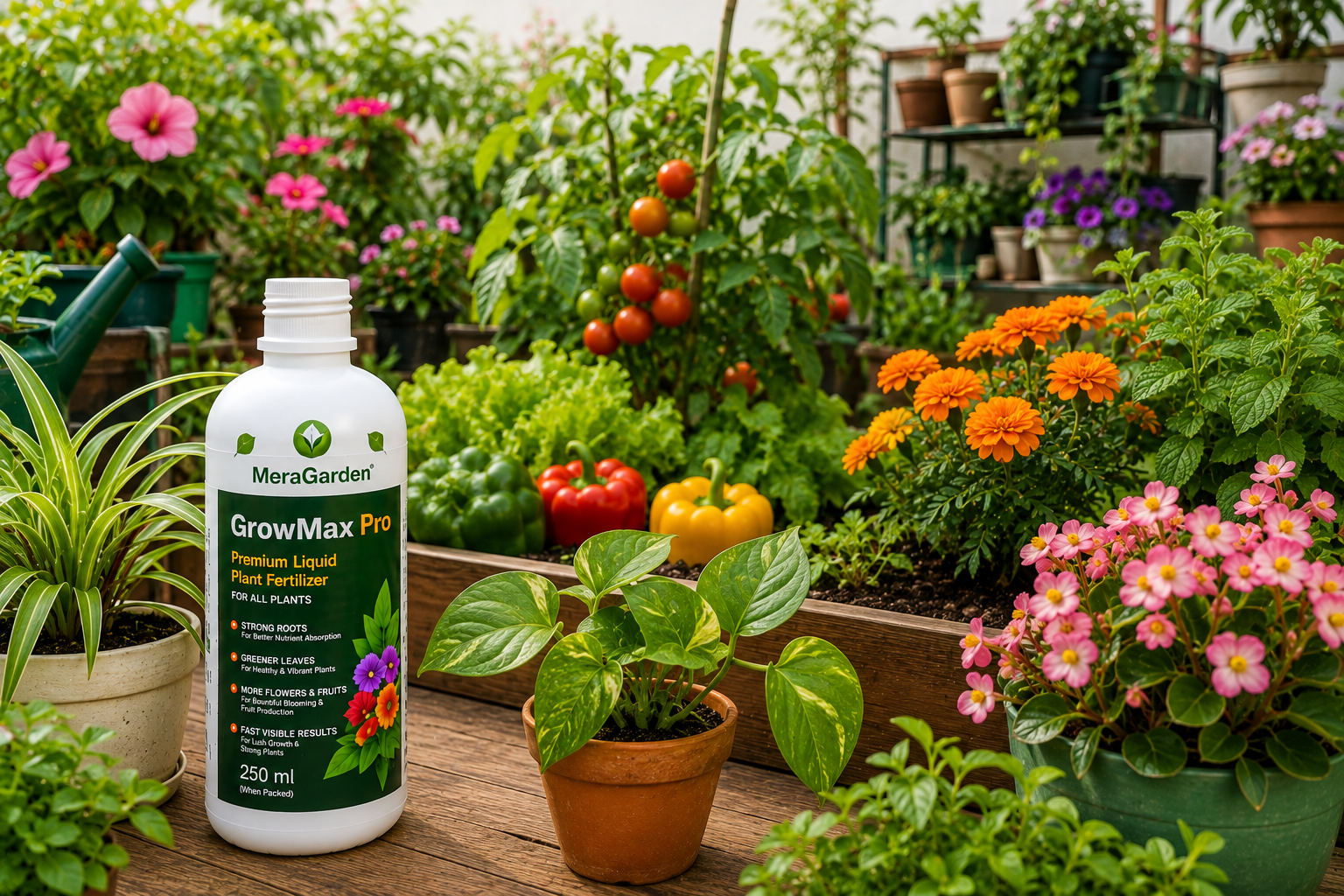
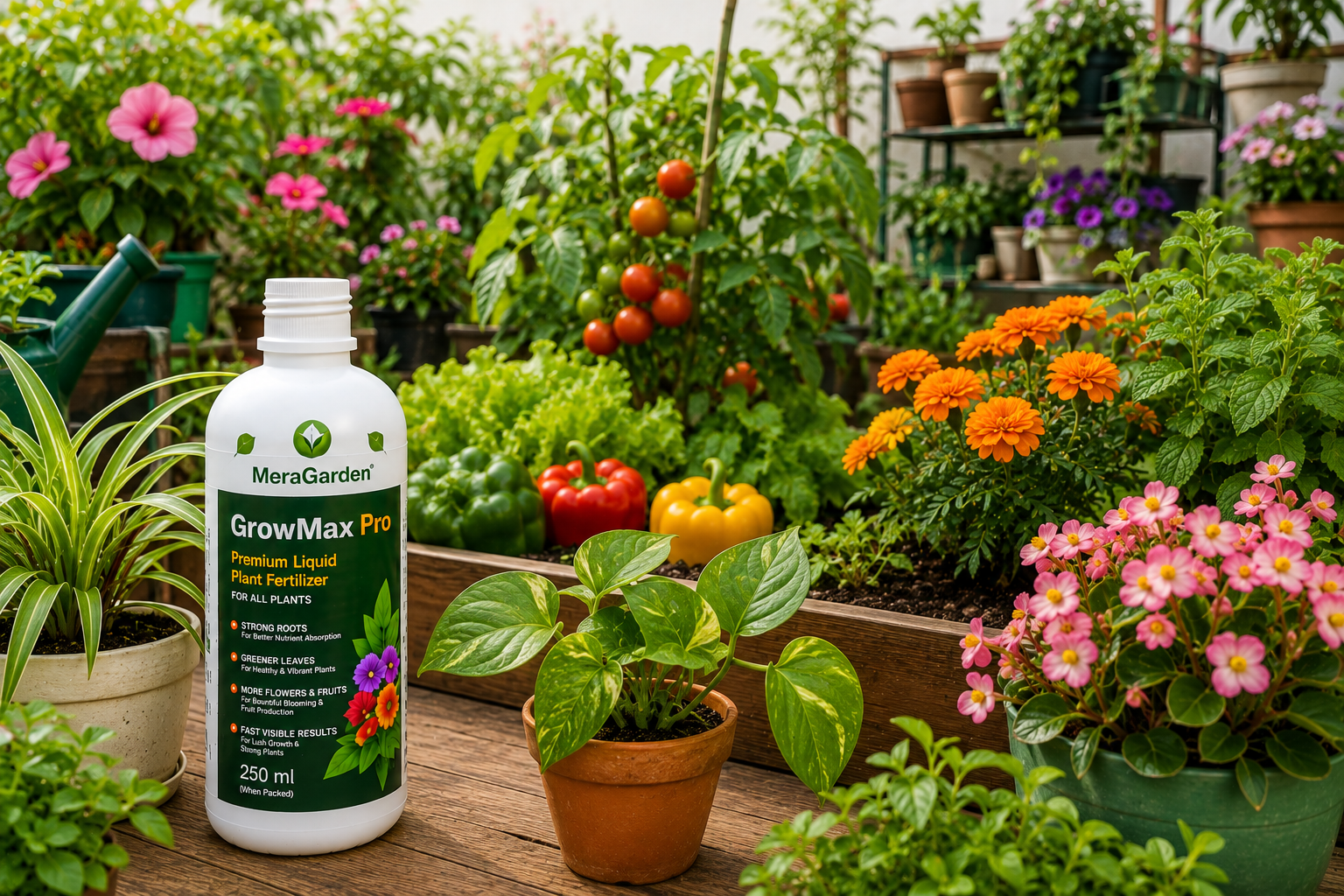
In this guide, we will explain 7 benefits of liquid fertilizer for plants, how to use it correctly, what to compare before buying one, and how MeraGarden GrowMax Pro can fit into a simple home-garden feeding routine.
Table of Contents
7 Benefits of Liquid Fertilizer for Plants
Liquid fertilizer can be convenient because it combines fertilizer application with watering. But its usefulness depends on the plant, soil, growing stage and fertilizer formulation.
Here are seven practical benefits to understand.
Benefit 1: Nutrients Are Available in a Convenient Liquid Form
One of the biggest advantages of liquid fertilizer is its convenient application.
Unlike a dry fertilizer that has to dissolve in the soil before nutrients become available, a liquid fertilizer is already dissolved or prepared to be diluted with water according to the product instructions.
This can make feeding easier for home gardeners, particularly when caring for plants in pots and containers.
Plants absorb nutrients primarily through their roots, and nutrients need to be in an available form before roots can take them up. The RHS explains that liquid feeds can provide nutrients in dissolved form, making them useful when a plant needs a relatively quick nutrient supply.
This does not mean that every plant needs frequent liquid feeding. Healthy garden soil may already contain many of the nutrients plants require.
The key is using fertilizer when needed and applying the correct amount.
When this benefit is especially useful
Liquid fertilizer can be convenient for:
- Potted plants
- Indoor plants
- Balcony gardens
- Container vegetables
- Flowering plants
- Young plants
- Plants growing in nutrient-limited potting mixes
For plants grown in containers, nutrients can gradually become depleted because the amount of growing medium is limited.
Read our guide on [Best Liquid Fertilizer for Plants: Complete Guide for Home Gardeners] to understand how liquid fertilizers compare with other fertilizer options.
Benefit 2: Easy to Mix and Apply During Regular Watering
Another important advantage is simplicity.
For many home gardeners, the easiest fertilizer routine is to measure the recommended amount, dilute it with water and apply it around the soil near the plant.
This can be much simpler than spreading granular fertilizer evenly around individual pots.
For example, if you have ten or twenty container plants on a balcony, you can prepare the required diluted fertilizer solution and apply it during your normal gardening routine.
The exact dilution depends on the fertilizer product. Therefore, always follow the dosage and dilution instructions printed on the product label.
The RHS also recommends following the manufacturer’s instructions for the correct method, timing and dosage.
Benefit 3: Useful for Container and Potted Plants
Container plants have different nutritional conditions from plants growing directly in the ground.
A pot contains a limited amount of growing medium. Every time you water, some nutrients may eventually move through the soil. At the same time, the plant continues taking nutrients from the growing medium.
This is one reason container plants can benefit from appropriate feeding during active growth.
The RHS specifically identifies container plants, including ornamental plants, vegetables and houseplants, as plants that may benefit from fertilizer.
Liquid fertilizer can be particularly convenient because it can be incorporated into a watering routine.
Examples include:
- Money plant
- Peace lily
- Spider plant
- Snake plant
- Hibiscus
- Rose
- Tomato
- Chilli
- Cucumber
- Balcony vegetables
However, different plants have different nutrient requirements. A fertilizer suitable for one plant may not be ideal for another.
For indoor plants, avoid blindly increasing the frequency because the plant appears to be growing slowly. Low light, poor drainage, unsuitable temperatures and watering problems can also cause slow growth.
Benefit 4: Convenient for Vegetable Garden Feeding
Vegetable plants can have substantial nutrient requirements during active growth, particularly when they are producing flowers and fruits.
Tomatoes, chillies, cucumbers and other productive plants may need additional nutrients depending on the soil and growing conditions.
A liquid fertilizer can make routine feeding convenient because it can be diluted and applied around the root zone.
For vegetable gardeners, the important thing is not simply to add more fertilizer. The goal is to provide an appropriate nutrient supply while avoiding excessive application.
A healthy vegetable garden should also have:
- Good-quality soil
- Adequate organic matter
- Proper drainage
- Sufficient sunlight
- Appropriate watering
- Good spacing
- Regular pest monitoring
Fertilizer should support these practices rather than replace them.
For more information, read [What Is NPK Fertilizer? 7 Easy Tips for Healthy Plants] to understand the role of nitrogen, phosphorus and potassium.
Benefit 5: Easy to Adjust for Different Gardening Needs
Another practical benefit of liquid fertilizer is that the amount can be measured before application.
This is particularly useful when you have different container sizes and different groups of plants.
For example, you may have:
- Small indoor pots
- Medium balcony containers
- Large vegetable containers
- Flower pots
- Hanging baskets
Instead of guessing the amount, you can measure the fertilizer and dilute it according to the product instructions.
This makes it easier to maintain a consistent feeding routine.
However, more fertilizer does not mean faster or healthier growth.
Overfertilization can damage plants. University of Minnesota Extension notes that excessive fertilizer can contribute to problems such as stunting and leaf drop, while the RHS warns that incorrect application and overuse can cause environmental problems.
So the correct approach is:
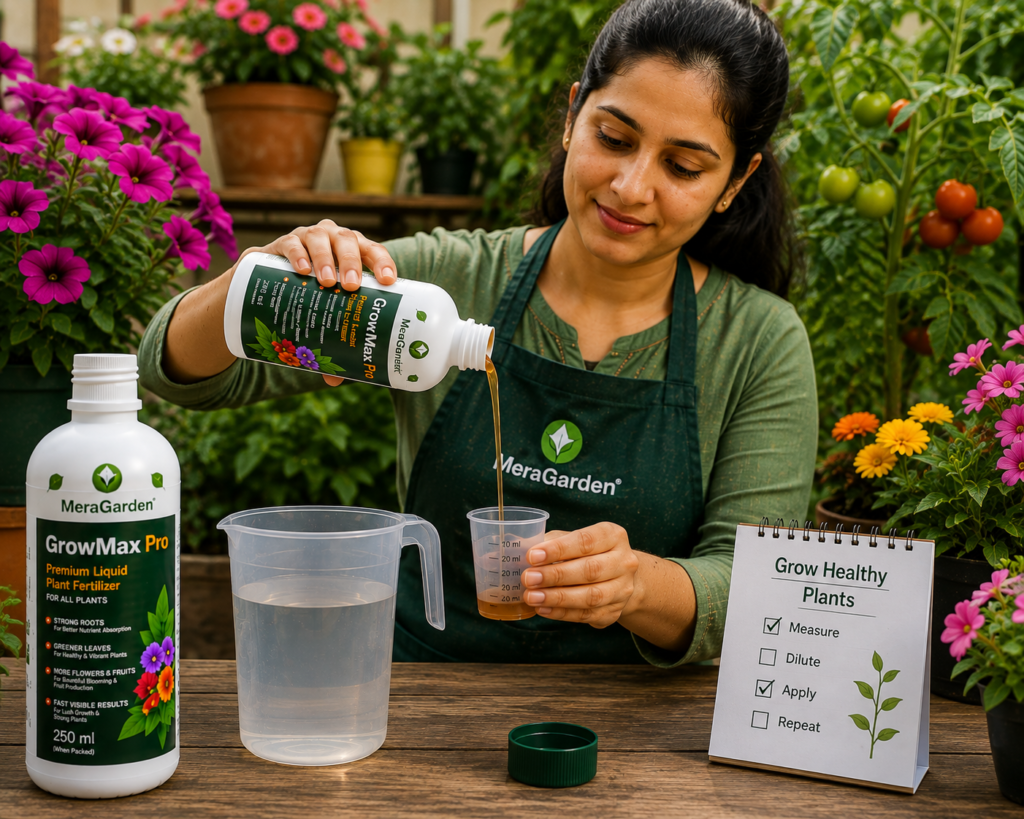
Measure → Dilute → Apply → Observe → Repeat only when required.
Benefit 6: Supports a Simple Feeding Routine
Gardening becomes easier when plant care is simple and consistent.
Instead of randomly fertilizing whenever a plant looks weak, create a basic feeding routine based on the fertilizer label, plant type and growing conditions.
For example, your routine could include:
Step 1: Check the plant
Look at the leaves, new growth and overall condition.
Step 2: Check the soil
Do not fertilize a plant simply because the leaves look different. Check watering, drainage and soil condition as well.
Step 3: Check the fertilizer label
Follow the recommended dosage.
Step 4: Measure
Use a measuring cup or suitable measuring container instead of estimating.
Step 5: Dilute
Mix the required amount with the recommended quantity of water.
Step 6: Apply
Apply the diluted solution around the root zone as directed on the product label.
Step 7: Monitor
Observe the plant over the following days and adjust the routine only when necessary.
This approach is safer and more effective than assuming that fertilizer should be applied every time you water.
Benefit 7: Useful for Different Types of Home-Garden Plants
A well-maintained home garden can contain many different types of plants.
You may have vegetables in one area, flowering plants in another and indoor plants inside the house.
A liquid fertilizer can be a convenient part of plant care because it can be measured and diluted for application according to the product directions.
For example:
Vegetable plants
Tomato, chilli, cucumber and leafy vegetables may require additional feeding depending on soil fertility and growth stage.
Flowering plants
Roses, hibiscus, marigolds and other flowering plants have their own nutritional requirements.
Indoor plants
Plants such as money plant, peace lily and spider plant grow in containers with limited growing medium.
Balcony plants
Container gardening often benefits from a simple, well-managed feeding routine.
The important point is that one fertilizer routine should not automatically be used for every plant. Plant species, pot size, growing medium, season and growth stage all matter.
Try a Simple Liquid Fertilizer Routine
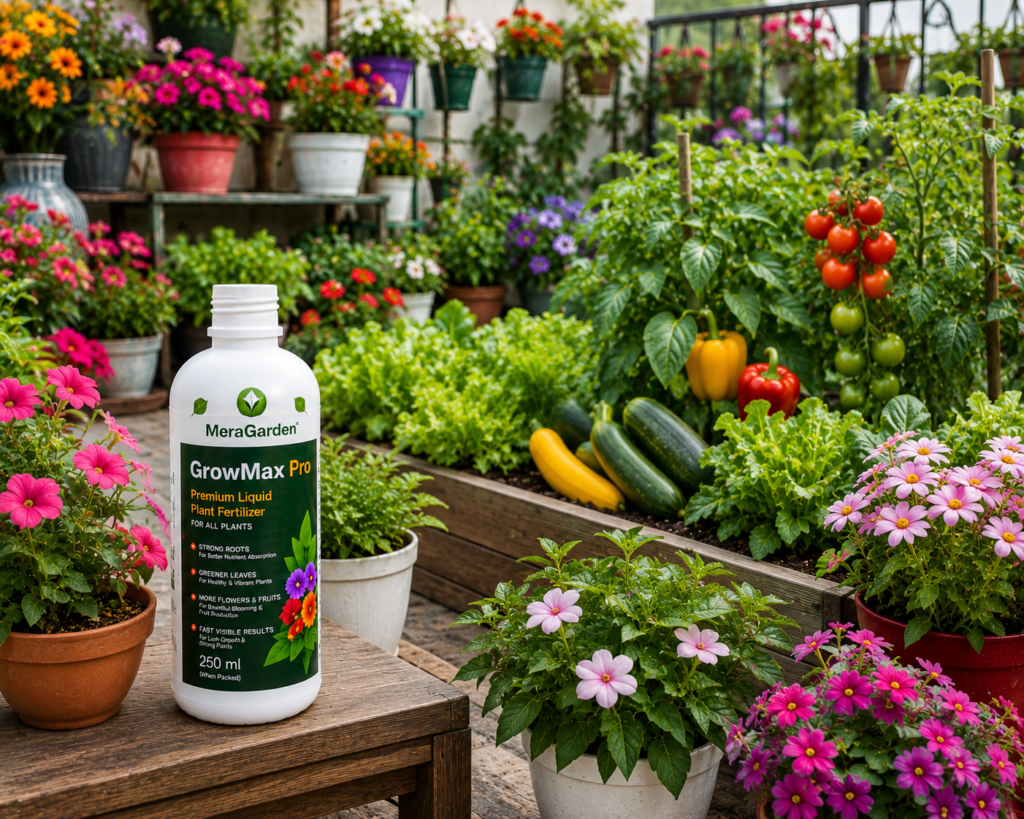
If you are looking for a convenient way to include liquid plant nutrition in your home-gardening routine, MeraGarden GrowMax Pro can be considered as part of your plant-care setup.
Before using any fertilizer, identify the plants you want to feed and check the product label for the recommended dilution and application instructions.
How to Use Liquid Fertilizer for Plants
Using liquid fertilizer correctly is just as important as choosing the product.
Follow these basic steps.
1. Choose the Right Time
Fertilizer is generally most useful when plants are actively growing and actually need additional nutrients.
The RHS recommends feeding plants only when required and notes that many plants do not need regular feeding.
For indoor plants, feeding should also take account of light and active growth.
2. Water Dry Soil Before Fertilizing
Avoid applying fertilizer to severely dry soil.
For houseplants, the RHS specifically advises against applying fertilizer to dry soil because concentrated fertilizer around dry roots can cause root damage.
If the soil is extremely dry, bring it back to a suitable moisture level first.
3. Measure MeraGarden GrowMax Pro
Use an appropriate measuring container.
Do not estimate the quantity by simply pouring fertilizer into the watering can.
The exact amount should always follow the MeraGarden GrowMax Pro product label.
4. Dilute With Water
Add the measured amount to the recommended quantity of water.
Mix properly before application.
Do not make the solution stronger because you think a higher concentration will produce faster growth.
5. Apply Around the Root Zone
Apply the diluted fertilizer solution to the soil around the plant as directed on the product label.
Avoid unnecessary contact with leaves unless the product specifically states that it is suitable for foliar application.
6. Maintain a Sensible Schedule
Do not fertilize simply because a calendar says it is time.
Consider:
- Plant type
- Growth stage
- Soil condition
- Pot size
- Growing medium
- Season
- Previous fertilizer applications
A simple schedule is useful, but plant condition and product instructions should guide the final decision.
Liquid Fertilizer vs Granular Fertilizer
Both liquid and granular fertilizers can be useful. The better choice depends on your gardening situation.
| Feature | Liquid Fertilizer | Granular Fertilizer |
|---|---|---|
| Application | Mixed with water | Applied to soil |
| Measurement | Easy to measure as a liquid | Measured by weight/volume |
| Nutrient availability | Often readily available after dilution | Depends on formulation |
| Container plants | Very convenient | Also useful |
| Indoor plants | Convenient | Can be convenient but needs careful application |
| Vegetables | Useful during active growth | Useful depending on formulation |
| Flowering plants | Convenient for routine feeding | Useful for longer-lasting feeding |
| Application frequency | Depends on product | Depends on formulation |
| Risk of overuse | Possible if over-concentrated | Possible if over-applied |
| Best approach | Follow label dosage | Follow label dosage |
The RHS classifies fertilizers into several forms, including liquids, granules, pellets and powders. Liquid fertilizers are generally faster acting than dry organic fertilizers because they are already dissolved.
Neither format is automatically “better” for every plant.
The right choice depends on the plant, growing medium and fertilizer formulation.
Why Consider MeraGarden GrowMax Pro?
MeraGarden GrowMax Pro is designed to be used as a liquid plant fertilizer in a home-gardening routine.
Its liquid format makes measuring and dilution straightforward when used according to the product instructions.
It can be considered for gardeners managing different types of plants, such as:
- Flowering plants
- Vegetable plants
- Potted plants
- Balcony plants
- Home gardens
- Container gardens
The important part is to use the product according to its label rather than assuming that a higher dose will provide better results.
A simple GrowMax Pro routine
Check plant → Measure → Dilute → Apply → Observe
This simple process helps keep fertilizer application controlled.
If you are already using compost or another fertilizer, consider the total nutrient input rather than automatically adding another fertilizer on top.
Make Plant Feeding Simpler
Want to make your home-garden fertilizer routine easier?
MeraGarden GrowMax Pro can be added to your regular plant-care routine according to its recommended application and dilution instructions.
Conclusion
Liquid fertilizer can be a convenient option for gardeners who need to provide additional nutrients to plants.
The 7 benefits of liquid fertilizer for plants include convenient nutrient application, easy mixing, usefulness for container plants, support for vegetable gardens, easier measurement, a simple feeding routine and flexibility across different home-garden plants.
However, fertilizer should not be treated as a replacement for good soil, sunlight, watering and proper plant care.
The most important rule is simple:
Use the right fertilizer, at the right dilution, at the right time and in the right amount.
For gardeners looking for a convenient liquid fertilizer option, MeraGarden GrowMax Pro can be considered as part of a balanced home-gardening routine. Always follow the product label for dosage, dilution and application instructions.
FAQs
1. What are the main benefits of liquid fertilizer for plants?
The main benefits include convenient application, easy measurement, quick availability of dissolved nutrients and suitability for many container, vegetable and flowering plants when additional feeding is required.
2. Is liquid fertilizer better than granular fertilizer?
Not necessarily. Both have advantages. Liquid fertilizers are convenient to dilute and apply, while some granular formulations can provide nutrients over a longer period. The best option depends on the plant and fertilizer formulation.
3. How often should I use liquid fertilizer?
There is no single schedule for every plant. Follow the fertilizer label and consider the plant’s species, growth stage, growing medium and season. Overfertilizing can damage plants.
4. Can liquid fertilizer be used for indoor plants?
Yes, liquid fertilizers can be convenient for indoor plants because they can be diluted and applied during watering. However, indoor plants generally need less fertilizer when growth and light levels are low.
5. Can I use liquid fertilizer for vegetables?
Liquid fertilizer can be used for vegetable plants when additional feeding is appropriate. Always follow the product label and avoid excessive application.
6. Can I use MeraGarden GrowMax Pro for flowering plants?
MeraGarden GrowMax Pro can be used according to its product instructions. Check the label for the recommended plants, dosage and dilution before applying it to flowering plants.
7. Should I fertilize a plant when the soil is completely dry?
It is better not to apply fertilizer to severely dry soil. For container plants, bring the soil to an appropriate moisture level and follow the fertilizer instructions before feeding.
8. Can too much liquid fertilizer harm plants?
Yes. Too much fertilizer or an overly concentrated solution can damage roots and negatively affect plant growth. Always measure the product and follow the recommended dosage.
9. Can liquid fertilizer replace compost?
No. Fertilizer and organic matter serve different purposes. Compost can contribute organic matter and improve soil structure, while fertilizer provides concentrated plant nutrients.
10. What is the easiest way to use liquid fertilizer?
A simple approach is to measure the recommended quantity, dilute it with the specified amount of water and apply it around the plant’s root zone according to the product instructions.
Recommended Articles
- How Often Should You Fertilize Plants? 7 Easy Rules for Healthy Growth
- How Often Should You Fertilize Plants? Complete Fertilizer Schedule
- What Is NPK Fertilizer? 7 Easy Tips for Healthy Plants
- Best Liquid Fertilizer for Plants: Complete Guide for Home Gardeners
- How to Use Liquid Fertilizer for Plants: 7 Easy Steps for Better Growth
- Best Organic Fertilizers for Plants: 7 Natural Options for Healthy Growth
- Best Fertilizer for Indoor Plants in India: 7 Easy Tips for Healthy Growth
- Best Fertilizer for Flowering Plants in India: 7 Top Options
- Best Fertilizer for Plants: 7 Smart Tips to Avoid Common Mistakes
- 5 Signs Your Plants May Need Fertilizer
- How Much Liquid Fertilizer Should You Use for Plants?
- 7 Benefits of Liquid Fertilizer for Plants: Grow Healthier Plants Faster
- 7 Benefits of Liquid Fertilizer for Plants: A Simple Guide for Healthy Growth
- Best Fertilizer for Peace Lily: 7 Powerful Tips for Beautiful Blooms and Avoiding Common Mistakes
- Best Fertilizer for Spider Plant: 7 Powerful Tips for Lush Growth and Avoiding Common Mistakes
- Liquid Fertilizer vs Granular Fertilizer: Which Is Better? 7 Key Differences for Home Gardeners
- Liquid Fertilizer vs Organic Fertilizer: 7 Powerful Pros, Cons & the Best Choice for Your Plants
- How to Choose the Right Fertilizer for Your Plants: 7 Smart Tips to Avoid Common Mistakes
- 5 Positive Signs Your Plants Need Fertilizer — Avoid These Warning Symptoms for Healthier Growth
- How to Grow Peace Lilies
- How To Grow Houseplants