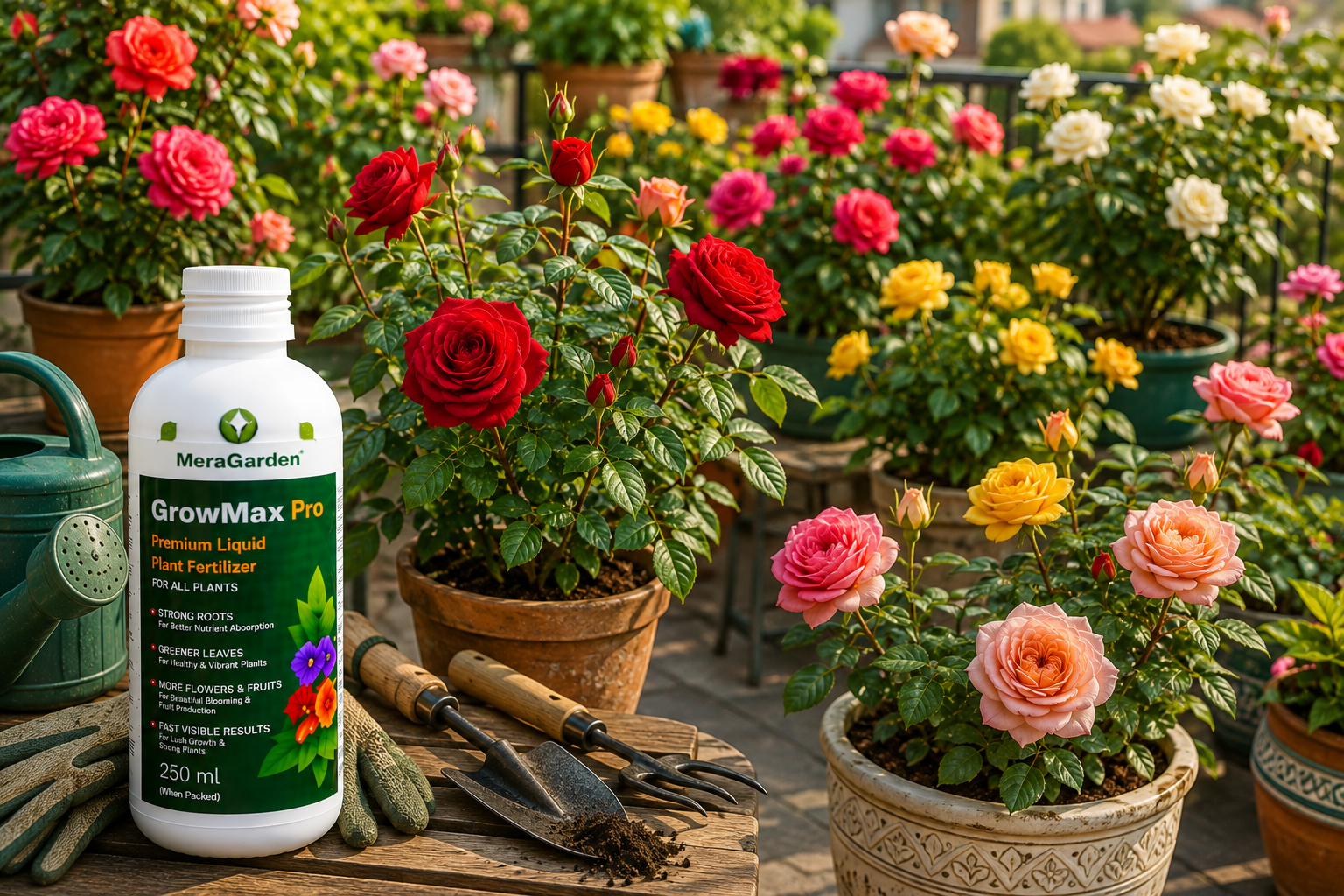
Roses are among the most loved flowering plants in Indian home gardens. Whether you grow hybrid tea roses, miniature roses, climbing roses, floribundas, or simple desi rose varieties, healthy plants need more than just sunlight and water. Proper nutrition can help support vigorous growth, healthy foliage and good flowering.
But choosing the best fertilizer for rose plants can become confusing. Garden stores offer liquid fertilizers, granular fertilizers, organic fertilizers, compost, rose-specific feeds and many different NPK combinations. Many gardeners also make the mistake of assuming that giving more fertilizer will automatically produce more flowers.
It does not work that way.
Roses need nutrients in appropriate amounts, and the right feeding approach depends on factors such as whether the plant is growing in a pot or in the ground, the condition of the soil, the plant’s growth stage and the fertilizer being used.
The Royal Horticultural Society notes that roses are hungry plants and can benefit from feeding, while container-grown roses generally need more frequent feeding because they have less access to nutrients.
For Indian home gardeners, especially those growing roses in pots, terraces, balconies and small gardens, a practical fertilizer routine can make rose care much easier.
In this guide, we will look at 7 powerful tips for choosing and using fertilizer for rose plants, common mistakes to avoid, how liquid fertilizer fits into a rose-care routine, and how to use MeraGarden GrowMax Pro according to its product instructions.
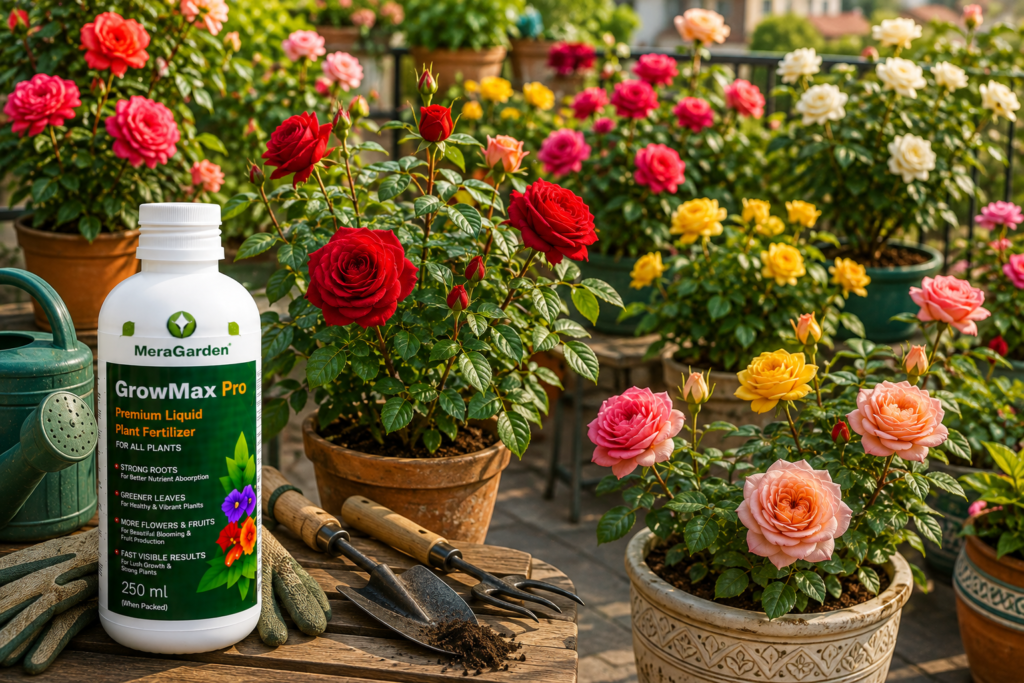
Table of Contents
7 Benefits of Choosing the Right Fertilizer for Rose Plants
1. Supports Stronger Rose Plant Growth
One of the first reasons to use the right fertilizer is to support healthy overall plant growth.
A rose plant needs nutrients to produce new stems, leaves, roots and flowers. Nitrogen, phosphorus and potassium are the three major nutrients commonly discussed in fertilizers, although plants also require several secondary and micronutrients.
The important point is balance.
Too little nutrition can result in weak or slow growth, while excessive fertilizer can damage plants. Fertilizer should therefore be treated as plant nutrition rather than simply a way to force faster growth.
This is particularly important for potted roses. A rose growing in a container has a limited amount of growing medium from which it can obtain nutrients. Repeated watering can also gradually move soluble nutrients away from the root zone.
The RHS specifically notes that container-grown roses require feeding more often than roses growing in borders because they have less access to nutrients.
For Indian gardeners growing roses in 8–18 inch pots, nutrition should therefore be considered as part of a complete care routine that also includes:
- Good sunlight
- Proper watering
- Well-drained soil
- Pruning
- Deadheading
- Pest monitoring
- Appropriate feeding
Fertilizer cannot compensate for poor growing conditions, but when nutrition is actually needed, the right fertilizer can support healthier plant development.
2. Helps Support Better Flowering
For most rose gardeners, flowers are the main goal.
A healthy rose plant with strong stems and good foliage has a better foundation for producing flowers. Proper nutrition can support the plant during active growth and flowering periods.
However, fertilizer should not be viewed as a magic solution for flowering problems.
If your rose receives insufficient sunlight, has waterlogged soil, suffers from severe pest problems or has been heavily stressed, simply adding more fertilizer may not solve the problem.
The RHS recommends feeding established roses at appropriate times and notes that repeat-flowering roses can benefit from feeding after their first flush of flowers.
For home gardeners, this means fertilizer works best when combined with good rose care.
Good sunlight + healthy roots + appropriate watering + pruning/deadheading + balanced nutrition = better conditions for flowering.
Internal Link Opportunity
Link the phrase best fertilizer for flowering plants to your relevant MeraGarden article from the earlier cluster.
3. Provides Convenient Nutrition for Potted Roses
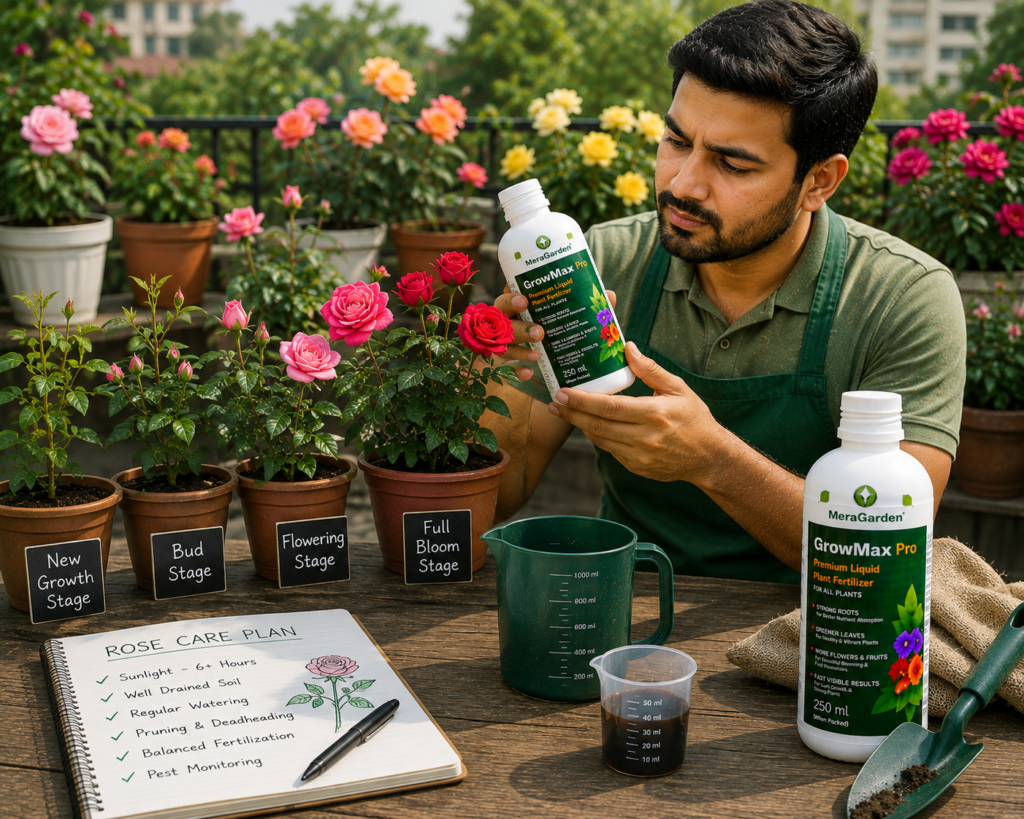
Liquid fertilizers can be particularly convenient for gardeners who grow roses in containers.
Instead of handling dry granules, a liquid fertilizer can be diluted according to the product label and applied with normal garden equipment.
This can make feeding easier for terrace gardens, balconies and small home gardens where gardeners may have several individual pots.
The RHS describes liquid feeding as one of the standard ways to apply fertilizer, where the fertilizer is diluted according to product instructions and applied to the growing medium.
This does not mean liquid fertilizer is automatically better than every other fertilizer.
Different fertilizers have different formulations and purposes. The best option depends on the plant, soil, growing conditions and product instructions.
For gardeners who prefer a convenient feeding method, however, a suitable liquid fertilizer can be an easy addition to a rose-care routine.
4. Helps Maintain Healthy Leaves and New Growth
Beautiful flowers usually start with a healthy plant.
Rose leaves are important because they help the plant produce energy through photosynthesis. If a rose has weak growth or poor foliage, flowering can also be affected.
Plant nutrition is one part of maintaining healthy growth.
But gardeners should be careful not to interpret every yellow leaf or growth problem as a fertilizer deficiency.
Yellow leaves can have many causes, including:
- Overwatering
- Poor drainage
- Root problems
- Pest infestation
- Disease
- Insufficient sunlight
- Nutrient imbalance
- Natural ageing of older leaves
This is why adding fertilizer immediately whenever a leaf changes colour can sometimes make the problem worse.
Instead, inspect the whole plant first.
Check the soil moisture, drainage, sunlight, leaves, stems and roots before deciding whether additional nutrition is actually needed.
5. Supports Roses During Active Growth
Rose plants go through different growth stages.
After pruning or during an active growth period, the plant may produce new shoots and leaves. Later, it may shift more attention toward flower production.
A feeding routine should therefore be based on the plant’s condition and the fertilizer’s instructions rather than following an unnecessarily aggressive schedule.
For roses growing in the ground, the RHS recommends feeding around the start of growth and again during the growing season for appropriate rose types. Container roses may require more frequent feeding.
Indian growing conditions vary considerably. A rose growing on a sunny terrace in Gujarat may experience very different heat and watering conditions from one growing in a cooler northern region.
Therefore, observe the plant rather than blindly copying another gardener’s schedule.
A Simple Rose Nutrition Checklist
Before feeding, ask:
- Is the plant actively growing?
- Is the soil well drained?
- Is the plant receiving enough sunlight?
- Does the plant appear healthy?
- Have I recently applied another fertilizer?
- Am I following the current product label?
This simple checklist can prevent many unnecessary fertilizer applications.
6. Can Make Rose Feeding More Consistent
Consistency is often more useful than excessive fertilizer.
Many gardeners feed plants heavily once and then forget about them for several weeks. Others use different fertilizers together without checking their ingredients or instructions.
A better approach is to create a simple feeding routine.
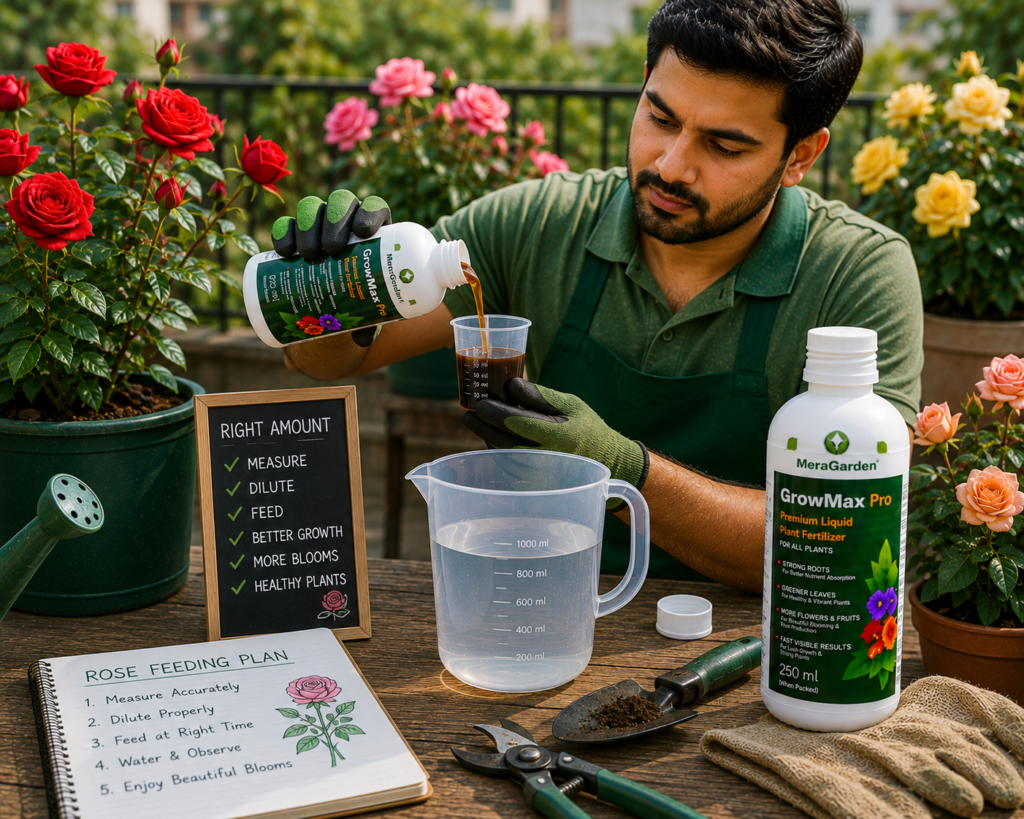
Keep your fertilizer bottle in a clearly labelled gardening area. Record when you feed your plants and follow the recommended dosage and application method printed on the product.
This is particularly useful if you have several rose varieties.
You can maintain a simple notebook containing:
| Rose Plant | Pot Size | Last Feeding | Plant Condition | Next Check |
|---|---|---|---|---|
| Rose 1 | Medium pot | Recorded date | Healthy | Check |
| Rose 2 | Large pot | Recorded date | Flowering | Check |
| Rose 3 | Small pot | Recorded date | New growth | Check |
The exact fertilizer quantity and frequency should come from the product label rather than a generic internet recommendation.
This is important because fertilizer concentrations vary significantly between products.
The RHS also advises gardeners to follow fertilizer product instructions for the correct method, timing and dosage.
7. Reduces the Risk of Common Fertilizer Mistakes
One of the biggest benefits of choosing the right fertilizer approach is avoiding unnecessary problems.
More fertilizer does not mean more flowers.
Excess fertilizer can create problems such as root damage, excessive vegetative growth or nutrient imbalance. Incorrect application can also contribute to environmental pollution.
ICAR’s Directorate of Floricultural Research has also highlighted the importance of balanced, soil-test-based nutrient management in rose cultivation and warned about problems associated with excessive chemical fertilizer use, including increased soil alkalinity and electrical conductivity in intensive rose production.
For home gardeners, the lesson is simple:
Use fertilizer carefully, measure it correctly and avoid unnecessary applications.
Common Mistakes to Avoid
Mistake 1: Using too much fertilizer
Higher concentration does not automatically produce better growth.
Mistake 2: Feeding a stressed plant aggressively
If a plant is suffering from severe heat, drought, root damage or disease, first address the underlying problem.
Mistake 3: Ignoring the fertilizer label
Different products have different concentrations and application methods.
Mistake 4: Mixing several fertilizers without checking compatibility
Combining multiple products can unintentionally increase nutrient concentration.
Mistake 5: Fertilizing waterlogged soil
Poor drainage can damage roots regardless of how good the fertilizer is.
Mistake 6: Treating every yellow leaf as nutrient deficiency
Always examine the complete plant and growing conditions.
Mistake 7: Forgetting sunlight
Roses generally perform best in sunny conditions. The RHS notes that roses produce few flowers in shade.
Ready to Give Your Roses Better Nutrition?
If you want a convenient liquid fertilizer for your home garden, MeraGarden GrowMax Pro can be considered as part of your regular plant-care routine.
Use the product according to the instructions provided on the current GrowMax Pro label. Do not increase the concentration or application frequency simply to try to get faster results.
How to Use Fertilizer for Rose Plants
The correct application method is just as important as selecting the fertilizer.
Step 1: Check the Rose Plant
Before feeding, inspect the leaves, stems, soil and overall plant condition.
If the rose looks severely stressed, investigate the cause before applying additional fertilizer.
Step 2: Check the Product Label
Always read the current fertilizer label before preparing the solution.
The label should be your primary reference for:
- Dosage
- Dilution
- Application method
- Suitable plants
- Application frequency
- Safety instructions
Do not use a generic dosage from another fertilizer product.
Step 3: Measure Carefully
If you are using a liquid fertilizer, measure the required amount using a suitable measuring container.
Avoid estimating the amount by eye.
Accurate measurement is particularly important with concentrated liquid products.
Step 4: Dilute According to Instructions
Add the measured fertilizer to the recommended amount of water specified on the product label.
Mix properly before application.
Do not make the solution stronger because you believe a concentrated mixture will produce better results.
Step 5: Apply Around the Root Zone
For soil application, direct the prepared solution toward the growing medium around the plant rather than randomly pouring it over the flowers.
The RHS recommends directing water toward the soil around roses rather than wetting foliage and flowers unnecessarily.
Step 6: Observe the Plant
After feeding, continue normal rose care.
Watch the plant’s new growth, foliage and flowering response.
Keep records if you have several plants.
Step 7: Do Not Overfeed
Avoid applying additional fertilizer before the recommended interval simply because the plant has not produced flowers immediately.
Flowering depends on several factors, including light, temperature, variety, pruning, water availability and plant health.
Liquid Fertilizer vs Granular Fertilizer for Rose Plants
Both liquid and granular fertilizers can have a place in gardening. The better choice depends on your plants and growing conditions.
| Feature | Liquid Fertilizer | Granular Fertilizer |
|---|---|---|
| Application | Mixed/diluted according to label | Applied as directed |
| Convenience | Easy for container gardening | Convenient for soil application |
| Nutrient availability | Depends on formulation | Depends on formulation |
| Measuring | Requires careful dilution | Requires careful measurement |
| Container roses | Often convenient | Can also be suitable |
| Frequency | Product dependent | Product dependent |
| Main concern | Over-concentration if mismeasured | Over-application if misused |
The RHS recognises both liquid and granular fertilizers as common fertilizer forms. It also emphasises that application timing and dosage should follow the specific product instructions.
So the question should not simply be “Which fertilizer is strongest?”
A better question is:
“Which fertilizer fits my rose plant, growing conditions and care routine?”
MeraGarden GrowMax Pro for Rose Plants
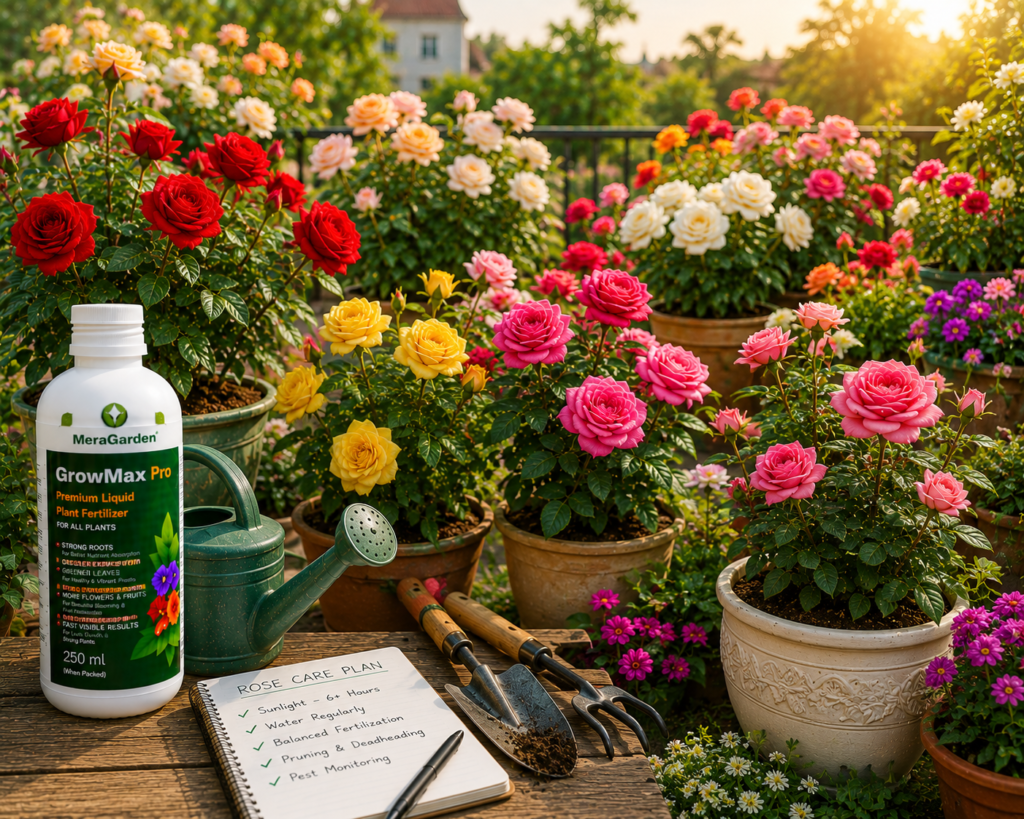
MeraGarden GrowMax Pro is a liquid plant fertilizer designed for plants and can be considered for home-grown roses as part of a broader plant-care routine.
For gardeners who already use liquid fertilizers for vegetables, flowering plants and container plants, a liquid formulation can be convenient because it can be measured and diluted according to its label directions.
However, remember an important point:
GrowMax Pro is a fertilizer, not a replacement for complete rose care.
Your roses still need suitable sunlight, healthy growing media, proper watering, drainage, pruning and pest monitoring.
For best results, use GrowMax Pro according to the current product label, including its specified dilution, dosage and application frequency. Avoid making up a stronger solution or applying it more frequently than recommended.
The RHS similarly advises following the fertilizer manufacturer’s instructions for dosage, timing and application method.
Why Liquid Fertilizer Can Be Useful for Home Rose Gardens
A liquid fertilizer can be especially practical when:
- You have several rose pots
- You grow roses on a balcony or terrace
- You prefer measured applications
- You want a simple feeding routine
- You already use liquid plant nutrition for other garden plants
For container roses, nutrition deserves particular attention because containers provide a limited root environment. The RHS specifically notes that container-grown roses have greater feeding needs than roses planted in borders.
One Important Rule
Do not assume that more fertilizer equals more roses.
Balanced nutrition and consistent plant care are much more important than excessive feeding.
Give Your Roses the Care They Deserve
Healthy roses need the right combination of sunlight, water, soil, pruning and nutrition.
If you are looking for a convenient liquid fertilizer to include in your home-garden routine, MeraGarden GrowMax Pro can be a practical option when used according to its product instructions.
Conclusion
Finding the best fertilizer for rose plants is not simply about choosing the strongest or most expensive product.
The right approach is to understand what your rose actually needs and then provide nutrition carefully and consistently.
The seven key lessons are:
- Choose nutrition that supports healthy overall growth.
- Use appropriate feeding to support flowering.
- Consider liquid fertilizer for convenient feeding, especially in containers.
- Maintain healthy leaves and new growth through complete plant care.
- Adjust your approach according to the plant’s growth stage and condition.
- Measure fertilizer carefully for consistent applications.
- Avoid overfertilizing and other common feeding mistakes.
Remember that fertilizer is only one part of successful rose gardening.
Give your roses adequate sunlight, good drainage, appropriate watering, regular pruning and careful pest monitoring. When fertilizer is needed, follow the product label instead of increasing the dose yourself.
With the right routine, your rose garden can become healthier, more productive and much easier to manage.
Frequently Asked Questions About the Best Fertilizer for Rose Plants
1. What is the best fertilizer for rose plants?
The best fertilizer depends on the rose variety, growing conditions, soil, container size and plant growth stage. A suitable fertilizer should be used according to its label rather than simply choosing the strongest formulation.
2. Is liquid fertilizer good for rose plants?
Yes, an appropriate liquid fertilizer can be convenient for roses, particularly container-grown roses. It should always be diluted and applied according to the product’s instructions.
3. Can I use liquid fertilizer for potted roses?
Yes. Container roses can benefit from appropriate feeding because they have limited access to nutrients compared with roses growing in the ground.
4. Can I use MeraGarden GrowMax Pro for rose plants?
MeraGarden GrowMax Pro is a liquid plant fertilizer suitable for plants according to its product labeling. For roses, follow the current GrowMax Pro label for the correct dosage, dilution and application instructions.
5. How often should I fertilize rose plants?
There is no single frequency that applies to every fertilizer. Feeding frequency depends on the product, rose type, growing conditions and whether the plant is grown in a container or in the ground. Always follow the fertilizer label.
6. Can too much fertilizer damage roses?
Yes. Excessive or incorrectly applied fertilizer can damage plants and create nutrient-related problems. Overuse of fertilizers can also contribute to environmental pollution.
7. Does fertilizer guarantee more rose flowers?
No. Fertilizer alone cannot guarantee more flowers. Sunlight, watering, drainage, pruning, plant variety, temperature, pest management and overall plant health also influence flowering.
8. Should I fertilize a sick rose plant?
First identify the cause of the problem. A sick or stressed rose may have issues related to watering, roots, pests, disease, heat or other growing conditions. Adding fertilizer without understanding the problem may not help.
9. Is organic fertilizer better than liquid fertilizer?
They are not directly comparable categories. “Organic” describes the source/type of fertilizer, while “liquid” describes the physical form. A fertilizer can be liquid or solid and may have different nutrient sources.
10. Do roses need fertilizer throughout the year?
Not necessarily. Feeding should depend on the plant’s growth cycle, growing conditions and fertilizer instructions. Roses planted in the ground may require less routine feeding than container-grown roses.
Must Read
- How Often Should You Fertilize Plants? 7 Easy Rules for Healthy Growth
- How Often Should You Fertilize Plants? Complete Fertilizer Schedule
- What Is NPK Fertilizer? 7 Easy Tips for Healthy Plants
- Best Liquid Fertilizer for Plants: Complete Guide for Home Gardeners
- How to Use Liquid Fertilizer for Plants: 7 Easy Steps for Better Growth
- Best Organic Fertilizers for Plants: 7 Natural Options for Healthy Growth
- Best Fertilizer for Indoor Plants in India: 7 Easy Tips for Healthy Growth
- Best Fertilizer for Flowering Plants in India: 7 Top Options
- Best Fertilizer for Plants: 7 Smart Tips to Avoid Common Mistakes
- 5 Signs Your Plants May Need Fertilizer
- How Much Liquid Fertilizer Should You Use for Plants?
- 7 Benefits of Liquid Fertilizer for Plants: Grow Healthier Plants Faster
- 7 Benefits of Liquid Fertilizer for Plants: A Simple Guide for Healthy Growth
- Best Fertilizer for Peace Lily: 7 Powerful Tips for Beautiful Blooms and Avoiding Common Mistakes
- Best Fertilizer for Spider Plant: 7 Powerful Tips for Lush Growth and Avoiding Common Mistakes
- Liquid Fertilizer vs Granular Fertilizer: Which Is Better? 7 Key Differences for Home Gardeners
- Liquid Fertilizer vs Organic Fertilizer: 7 Powerful Pros, Cons & the Best Choice for Your Plants
- How to Choose the Right Fertilizer for Your Plants: 7 Smart Tips to Avoid Common Mistakes
- 5 Positive Signs Your Plants Need Fertilizer — Avoid These Warning Symptoms for Healthier Growth
- How to Grow Peace Lilies
- How To Grow Houseplants