Choosing the right fertilizer can make a major difference in how well your plants grow. But with so many products available, home gardeners often face one important question: liquid fertilizer vs organic fertilizer—which one should you choose?
Both can play an important role in plant nutrition, but they are not exactly the same thing.
The biggest point to understand is that “liquid” describes the form of a fertilizer, while “organic” describes its source or production approach. An organic fertilizer can be liquid, and a liquid fertilizer can be non-organic. This means comparing the two categories directly can sometimes be misleading.
For example, liquid fertilizer is generally convenient because it can be diluted in water and applied around the root zone or, when the product label allows it, used as a foliar application. Organic fertilizers can include materials such as compost, manure, vermicompost, bone meal, neem-based products, and other naturally derived nutrient sources.
For home gardeners, the better choice depends on the plant, growing medium, nutrient requirements, application frequency, and how quickly you want to correct a nutrient shortage.
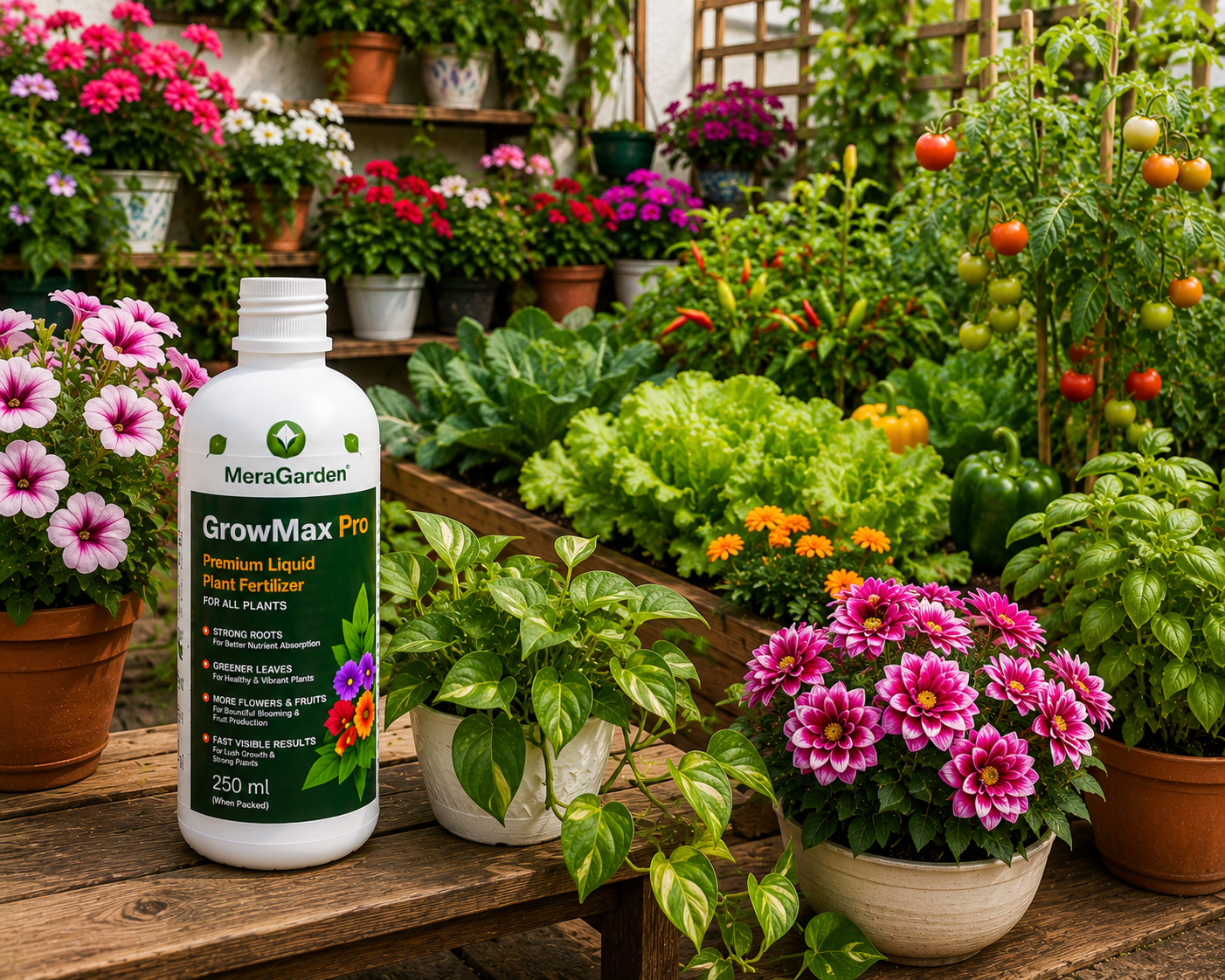
In this guide, we will compare liquid fertilizer vs organic fertilizer across seven important points, explain their advantages and limitations, and show where a concentrated liquid fertilizer such as MeraGarden GrowMax Pro can fit into a practical home-gardening routine.
Table of Contents
1. Liquid Fertilizer Offers Convenient Nutrient Application
One of the biggest advantages of liquid fertilizer is convenience.
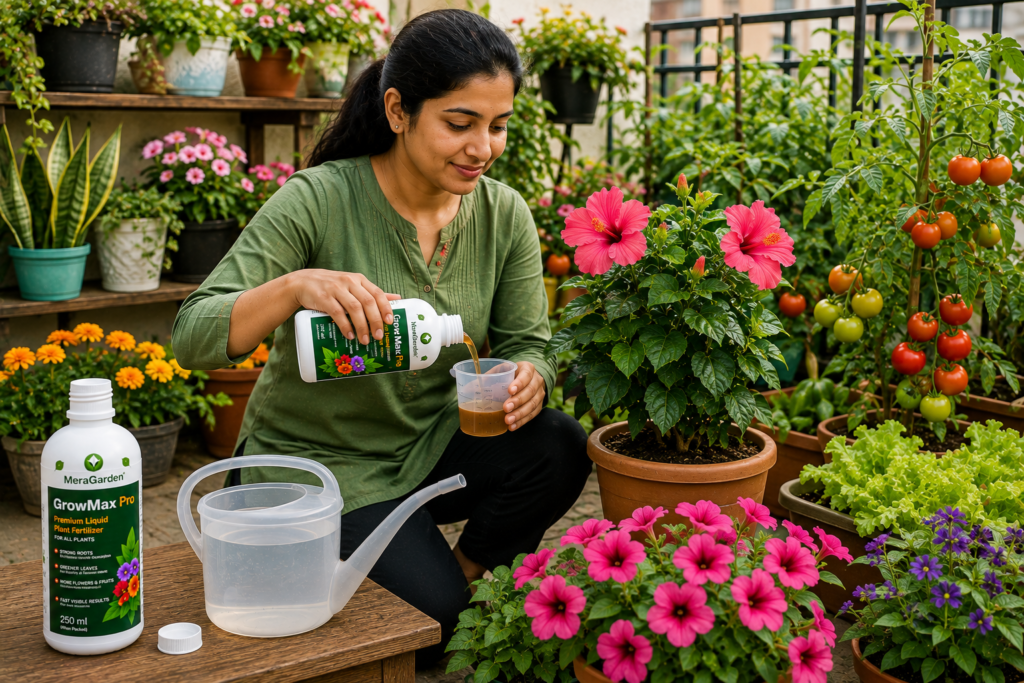
Liquid fertilizers are designed to be mixed with water according to the product’s recommended dilution rate. This makes them particularly useful for gardeners who maintain several types of plants at home.
Instead of measuring and spreading dry material over the soil, gardeners can prepare a fertilizer solution and apply it directly to the plants.
This can be especially convenient for:
- Balcony gardens
- Terrace gardens
- Container plants
- Indoor plants
- Flowering plants
- Vegetable gardens
- Small kitchen gardens
A concentrated product also allows the gardener to prepare only the amount of diluted solution required for the current application.
However, convenience does not mean that more fertilizer is better. Always follow the manufacturer’s recommended dosage. Using excessive fertilizer can damage roots or create nutrient imbalances.
2. Organic Fertilizers Can Improve Long-Term Soil Management
Organic fertilizers are popular among gardeners who want to include naturally derived materials in their soil-management routine.
Depending on the product, organic fertilizers can contribute nutrients and organic matter to the growing environment.
Common examples include:
- Compost
- Vermicompost
- Well-rotted manure
- Neem cake
- Bone meal
- Fish-based fertilizers
- Plant-based organic fertilizers
One major advantage of organic soil amendments is that they can become part of a broader soil-health strategy.
For example, compost can help improve the physical condition of soil while also contributing nutrients. This can be particularly useful in outdoor gardens where maintaining soil quality is an ongoing priority.
However, organic does not automatically mean that a product is suitable for every situation. Different organic fertilizers have different nutrient profiles and release characteristics.
3. Liquid Fertilizer Can Be Useful When Plants Need Regular Feeding
Plants growing in containers often have a different nutritional environment from plants growing directly in garden soil.
Every time a container plant is watered, some nutrients can potentially move through the growing medium. Plants also continuously use nutrients for new leaves, roots, flowers and fruit.
This is why container gardeners often prefer a fertilizer that is easy to measure and apply.
A liquid fertilizer can be incorporated into a regular feeding routine when the product is appropriate for the plant and used according to its instructions.
For example, a gardener may maintain separate routines for:
- Flowering plants
- Leafy vegetables
- Fruiting vegetables
- Indoor foliage plants
- Herbs
- Young plants
The exact frequency should depend on the product instructions and the needs of the plant rather than following one universal schedule.
4. Organic Fertilizer Can Be a Good Choice for Gardeners Focused on Naturally Derived Inputs
Organic fertilizer has become popular because many gardeners prefer naturally derived nutrient sources.
For gardeners following an organic gardening approach, organic fertilizers may be an important part of their overall plant-care system.
However, gardeners should read the product label carefully.
The word organic can refer to different standards, certifications, and formulations depending on the product and market. Therefore, it is better to check the actual ingredients, nutrient analysis, usage instructions and any certification information rather than choosing a product based only on the word “organic.”
Organic fertilizer can work particularly well as part of a broader gardening strategy that includes:
- Healthy soil
- Compost
- Proper watering
- Mulching
- Good drainage
- Crop diversity
- Correct sunlight
- Pest management
Fertilizer is only one part of successful plant care.
5. Liquid and Organic Are Not Always Opposites
This is perhaps the most important point in the entire comparison.
Liquid fertilizer and organic fertilizer are not two completely separate categories.
A fertilizer can be:
- Liquid and organic
- Liquid and non-organic
- Granular and organic
- Granular and non-organic
Therefore, when comparing products, gardeners should look beyond the physical form.
Consider these questions:
What nutrients does it provide?
Look for the nutrient analysis on the label.
What is the source of the nutrients?
Check the ingredient or source information.
How should it be applied?
Follow the manufacturer’s instructions.
Is it suitable for your plant?
A fertilizer intended for general garden use may not always be the best choice for every specific plant.
How frequently should it be used?
Avoid creating your own dosage schedule without considering the product instructions.
Understanding these factors is much more useful than simply asking whether liquid or organic is better.
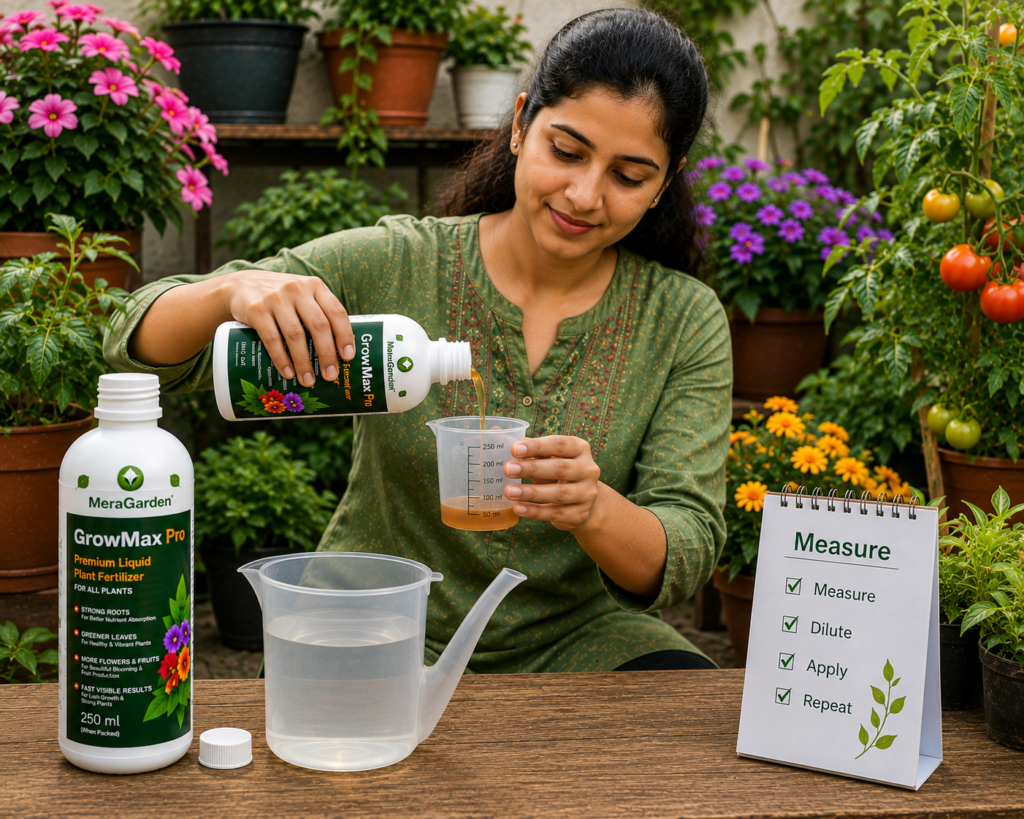
6. Liquid Fertilizer Can Make Measuring Easier
Correct measurement is one of the most important parts of fertilizer application.
A concentrated liquid product can be measured before dilution, allowing gardeners to prepare a consistent fertilizer solution.
This can be especially useful when caring for many potted plants.
For example, rather than applying an unknown quantity of fertilizer directly to the soil, a gardener can:
- Read the product label.
- Measure the recommended quantity.
- Add it to the recommended amount of water.
- Mix thoroughly.
- Apply the solution according to the instructions.
This approach can help reduce guesswork.
With MeraGarden GrowMax Pro, gardeners should use the dosage and application directions provided on the product packaging. Do not assume that a stronger mixture will produce faster growth.
7. The Best Fertilizer Depends on Your Gardening Goal
There is no single fertilizer that is automatically the best for every plant and every gardener.
Your choice should depend on what you are trying to achieve.
For convenient routine feeding
A liquid fertilizer may be practical.
For improving soil with organic matter
Compost and other organic soil amendments can be useful.
For container plants
A measured liquid fertilizer can be convenient because containers have limited growing media.
For an organic gardening approach
A suitable certified or clearly labeled organic fertilizer may fit better with your gardening philosophy.
For flowering and fruiting plants
Choose a fertilizer whose nutrient profile and instructions are appropriate for the plant’s growth stage.
The best approach is often not liquid versus organic, but rather the right nutrient source, formulation and application method for your specific plant.
Choose a Simple Fertilizer Routine
If you want an easy-to-measure liquid fertilizer for your home garden, explore MeraGarden GrowMax Pro and check its product instructions before use.
How to Use Liquid Fertilizer Correctly
Using fertilizer correctly is just as important as choosing the fertilizer.
Even a good fertilizer can cause problems when it is applied at an excessive concentration.
Follow these basic steps.
Step 1: Identify Your Plant
First determine what you are feeding.
Is it:
- An indoor plant?
- A flowering plant?
- A vegetable?
- A herb?
- A fruiting plant?
- A young seedling?
Different plants can have different nutritional requirements.
Step 2: Read the Product Label
Before mixing MeraGarden GrowMax Pro, read the instructions on the product packaging.
The label should be your primary guide for:
- Dosage
- Dilution
- Frequency
- Application method
- Suitable plants
- Precautions
Step 3: Measure the Fertilizer
Use an appropriate measuring container.
Avoid estimating the quantity by simply pouring directly from the bottle.
Step 4: Dilute With Water
Add the measured fertilizer to the recommended amount of water.
Mix thoroughly.
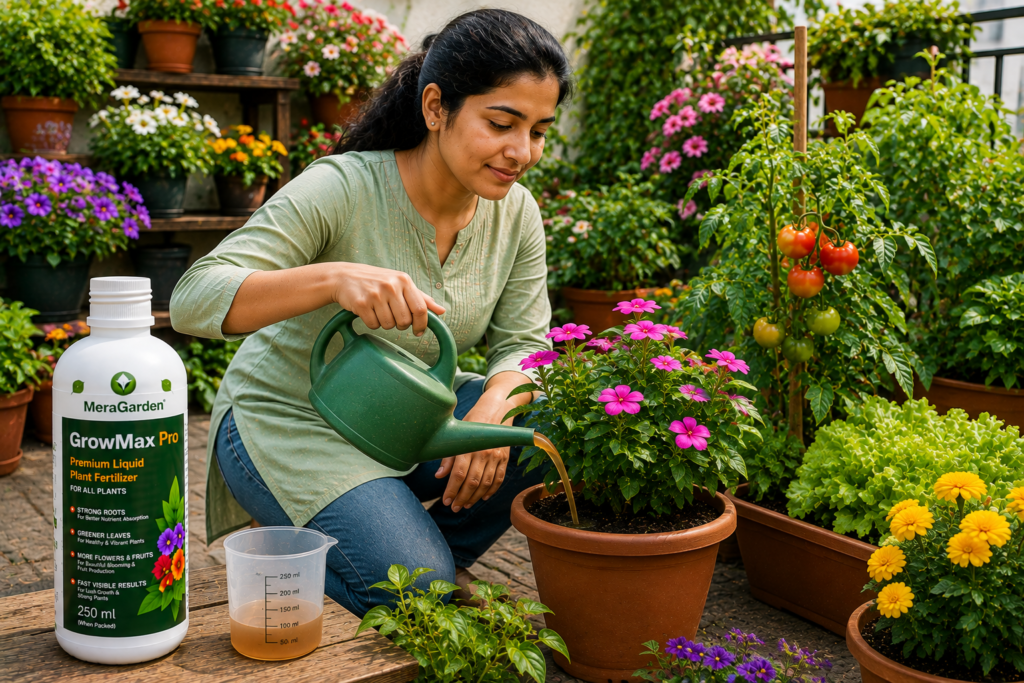
Step 5: Apply Around the Root Zone
For soil application, distribute the diluted solution around the plant’s root zone as directed by the product instructions.
Avoid deliberately concentrating fertilizer directly against the plant stem.
Step 6: Observe the Plant
After application, monitor the plant.
Look for healthy new growth and overall plant condition rather than expecting an immediate dramatic change.
Liquid Fertilizer vs Organic Fertilizer: Detailed Comparison
| Feature | Liquid Fertilizer | Organic Fertilizer |
|---|---|---|
| Form | Usually liquid concentrate or ready-to-use liquid | Can be liquid, powder, meal, compost or granular |
| Main advantage | Easy measuring and application | Naturally derived options are available |
| Application | Usually diluted or applied according to label | Depends heavily on product |
| Nutrient availability | Depends on formulation | Depends on source and decomposition |
| Container gardening | Often convenient | Can also work, depending on product |
| Soil improvement | Depends on formulation | Some organic amendments can improve soil |
| Precision | Generally easy to measure | Varies by product |
| Best use | Convenient nutrient application | Organic gardening and soil-management strategies |
The comparison shows why there is no universal winner.
A gardener should select a fertilizer based on plant requirements, nutrient analysis, application instructions and personal gardening goals.
Why Consider MeraGarden GrowMax Pro?
MeraGarden GrowMax Pro is a concentrated liquid plant fertilizer designed for convenient application across a home-gardening environment.
Its liquid format makes measuring and dilution straightforward when used according to the product instructions.
It can be considered for gardeners managing different types of plants, including:
- Flowering plants
- Vegetable plants
- Potted plants
- Indoor plants
- Home gardens
- Balcony gardens
- Terrace gardens
One practical advantage of a concentrated liquid fertilizer is that gardeners can prepare the amount of diluted solution they need rather than having to distribute a fixed quantity of dry fertilizer.
However, GrowMax Pro should not be treated as a replacement for good gardening practices.
Plants still require:
- Appropriate sunlight
- Correct watering
- Good drainage
- Suitable soil
- Adequate air circulation
- Pest management
- Proper pruning when required
- Correct nutrient management
Fertilizer works best as part of a complete plant-care routine.
Give Your Plants a Consistent Feeding Routine
Want to make fertilizer application easier and more measurable?
MeraGarden GrowMax Pro can be added to your regular home-garden care routine when used according to its product directions.
Conclusion
So, liquid fertilizer vs organic fertilizer—which should you choose?
The answer depends on what you actually mean by “liquid” and “organic.”
Liquid describes the form of the fertilizer, while organic generally describes the source or production approach. Therefore, the two categories can overlap.
A liquid fertilizer can be convenient for gardeners who want an easy-to-measure feeding solution. Organic fertilizers and amendments can be valuable for gardeners who prioritize naturally derived inputs and long-term soil-management practices.
For container gardening and busy home gardeners, a concentrated liquid fertilizer such as MeraGarden GrowMax Pro can provide a practical way to incorporate fertilizer into a regular plant-care routine.
The most important rule is simple: choose the right product for your plants and always follow the recommended application instructions.
Healthy plants are not created by fertilizer alone. Consistent watering, suitable sunlight, good soil, drainage and proper care all work together to produce a thriving garden.
FAQs
1. Is liquid fertilizer better than organic fertilizer?
Not necessarily. Liquid describes the physical form, while organic describes the nutrient source or production approach. An organic fertilizer can also be liquid. The better choice depends on your plant and gardening goals.
2. Can liquid fertilizer be organic?
Yes. Some organic fertilizers are available in liquid form. Always check the product label, ingredients and certification information if organic status is important to you.
3. Is organic fertilizer safer for plants?
Organic does not automatically mean that a product can be used without care. Any fertilizer should be applied according to its instructions. Excessive fertilizer, regardless of type, can cause plant problems.
4. Which fertilizer is best for indoor plants?
A fertilizer suitable for indoor plants should be selected according to the plant species, growing medium and nutrient requirements. A properly diluted liquid fertilizer can be convenient for indoor plants because it is easy to measure.
5. Can I use liquid fertilizer on vegetables?
Some liquid fertilizers are suitable for vegetable plants. Always check the product label to confirm that the fertilizer is appropriate for your plants and follow the recommended dosage.
6. How often should I use liquid fertilizer?
There is no single frequency that works for every fertilizer and plant. Follow the manufacturer’s recommended application schedule and consider the plant’s growth stage and growing conditions.
7. Can I use organic fertilizer and liquid fertilizer together?
It depends on the specific products and their nutrient contents. Combining fertilizers without understanding their nutrient levels can result in excessive feeding. Check both labels before combining products.
8. Is liquid fertilizer good for potted plants?
Liquid fertilizer can be convenient for potted plants because the amount can be measured and diluted before application. However, the correct product and dosage are important.
9. Is MeraGarden GrowMax Pro organic fertilizer?
Do not assume that a product is organic simply because it is a plant fertilizer. Check the MeraGarden GrowMax Pro product label and manufacturer’s specifications for its exact formulation and any applicable organic certification.
10. What is more important than choosing liquid or organic fertilizer?
The most important factors are the plant’s nutrient requirements, correct dosage, suitable growing medium, watering, sunlight, drainage and consistent overall care.
- What Is NPK Fertilizer? 7 Easy Tips for Healthy Plants
- Best Organic Fertilizers for Plants: 7 Natural Options for Healthy Growth
- Best Liquid Fertilizer for Plants: Complete Guide for Home Gardeners
- How to Use Liquid Fertilizer for Plants: 7 Easy Steps for Better Growth
- Best Fertilizer for Indoor Plants in India: 7 Easy Tips for Healthy Growth
- Best Fertilizer for Flowering Plants in India: 7 Top Options