Choosing the right fertilizer can make a big difference in the health and growth of your plants. But when you visit a gardening store or search online, you may find many different options, including liquid fertilizers, granular fertilizers, slow-release fertilizers, organic fertilizers and water-soluble fertilizers.
This often leads to one common question:
Liquid fertilizer vs granular fertilizer — which is better?
The answer is not as simple as saying one type is always better. Both can provide essential nutrients to plants, but they work differently and are better suited to different gardening situations.
Liquid fertilizers are mixed with water before application. They are convenient when you want to provide nutrients in a form that can become available relatively quickly. Granular fertilizers, on the other hand, are dry particles that are applied directly to the soil and may provide nutrients over a longer period depending on the formulation.
According to extension guidance, both liquid and granular fertilizers can be effective. The important factors include the nutrient analysis, application rate, soil condition, plant type and timing.
For home gardeners growing vegetables, flowers, herbs and indoor plants, understanding these differences can help you choose a fertilizer more confidently.
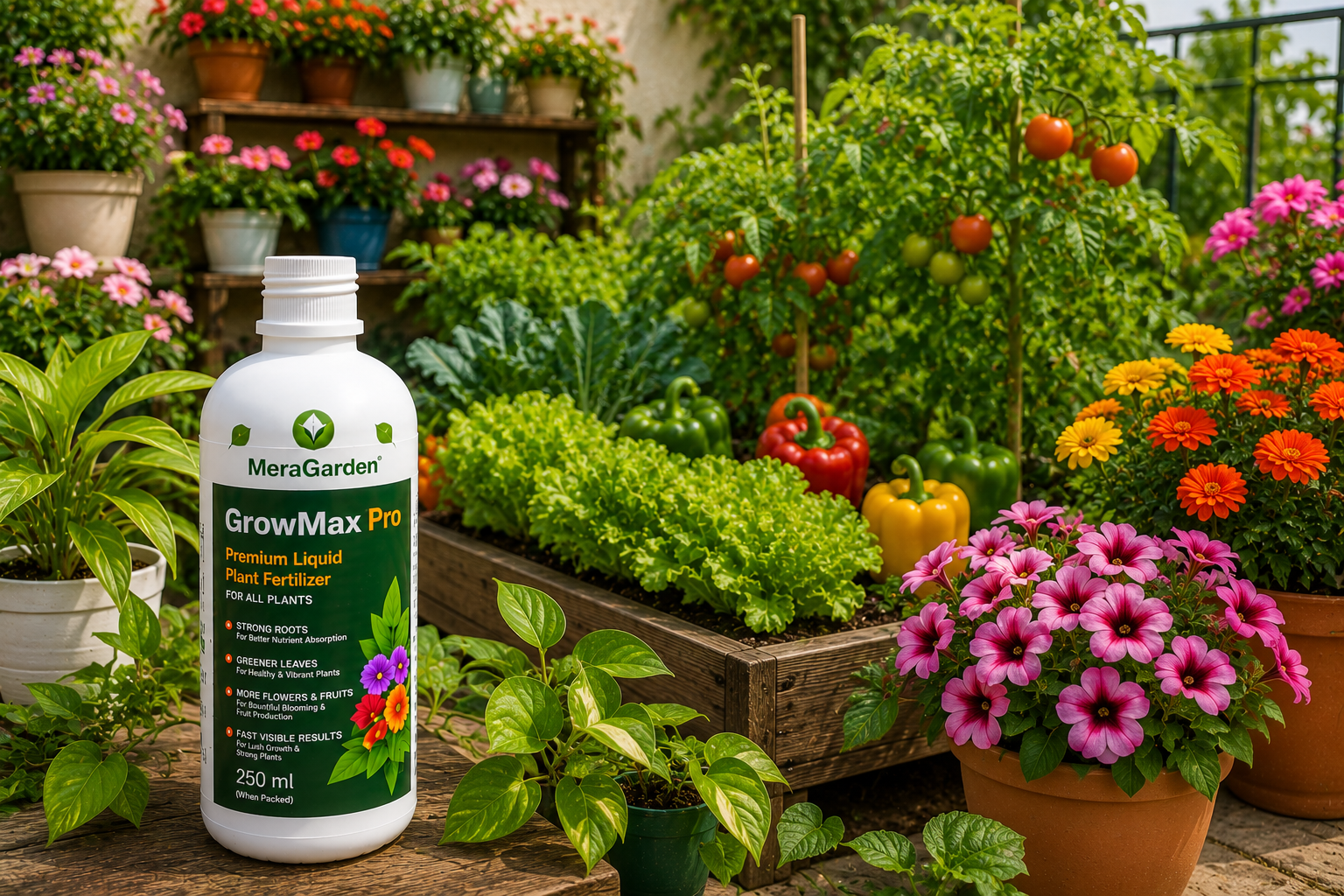
In this guide, we will compare 7 important differences between liquid and granular fertilizer, explain when each type makes sense, and show where a product such as MeraGarden GrowMax Pro can fit into a practical home-gardening routine.
Table of Contents
Liquid Fertilizer vs Granular Fertilizer: The Basic Difference
Before comparing the two, let’s understand what they actually are.
What is liquid fertilizer?
Liquid fertilizer is a fertilizer supplied in liquid form or a water-soluble product that is mixed with water before application.
Depending on the product, it may be applied around the root zone or, when the label specifically allows it, as a foliar spray.
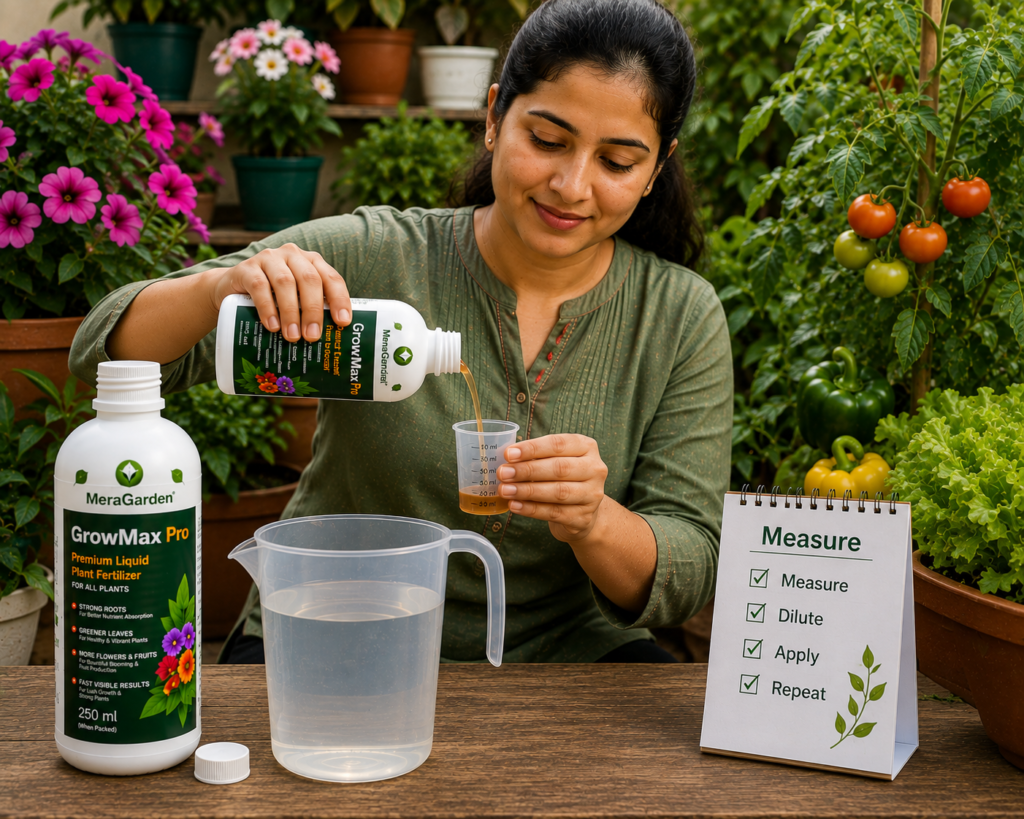
One advantage of liquid fertilizer is convenience. You can measure a specific quantity, dilute it according to the product instructions and apply it directly to your plants.
Many liquid fertilizers are relatively quick acting because the nutrients are already dissolved or become dissolved during mixing. Extension guidance notes that liquid fertilizers can become available relatively quickly, although nutrients can also move out of the root zone quickly under some conditions.
What is granular fertilizer?
Granular fertilizer consists of dry particles or granules containing plant nutrients.
The granules are generally distributed around the plant or incorporated into the soil according to the product instructions. Water then helps dissolve the nutrients and move them into the soil.
Some granular fertilizers are designed to release nutrients relatively quickly, while slow-release or controlled-release granules can release nutrients over a longer period.
So, the biggest difference isn’t simply that one is “good” and the other is “bad.”
The main difference is how the nutrients are delivered and managed.
1. Liquid Fertilizer Usually Gives You More Control Over Application
One of the biggest advantages of liquid fertilizer for home gardeners is the ability to measure and dilute the product.
For example, if your fertilizer label recommends a particular amount per litre of water, you can prepare only the quantity you need for your plants.
This can be especially convenient when you are caring for:
- Balcony plants
- Indoor plants
- Flower pots
- Kitchen gardens
- Vegetable containers
- Small raised beds
- Seedlings and young plants
You can prepare a smaller batch instead of spreading dry fertilizer over a large area.
Granular fertilizer can also be measured accurately, but it requires more attention to even distribution.
Important: Always follow the fertilizer label. More fertilizer does not mean faster or healthier growth. Excess fertilizer can cause nutrient problems or salt-related damage.
Extension guidance recommends reading the fertilizer label carefully and applying nutrients at recommended rates rather than simply adding more.
2. Liquid Fertilizer Can Be Convenient When Plants Need a Quick Nutrient Supply
Liquid fertilizer is often chosen when gardeners want nutrients to become available relatively quickly.
This can be useful during active growth when plants are producing new leaves, flowers or fruit and you want to maintain a regular feeding routine.
Liquid fertilizers can also be useful when growing seedlings or container plants. Extension guidance specifically notes that liquid or water-soluble fertilizers can be suitable for seedlings, while slow-release granular fertilizer can also be useful after transplanting.
However, “quickly available” should not be confused with “automatically better.”
A plant can only use nutrients according to its growth stage and requirements. If the soil already contains sufficient nutrients, adding more fertilizer may not improve growth.
3. Granular Fertilizer Can Be More Convenient for Longer Feeding Intervals
Granular fertilizer has an important advantage: certain formulations can provide nutrients over an extended period.
This is particularly true for slow-release and controlled-release granular fertilizers.
Some slow-release fertilizers are specially designed so that nutrients are released gradually instead of becoming available all at once. The release rate can depend on the formulation and environmental conditions.
This can make granular fertilizer attractive for gardeners who don’t want to prepare a liquid fertilizer solution frequently.
For example, a busy gardener may prefer applying an appropriate slow-release fertilizer according to the label and then maintaining the plants with regular watering and observation.
But remember:
Not every granular fertilizer is slow-release.
A normal granular fertilizer may dissolve relatively quickly once moisture reaches the granules.
Therefore, always check the product packaging for terms such as:
- Slow release
- Controlled release
- Water soluble
- Quick release
- NPK analysis
- Application frequency
4. Liquid Fertilizer Is Often Easier for Pots and Container Plants
Container gardening has become very popular because people can grow plants on balconies, terraces, patios and even indoors.
But containers have limited soil volume.
This means fertilizer application needs to be more carefully managed.
Liquid fertilizer can be convenient because you can mix the required quantity with water and apply it evenly to the growing medium.
This can be particularly useful for:
- Money plants
- Peace lilies
- Spider plants
- Flowering plants
- Herbs
- Tomato plants in containers
- Chilli plants
- Small vegetable gardens
However, container plants can also be sensitive to fertilizer salts. Regular watering and proper drainage are important.
Some extension guidance recommends periodic watering practices to help prevent salt buildup in container growing media.
So the goal should not be to fertilize as frequently as possible.
The goal is to provide the right nutrients at the right rate.
5. Granular Fertilizer Can Be Practical for Larger Garden Areas
If you have a relatively large outdoor garden, granular fertilizer may be convenient because you can distribute it over a larger soil area.
For example, a gardener maintaining:
- Large vegetable beds
- Lawn areas
- Shrubs
- Flower borders
- Fruit plants
- Large outdoor beds
may find dry fertilizer easier to handle than preparing multiple containers of liquid fertilizer.
Granules can be spread around the appropriate root zone, depending on the product instructions.
However, application must be even.
Do not create concentrated piles of fertilizer near the plant stem or crown. Incorrect placement can increase the risk of plant injury. Extension recommendations for some crops specifically advise spreading granular fertilizer evenly and avoiding direct contact with the crown.
6. Liquid Fertilizer Makes It Easier to Adjust Feeding Frequency
Another important difference is flexibility.
With a liquid fertilizer, gardeners can often divide feeding into smaller applications when the product instructions allow it.
This approach can be useful during active growth.
For example, extension guidance for certain fruit crops recommends dividing liquid fertilizer applications into smaller, more frequent applications because liquid nutrients can become available quickly and may also move beyond the root zone relatively quickly.
This does not mean every liquid fertilizer should be used weekly.
The correct frequency depends on:
- Product concentration
- NPK formulation
- Plant type
- Plant age
- Growing medium
- Weather
- Season
- Container size
- Existing soil fertility
Always follow the instructions on the specific product you are using.
7. The Best Choice Depends More on Nutrient Requirements Than Physical Form
This is probably the most important point in the entire liquid fertilizer vs granular fertilizer comparison.
Liquid does not automatically mean better.
Granular does not automatically mean better.
The plant ultimately needs nutrients in usable forms, and the effectiveness of a fertilizer depends on factors such as nutrient content, soil conditions, timing and application rate.
Extension guidance notes that the plant-available nutrient is what matters regardless of whether the fertilizer is supplied in liquid or dry form.
Therefore, before buying fertilizer, look at the fertilizer analysis.
For example, an N-P-K number such as 10-10-10 represents:
- 10% nitrogen
- 10% phosphate
- 10% potash
The exact fertilizer requirement, however, depends on the plant and soil.
Give Your Plants the Nutrition They Need
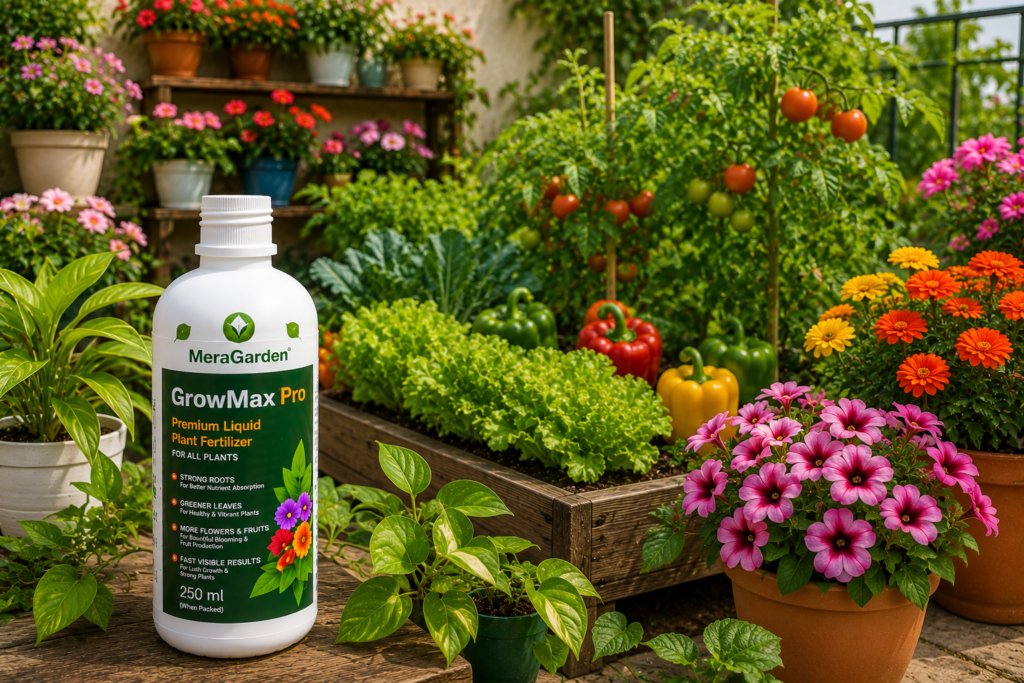
If you prefer a convenient liquid feeding routine for your home garden, MeraGarden GrowMax Pro can be considered as part of your plant-care routine.
It is designed as a liquid plant fertilizer for gardeners who want an easy-to-measure and easy-to-dilute fertilizer format.
How to Use Liquid Fertilizer Correctly
Using liquid fertilizer correctly is just as important as choosing the right fertilizer.
A simple routine can help reduce the risk of overapplication.
Step 1: Read the Product Label
Start by checking the instructions printed on your fertilizer bottle.
Look for:
- Recommended dilution
- Application method
- Suitable plants
- Recommended frequency
- Storage instructions
- Safety precautions
Never assume that the same dilution is suitable for every fertilizer.
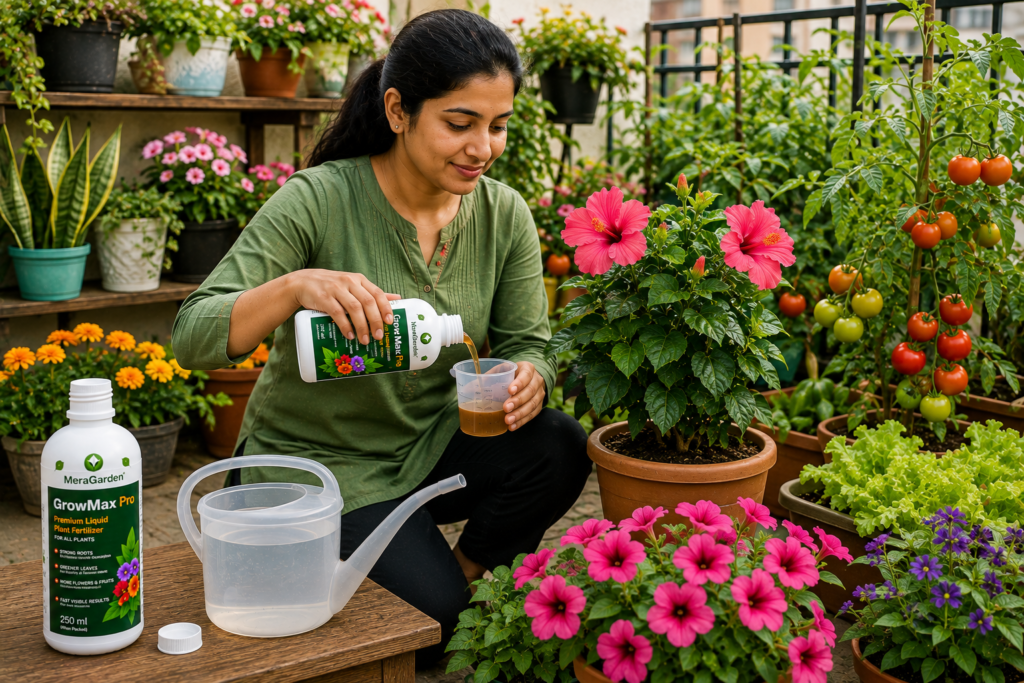
Step 2: Measure the Recommended Quantity
Use a measuring cup, cap or other suitable measuring tool.
Avoid estimating the amount by simply pouring the fertilizer directly into the watering can.
Accurate measurement helps you maintain consistency.
Step 3: Dilute With Water
Add the measured fertilizer to the recommended amount of water.
Mix thoroughly.
For MeraGarden GrowMax Pro, follow the dilution instructions provided on the product packaging rather than using a generic fertilizer ratio.
Step 4: Apply Around the Root Zone
For soil application, apply the diluted fertilizer around the plant’s root zone rather than concentrating it directly against the stem.
Make sure the growing medium is appropriate for the fertilizer application.
Step 5: Don’t Overfertilize
More fertilizer is not necessarily better.
Excess fertilizer can lead to salt buildup or plant injury, particularly in containers.
Extension resources also warn that highly soluble fertilizers can be easier to over-apply, increasing the possibility of fertilizer burn.
Step 6: Maintain a Consistent Schedule
Instead of randomly feeding plants, create a simple fertilizer schedule.
Record:
- Date
- Product used
- Amount
- Plants fertilized
- Plant response
This is especially useful if you grow many plants.
Liquid Fertilizer vs Granular Fertilizer: Comparison
| Feature | Liquid Fertilizer | Granular Fertilizer |
|---|---|---|
| Form | Liquid or diluted solution | Dry granules |
| Application | Mixed with water | Applied directly to soil |
| Nutrient availability | Often relatively quick | Depends on formulation |
| Slow-release options | Available, depending on product | Very common |
| Container plants | Very convenient | Also useful |
| Large gardens | Can require more preparation | Often convenient |
| Measuring | Easy to dilute and measure | Requires accurate dry measurement |
| Feeding frequency | Often used in smaller applications | Can be less frequent with slow-release types |
| Risk of overapplication | Possible if overconcentrated | Possible if too much is applied |
| Storage | Requires sealed liquid container | Usually easy to store when kept dry |
| Best use | Flexible feeding and containers | Larger areas and longer-release feeding |
The comparison shows why there is no universal winner.
The best fertilizer is the one that matches your plant, soil, growing system and gardening routine.
Liquid Fertilizer vs Granular Fertilizer: Which Is Better for Home Gardens?
For many home gardeners, the answer depends on what they are growing.
For indoor plants
Liquid fertilizer can be particularly convenient because indoor plants are usually grown in containers and need controlled feeding.
For balcony gardens
Liquid fertilizer is easy to measure and dilute for a limited number of pots.
For vegetable containers
Liquid fertilizer can be convenient during active growth when used according to the product instructions.
For large outdoor gardens
Granular fertilizer may be easier to distribute over larger areas.
For long-term feeding
A suitable slow-release granular fertilizer may be convenient.
For flexible feeding
Liquid fertilizer can offer greater control over individual applications.
Therefore, rather than asking “Which fertilizer is always better?”, ask:
“Which fertilizer format is better for my plants and my gardening routine?”
Why Consider MeraGarden GrowMax Pro?
If your preference is a convenient liquid fertilizer that can be measured and diluted before application, MeraGarden GrowMax Pro can fit naturally into a home-gardening routine.
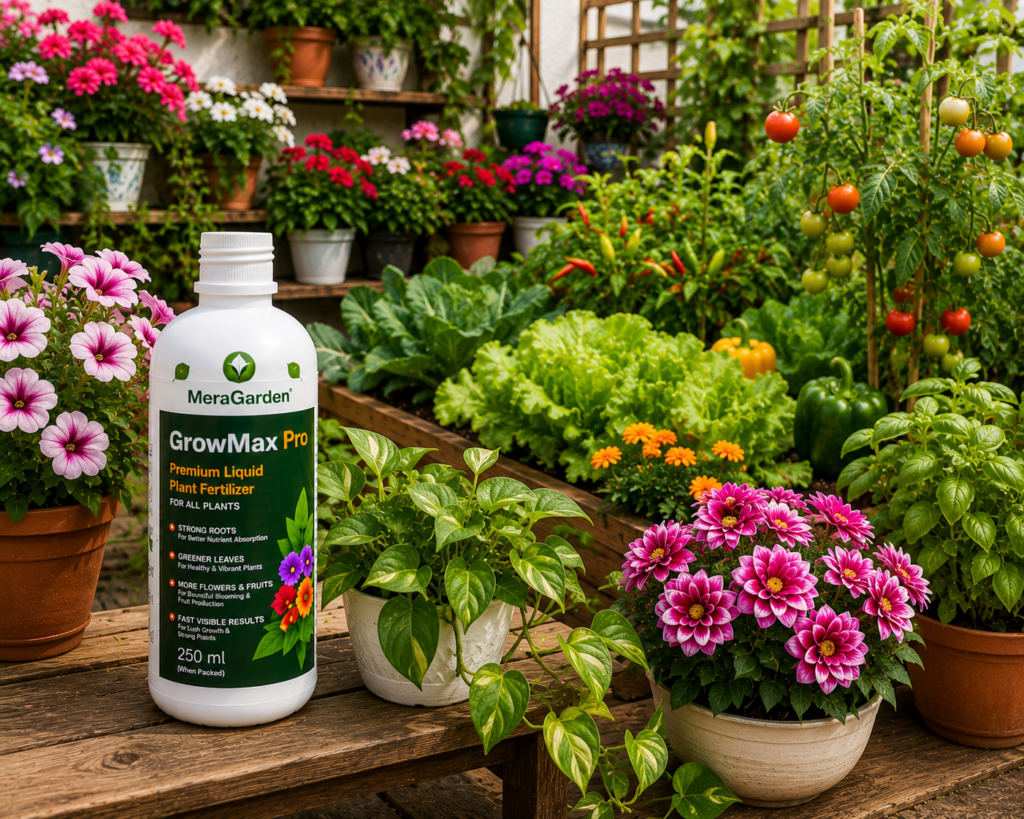
Its liquid format makes it practical for gardeners managing different types of plants, including potted plants, flowering plants and vegetables.
The key advantage for the gardener is convenience: measure the required quantity, dilute according to the product instructions and apply as directed.
Remember that fertilizer is only one part of plant care.
Healthy plants also require:
- Suitable sunlight
- Good-quality growing media
- Correct watering
- Proper drainage
- Adequate air circulation
- Pest and disease management
- Appropriate pruning
- Correct nutrition
A fertilizer cannot compensate for poor growing conditions.
Make Fertilizing Your Plants Simple
Want an easy-to-measure liquid fertilizer for your home garden?
Conclusion
So, liquid fertilizer vs granular fertilizer — which is better?
There is no single answer for every garden.
Liquid fertilizer is often attractive for home gardeners because it is easy to measure, dilute and apply. It can be especially convenient for containers, indoor plants, balcony gardens and situations where gardeners prefer smaller, more controlled applications.
Granular fertilizer can be a practical choice for larger garden areas, and slow-release granular products can reduce the need for frequent applications.
The most important thing is not simply whether the fertilizer is liquid or granular. You should consider the nutrient analysis, plant requirements, soil condition, application rate and timing.
If you prefer a liquid feeding system, MeraGarden GrowMax Pro offers a convenient format for incorporating fertilizer into your regular plant-care routine.
Use the product according to its label instructions, avoid overfertilization and observe how your plants respond.
With the right fertilizer, proper watering, suitable sunlight and good soil management, you can build a healthier and more productive home garden.
FAQs
1. Is liquid fertilizer better than granular fertilizer?
Not always. Both can be effective. Liquid fertilizer is often convenient for quick and flexible feeding, while granular fertilizer can be useful for larger areas and slow-release feeding.
2. Which fertilizer is better for indoor plants?
Liquid fertilizer can be very convenient for indoor plants because most indoor plants are grown in containers and can be fed using a measured, diluted solution. Always follow the product’s recommended dilution.
3. Is granular fertilizer slow-release?
Not necessarily. Some granular fertilizers are quick-release, while others are specifically formulated as slow-release or controlled-release fertilizers. Check the product label.
4. Can I use liquid fertilizer for vegetables?
Yes, liquid fertilizers can be used for vegetable plants when the product is suitable for vegetables and applied according to its label instructions.
5. Can liquid fertilizer burn plants?
Yes. Using a fertilizer at a concentration higher than recommended can increase the risk of plant injury. Always follow the manufacturer’s dilution instructions. Highly soluble fertilizers can be easier to over-apply.
6. How often should I use liquid fertilizer?
There is no universal schedule. Frequency depends on the product, plant, growing medium and growing conditions. Follow the instructions on your fertilizer label.
7. Can I use granular and liquid fertilizer together?
It may be possible, but you should not automatically combine them. Adding multiple fertilizer products can result in excessive nutrient application. Check the instructions for both products and consider the total nutrient being supplied.
8. Which is better for a balcony garden?
Liquid fertilizer is often convenient for balcony gardens because it can be measured and diluted for individual containers. However, a suitable slow-release granular fertilizer can also work well.
9. Which fertilizer is better for flowering plants?
Both liquid and granular fertilizers can be used for flowering plants. Choose a product whose nutrient profile and instructions are appropriate for the plant and its growth stage.
10. Is MeraGarden GrowMax Pro a liquid fertilizer?
Yes. MeraGarden GrowMax Pro is a liquid plant fertilizer designed for convenient measurement and dilution before application. Use it according to the instructions provided on the product packaging.