
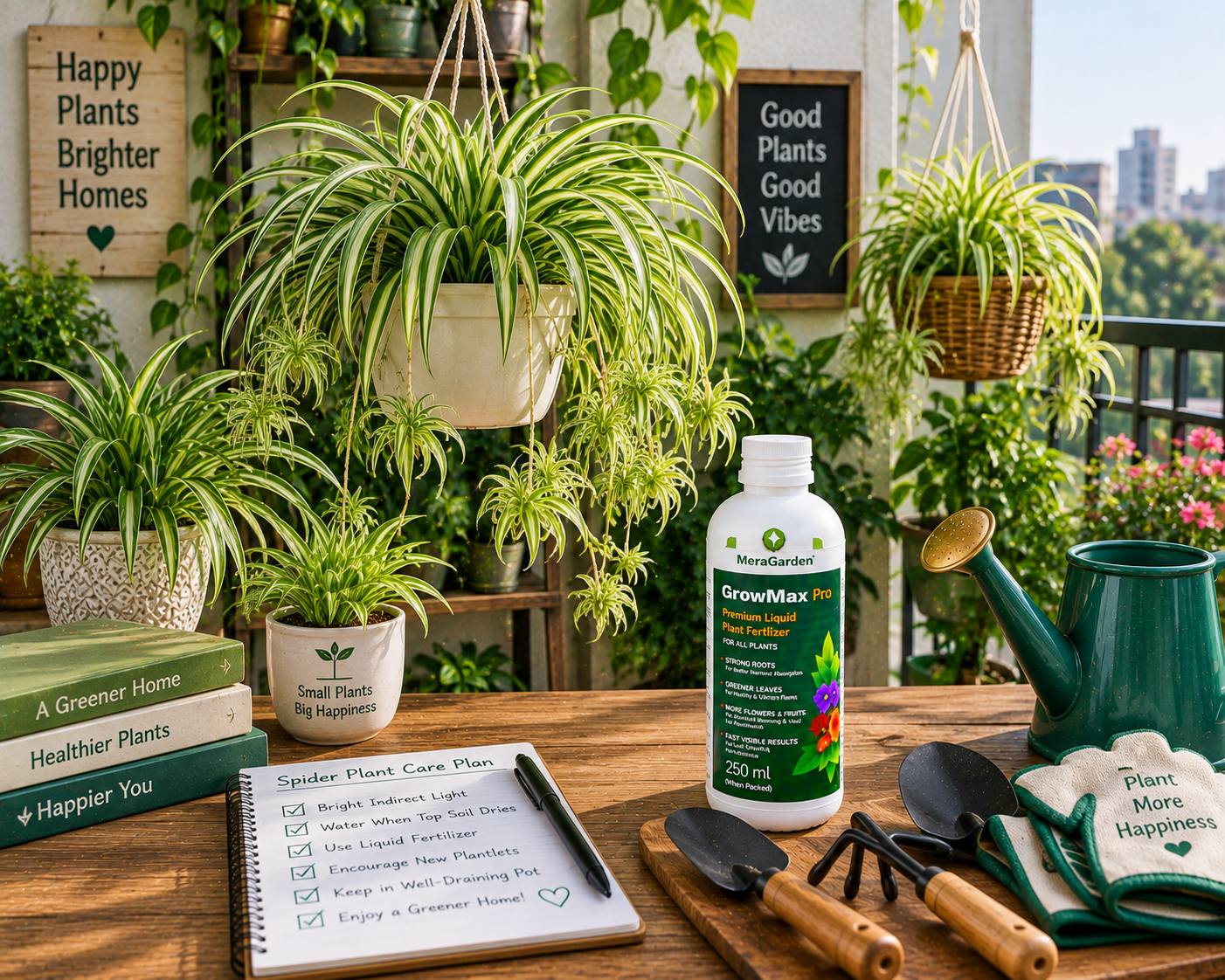
Spider plants are among the most popular indoor plants for Indian homes. Their long, arching leaves, attractive green-and-white patterns and small baby plants make them an easy way to add greenery to balconies, living rooms, bedrooms and offices.
The botanical name of the common spider plant is Chlorophytum comosum. It is considered a tough and relatively easy-to-grow houseplant that can tolerate a range of indoor conditions. Spider plants generally prefer bright, indirect light but can also tolerate lower light, although growth may become slower.
Although spider plants are forgiving, good nutrition can still be useful, especially when they are growing in containers for a long time. Potting soil contains a limited amount of nutrients, and regular repotting or appropriate feeding can help maintain healthy growth.
But this does not mean that more fertilizer is always better.
One of the biggest mistakes indoor gardeners make is assuming that fertilizer can solve every spider plant problem. Yellow leaves, brown tips, slow growth or weak new leaves may also be related to light, watering, poor drainage, temperature or other growing conditions.
So, what is the best fertilizer for spider plant?
For most home gardeners, a suitable balanced liquid fertilizer, used carefully according to its product instructions, can be a convenient choice. Liquid fertilizers are generally fast-acting and are particularly useful for container plants.
Let’s look at seven practical tips to help you create a better feeding routine for your spider plant.
Table of Contents
1. Choose a Balanced Fertilizer for Healthy Spider Plant Growth
The first step in finding the best fertilizer for spider plant is understanding what the plant actually needs.
Fertilizers generally provide nutrients such as nitrogen (N), phosphorus (P) and potassium (K), along with other nutrients depending on the formulation. Plants require these nutrients in different amounts for healthy growth.
For a spider plant grown mainly for its attractive foliage, a balanced fertilizer can be a practical option.
Nitrogen is particularly important for leafy growth, while phosphorus and potassium also have important roles in plant development.
However, avoid choosing a fertilizer simply because its NPK number looks high.
Higher strength does not automatically mean better results.
Spider plants are relatively low-maintenance. The RHS specifically notes that they generally do not need feeding when regularly repotted using fresh compost. If additional feeding is required, it recommends a balanced liquid fertilizer during the main growing season.
Therefore, think of fertilizer as supplementary nutrition, not as a replacement for good soil, proper light and correct watering.
2. Use Fertilizer to Support Lush Green Leaves
One of the main reasons people grow spider plants is their attractive foliage.
A healthy spider plant can produce numerous long, arching leaves and eventually develop hanging stems with small spider-like plantlets.
If your spider plant has suitable light, proper watering and healthy roots, adequate nutrition can support continued foliage development.
This is especially useful for plants growing in containers where the available nutrients can gradually decline.
However, remember that pale or yellow leaves do not automatically mean your spider plant needs fertilizer.
According to the RHS, yellowing of spider plant leaves is often related to insufficient light rather than nutrient deficiency.
Before adding fertilizer, check:
- Is the plant receiving bright, indirect light?
- Is the pot draining properly?
- Is the soil staying wet for too long?
- Has the plant recently been repotted?
- Are the roots healthy?
- Is the plant showing active new growth?
Solving the actual problem first is usually better than immediately increasing fertilizer.
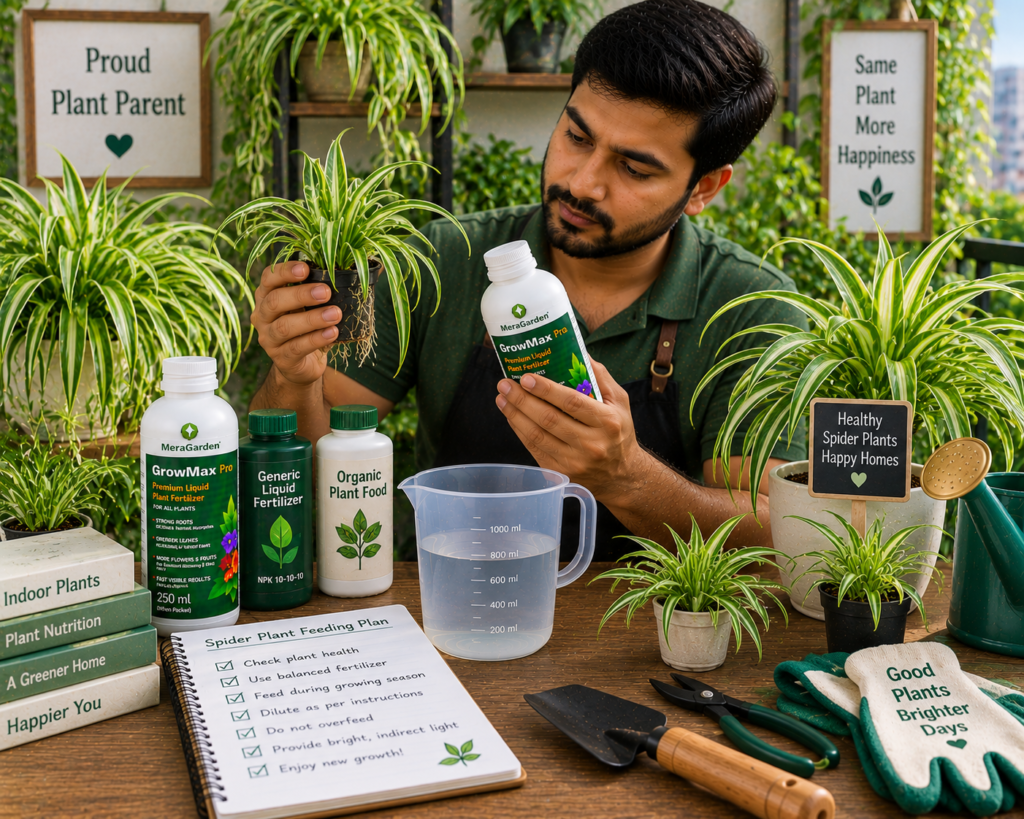
3. Feed Spider Plants During Active Growth
Timing matters when using the best fertilizer for spider plant.
Plants generally make better use of nutrients when they are actively growing. The RHS recommends feeding houseplants mainly during their growing season and limiting winter feeding because lower light levels can reduce the plant’s ability to use fertilizer effectively.
For spider plants specifically, the RHS recommends a balanced liquid fertilizer every other month through the main growing season, approximately April to September in its UK guidance, when feeding is needed.
For Indian gardeners, the exact growing period can vary depending on your local temperature, light and whether the plant is kept indoors or outdoors.
For example:
- A warm, bright balcony may support active growth for much of the year.
- An indoor plant in a darker room may grow much more slowly.
- During cooler or darker periods, the plant may require less fertilizer.
- A recently repotted spider plant may have enough nutrients in fresh potting mix.
The important principle is simple:
Feed according to active growth and the fertilizer label rather than following an aggressive fixed schedule.
4. Don’t Fertilize a Completely Dry Spider Plant
One of the most important rules when using liquid fertilizer is to pay attention to soil moisture.
The RHS advises against applying fertilizer to dry soil because concentrated fertilizer can damage plant roots.
Before feeding your spider plant, check the potting mix.
If the soil is extremely dry, water appropriately first and allow the plant to recover rather than immediately applying a concentrated fertilizer solution.
Spider plants like reasonably even moisture but do not like sitting in water for extended periods. Excess water should be allowed to drain away rather than remaining in the saucer or outer pot.
This is particularly important for indoor plants because poor drainage combined with frequent watering can create root problems.
A simple routine is:
Check the soil → check the plant → prepare diluted fertilizer → apply according to label instructions.
5. Liquid Fertilizer Can Be Convenient for Potted Spider Plants
Liquid fertilizer is one of the most convenient options for indoor container plants.
Liquid fertilizers are generally fast-acting and can be diluted with water before being applied to the growing medium. The RHS lists liquid fertilizer as one of the common fertilizer forms and notes that liquid feeds are particularly useful for container plants.
This makes liquid fertilizer convenient for spider plant owners because you can:
- Measure the required quantity.
- Dilute it with water.
- Apply it around the growing medium.
- Maintain a simple feeding routine.
- Adjust feeding according to plant growth and product instructions.
However, convenience should never become an excuse for overfeeding.
Always check the product label for the correct dilution, application method and frequency.
Different liquid fertilizers have different concentrations, so there is no single dosage that is correct for every product.
6. Proper Nutrition Can Support New Growth and Spider Babies
A mature spider plant can produce long stems carrying small plantlets, commonly called spider babies or spiderettes.
These plantlets are one of the features that make spider plants so enjoyable to grow and propagate.
Good overall plant care—including suitable light, watering, healthy roots and adequate nutrition—can support vigorous growth.
However, fertilizer should not be treated as a guaranteed method for producing more spider babies.
If your spider plant is not producing plantlets, first consider:
- Plant maturity
- Light conditions
- Seasonal growth
- Pot size
- Overall plant health
- Watering routine
- Recent repotting
The RHS notes that young spider plants can take up to a year before beginning to produce offsets, so a lack of spider babies does not necessarily indicate a fertilizer problem.
Good nutrition is just one part of successful spider plant care.
7. Avoid Overfertilizing Your Spider Plant
This is perhaps the most important fertilizer tip.
Many gardeners think that increasing fertilizer will make plants grow faster. Unfortunately, excessive fertilizer can create problems instead of improving plant health.
The RHS recommends using the minimum amount of feed required to achieve the desired plant quality and warns that incorrect application and overuse can cause problems.
Overfeeding can be particularly unnecessary for spider plants because they are naturally resilient and can grow successfully without frequent fertilizer when they have fresh, suitable potting compost.
Avoid:
- Adding extra fertilizer because growth seems slow
- Using a stronger solution than recommended
- Fertilizing at every watering without checking the product instructions
- Feeding a stressed or unhealthy plant simply to “boost” it
- Mixing multiple fertilizers without knowing whether they are compatible
- Applying concentrated fertilizer directly to dry soil
The goal is not maximum fertilizer.
The goal is appropriate nutrition at the right time.
🌿 Give Your Spider Plant a Better Feeding Routine
Healthy spider plants don’t need complicated care.
Choose a suitable fertilizer, follow the product instructions, monitor the soil and feed only when the plant actually needs additional nutrition.
Want an easy liquid fertilizer option for your indoor plants?
How to Use Liquid Fertilizer for Spider Plant
Using liquid fertilizer correctly is more important than simply choosing an expensive product.
Follow these steps for a safer and more consistent feeding routine.
Step 1: Check the Plant First
Look at the leaves, stems and overall growth.
If the plant is severely wilted, diseased, suffering from root problems or experiencing another major stress, correct the underlying issue first.
Fertilizer is not a cure for poor watering, inadequate light or root damage.
Step 2: Check the Soil Moisture
Do not apply concentrated fertilizer to completely dry soil.
Check the growing medium with your finger. If the soil is excessively dry, deal with watering first.
Spider plants prefer soil that is not constantly soggy. Good drainage is important.
Step 3: Read the Fertilizer Label
This step is essential.
Every fertilizer can have a different concentration.
Read the manufacturer’s instructions for:
- Dilution
- Dosage
- Application method
- Recommended frequency
- Suitable plants
- Storage instructions
Do not copy the dosage of another fertilizer onto GrowMax Pro or any other product.
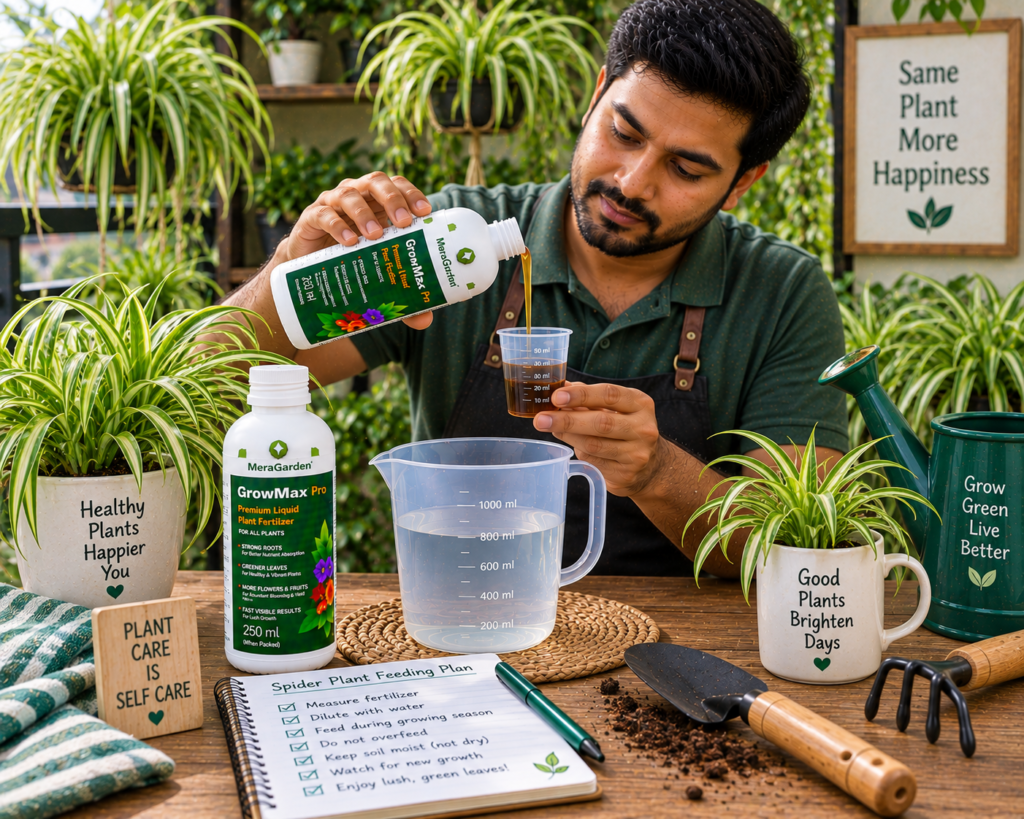
Step 4: Measure the Fertilizer
Use a proper measuring container rather than guessing.
Accurate measurement helps maintain consistency and reduces the risk of accidentally using too much fertilizer.
For MeraGarden GrowMax Pro, use the current dosage and dilution instructions printed on the product label.
Step 5: Dilute Before Application
If the product label instructs you to dilute the liquid fertilizer, mix the measured fertilizer with the recommended amount of water.
Mix it thoroughly before application.
Never assume that a concentrated liquid fertilizer should be poured directly onto the soil.
Step 6: Apply Around the Growing Medium
Apply the prepared fertilizer solution around the soil or growing medium according to the product instructions.
Avoid creating a concentrated pool of fertilizer in one small area.
For indoor plants, also make sure excess liquid can drain from the pot.
Step 7: Observe the Plant
After feeding, continue your normal plant-care routine.
Watch for:
- New leaves
- Improved foliage
- Healthy growth
- Leaf-tip browning
- Yellowing
- Wilting
- Signs of overwatering
Do not immediately feed again simply because you don’t see a visible change after a few days.
Plants need time to respond.
Common Fertilizer Mistakes to Avoid
Using too much fertilizer
More fertilizer does not automatically mean more growth.
Fertilizing every time you water
This should only be done if the particular fertilizer’s instructions support that method and concentration.
Feeding a dry plant
Avoid applying fertilizer to completely dry soil.
Ignoring light problems
If a spider plant is pale or yellow, check its lighting before assuming nutrient deficiency.
Fertilizing during slow growth
When growth slows because of low light or cooler conditions, fertilizer demand may also decrease.
Liquid vs Granular vs Slow-Release vs Organic Fertilizer for Spider Plants
There is no single fertilizer type that is perfect for every gardener.
| Fertilizer Type | Advantages | Limitations | Suitable for Spider Plant? |
|---|---|---|---|
| Liquid fertilizer | Easy to measure, dilute and apply; generally fast acting | Requires regular application | Yes |
| Granular fertilizer | Convenient and can provide longer-lasting feeding | Can be easier to overapply if incorrectly measured | Yes |
| Slow-release fertilizer | Releases nutrients gradually and reduces frequent feeding | Less immediate control over feeding | Yes |
| Organic fertilizer | Can add organic nutrients depending on the product | May have slower nutrient availability and can be less convenient indoors | Can be used if suitable |
The RHS notes that liquid, granular, pellet and dry powder fertilizers are all available, while slow-release products can gradually release nutrients over time.
For indoor spider plants, liquid fertilizer can be particularly convenient because it allows the gardener to control the amount being applied.
Why MeraGarden GrowMax Pro Can Be a Convenient Choice
If you’re looking for a practical liquid fertilizer for spider plant, MeraGarden GrowMax Pro is designed as a liquid plant fertilizer suitable for all plants.
Its liquid format makes it convenient for gardeners who prefer to measure and dilute fertilizer before feeding their potted plants.
For spider plants, the important advantage is the ability to incorporate feeding into a simple plant-care routine without needing to handle dry granules.
GrowMax Pro is useful for gardeners who want:
- A liquid fertilizer format
- Easy measurement and application
- A product suitable for different plants
- A convenient option for indoor container gardening
- A simple feeding routine
However, remember that GrowMax Pro is a chemical-based fertilizer, not an organic fertilizer.
Most importantly, always follow the current GrowMax Pro product label for dosage, dilution and frequency. Do not increase the recommended concentration in an attempt to get faster results.
🌱 Give Your Spider Plants Better Nutrition
Your spider plant doesn’t need an overly complicated fertilizer routine.
With suitable light, correct watering, good drainage and sensible feeding, you can create better conditions for healthy foliage and continued growth.
If you want to add a convenient liquid fertilizer to your gardening routine:
Grow Better. Bloom Bigger.
Conclusion
Finding the best fertilizer for spider plant is not about choosing the strongest fertilizer or feeding the plant as frequently as possible.
Spider plants are naturally resilient and can grow well with relatively simple care. Fresh, suitable potting compost, bright indirect light, appropriate watering and good drainage should come first.
When additional feeding is needed, a balanced liquid fertilizer can be a convenient option. The RHS recommends a balanced liquid fertilizer for spider plants when feeding is required during the main growing season.
The seven most important lessons are:
- Choose a suitable balanced fertilizer.
- Use fertilizer to support healthy foliage.
- Feed mainly during active growth.
- Avoid applying fertilizer to completely dry soil.
- Use liquid fertilizer carefully and correctly.
- Support overall plant health rather than chasing more spider babies.
- Avoid overfertilizing.
Most importantly, don’t use fertilizer to compensate for poor light, overwatering or drainage problems.
A healthy spider plant needs balanced care—not excessive feeding.
FAQs About the Best Fertilizer for Spider Plant
1. What is the best fertilizer for spider plant?
A suitable balanced fertilizer can be a good choice for spider plants. When additional feeding is needed, the RHS recommends a balanced liquid fertilizer during the main growing season.
2. Is liquid fertilizer good for spider plants?
Yes. Liquid fertilizer can be convenient for potted spider plants because it can be measured, diluted and applied according to the product instructions.
3. How often should I fertilize a spider plant?
The correct frequency depends on the fertilizer and growing conditions. The RHS recommends feeding spider plants with a balanced liquid fertilizer every other month during the main growing season when feeding is needed.
Always follow the instructions on your specific fertilizer.
4. Can I use GrowMax Pro on spider plants?
GrowMax Pro is a liquid plant fertilizer suitable for all plants, so it can be used as part of a spider plant feeding routine. Follow the current product label for the correct dosage and dilution.
5. Can fertilizer make spider plant leaves greener?
Adequate nutrition can support healthy foliage, but leaf color also depends heavily on light, watering and general plant health. Yellowing should not automatically be treated as a fertilizer deficiency.
6. Why are my spider plant leaves turning yellow?
Yellow leaves can have several causes. The RHS notes that insufficient light is a common reason for yellowing in spider plants. Overwatering and other growing problems can also affect plant health.
7. Should I fertilize a newly repotted spider plant?
Usually, there is no need to rush. Fresh potting compost may already contain nutrients. Give the plant time to establish and follow the fertilizer and compost instructions.
8. Can too much fertilizer damage a spider plant?
Yes. Overuse or incorrect application of fertilizer can cause problems. The RHS recommends using the minimum amount of feed needed and following product instructions.
9. Should I fertilize a spider plant in winter?
Usually, feeding should be reduced when the plant’s growth slows because of lower light or cooler conditions. The exact timing depends on your local climate and indoor growing conditions.
10. Does fertilizer make spider plants produce more babies?
Fertilizer supports overall plant nutrition, but it does not guarantee more spider babies. Plant maturity, light, growing conditions and general health also influence offset production.
11. Is organic fertilizer better than liquid fertilizer for spider plants?
Not necessarily. “Organic” and “liquid” describe different characteristics: organic refers to the source/type of fertilizer, while liquid describes its physical form. Choose a fertilizer appropriate for the plant and follow its instructions.
12. What is more important than fertilizer for spider plants?
Light, watering and drainage are extremely important. Spider plants prefer bright, indirect light and should not be left sitting in soggy soil.
Must Read
- How Often Should You Fertilize Plants? 7 Easy Rules for Healthy Growth
- How Often Should You Fertilize Plants? Complete Fertilizer Schedule
- What Is NPK Fertilizer? 7 Easy Tips for Healthy Plants
- Best Liquid Fertilizer for Plants: Complete Guide for Home Gardeners
- How to Use Liquid Fertilizer for Plants: 7 Easy Steps for Better Growth
- Best Organic Fertilizers for Plants: 7 Natural Options for Healthy Growth
- Best Fertilizer for Indoor Plants in India: 7 Easy Tips for Healthy Growth
- Best Fertilizer for Flowering Plants in India: 7 Top Options
- Best Fertilizer for Plants: 7 Smart Tips to Avoid Common Mistakes
- 5 Signs Your Plants May Need Fertilizer
- How Much Liquid Fertilizer Should You Use for Plants?
- 7 Benefits of Liquid Fertilizer for Plants: Grow Healthier Plants Faster
- 7 Benefits of Liquid Fertilizer for Plants: A Simple Guide for Healthy Growth
- Best Fertilizer for Peace Lily: 7 Powerful Tips for Beautiful Blooms and Avoiding Common Mistakes
- Best Fertilizer for Spider Plant: 7 Powerful Tips for Lush Growth and Avoiding Common Mistakes
- Liquid Fertilizer vs Granular Fertilizer: Which Is Better? 7 Key Differences for Home Gardeners
- Liquid Fertilizer vs Organic Fertilizer: 7 Powerful Pros, Cons & the Best Choice for Your Plants
- How to Choose the Right Fertilizer for Your Plants: 7 Smart Tips to Avoid Common Mistakes
- 5 Positive Signs Your Plants Need Fertilizer — Avoid These Warning Symptoms for Healthier Growth
- How to Grow Peace Lilies
- How To Grow Houseplants