
Introduction
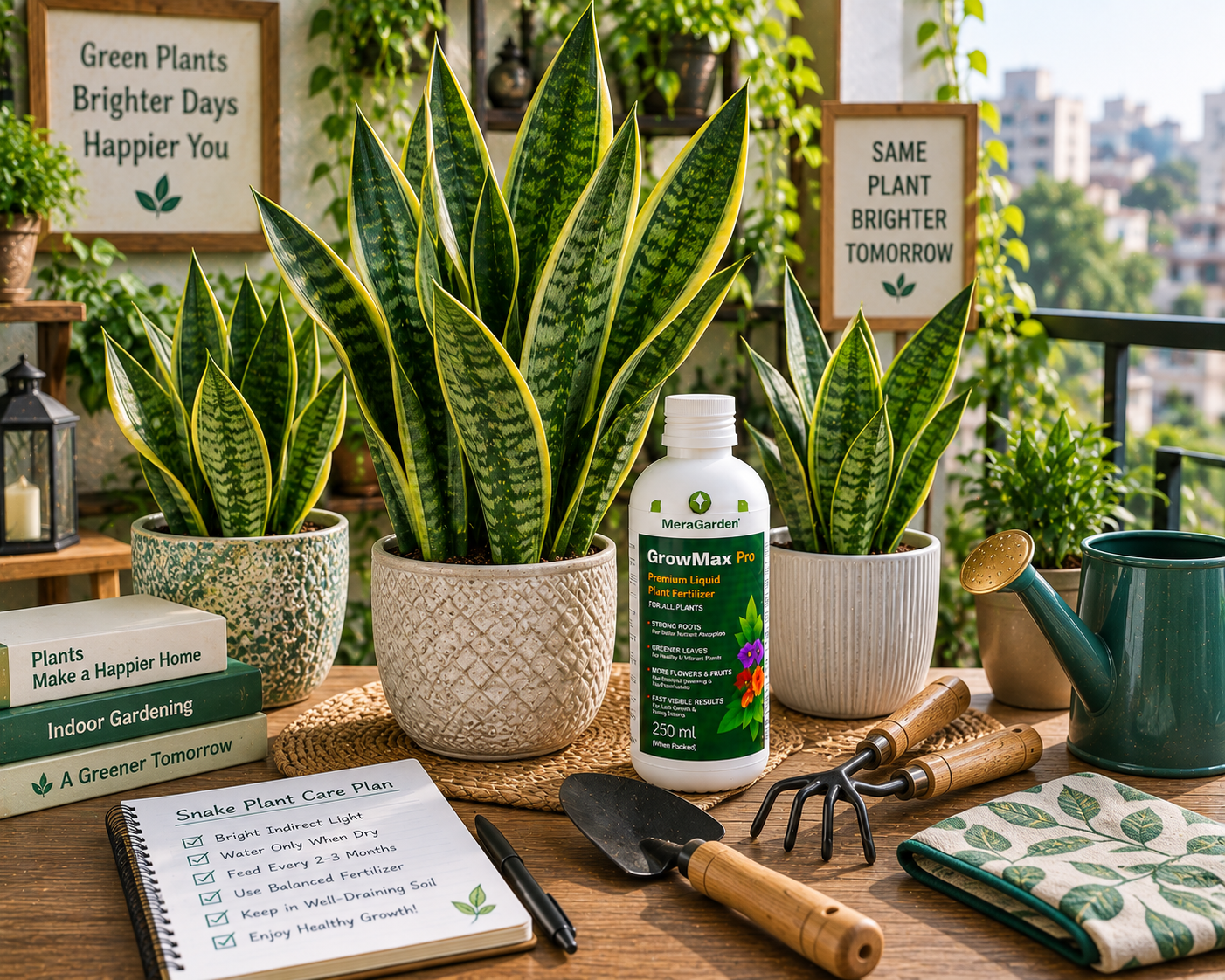
Snake plants are one of the most popular indoor plants in Indian homes. They are attractive, require relatively little maintenance and can tolerate a wider range of indoor conditions than many other houseplants. Their upright, sword-shaped leaves also make them a great choice for living rooms, bedrooms, offices, balconies and other indoor spaces.
But being a low-maintenance plant does not mean a snake plant never needs nutrients.
When grown in a pot for a long time, the available nutrients in the growing medium can gradually become limited. A suitable fertilizer, used at the right time and in the right quantity, can support healthy growth and attractive foliage.
The important point is that snake plants are not heavy feeders.
The Royal Horticultural Society (RHS) describes Sansevierias, commonly known as snake plants, as resilient, drought-tolerant houseplants. Its growing guide recommends feeding once a month during the growing season with a liquid houseplant fertilizer or specialist liquid cactus feed to boost growth.
This means choosing the best fertilizer for snake plant is not about using the strongest fertilizer possible. It is about choosing a suitable product and using it carefully.
In this guide, we will cover seven important benefits of proper fertilization, how to choose a suitable fertilizer, how to use liquid fertilizer safely, common mistakes to avoid, and how MeraGarden GrowMax Pro can fit into your snake plant care routine.
Table of Contents
7 Benefits of Using the Right Fertilizer for Snake Plant
Snake plants are naturally slow-growing compared with many tropical foliage plants. Therefore, fertilizer should be used as a supporting part of plant care rather than as a shortcut to force rapid growth.
Here are seven useful benefits of maintaining appropriate nutrition.
1. Supports Healthy Green Leaf Growth
The attractive leaves are the main reason people grow snake plants.
Healthy snake plants can develop firm, upright leaves with strong colour and attractive patterns, depending on the variety. Nutrition plays a role in the plant’s ability to produce and maintain new growth.
Plants require several nutrients for normal development. Nitrogen, phosphorus and potassium are the three nutrients most commonly associated with fertilizer labels, although plants also need several secondary and micronutrients.
For a foliage plant such as snake plant, adequate nutrition can support healthy vegetative growth.
However, this does not mean that adding more fertilizer will automatically produce better leaves.
Overfertilization can cause problems, particularly in container plants. The RHS advises gardeners to use fertilizer carefully, follow product instructions and avoid unnecessary applications.
Therefore, the goal should be appropriate nutrition, not maximum nutrition.
If your snake plant has been growing in the same container for a long time, sensible fertilization may help provide nutrients that are no longer readily available in the potting medium.
2. Helps Maintain Attractive Foliage
Snake plants are primarily grown for their foliage.
Depending on the variety, leaves may have green, grey-green, yellow or variegated patterns. Keeping these leaves healthy requires more than fertilizer, but appropriate nutrition can be one part of maintaining good overall growth.
If your snake plant appears weak, pale or unusually slow-growing, check the complete growing environment before reaching for fertilizer.
Ask yourself:
- Is the plant getting enough light?
- Is the pot draining properly?
- Is the soil staying wet for too long?
- Is the plant receiving too much direct afternoon sun?
- Has the plant been recently repotted?
- Are the roots healthy?
- Is there any pest damage?
Snake plants are particularly sensitive to excessive moisture around their roots. The RHS recommends allowing the compost to dry out between waterings because overwatering is a common cause of poor health and root rot.
So, fertilizer should never be used to compensate for poor watering practices.
3. Supports New Growth During the Active Season
Snake plants are generally slow growers, but they can produce new leaves and offsets when conditions are favourable.
During active growth, appropriate nutrients can support the plant’s normal development.
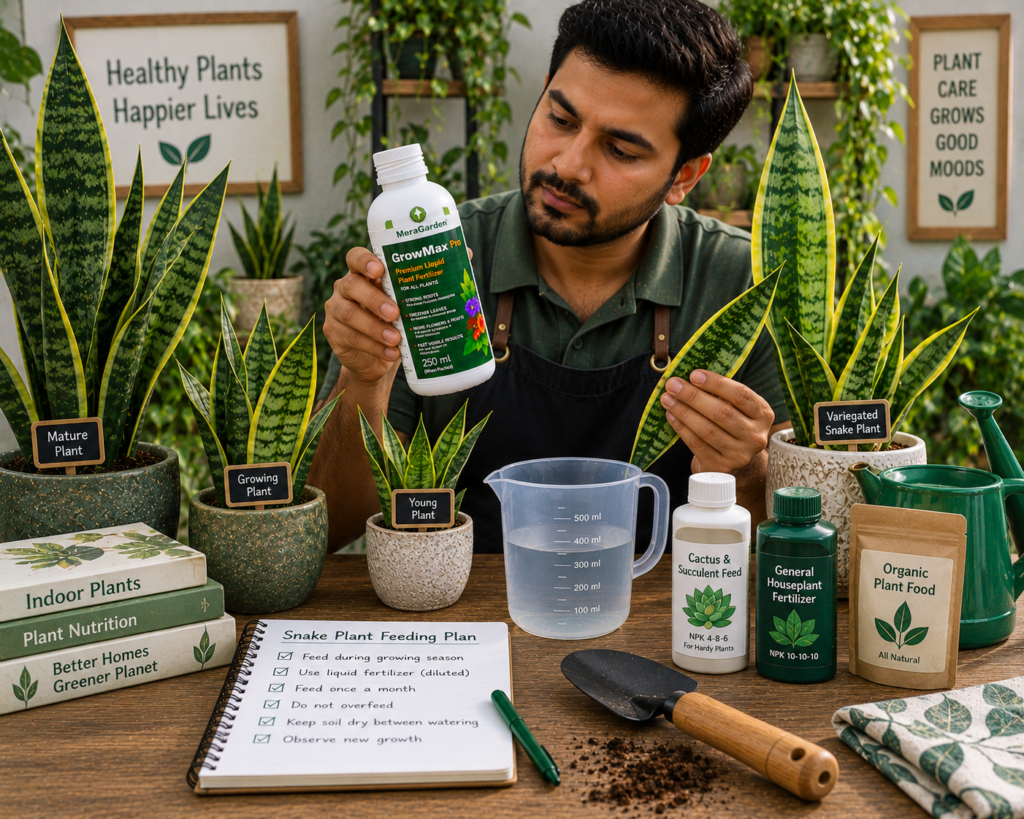
The RHS recommends feeding Sansevierias once a month through the growing season, listed as April to September in its growing guide.
However, gardeners in India should consider their own local conditions rather than treating those months as a universal rule.
Temperature, sunlight, indoor conditions and seasonal growth can differ significantly across India.
A snake plant kept indoors in a warm, bright location may continue growing differently from one kept in a darker room.
The important principle is simple:
Feed when the plant is actively growing and when additional nutrition is appropriate.
During periods of slow growth, particularly when light levels are low, unnecessary fertilizer can accumulate in the growing medium.
4. Helps Support Strong Overall Plant Development
A healthy snake plant needs more than nitrogen.
Plants require a range of nutrients, each performing different functions. Nitrogen is associated strongly with vegetative growth, while phosphorus and potassium are also important plant nutrients.
This is why a balanced fertilizer can be a practical choice rather than trying to provide one nutrient separately.
For container-grown plants, fertilization can sometimes be particularly useful because the plant has access to a limited quantity of growing medium.
The RHS notes that plants in containers, including houseplants, are among the plants that can benefit from feeding.
Still, fertilizer should be used according to the product’s instructions.
A common mistake is assuming:
More fertilizer = faster growth.
That is not a safe gardening rule.
Using too much fertilizer can increase the concentration of soluble salts around the roots and may stress the plant.
5. Liquid Fertilizer Can Be Convenient for Potted Snake Plants
If you grow snake plants indoors, liquid fertilizer can be convenient because it can be measured and diluted before application.
This is particularly useful when you have several different indoor plants with different feeding requirements.
A liquid fertilizer allows you to prepare the required solution rather than scattering fertilizer granules around a small indoor pot.
The RHS lists liquid, granular, pellet and powder fertilizers as different fertilizer forms and advises following the manufacturer’s instructions for application, timing and dosage.
For snake plants, this convenience is useful because they are generally slow-growing and do not need aggressive feeding.
A measured liquid feeding routine can help prevent random overapplication.
6. Helps Maintain Growth When Container Nutrients Decline
A snake plant can remain in the same pot for a considerable period.
The RHS notes that Sansevierias generally prefer a snug-fitting pot and only need repotting when roots and leaves have filled the existing container or the container is becoming distorted.
Because the plant may remain in the same growing medium for years, nutrient availability can change over time.
This is one reason feeding can be useful for container-grown snake plants.
However, fertilizer should not replace repotting when repotting is actually necessary.
If the pot has become badly rootbound, drainage has deteriorated or the growing medium has broken down, simply adding more fertilizer will not solve the underlying problem.
Good plant care combines:
Suitable pot + good drainage + appropriate watering + adequate light + sensible feeding.
7. Creates a Simple and Consistent Feeding Routine
One of the biggest advantages of using a suitable fertilizer is that it allows you to create a repeatable plant-care routine.
Instead of fertilizing whenever you remember, you can observe the plant and maintain a simple schedule based on active growth and the fertilizer label.
For example:
Check plant → Check soil → Confirm active growth → Measure fertilizer → Dilute correctly → Apply → Observe
This approach is much safer than randomly increasing fertilizer whenever the snake plant appears slow.
The RHS recommends feeding snake plants during the growing season and emphasizes careful fertilizer use.
Consistency is more valuable than excessive feeding.
Give Your Snake Plant a Better Feeding Routine
Looking for a convenient liquid fertilizer for your indoor plants?
MeraGarden GrowMax Pro is a concentrated liquid plant fertilizer labelled for all plants and can be incorporated into a sensible snake plant care routine.
Use it according to the instructions on the current product label.
How to Use Liquid Fertilizer for Snake Plant
Choosing the best fertilizer for snake plant is only one part of the process.
Correct application is equally important.
Snake plants store water in their fleshy leaves and are naturally drought-tolerant. The RHS recommends allowing the growing medium to dry out between waterings and warns that overwatering can lead to root rot.
Because of this, fertilizer should be used thoughtfully.
Step 1: Check Your Snake Plant Before Feeding
Before fertilizing, inspect the plant.
Look at the leaves and growing medium.
Check for:
- Healthy new growth
- Firm leaves
- Yellowing
- Brown or damaged tips
- Soft leaves
- Pest problems
- Wet or poorly draining soil
- Signs of root problems
If your plant is suffering from root rot or severe overwatering, fertilizer is not the first solution.
Correct the growing conditions first.
Step 2: Check the Soil Moisture
Do not make fertilizer application a substitute for proper watering.
Snake plants generally prefer the growing medium to dry between waterings.
Before feeding, check whether the soil is excessively dry or excessively wet.
The RHS general houseplant guidance also advises against applying fertilizer to dry soil because concentrated fertilizer can damage roots.
Follow the watering and feeding directions for your specific fertilizer.
Step 3: Measure the Fertilizer
Never guess the amount of concentrated liquid fertilizer by simply pouring it directly into the pot.
Use a suitable measuring container.
The correct amount depends on the specific fertilizer formulation and concentration.
Therefore, always follow the dosage instructions printed on the current MeraGarden GrowMax Pro label.
Do not copy a dosage from another fertilizer because two products can have very different concentrations.
Step 4: Dilute According to the Product Instructions
Once you have measured the required amount, dilute it with the recommended quantity of water.
Mix the solution properly before applying.
Do not make the solution stronger because you want faster results.
A concentrated fertilizer solution can increase the risk of root stress.
The RHS specifically advises following fertilizer product instructions for the correct dosage and application method.
Step 5: Apply Around the Growing Medium
Apply the properly diluted fertilizer to the growing medium according to the product instructions.
Avoid deliberately pouring concentrated fertilizer directly onto the leaves.
For indoor plants, apply carefully to prevent spills on floors, furniture or decorative surfaces.
If your fertilizer label provides specific application instructions, those instructions should take priority.
Step 6: Feed During Active Growth
Snake plants generally need less fertilizer than fast-growing foliage plants.
The RHS recommends feeding once a month during the growing season with a liquid houseplant fertilizer or specialist liquid cactus feed.
For Indian conditions, the actual active-growth period can vary depending on where the plant is kept.
A warm, well-lit indoor plant may remain active for longer than a plant kept in a cooler or darker location.
Always combine the plant’s growth stage with the fertilizer manufacturer’s instructions.
Step 7: Observe Before Feeding Again
After feeding, don’t immediately assume that more fertilizer is required.
Observe the plant over time.
Look for:
- New leaves
- Healthy foliage
- Firm leaf structure
- Normal growth
- Signs of fertilizer stress
- Brown leaf tips
- Unusual leaf changes
- White mineral or salt buildup on the growing medium
If the plant is growing well, there is no reason to increase fertilizer simply because you want faster results.
Important Mistakes to Avoid
Mistake 1: Overfertilizing
More fertilizer is not always better.
Snake plants are slow-growing and relatively low-maintenance, so excessive feeding is unnecessary.
Mistake 2: Fertilizing Every Time You Water
A regular watering schedule does not automatically mean fertilizer should be added every time.
Follow the fertilizer label.
Mistake 3: Feeding a Severely Stressed Plant
If the plant has root rot, severe overwatering or another major problem, identify and correct the cause first.
Mistake 4: Using a Random Dosage
Different fertilizers have different concentrations.
Always use the dosage recommended for that specific product.
Mistake 5: Ignoring Light
Snake plants tolerate lower light, but the RHS notes that brighter locations generally encourage better growth.
If your snake plant is receiving extremely little light, adding more fertilizer may not solve slow growth.

Liquid Fertilizer vs Granular Fertilizer vs Organic Fertilizer for Snake Plant
When choosing the best fertilizer for snake plant, gardeners often wonder whether liquid, granular or organic fertilizer is better.
There is no single format that is automatically best for every gardener.
The right choice depends on your plant, growing medium, feeding habits and the instructions supplied with the fertilizer.
| Fertilizer Type | Main Advantage | Important Consideration |
|---|---|---|
| Liquid fertilizer | Easy to measure and dilute | Correct dilution is important |
| Granular fertilizer | Can provide longer-lasting feeding depending on formulation | Must be applied carefully |
| Slow-release fertilizer | Convenient and reduces frequent feeding | Follow product-specific instructions |
| Organic fertilizer | Can be part of a broader soil-care approach | Nutrient release and indoor odour can vary |
For many indoor gardeners, liquid fertilizer is convenient because the product can be measured and diluted before application.
The RHS also explains that liquid fertilizers can be used for houseplants, while granular fertilizers may be applied less frequently depending on the product.
For a snake plant, convenience and controlled application are particularly useful because the plant generally does not require heavy feeding.
MeraGarden GrowMax Pro for Snake Plant
If you are searching for a liquid fertilizer for snake plant, MeraGarden GrowMax Pro can be considered as part of your regular indoor plant-care routine.
GrowMax Pro is a concentrated liquid plant fertilizer and its packaging states that it is suitable for all plants.
Its liquid format makes it convenient for gardeners who prefer measuring and diluting fertilizer before applying it.
Why GrowMax Pro Can Be Convenient
1. Liquid Format
A liquid fertilizer can be measured and diluted before application, which makes it practical for container-grown indoor plants.
2. Suitable for All Plants
GrowMax Pro is labelled as a liquid plant fertilizer for all plants, making it useful for gardeners who have several different types of plants at home.
3. Easy to Include in a Plant-Care Routine
A planned feeding routine can help you avoid random or excessive fertilizer applications.
4. Convenient for Indoor Gardening
Snake plants are commonly grown in pots indoors. A liquid fertilizer format can be convenient for this type of gardening.
5. Useful for Different Indoor Plants
If you also grow money plants, peace lilies, roses in containers or other decorative plants, a fertilizer labelled for all plants can be convenient to keep as part of your gardening supplies.
However, remember that fertilizer is only one part of plant care.
Your snake plant still needs:
- Suitable light
- Good drainage
- Appropriate watering
- A suitable growing medium
- Correct pot size
- Pest monitoring
- Sensible fertilization
Important: Follow the GrowMax Pro Label
Do not use a guessed dosage.
The correct GrowMax Pro dilution and application rate should always be taken from the current product packaging instructions.
Fertilizer concentrations differ between products, so a dosage recommended for another fertilizer should not automatically be used for GrowMax Pro.
The RHS likewise recommends following the manufacturer’s instructions for fertilizer timing, dosage and application.
Help Your Snake Plant Grow Better
Give your indoor plants a simple and controlled nutrition routine with MeraGarden GrowMax Pro.
Grow Better. Bloom Bigger.
Conclusion
Finding the best fertilizer for snake plant does not mean searching for the strongest fertilizer or feeding your plant as frequently as possible.
Snake plants are naturally resilient and relatively low-maintenance. Their fleshy leaves allow them to tolerate periods of dryness, while their roots can be damaged by excessive moisture.
For this reason, successful snake plant care is about balance.
A suitable fertilizer can support healthy growth when the plant is actively growing and needs additional nutrients. Liquid fertilizer can be especially convenient because it can be measured and diluted before application.
Remember these seven important points:
- Support healthy green leaf growth.
- Maintain attractive foliage.
- Support new growth during the active season.
- Provide appropriate overall nutrition.
- Use liquid fertilizer carefully for convenient feeding.
- Replace depleted container nutrients when appropriate.
- Build a consistent feeding routine instead of overfertilizing.
Most importantly, don’t assume that yellow leaves, slow growth or damaged foliage always mean your snake plant needs more fertilizer.
Check the light, watering, drainage, potting medium and root condition first.
Once the basic growing conditions are right, sensible fertilization can become a useful part of your snake plant care routine.
Frequently Asked Questions About the Best Fertilizer for Snake Plant
1. What is the best fertilizer for snake plant?
A suitable liquid houseplant fertilizer can be a convenient choice for snake plants. The RHS recommends feeding Sansevierias once a month during the growing season with a liquid houseplant fertilizer or specialist liquid cactus feed.
Always follow the instructions of the fertilizer you are using.
2. Is liquid fertilizer good for snake plants?
Yes. Liquid fertilizer can be convenient for snake plants because it can be measured and diluted before application.
The RHS specifically recommends liquid houseplant fertilizer for Sansevierias during their growing season.
3. How often should I fertilize a snake plant?
The RHS recommends feeding snake plants once a month during the growing season.
However, always consider the instructions on your particular fertilizer because formulations and recommended dosages vary.
4. Can I use GrowMax Pro on snake plants?
GrowMax Pro is labelled as a liquid plant fertilizer suitable for all plants, so it can be considered for snake plant care.
Use the dosage and dilution instructions printed on the current product label.
5. Can too much fertilizer damage a snake plant?
Yes. Excess fertilizer can create an overly concentrated root-zone environment and may cause plant stress.
Snake plants are not heavy feeders, so increasing the fertilizer concentration is not a good way to force faster growth.
6. Why is my snake plant growing very slowly?
Slow growth can be normal because snake plants are relatively slow-growing.
However, insufficient light, poor drainage, root problems, unsuitable temperatures or other growing conditions can also affect growth.
The RHS notes that snake plants generally grow better in brighter locations, although they tolerate lower light.
7. Should I fertilize a newly repotted snake plant?
Avoid unnecessary immediate fertilization unless the instructions for your fertilizer or growing medium specifically recommend it.
Allow the plant to settle and follow the appropriate care instructions.
8. Should snake plants be fertilized in winter?
Snake plants generally require less feeding when growth slows.
The RHS recommends feeding during the growing season, while general RHS houseplant guidance advises limiting winter feeding because lower light can reduce active growth.
9. Can fertilizer make a snake plant grow faster?
Fertilizer can support growth when nutrients are limiting, but it cannot overcome poor light, overwatering, root problems or unsuitable growing conditions.
Snake plants are naturally relatively slow-growing.
10. What is more important for a snake plant: fertilizer or watering?
Both matter, but correct watering is especially important because snake plants are drought-tolerant and prone to problems from excessive moisture.
The RHS recommends allowing the growing medium to dry out between waterings.
11. Can I use fertilizer every time I water my snake plant?
Do not automatically add fertilizer every time you water.
Follow the fertilizer’s recommended frequency and dilution instructions. Overfeeding can be more harmful than occasional underfeeding.
12. Does snake plant fertilizer help with flowering?
Snake plants are primarily grown for their foliage, although mature plants can occasionally produce fragrant flowers.
Good overall plant health and appropriate growing conditions are more important than simply increasing fertilizer.
Must Read
- How Often Should You Fertilize Plants? 7 Easy Rules for Healthy Growth
- How Often Should You Fertilize Plants? Complete Fertilizer Schedule
- What Is NPK Fertilizer? 7 Easy Tips for Healthy Plants
- Best Liquid Fertilizer for Plants: Complete Guide for Home Gardeners
- How to Use Liquid Fertilizer for Plants: 7 Easy Steps for Better Growth
- Best Organic Fertilizers for Plants: 7 Natural Options for Healthy Growth
- Best Fertilizer for Indoor Plants in India: 7 Easy Tips for Healthy Growth
- Best Fertilizer for Flowering Plants in India: 7 Top Options
- Best Fertilizer for Plants: 7 Smart Tips to Avoid Common Mistakes
- 5 Signs Your Plants May Need Fertilizer
- How Much Liquid Fertilizer Should You Use for Plants?
- 7 Benefits of Liquid Fertilizer for Plants: Grow Healthier Plants Faster
- 7 Benefits of Liquid Fertilizer for Plants: A Simple Guide for Healthy Growth
- Best Fertilizer for Peace Lily: 7 Powerful Tips for Beautiful Blooms and Avoiding Common Mistakes
- Best Fertilizer for Spider Plant: 7 Powerful Tips for Lush Growth and Avoiding Common Mistakes
- Liquid Fertilizer vs Granular Fertilizer: Which Is Better? 7 Key Differences for Home Gardeners
- Liquid Fertilizer vs Organic Fertilizer: 7 Powerful Pros, Cons & the Best Choice for Your Plants
- How to Choose the Right Fertilizer for Your Plants: 7 Smart Tips to Avoid Common Mistakes
- 5 Positive Signs Your Plants Need Fertilizer — Avoid These Warning Symptoms for Healthier Growth
- How to Grow Peace Lilies
- How To Grow Houseplants