Choosing the right fertilizer for your plants can feel confusing, especially when garden stores and online marketplaces offer so many different options. Liquid fertilizers, granular fertilizers, organic fertilizers, NPK fertilizers, plant food, flowering fertilizers and specialized products can all look similar at first.
But the best fertilizer for plants is not necessarily the most expensive product or the one with the biggest claims on the label. The right choice depends on your plant, growing medium, nutrient requirements, growth stage and how you plan to apply the fertilizer.
A tomato plant, flowering rose, money plant and young seedling may not have exactly the same nutritional needs. Similarly, plants growing in containers can have different fertilizer requirements from plants growing directly in garden soil.
Understanding a few basic principles can make fertilizer selection much easier.
In this guide, we will cover 7 smart tips for choosing the right fertilizer, explain what to look for on a fertilizer label, discuss liquid and granular options, and explain how a product such as MeraGarden GrowMax Pro can fit into a practical home-gardening routine.
The goal is simple: choose fertilizer more confidently while avoiding common application mistakes.
Table of Contents
1. Identify Your Plant Before Choosing Fertilizer
The first and most important step is to identify the plant you want to feed.
Different plants have different growth habits and nutritional requirements. A fertilizer that works well as part of a vegetable-garden routine may not necessarily be the ideal choice for every indoor plant or flowering plant.
Before buying a fertilizer, ask yourself:
- What type of plant am I growing?
- Is it a vegetable, flower, herb, fruit plant or indoor plant?
- Is it young or mature?
- Is it actively growing?
- Is it flowering or producing fruit?
- Is it planted in soil or a container?
- Does the plant show any signs of nutrient deficiency?
For example, a home gardener may grow tomatoes, chillies, cucumbers, leafy vegetables, roses and indoor foliage plants at the same time.
Instead of assuming that every plant needs the same fertilizer, consider the requirements of each group.
Vegetable plants
Vegetables need adequate nutrition throughout their growth cycle. The nutritional requirements can change as plants develop leaves, flowers and fruits.
Flowering plants
Flowering plants need appropriate nutrition to support healthy vegetative growth and flowering. However, simply adding more fertilizer does not automatically produce more flowers.
Indoor plants
Indoor plants often grow in containers with limited growing media. Their fertilizer routine should take into account the size of the pot, growing medium, light level and watering pattern.
Young plants
Seedlings and young plants can be more sensitive to excessive fertilizer. A stronger fertilizer solution is not necessarily better for them.
The first rule is therefore simple: identify the plant before selecting the fertilizer.
2. Understand NPK Before Buying a Fertilizer
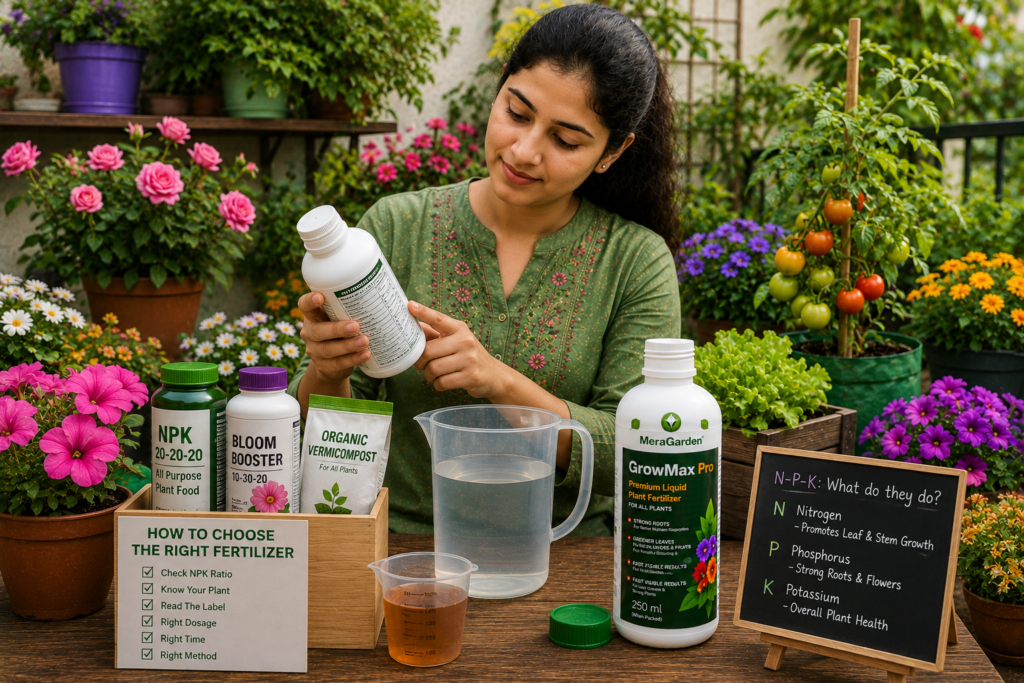
One of the most useful things a gardener can learn is how to read an NPK label.
NPK represents three major plant nutrients:
- N = Nitrogen
- P = Phosphorus
- K = Potassium
These nutrients perform different functions in plants.
Nitrogen
Nitrogen is strongly associated with vegetative growth and the development of green plant tissues.
It is particularly important for healthy leaf and stem development.
However, excessive nitrogen is not necessarily beneficial. Too much nitrogen can encourage excessive vegetative growth and may not be appropriate when a plant’s primary goal is flowering or fruit production.
Phosphorus
Phosphorus plays important roles in plant energy processes and root development and is involved in reproductive growth.
However, gardeners should not automatically add high-phosphorus fertilizer simply because they want more flowers or fruit. The correct nutrient balance depends on the plant and growing conditions.
Potassium
Potassium supports several important physiological processes in plants and contributes to overall plant health and stress responses.
Understanding these three letters makes it easier to compare fertilizer products.
For example, if you see an NPK ratio such as 10-10-10, the three numbers represent the relative analysis of nitrogen, phosphate and potash in the fertilizer.
The important point is not simply to find the highest number.
Choose the fertilizer based on your plant’s requirements rather than assuming a stronger NPK number means better results.
3. Choose the Right Fertilizer Form for Your Gardening Routine
Fertilizer comes in different forms, and each can have practical advantages.
The most common options include:
- Liquid fertilizer
- Granular fertilizer
- Powdered fertilizer
- Slow-release fertilizer
- Organic amendments
The right form depends partly on how you prefer to maintain your garden.
Liquid fertilizer
Liquid fertilizer is generally diluted with water according to the manufacturer’s instructions.
For home gardeners, one advantage is the ability to measure a specific quantity and prepare a fertilizer solution for application.
Liquid fertilizers can be particularly convenient for:
- Balcony plants
- Potted plants
- Indoor plants
- Flowering plants
- Vegetable gardens
- Container gardens
Granular fertilizer
Granular fertilizers are applied to the growing medium according to product instructions.
They can be convenient for gardeners who prefer dry fertilizer applications.
However, the application rate must be followed carefully. Simply adding more granules because a plant appears weak is not a good strategy.
Organic fertilizers
Organic fertilizers can come in different forms, including liquid and solid products.
Therefore, liquid and organic are not opposites. An organic fertilizer can be liquid, and a liquid fertilizer does not automatically mean it is organic.
When choosing an organic product, look at the actual ingredients, nutrient analysis and product claims.
4. Consider the Growing Medium and Pot Size
The same fertilizer routine does not necessarily work for every growing environment.
Container plants have limited space for roots and growing media. Outdoor garden soil may have a much larger nutrient reservoir.
This is why pot size and growing medium should be considered when planning fertilizer applications.
For example, a small indoor plant in a compact pot should not automatically receive the same amount of fertilizer as a large outdoor vegetable plant.
Consider:
Pot size
A small pot contains less growing medium than a large container.
Drainage
Poor drainage can cause root problems regardless of how good the fertilizer is.
Soil or growing medium
Different growing media have different nutrient-holding characteristics.
Watering
Frequent watering can influence nutrient availability and movement through the growing medium.
Plant growth
A rapidly growing plant may have different nutritional requirements from a dormant or slow-growing plant.
These factors should be considered alongside the fertilizer label.
5. Choose Fertilizer According to the Plant’s Growth Stage
A plant’s nutritional requirements can change during its life cycle.
A young plant is not necessarily managed in exactly the same way as a mature flowering or fruiting plant.
A simplified growth cycle can include:
Seed → Seedling → Vegetative growth → Flowering → Fruiting → Maturity
During vegetative growth, plants are developing leaves, stems and roots.
During flowering and fruit production, nutritional requirements can change.
This does not mean you need a different fertilizer every few weeks. Instead, it means you should understand what the fertilizer provides and whether it is appropriate for the plant’s current stage.
For example, if you are growing tomatoes, you may consider the plant’s needs during:
- Early establishment
- Vegetative growth
- Flowering
- Fruit development
Always use the fertilizer according to its instructions rather than creating an excessively strong mixture.
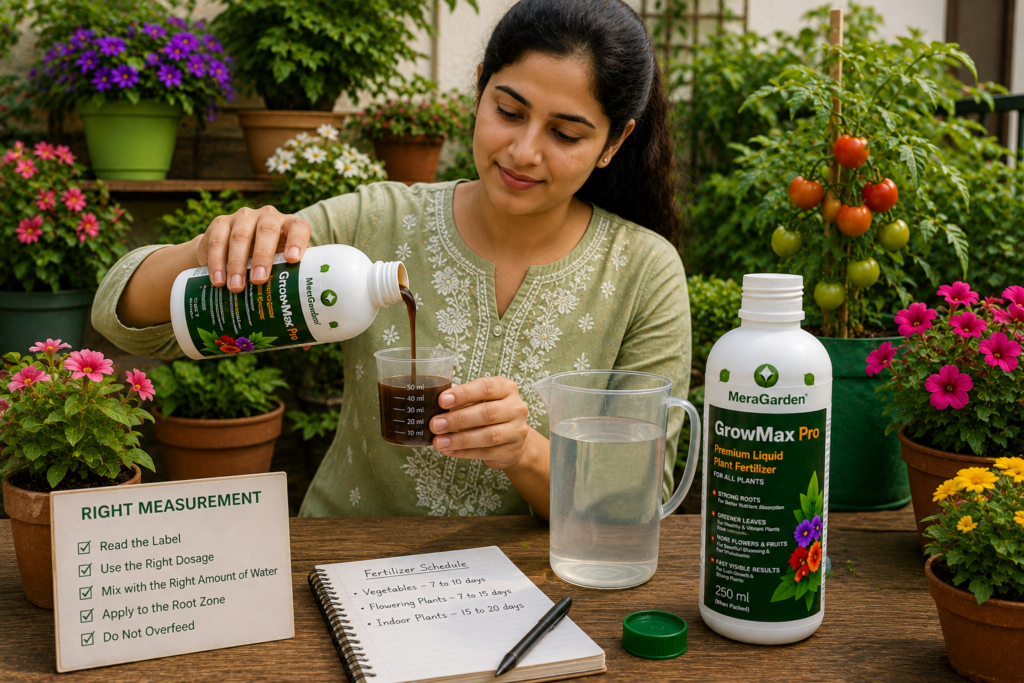
6. Always Read the Fertilizer Label and Dosage
One of the most common fertilizer mistakes is ignoring the recommended dosage.
Gardeners sometimes believe that applying more fertilizer will make plants grow faster.
That is not a safe assumption.
Fertilizer should be treated as a nutrient input, not as a growth shortcut.
Before using any fertilizer, check:
- Recommended dosage
- Dilution instructions
- Application frequency
- Suitable plants
- Application method
- Storage instructions
- Safety precautions
- Nutrient analysis
If the product is concentrated, measuring the correct amount becomes particularly important.
For a liquid fertilizer, use an appropriate measuring container rather than estimating the quantity by eye.
For granular fertilizer, use the recommended application rate rather than scattering an excessive amount around the plant.
Why over-fertilizing can be a problem
Excess fertilizer can contribute to excessive salt accumulation in the growing medium and can potentially damage plant roots.
Symptoms associated with fertilizer problems can include:
- Leaf-tip burn
- Browning leaf margins
- Wilting
- Poor growth
- Salt buildup on soil surfaces
- Root stress
If you are uncertain, follow the product label rather than increasing the dose yourself.
7. Avoid Choosing Fertilizer Based Only on Marketing Claims
Packaging can make fertilizer selection confusing.
You may see phrases such as:
- Fast growth
- More flowers
- Strong roots
- Healthy leaves
- Premium plant food
- Complete nutrition
- Natural fertilizer
These phrases can be useful for understanding what the manufacturer intends the product to do, but they should not replace checking the actual product information.
Look for measurable information such as:
- NPK analysis
- Nutrient sources
- Application instructions
- Suitable plants
- Recommended dosage
- Manufacturer information
This approach allows you to make a more informed decision.
The best fertilizer is not necessarily the one with the most impressive-looking packaging.
The best fertilizer is the one that matches your plant’s needs and can be applied correctly.
Choose the Right Fertilizer for Your Garden
Looking for a convenient liquid fertilizer for your home garden?
Explore MeraGarden GrowMax Pro, check the product specifications and follow the recommended dosage for your plants.
How to Use Fertilizer Correctly
Once you have selected the right fertilizer, correct application becomes the next priority.
Here is a simple process for using a concentrated liquid fertilizer.
Step 1: Check the Plant
Make sure the plant is generally healthy and identify whether it is actively growing.
If the plant is severely stressed because of drought, waterlogging, pests or disease, fertilizer may not solve the underlying problem.
Step 2: Read the Product Instructions
Before preparing MeraGarden GrowMax Pro, read the current product label carefully.
Use the manufacturer’s recommended dilution and frequency.
Step 3: Measure the Correct Quantity
Use a measuring cup or other suitable measuring container.
Avoid guessing the quantity.
Step 4: Add Water
Add the measured fertilizer to the recommended amount of water.
Mix according to the product instructions.
Step 5: Apply Correctly
Apply the diluted solution according to the manufacturer’s recommended method.
For soil application, distribute it around the root zone rather than deliberately concentrating it against the stem.
Step 6: Don’t Overfeed
More fertilizer does not automatically mean faster or healthier growth.
Stick to the recommended dosage.
Step 7: Maintain Other Plant-Care Practices
Fertilizer cannot compensate for:
- Insufficient light
- Poor drainage
- Incorrect watering
- Compacted soil
- Pest infestations
- Serious disease
- Unsuitable temperatures
Healthy plants need a complete care routine.
Liquid Fertilizer vs Granular Fertilizer vs Organic Fertilizer
Once you understand the basics, it becomes easier to compare the major fertilizer options.
| Feature | Liquid Fertilizer | Granular Fertilizer | Organic Fertilizer |
|---|---|---|---|
| Physical form | Liquid | Dry granules | Liquid or solid |
| Measurement | Usually easy to measure before dilution | Measured by weight/volume or label instructions | Depends on product |
| Application | Usually diluted or applied as directed | Applied to soil/media | Depends on product |
| Convenience | High for many container gardeners | Convenient for dry applications | Varies |
| Nutrient source | Depends on formulation | Depends on formulation | Generally naturally derived sources |
| Suitable plants | Depends on product | Depends on product | Depends on product |
| Soil improvement | Depends on formulation | Depends on formulation | Some products/amendments can contribute organic matter |
| Best selection method | Match nutrients to plant needs | Match nutrients and application rate | Check ingredients, analysis and certification where relevant |
This comparison highlights an important point:
There is no universally superior fertilizer type.
Your decision should be based on the plant, nutrient requirements, growing environment and application method.
Why Consider MeraGarden GrowMax Pro?
For gardeners who prefer a convenient liquid format, MeraGarden GrowMax Pro can be considered as part of a regular home-garden fertilizer routine.
A concentrated liquid fertilizer can make measuring and dilution straightforward when the manufacturer’s instructions are followed.
This can be useful when you are managing several types of plants, such as:
- Vegetable plants
- Flowering plants
- Potted plants
- Indoor plants
- Balcony plants
- Terrace gardens
- Home gardens
One practical advantage of a liquid product is that the gardener can measure the required quantity before mixing it with water.
However, GrowMax Pro should be used according to the product’s label instructions. The correct dosage depends on the actual product formulation and recommended application method.
Do not increase the concentration simply because a plant appears to be growing slowly.
Instead, check other possible causes such as:
- Lack of sunlight
- Poor soil
- Incorrect watering
- Poor drainage
- Pest problems
- Temperature stress
- Root-bound conditions
Fertilizer is only one part of successful gardening.
Make Fertilizer Application Simple
If you want a convenient liquid fertilizer option for your home garden, take a closer look at MeraGarden GrowMax Pro and use it according to the manufacturer’s recommended instructions.
Conclusion
Learning how to choose the right fertilizer for your plants does not have to be complicated.
Start by identifying the plant and understanding its growing conditions. Then check the fertilizer’s NPK analysis, nutrient sources, application method and recommended dosage.
Remember these seven key tips:
- Identify your plant before choosing fertilizer.
- Understand NPK.
- Choose a fertilizer form that suits your routine.
- Consider the growing medium and pot size.
- Match feeding to the plant’s growth stage.
- Follow the dosage and label instructions carefully.
- Look beyond marketing claims and check actual product information.
For home gardeners who prefer liquid products, MeraGarden GrowMax Pro can be incorporated into a regular plant-care routine when used according to its product instructions.
The goal should not be to use the maximum amount of fertilizer. The goal is to provide appropriate nutrition while maintaining good soil, watering, light and general plant-care practices.
Choose wisely, measure carefully and keep your plant’s actual needs at the center of your fertilizer routine.
FAQs
1. How do I choose the right fertilizer for my plants?
Start by identifying the plant, its growth stage and growing environment. Then check the fertilizer’s NPK ratio, nutrient sources, recommended dosage and suitable plant types.
2. What does NPK mean on fertilizer?
NPK stands for nitrogen (N), phosphorus (P) and potassium (K). These are three major nutrients involved in different aspects of plant growth and development.
3. Is liquid fertilizer better than granular fertilizer?
Neither is automatically better. Liquid fertilizer can be convenient for measuring and dilution, while granular fertilizer can be convenient for dry soil applications. The appropriate choice depends on your plants and gardening routine.
4. Can I use the same fertilizer for all plants?
Not always. Some fertilizers are designed for general plant feeding, while others are formulated for particular plants or purposes. Always check the product label before using it.
5. Can too much fertilizer harm plants?
Yes. Excess fertilizer can contribute to salt accumulation and root stress and may cause symptoms such as leaf-tip burn. Follow the recommended dosage.
6. What fertilizer is best for flowering plants?
Choose a fertilizer that is appropriate for flowering plants and matches their nutritional requirements. Do not assume that simply using a high-phosphorus product will automatically produce more flowers.
7. What fertilizer should I use for vegetable plants?
Use a fertilizer that is labeled as suitable for vegetables and follow its recommended dosage. Nutritional needs can vary between leafy vegetables, fruiting vegetables and different growth stages.
8. Is liquid fertilizer good for indoor plants?
Liquid fertilizer can be convenient for indoor plants because it can be measured and diluted before application. However, the product must be suitable for the plant and used according to its instructions.
9. How often should I fertilize my plants?
There is no single schedule for every fertilizer and plant. Follow the product manufacturer’s recommended frequency and consider the plant’s growth stage and growing conditions.
10. Can I use MeraGarden GrowMax Pro on vegetables and flowers?
Check the current MeraGarden GrowMax Pro product label for its listed suitable plants and application instructions. Use the recommended dilution and frequency rather than applying a stronger mixture.
11. Should I fertilize a sick plant?
Fertilizer does not treat every plant problem. First determine whether the problem is caused by watering, light, pests, disease, poor drainage or another issue. Fertilize only according to the product instructions.
12. Is organic fertilizer always better?
Not necessarily. Organic and non-organic fertilizers can both have useful applications. The best choice depends on the plant’s nutritional requirements, your gardening goals and the product’s formulation.
Recommended Links
- How Often Should You Fertilize Plants? 7 Easy Rules for Healthy Growth
- How Often Should You Fertilize Plants? Complete Fertilizer Schedule
- What Is NPK Fertilizer? 7 Easy Tips for Healthy Plants
- Best Liquid Fertilizer for Plants: Complete Guide for Home Gardeners
- How to Use Liquid Fertilizer for Plants: 7 Easy Steps for Better Growth
- Best Organic Fertilizers for Plants: 7 Natural Options for Healthy Growth
- Best Fertilizer for Indoor Plants in India: 7 Easy Tips for Healthy Growth
- Best Fertilizer for Flowering Plants in India: 7 Top Options
- Best Fertilizer for Plants: 7 Smart Tips to Avoid Common Mistakes
- 5 Signs Your Plants May Need Fertilizer
- How Much Liquid Fertilizer Should You Use for Plants?
- 7 Benefits of Liquid Fertilizer for Plants: Grow Healthier Plants Faster
- 7 Benefits of Liquid Fertilizer for Plants: A Simple Guide for Healthy Growth
- Best Fertilizer for Peace Lily: 7 Powerful Tips for Beautiful Blooms and Avoiding Common Mistakes
- Best Fertilizer for Spider Plant: 7 Powerful Tips for Lush Growth and Avoiding Common Mistakes
- Liquid Fertilizer vs Granular Fertilizer: Which Is Better? 7 Key Differences for Home Gardeners
- Liquid Fertilizer vs Organic Fertilizer: 7 Powerful Pros, Cons & the Best Choice for Your Plants
- How to Choose the Right Fertilizer for Your Plants: 7 Smart Tips to Avoid Common Mistakes
- 5 Positive Signs Your Plants Need Fertilizer — Avoid These Warning Symptoms for Healthier Growth
- How to Grow Peace Lilies
- How To Grow Houseplants