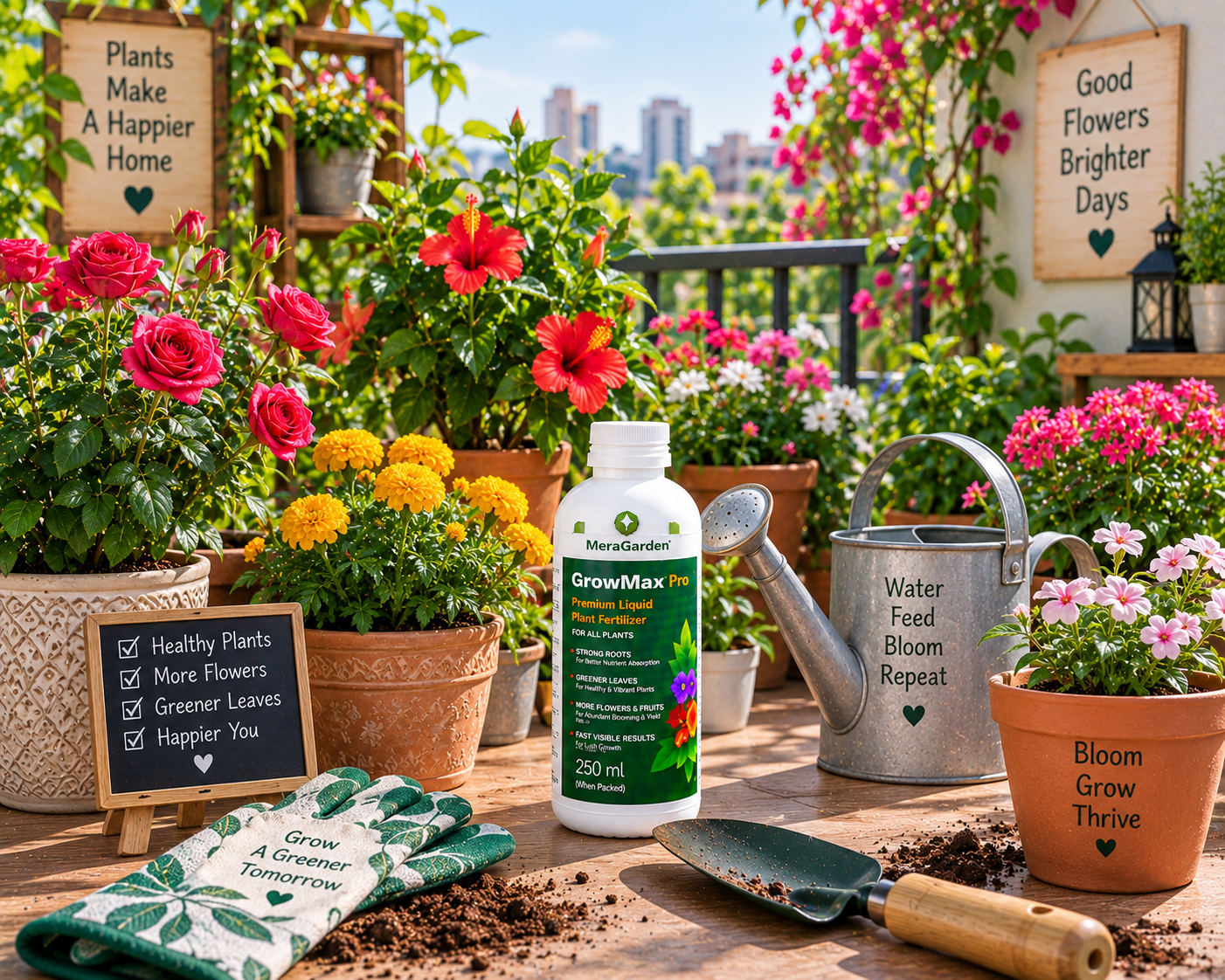
Flowering plants can transform a balcony, terrace, windowsill or small home garden into a colourful and attractive space. From roses and hibiscus to petunias, marigolds, chrysanthemums and other seasonal flowers, growing plants in pots is a practical choice when garden space is limited.
However, flowering plants grown in containers have different nutritional needs from plants growing freely in the ground.
A pot has limited space for roots, and the growing medium contains a finite supply of nutrients. Regular watering can also gradually reduce available nutrients. The RHS notes that container plants often benefit from feeding because their restricted root space makes them less self-sufficient.
This is why choosing the best fertilizer for flowering plants in pots can make an important difference to a well-managed container garden.
But there is an important point to understand:
More fertilizer does not automatically mean more flowers.
Flower production depends on several factors, including the plant variety, sunlight, watering, temperature, potting mix, root health and nutrition. Fertilizer is only one part of the overall growing environment.
When choosing fertilizer for flowering plants, pay attention to the nutrients supplied by the product. Nitrogen generally supports vegetative growth, while phosphorus and potassium have important roles in flowering and fruiting. The RHS specifically notes that flowering plants should generally have fertilizer higher in phosphorus and potassium compared with fertilizers intended primarily for foliage plants.
Liquid fertilizer can be particularly convenient for potted plants because it can be diluted and applied through watering. The RHS describes liquid fertilizers as generally fast-acting and particularly useful for container plants.
In this guide, we’ll look at seven practical tips for choosing and using fertilizer for flowering plants in pots while avoiding common mistakes.
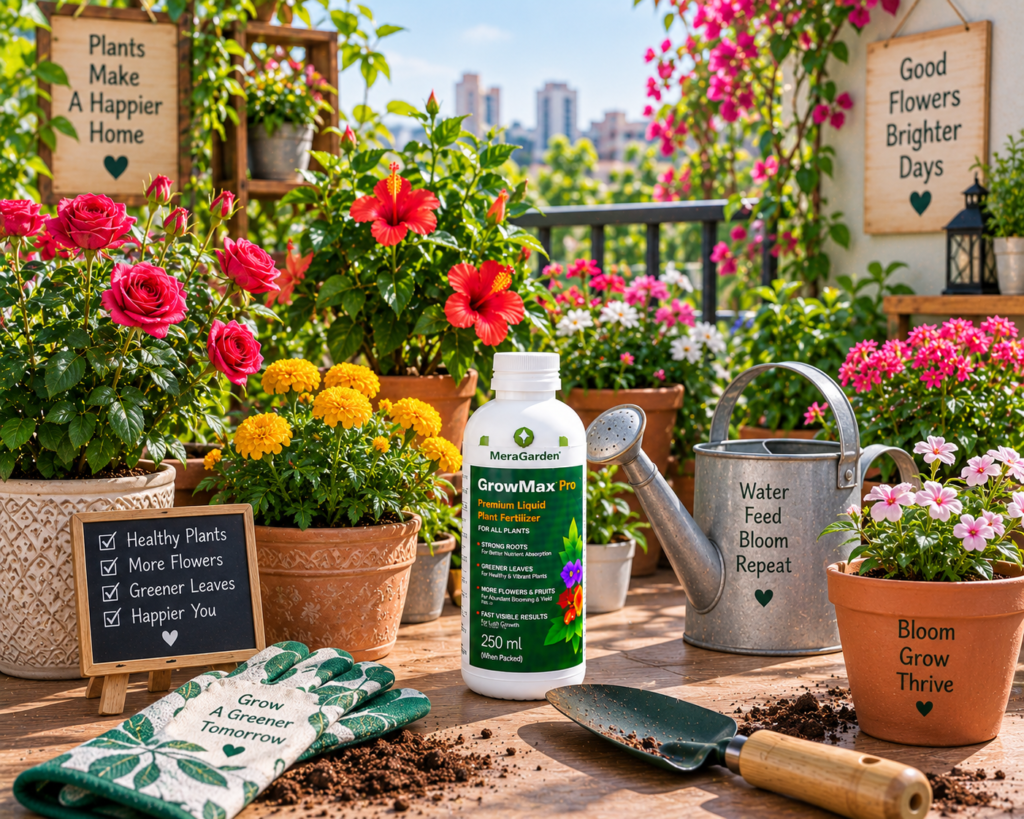
Table of Contents
1. Choose a Fertilizer That Supports Flowering and Overall Growth
The first step in finding the best fertilizer for flowering plants in pots is understanding what your plants actually need.
Plants require several nutrients, but nitrogen (N), phosphorus (P) and potassium (K) are among the main nutrients represented on fertilizer labels.
Each has a different role.
Nitrogen
Nitrogen is strongly associated with leafy and vegetative growth.
A fertilizer that is heavily focused on nitrogen may encourage lush foliage, but flowering plants also need appropriate amounts of other nutrients during their growth and flowering stages.
Phosphorus
Phosphorus plays an important role in plant development and is associated with flowering and fruiting.
Potassium
Potassium supports several plant processes and is particularly associated with flowering, fruiting and overall plant strength.
This does not mean that you should automatically choose the fertilizer with the highest phosphorus or potassium number.
Instead, consider the plant species, its growth stage and the fertilizer manufacturer’s recommendations.
For example, a young plant establishing foliage may have different nutritional priorities from a mature plant actively producing flowers.
The best fertilizer is not necessarily the strongest fertilizer. It is the fertilizer that suits the plant and is used correctly.
2. Give Potted Flowering Plants the Nutrition They Need
Container gardening is convenient, but pots have a major limitation: restricted root space.
A plant growing in the ground can potentially explore a much larger volume of soil. A plant growing in a pot has access only to the growing medium inside that container.
Over time, nutrients can become depleted.
The RHS explains that plants grown in containers can use up nutrients in their compost and therefore often benefit from occasional feeding.
This is particularly relevant for flowering plants because producing new stems, leaves and flowers requires resources.
However, don’t interpret this as a reason to fertilize every few days.
Instead, build a sensible feeding routine around:
- The plant species
- The size of the pot
- The potting medium
- The plant’s growth stage
- The season
- The amount of sunlight
- The fertilizer label
If your flowering plant is already growing strongly in fresh, nutrient-rich potting mix, additional fertilizer may not be immediately necessary.
The goal is to maintain appropriate nutrition, not continuously add nutrients.
3. Feed During Active Growth
Timing is an important part of successful fertilizing.
Plants generally make better use of nutrients when they are actively growing. The RHS recommends feeding houseplants primarily during their growing season and reducing feeding when low light limits active growth.
For outdoor flowering plants in India, the exact growing and flowering period varies significantly depending on the species and local climate.
For example:
- Some annual flowers grow quickly during a particular season.
- Hibiscus can grow and flower over long periods in suitable warm conditions.
- Roses may have different growth and flowering cycles depending on climate.
- Seasonal balcony flowers may slow down during extreme heat.
- Plants may also reduce growth during periods of stress.
Therefore, don’t blindly follow a fertilizer calendar designed for a different climate or plant.
Instead, look for active growth.
Signs can include:
- New leaves
- New shoots
- Developing flower buds
- Active stem growth
- Healthy foliage
When the plant is actively growing, appropriate feeding can become more useful.
During periods of very slow growth, heavy stress or poor light, increasing fertilizer is usually not the right solution.
4. Don’t Apply Fertilizer to Completely Dry Soil
This is one of the most important rules when using liquid fertilizer.
Never assume that fertilizer should be poured onto completely dry potting soil simply because the plant looks thirsty.
The RHS advises that fertilizer should not be applied to dry soil because this can burn plant roots.
Instead, check the condition of the potting mix before feeding.
If the soil is extremely dry, address the watering requirement first according to the needs of the particular plant.
At the same time, avoid the opposite mistake: keeping the pot permanently waterlogged.
Good drainage is essential for container gardening. The RHS recommends drainage holes in the base of containers and warns that waterlogged growing media can lead to root problems.
A healthy feeding routine therefore begins with healthy roots.
Think of the sequence as:
Healthy roots → appropriate moisture → correct fertilizer → balanced growth.
Fertilizer cannot compensate for poor drainage or incorrect watering.
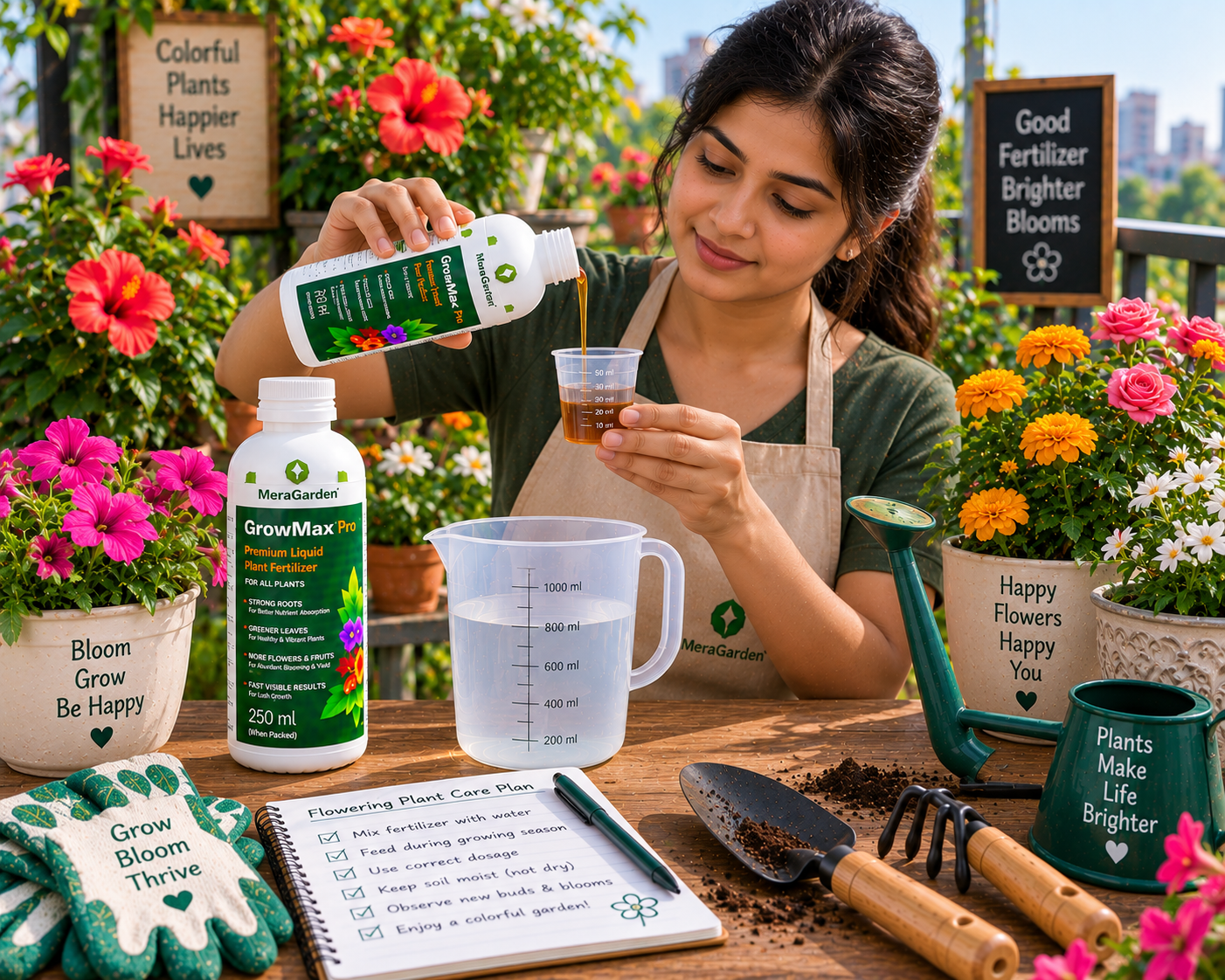
5. Liquid Fertilizer Is Convenient for Flower Pots
If you have several flowering plants in containers, liquid fertilizer can be an easy option.
Liquid fertilizer is mixed with water and applied to the growing medium. The RHS describes liquid fertilizers as generally fast acting and particularly suitable for container plants.
This makes liquid fertilizer convenient for home gardeners because it allows them to:
- Measure the required amount
- Dilute it with water
- Apply it directly to the growing medium
- Adjust feeding according to the plant and product instructions
- Include feeding in an existing watering routine
However, the word liquid does not mean the product can be used at any concentration.
Different products have different formulations and concentrations.
Always follow the instructions on the specific fertilizer bottle.
If you’re using MeraGarden GrowMax Pro, use the current dosage and dilution directions printed on the product label.
Do not copy the dosage of another liquid fertilizer.
6. Good Nutrition Supports Healthy Plants and Flowering
A flowering plant needs more than fertilizer to produce attractive flowers.
It needs suitable light, water, temperature, healthy roots and an appropriate growing medium.
When those conditions are already in place, proper nutrition can support the plant’s ongoing development.
For example, a healthy flowering plant may need nutrients to maintain:
- New leaf growth
- New stems
- Flower buds
- Existing foliage
- General plant development
The RHS explains that plants need a range of nutrients in different amounts depending on the plant and its growth stage.
This is why there isn’t one universal fertilizer schedule that works perfectly for every flowering plant.
A rose, hibiscus, petunia and marigold may all be grown in pots, but their growth habits and nutritional requirements can differ.
Use fertilizer as part of a broader care routine rather than treating it as a guaranteed “flower booster.”
If flowering is poor, check other factors first.
Is the plant getting enough sunlight?
Many flowering plants need good light to flower well.
Is the pot draining properly?
Poor drainage can affect root health.
Is the plant root-bound?
A severely crowded root system may affect overall growth.
Is the plant being pruned correctly?
Some flowering plants benefit from appropriate pruning or deadheading.
Is the plant under heat or water stress?
Extreme conditions can reduce growth and flowering.
Fixing these issues may be more important than simply adding more fertilizer.
7. Avoid Overfertilizing Flowering Plants
This is the mistake that can turn a good feeding routine into a bad one.
Some gardeners believe that if a small amount of fertilizer helps, a larger amount must work even better.
That is not how plant nutrition works.
The RHS recommends using fertilizer only when needed and using the minimum amount necessary to achieve the desired plant quality. It also warns that incorrect application and overuse can cause problems.
Overfertilizing may cause unnecessary salt accumulation in the growing medium and can damage roots.
Avoid mistakes such as:
- Using more fertilizer than the label recommends
- Fertilizing every time you water without checking instructions
- Applying concentrated fertilizer directly to dry soil
- Feeding a severely stressed plant
- Combining several fertilizers unnecessarily
- Assuming yellow leaves always mean fertilizer deficiency
- Increasing fertilizer simply because flowers are not appearing
Remember:
More fertilizer is not the same as better nutrition.
A consistent, moderate and plant-appropriate feeding routine is generally a better approach.
🌸 Give Your Flowering Plants a Better Feeding Routine
Beautiful flowers start with healthy plants.
If your flowering plants are growing in containers, appropriate nutrition can be an important part of their care routine—but it should always work together with proper sunlight, watering, drainage and potting mix.
Looking for a convenient liquid fertilizer for your home garden?
Grow Better. Bloom Bigger.
How to Use Liquid Fertilizer for Flowering Plants in Pots
Using the best fertilizer for flowering plants in pots is only half the job.
The other half is applying it correctly.
Step 1: Identify the Plant
Before feeding, identify what you’re growing.
A rose, hibiscus, petunia, marigold and flowering houseplant may have different feeding requirements.
If you know the plant variety, check its care requirements before establishing a fertilizer routine.
Step 2: Check Plant Health
Inspect the plant before feeding.
Look for:
- Healthy leaves
- New growth
- Flower buds
- Wilting
- Yellowing
- Pest damage
- Root or drainage problems
If the plant is severely stressed, determine the cause first.
Fertilizer is not a universal treatment for plant problems.
Step 3: Check Soil Moisture
Don’t apply fertilizer to completely dry soil.
The growing medium should be appropriately moist for the plant and capable of receiving the diluted fertilizer solution.
Remember that different flowering plants have different watering requirements.
Step 4: Read the Product Label
This is essential.
Before using any liquid fertilizer, check:
- Recommended dilution
- Dosage
- Frequency
- Application method
- Suitable plants
- Storage instructions
For MeraGarden GrowMax Pro, always use the current instructions printed on the product label.
Do not estimate the dosage based on the size of the pot alone.
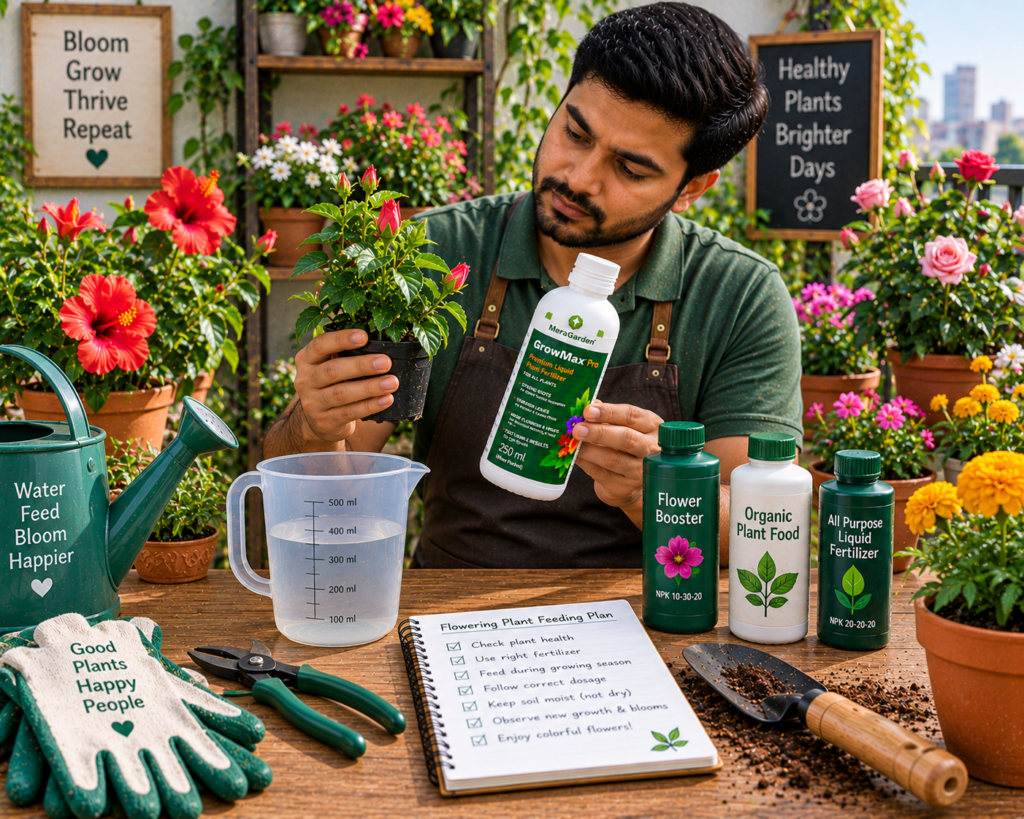
Step 5: Measure Carefully
Use a proper measuring container.
Avoid estimating the fertilizer by simply pouring “a little” into the watering can.
Accurate measurement creates a more consistent feeding routine and helps prevent accidental overapplication.
Step 6: Dilute With Water
If the product instructions require dilution, add the measured fertilizer to the recommended amount of water.
Mix properly before applying it.
Do not increase the concentration because you want faster flowers.
Step 7: Apply to the Growing Medium
Apply the prepared solution around the soil according to the product instructions.
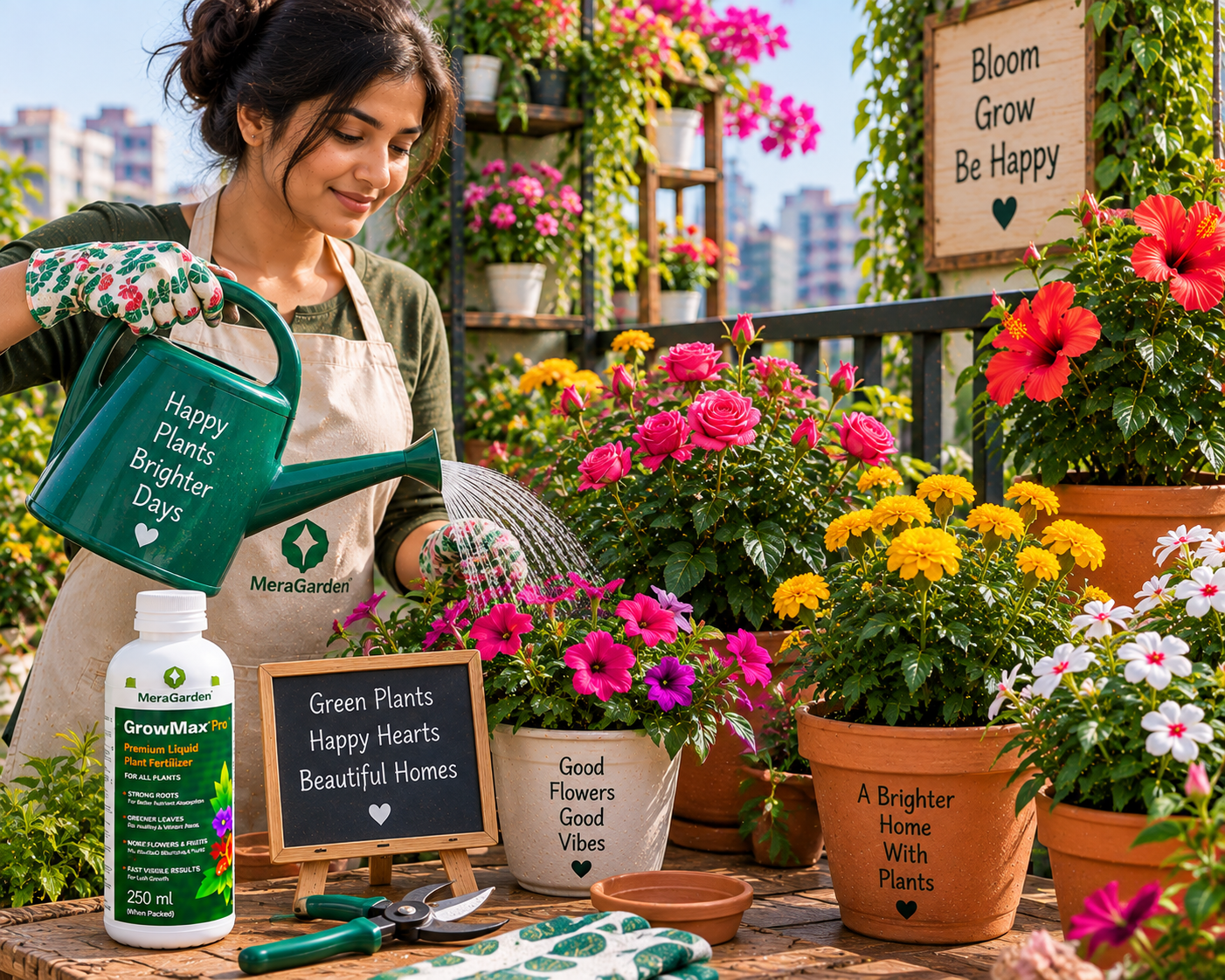
Avoid applying concentrated fertilizer directly onto leaves or stems unless the product specifically instructs you to use it as a foliar feed.
The RHS notes that liquid feeding is commonly carried out by diluting fertilizer in water and applying it to the soil or pots where plants are growing.
Step 8: Observe Before Feeding Again
After feeding, give the plant time to respond.
Look for healthy new growth and developing buds rather than expecting dramatic results immediately.
Don’t repeat the application early simply because you don’t see flowers within a few days.
Plant growth takes time.
Common Mistakes to Avoid
Mistake 1: Using too much fertilizer
Always follow the product label.
Mistake 2: Fertilizing completely dry soil
This can increase the risk of root damage.
Mistake 3: Ignoring sunlight
A fertilizer cannot replace adequate light.
Mistake 4: Waterlogging the pot
Make sure the container has proper drainage.
Mistake 5: Assuming yellow leaves mean deficiency
Nutrient deficiencies can cause leaf discoloration, but growing-condition problems can look similar.
Mistake 6: Feeding too frequently
Follow the product’s recommended frequency rather than creating your own aggressive schedule.
Liquid vs Granular vs Slow-Release vs Organic Fertilizer for Flowering Plants
There are several fertilizer types available for container gardening.
The best option depends on the plant, growing conditions and gardener’s preferences.
| Fertilizer Type | Main Advantage | Potential Limitation | Suitable for Potted Flowers? |
|---|---|---|---|
| Liquid fertilizer | Easy to measure, dilute and apply | Requires correct dilution and regular application | Yes |
| Granular fertilizer | Convenient and can provide longer-lasting nutrition | Incorrect application can lead to overfeeding | Yes |
| Slow-release fertilizer | Releases nutrients gradually | Less immediate control over feeding | Yes |
| Organic fertilizer | Can provide nutrients from organic sources | May release nutrients more slowly depending on product | Yes, if suitable |
The RHS lists liquid, granular, pellet and powder fertilizers and explains that slow-release products can provide nutrients gradually.
For home gardeners with multiple pots, liquid fertilizer can be particularly convenient because the feeding solution can be prepared and applied during normal plant care.
However, the fertilizer type should always match the plant’s requirements.
Why MeraGarden GrowMax Pro Can Be a Convenient Option
If you’re looking for a liquid fertilizer for flowering plants, MeraGarden GrowMax Pro offers a convenient liquid format for home gardening.
Because flowering plants in pots are grown in a restricted root environment, a liquid fertilizer can be practical when additional feeding is appropriate.
GrowMax Pro is designed as a liquid plant fertilizer suitable for all plants.
Why gardeners may prefer a liquid format:
- Easy to measure
- Easy to dilute
- Convenient for potted plants
- Simple to incorporate into a gardening routine
- Suitable for different plants in a home garden
- Convenient for balcony and terrace gardening
However, remember that GrowMax Pro is a chemical-based fertilizer, not an organic fertilizer.
Also, don’t assume that a product being suitable for all plants means every plant should receive exactly the same feeding frequency.
Different plants have different requirements.
For flowering plants, use GrowMax Pro according to the current product label instructions and do not exceed the recommended dosage.
The RHS also recommends checking fertilizer labels because application instructions can vary between products.
🌺 Give Your Potted Flowers Better Nutrition
Your flowering plants don’t need an unnecessarily complicated feeding routine.
Start with good potting soil, proper drainage, suitable sunlight and correct watering. Then use fertilizer when the plant needs additional nutrition.
If you want a convenient liquid fertilizer option for your home garden:
Grow Better. Bloom Bigger.
Conclusion
Finding the best fertilizer for flowering plants in pots is about much more than choosing a fertilizer with a high nutrient number.
Potted flowering plants have restricted root space, so they can benefit from appropriate feeding when nutrients in the growing medium become limited.
A suitable fertilizer should complement the plant’s existing care routine.
The seven most important tips are:
- Choose a fertilizer appropriate for flowering plants.
- Understand the role of NPK nutrients.
- Feed mainly during active growth.
- Never apply fertilizer to completely dry soil.
- Use liquid fertilizer carefully and according to its label.
- Maintain good overall plant health for better flowering potential.
- Avoid overfertilizing.
For gardeners growing roses, hibiscus, marigolds, petunias and other flowering plants in pots, consistency is more useful than excessive feeding.
Remember that fertilizer is only one part of the equation.
Good light + healthy roots + correct watering + suitable soil + appropriate nutrition = better conditions for healthy flowering plants.
If you choose MeraGarden GrowMax Pro, use the current label instructions and make it part of a sensible plant-care routine rather than using excessive amounts.
FAQs About the Best Fertilizer for Flowering Plants in Pots
1. What is the best fertilizer for flowering plants in pots?
A fertilizer appropriate for flowering plants and their growth stage is generally a good choice. Flowering plants are commonly given fertilizer with appropriate phosphorus and potassium, while the overall nutrient balance remains important.
2. Is liquid fertilizer good for flowering plants?
Yes. Liquid fertilizer can be convenient for container-grown flowering plants because it can be measured, diluted and applied through watering. The RHS describes liquid fertilizers as particularly useful for container plants.
3. Can I use GrowMax Pro for flowering plants?
MeraGarden GrowMax Pro is a liquid plant fertilizer suitable for all plants. It can be incorporated into a flowering plant feeding routine according to its current product-label instructions.
4. Does more fertilizer mean more flowers?
No. More fertilizer does not automatically produce more flowers. Excessive fertilizer can cause problems, while flowering also depends on light, watering, temperature, plant variety and root health.
5. Should flowering plants get more phosphorus?
Flowering plants generally have a greater emphasis on phosphorus and potassium compared with foliage plants, according to RHS houseplant guidance. However, the complete nutrient balance and plant requirements are also important.
6. How often should I fertilize flowering plants in pots?
There is no single frequency that applies to every flowering plant and fertilizer. Follow the instructions on your specific fertilizer and consider the plant’s growth stage, potting mix and growing conditions.
7. Can I fertilize a flowering plant when the soil is completely dry?
It is better to avoid applying fertilizer to completely dry soil. RHS guidance warns that fertilizer applied to dry soil can burn plant roots.
8. Why is my flowering plant growing leaves but not flowers?
Possible causes include insufficient light, incorrect pruning, unsuitable temperature, plant maturity, watering problems, excessive nitrogen or other growing-condition issues. Fertilizer alone cannot solve every flowering problem.
9. Is liquid fertilizer better than granular fertilizer?
Not necessarily. Liquid fertilizer offers convenient measurement and application, while granular and slow-release products can provide different feeding patterns. Choose according to the plant and your gardening routine.
10. Can I use the same fertilizer for roses, hibiscus and marigolds?
A general fertilizer may be suitable for multiple plants if its label says so, but feeding frequency and requirements can differ between species. Always check the individual plant’s care requirements.
11. Should I fertilize newly potted flowering plants?
Not necessarily. Fresh potting mix may already contain nutrients. Check the growing medium and follow both the potting mix and fertilizer instructions before starting additional feeding.
12. Can overfertilizing damage flowering plants?
Yes. Incorrect application and overuse can cause problems. The RHS recommends using fertilizer only when required and using the minimum amount needed.
13. What is more important than fertilizer for flowering plants?
Light, water, drainage, healthy roots and suitable growing media are all essential. Fertilizer should complement these conditions rather than replace them.
14. Can fertilizer fix yellow leaves?
Not always. Nutrient deficiencies can cause yellow or pale leaves, but problems with light, watering, roots or other growing conditions can produce similar symptoms.
Must Read
- How Often Should You Fertilize Plants? 7 Easy Rules for Healthy Growth
- How Often Should You Fertilize Plants? Complete Fertilizer Schedule
- What Is NPK Fertilizer? 7 Easy Tips for Healthy Plants
- Best Liquid Fertilizer for Plants: Complete Guide for Home Gardeners
- How to Use Liquid Fertilizer for Plants: 7 Easy Steps for Better Growth
- Best Organic Fertilizers for Plants: 7 Natural Options for Healthy Growth
- Best Fertilizer for Indoor Plants in India: 7 Easy Tips for Healthy Growth
- Best Fertilizer for Flowering Plants in India: 7 Top Options
- Best Fertilizer for Plants: 7 Smart Tips to Avoid Common Mistakes
- 5 Signs Your Plants May Need Fertilizer
- How Much Liquid Fertilizer Should You Use for Plants?
- 7 Benefits of Liquid Fertilizer for Plants: Grow Healthier Plants Faster
- 7 Benefits of Liquid Fertilizer for Plants: A Simple Guide for Healthy Growth
- Best Fertilizer for Peace Lily: 7 Powerful Tips for Beautiful Blooms and Avoiding Common Mistakes
- Best Fertilizer for Spider Plant: 7 Powerful Tips for Lush Growth and Avoiding Common Mistakes
- Liquid Fertilizer vs Granular Fertilizer: Which Is Better? 7 Key Differences for Home Gardeners
- Liquid Fertilizer vs Organic Fertilizer: 7 Powerful Pros, Cons & the Best Choice for Your Plants
- How to Choose the Right Fertilizer for Your Plants: 7 Smart Tips to Avoid Common Mistakes
- 5 Positive Signs Your Plants Need Fertilizer — Avoid These Warning Symptoms for Healthier Growth
- How to Grow Peace Lilies
- How To Grow Houseplants