
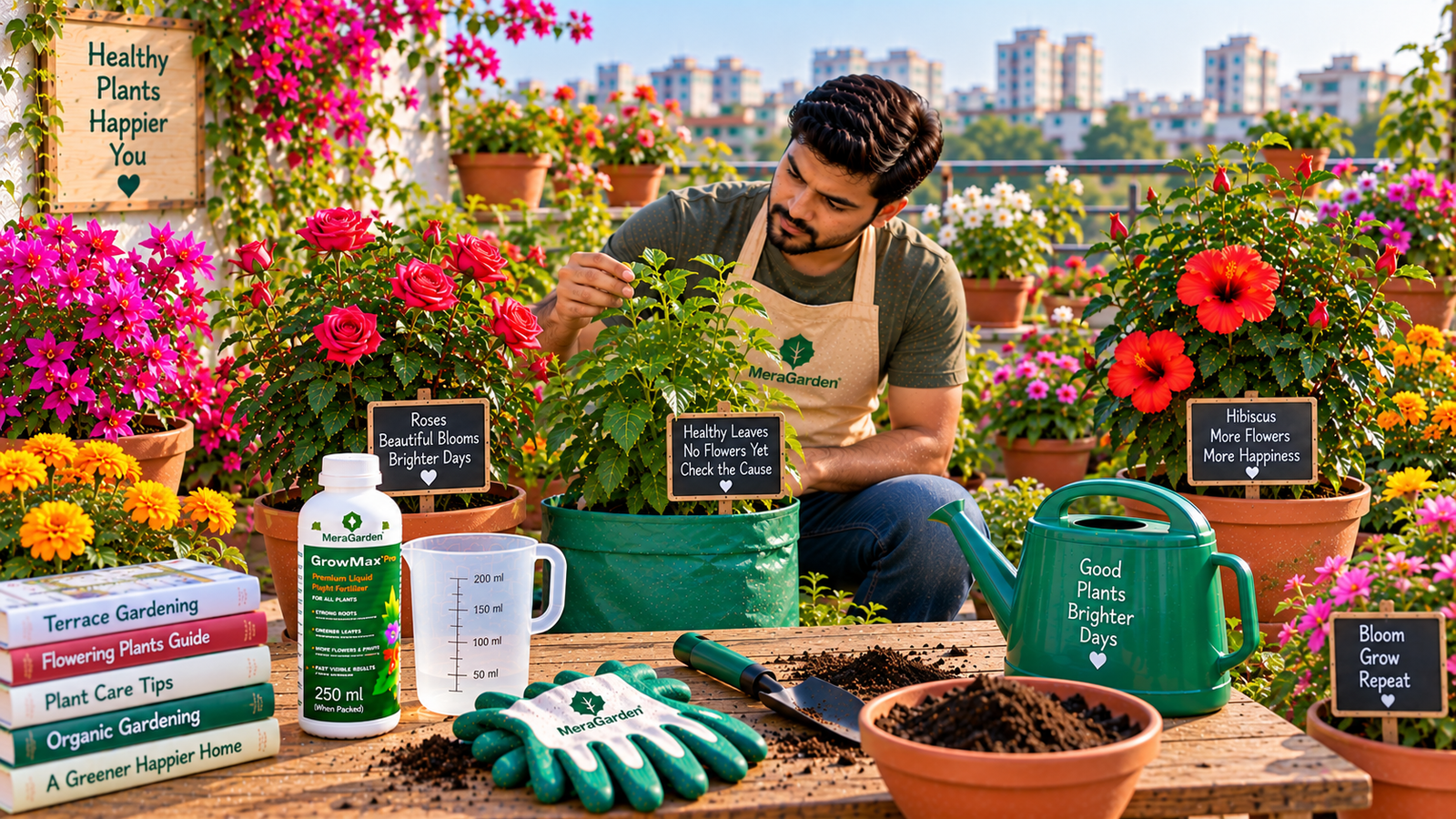
Why are my plants not flowering? This is one of the most frustrating questions for home gardeners.
You may have a healthy-looking plant with plenty of green leaves, strong stems and new growth, but still see very few—or absolutely no—flowers.
It is tempting to think that the plant simply needs more fertilizer.
But flowering depends on much more than fertilizer.
Plants need a suitable combination of light, water, temperature, nutrients, root health, maturity and regular care. If one important requirement is missing, a plant may continue producing leaves while putting little energy into flowers.
This is especially common with plants grown in pots, grow bags, balconies and terrace gardens because their growing conditions can be very different from plants growing naturally in the ground.
For example, a flowering plant may receive too little sunlight on a shaded balcony. Another plant may receive plenty of sunlight but remain in constantly wet soil. A third plant may be growing vigorously but receive an unsuitable feeding routine.
The good news is that flowering problems can often be investigated systematically.
Instead of immediately adding more fertilizer, first look at the plant’s environment and growth stage. Then consider whether nutrition is actually limiting flowering.
In this guide, we’ll explain 9 common reasons why plants are not flowering, along with practical ways to improve their growing conditions and encourage healthier blooms.
Table of Contents
Causes 1–2: Start With Light and Plant Maturity
1. Your Plant May Not Be Getting Enough Light
One of the most important factors affecting flowering is light.
Plants use light to produce energy through photosynthesis, and flowering plants often require suitable light levels to produce flowers successfully.
If a plant receives insufficient light, it may continue producing foliage while flowering becomes limited.
This can happen frequently with balcony and indoor plants.
For example, you may place a flowering plant inside a bright-looking room, but the actual light reaching the leaves may still be much lower than what the plant requires.
Similarly, a terrace plant may be shaded by:
- Walls
- Other plants
- Shade structures
- Buildings
- Large trees
- Balcony coverings
Signs that light may be the problem
Look for:
- Lots of leaves but few flowers
- Long, weak stems
- Plants leaning toward sunlight
- Smaller new leaves
- Slow growth
- Flower buds that fail to develop
- Very long gaps between leaves
How to improve the situation
First identify the light requirement of the particular plant.
Some flowering plants need several hours of direct sunlight, while others perform better with bright indirect light.
Don’t assume that placing every plant in intense afternoon sunlight is the solution.
If the plant needs more light, gradually move it toward a more suitable location.
More fertilizer cannot compensate for inadequate light.
2. The Plant May Be Too Young to Flower
Another commonly overlooked reason is simply plant maturity.
Not every plant flowers as soon as it starts producing leaves.
Some plants need time to establish their roots and develop sufficient vegetative growth before they are capable of producing flowers.
This is particularly relevant when growing plants from:
- Seeds
- Cuttings
- Young nursery plants
- Recently transplanted seedlings
Why patience matters
A young plant may spend considerable energy developing:
- Roots
- Stems
- Leaves
- Branches
before reaching the stage where flowering becomes a priority.
Therefore, a healthy young plant with no flowers is not necessarily suffering from a fertilizer deficiency.
What should you do?
Find out the normal maturity and flowering period of the particular plant.
Continue providing appropriate:
- Light
- Water
- Growing space
- Temperature
- Nutrition
Avoid forcing flowering by continuously increasing fertilizer.
Sometimes the best solution is simply giving the plant enough time to mature.
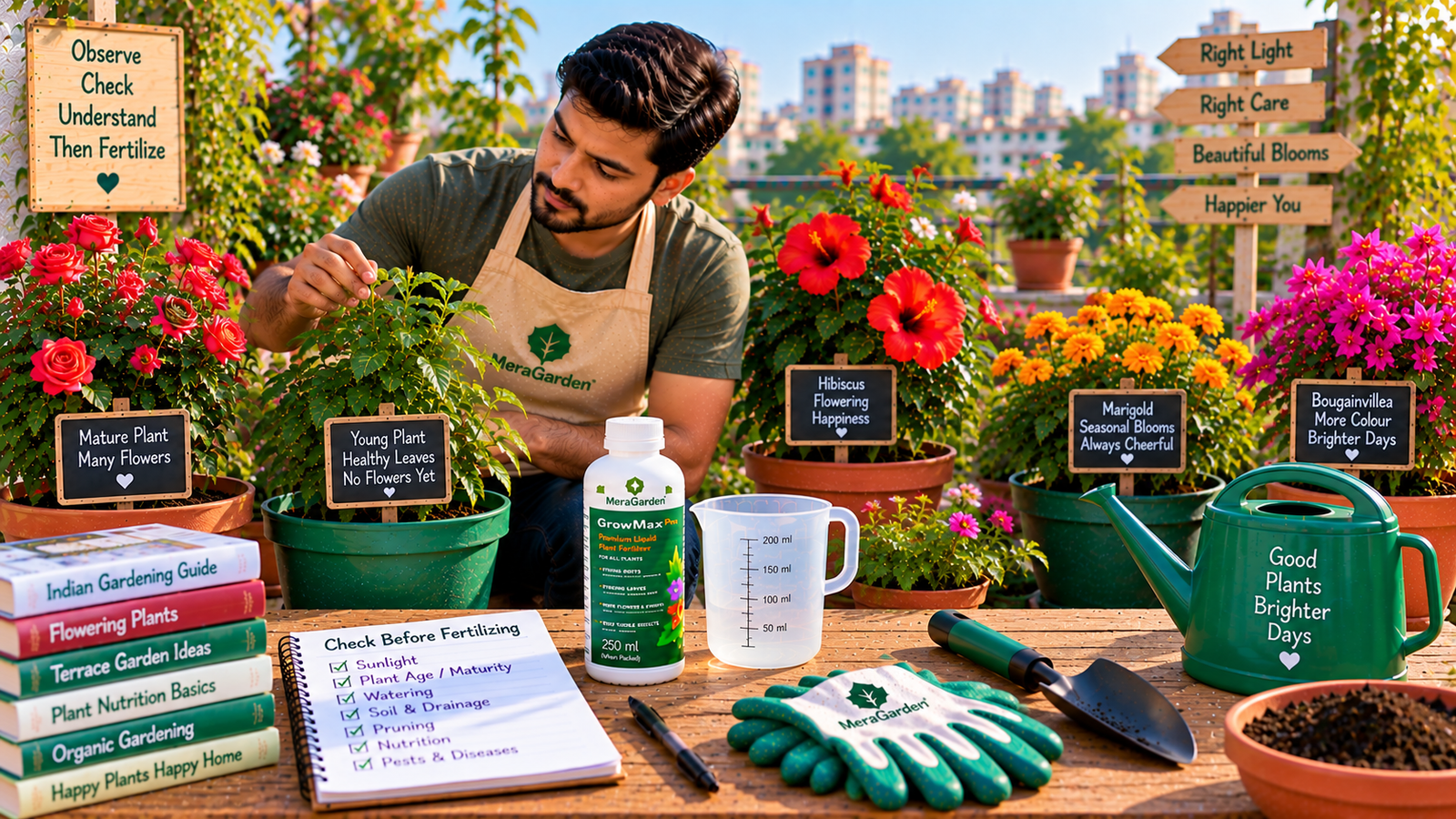
Causes 3–5: Water, Pruning and Plant Nutrition
3. Incorrect Watering Can Reduce Flowering
Water is essential for plant growth and flowering, but too much or too little water can create stress.
A stressed plant may prioritize survival and vegetative growth rather than producing flowers.
Underwatering
A plant that repeatedly becomes too dry may experience:
- Wilting
- Drooping leaves
- Dry leaf edges
- Bud drop
- Slow growth
- Poor flowering
Container plants can be particularly vulnerable because pots and grow bags can dry quickly during hot weather.
Overwatering
Excess water can create a different set of problems.
If the growing medium remains wet for too long, roots may become stressed because they require both water and air.
Possible signs include:
- Yellow leaves
- Weak growth
- Poor flowering
- Persistent wet growing medium
- Root problems
- Leaf drop
The solution
Don’t water simply because it is a particular day.
Check the growing medium and consider:
- Plant species
- Pot size
- Weather
- Temperature
- Sun exposure
- Growing medium
- Drainage
The goal is not to keep the soil permanently wet.
The goal is to maintain an appropriate moisture level for the plant.
4. Incorrect Pruning Can Remove Flowering Growth
Pruning can be very useful for many plants, but timing matters.
One reason a plant may not flower is that its flower-producing growth has been removed at the wrong time.
Some plants flower on new growth, while others may produce flowers on older stems or growth formed during a previous season.
If you prune without understanding the plant’s flowering habit, you may accidentally remove developing flower buds.
Before pruning, ask:
- When does this plant normally flower?
- Does it flower on old or new growth?
- Which branches should be removed?
- Is pruning recommended at this time of year?
Avoid aggressive pruning simply because the plant looks crowded.
For flowering plants such as roses and other ornamentals, pruning should be based on the specific plant rather than following one universal rule.
Another common mistake
Some gardeners continuously cut off new shoots because they want the plant to remain small.
But those shoots may eventually become flowering branches.
Healthy pruning should improve plant structure—not repeatedly remove potential flowering growth.
5. Nutrient Imbalance Can Affect Flowering
Nutrition is another important factor.
Plants require a range of nutrients for healthy development. Nitrogen, phosphorus and potassium are major nutrients, while several micronutrients are also required.
However, flowering plants don’t simply need “more fertilizer.”
They need appropriate nutrition.
Too much nitrogen can be a problem
Nitrogen is important for leaf and stem development.
But if a plant receives excessive nitrogen relative to its needs, it may produce vigorous green foliage without achieving the flowering performance you expect.
This is one reason gardeners sometimes see:
Lots of leaves + very few flowers.
Nutrient deficiency can also affect flowering
If nutrients are genuinely limited, plants may show:
- Weak growth
- Pale foliage
- Small leaves
- Poor bud development
- Reduced flowering
- Poor overall vigour
The RHS notes that nutrient availability is important for plant growth and that container-grown plants can experience nutrient depletion because they have a limited volume of growing medium. (rhs.org.uk)
Don’t diagnose from flowers alone
Poor flowering does not automatically mean fertilizer deficiency.
Check light, water, roots and plant maturity first.
If nutrition is appropriate to address, use a suitable fertilizer according to its label.
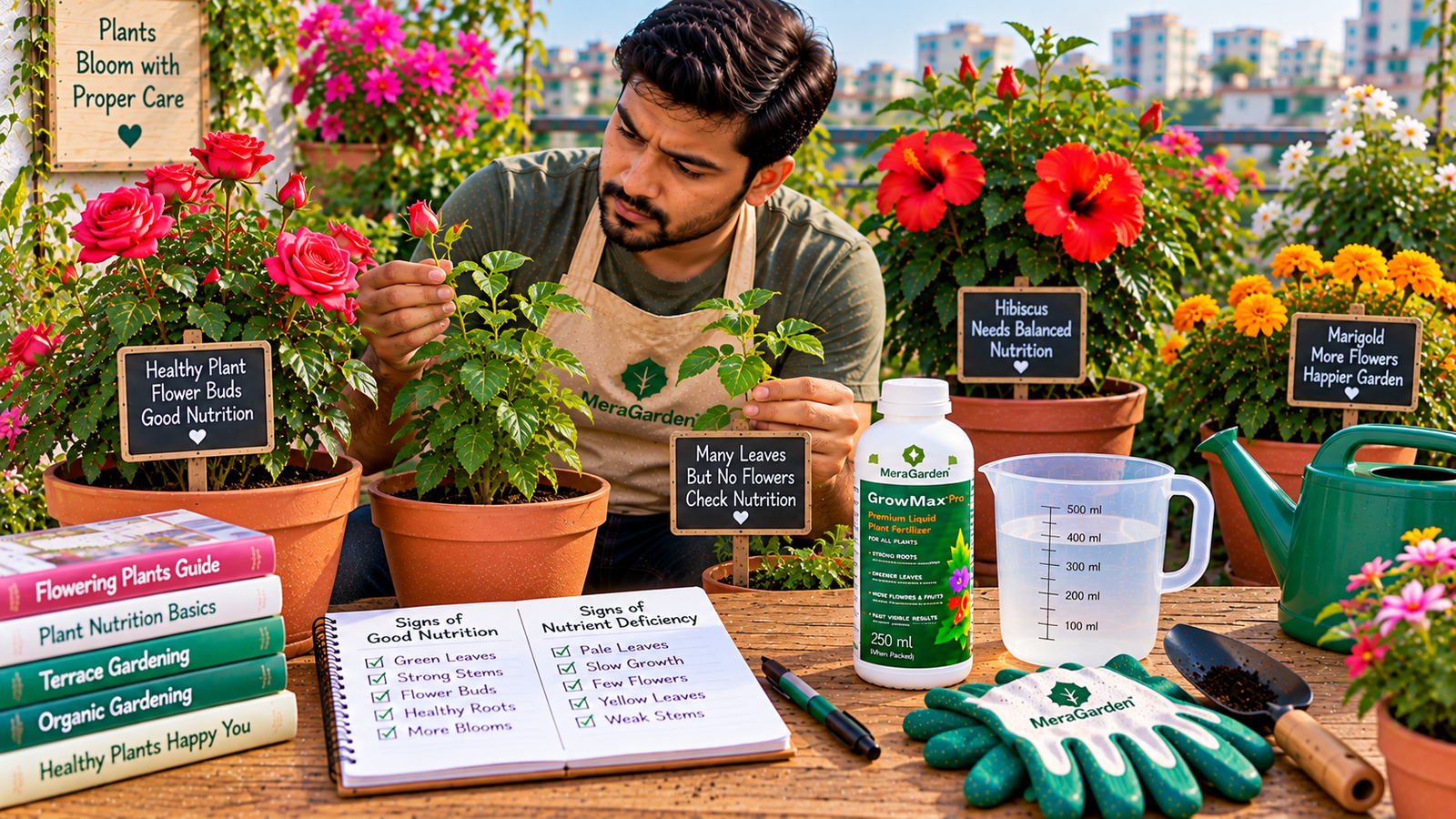
Causes 6–7: Roots, Containers and Environment
6. Poor Drainage or Root Problems May Be Affecting Flowering
Healthy flowers start with healthy roots.
If roots are constantly stressed, the plant may have difficulty supporting strong growth and flowering.
Poor drainage is particularly common in containers.
A pot may look attractive, but if excess water cannot escape, the root environment can become unsuitable.
Check your pot
Make sure:
- Drainage holes are present.
- Drainage holes are not blocked.
- Excess water can escape.
- The pot is not permanently sitting in water.
- The growing medium is not severely compacted.
Root-bound plants
A plant can also become crowded when its roots fill the available container space.
Possible signs include:
- Roots emerging from drainage holes
- Roots tightly circling the container
- Growing medium drying unusually quickly
- Poor new growth
- Plant becoming unstable
- Water passing through very quickly
However, don’t repot every non-flowering plant automatically.
Some plants tolerate restricted roots better than others.
Always consider the plant’s specific requirements before changing containers.
7. Temperature and Seasonal Stress Can Delay Flowers
Flowering is strongly influenced by environmental conditions.
Temperature that is too high or too low can affect plant growth and flowering.
This is especially relevant in India, where gardeners may experience:
- Very hot summers
- Strong afternoon heat
- Monsoon humidity
- Cooler winter periods
- Sudden temperature changes
A plant that flowers beautifully during one season may produce fewer flowers during another.
Heat stress
During very hot conditions, plants may experience:
- Wilting
- Leaf scorch
- Reduced growth
- Bud drop
- Poor flowering
Cold stress
Some plants may slow down when temperatures fall below their preferred range.
What can you do?
Understand the natural flowering season of your plant.
Avoid assuming that the absence of flowers always indicates a fertilizer problem.
Provide suitable:
- Light
- Water
- Air movement
- Protection from extreme conditions
- Seasonal care
Sometimes the plant simply needs to wait for more suitable weather.
8. Pests and Diseases Can Prevent Healthy Flowering
A plant may have excellent light and adequate nutrition but still fail to flower because pests or diseases are affecting its health.
Pests can damage young shoots, flower buds and leaves.
Diseases can also interfere with healthy growth.
Inspect your plant carefully, particularly:
- New shoots
- Flower buds
- Leaf undersides
- Stems
- Growing tips
Look for:
- Tiny insects
- Sticky residue
- Webbing
- Holes
- Spots
- Curling leaves
- Distorted growth
- Damaged buds
Why this matters
If flower buds are repeatedly damaged before opening, adding fertilizer will not solve the underlying problem.
The pest or disease issue needs to be addressed separately.
Also remember:
Fertilizer is not a pesticide or disease treatment.
Use appropriate pest-management methods for the specific problem and follow product directions carefully.
9. Your Plant May Need Better Overall Care and Consistency
The final reason is not one specific mistake.
Sometimes plants fail to flower because their care routine is inconsistent.
For example:
- Heavy watering one day
- Very dry soil for several days
- Too much fertilizer
- Then no fertilizer for months
- Moving the plant repeatedly
- Pruning at random times
- Changing sunlight conditions frequently
Plants generally perform better when their basic requirements are consistently met.
Create a simple flowering routine
Regularly check:
Light: Is the plant receiving the appropriate amount?
Water: Does the growing medium need water?
Drainage: Is excess water escaping?
Nutrition: Does the plant actually need feeding?
Roots: Is the container suitable?
Temperature: Is the current environment appropriate?
Pests: Are new growth and buds healthy?
Pruning: Am I removing potential flowering growth?
This simple checklist can help you identify problems before they become severe.
Help Your Plants Produce Better Blooms
If your plants are not flowering, don’t immediately assume they need a stronger fertilizer.
Check the light, water, roots, pruning, temperature and plant maturity first.
When your plant genuinely needs additional nutrition, a suitable liquid fertilizer can become part of a consistent feeding routine.
👉 Support healthier growth and flowering with MeraGarden GrowMax Pro.
Grow Better. Bloom Bigger.
How to Use Liquid Fertilizer for Flowering Plants
If your plant has suitable growing conditions but needs additional nutrition, liquid fertilizer can be a convenient option.
Follow these steps.
Step 1: Identify the Flowering Plant
First determine what you are growing.
Examples include:
- Rose
- Hibiscus
- Marigold
- Bougainvillea
- Jasmine
- Petunia
- Geranium
- Flowering houseplants
Different plants can have different feeding requirements.
Step 2: Check Why the Plant Is Not Flowering
Before feeding, check:
- Light
- Water
- Drainage
- Root health
- Temperature
- Pests
- Plant maturity
- Pruning history
If one of these is clearly causing the problem, address it first.
Step 3: Check the Plant’s Condition
Don’t fertilize simply because the plant has no flowers.
If the plant is severely stressed, waterlogged or suffering from root damage, correct the underlying condition first.
Step 4: Read the Fertilizer Label
Always follow the current fertilizer label.
Check:
- Recommended dilution
- Application frequency
- Suitable plants
- Application method
- Safety instructions
Never guess the dosage.
Step 5: Measure Carefully
Use a suitable measuring container.
Accurate measurement helps maintain the correct concentration and prevents accidental over-application.
Step 6: Dilute With Water
Mix the fertilizer with water according to the product’s instructions.
Do not make the solution stronger because you want flowers to appear faster.
More fertilizer does not automatically mean more flowers.
Step 7: Apply and Monitor
Apply the diluted solution according to the product directions.
Continue observing the plant for:
- New growth
- Flower buds
- Flower development
- Leaf colour
- Overall plant health
If flowering does not improve, reassess the other growing conditions rather than repeatedly increasing fertilizer.
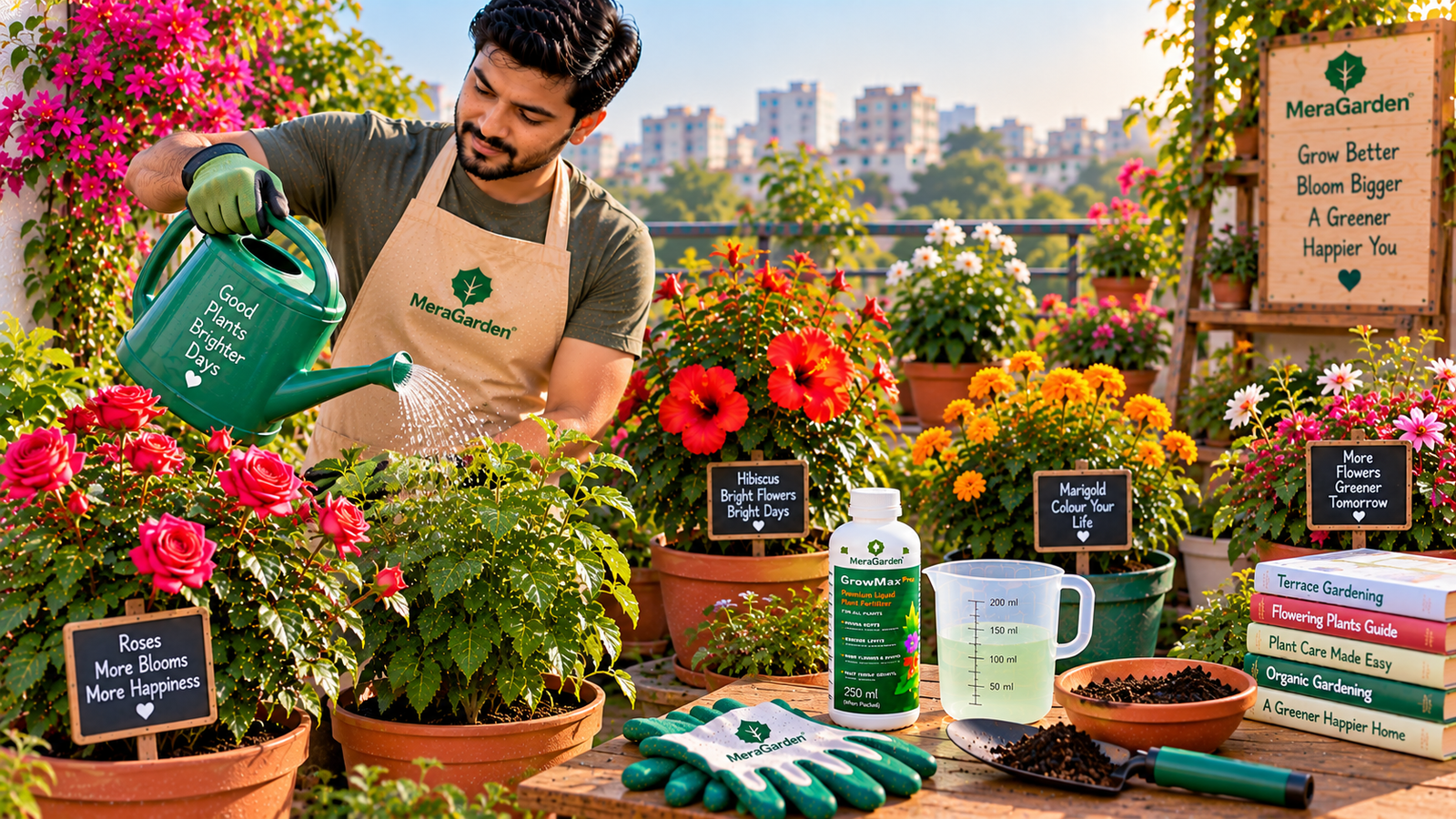
Liquid Fertilizer vs Granular Fertilizer for Flowering Plants
Gardeners often wonder whether liquid or granular fertilizer is better for flowering plants.
Both can be useful when used appropriately.
| Feature | Liquid Fertilizer | Granular Fertilizer |
|---|---|---|
| Application | Mixed with water | Applied in dry form |
| Convenience | Easy to dilute and apply | Convenient for planned feeding |
| Nutrient availability | Generally faster acting | Release varies by product |
| Container plants | Often particularly convenient | Can also be suitable |
| Measurement | Requires accurate dilution | Requires accurate application |
| Best use | Follow product directions | Follow product directions |
| Main mistake | Over-concentrating the solution | Over-applying granules |
The RHS notes that liquid fertilizers are generally faster acting and can be particularly useful for container-grown plants. (rhs.org.uk)
However, fertilizer type is only one part of flowering success.
A plant sitting in deep shade will not necessarily start flowering simply because you switch from granular fertilizer to liquid fertilizer.
Similarly, a waterlogged plant needs better root conditions—not more fertilizer.
GrowMax Pro for Flowering Plants
MeraGarden GrowMax Pro Liquid Plant Fertilizer can be used as part of a regular plant nutrition routine when additional feeding is appropriate.
GrowMax Pro is a chemical-based liquid fertilizer marketed as suitable for all plants, with product claims focused on:
- Strong roots
- Greener leaves
- More flowers and fruits
- Fast visible results
- Convenient liquid application
For gardeners growing flowering plants in pots, balconies and terrace gardens, a liquid fertilizer can be convenient because it can be measured and diluted before application.
But remember: flowering depends on more than fertilizer
If your rose, hibiscus or other flowering plant is not blooming, check:
Light → Water → Drainage → Roots → Temperature → Plant maturity → Pruning → Pests → Nutrition
This sequence can help prevent a common mistake: assuming that every flowering problem is caused by insufficient fertilizer.
When nutrition may matter
If the plant has:
- Appropriate light
- Healthy roots
- Suitable watering
- Good drainage
- Appropriate temperature
- No obvious pest problem
but still shows signs that nutrition may be limiting growth, feeding may be appropriate.
In that situation, GrowMax Pro can be incorporated into the plant-care routine according to its current product label.
Always measure correctly
Do not estimate the dosage.
Do not increase the concentration because the plant is not flowering.
Do not apply concentrated fertilizer directly to the plant unless the product label specifically instructs you to do so.
Correct application is more important than simply applying more.
Give Your Flowering Plants the Right Nutrition
Beautiful blooms don’t come from fertilizer alone.
They come from the right combination of light, water, roots, temperature, pruning and nutrition.
When additional nutrition is appropriate, make it part of a consistent plant-care routine.
Grow Better. Bloom Bigger.
Conclusion
If you are asking, “Why are my plants not flowering?”, the answer may be very different from what you expect.
A plant can fail to flower because it isn’t receiving enough light, is too young, has incorrect watering, has been pruned at the wrong time, has nutritional problems, has poor root conditions, is experiencing temperature stress, is affected by pests or simply isn’t receiving consistent care.
The 9 common causes covered in this guide are:
- Insufficient light
- Plant is too young
- Incorrect watering
- Incorrect pruning
- Nutrient imbalance or deficiency
- Poor drainage or root problems
- Temperature and seasonal stress
- Pests and diseases
- Inconsistent overall plant care
The most important lesson is:
Don’t treat a flowering problem before identifying its cause.
If a plant is sitting in deep shade, fertilizer will not replace sunlight.
If the roots are constantly waterlogged, more fertilizer will not solve the drainage problem.
If pests are destroying flower buds, plant food won’t eliminate the pests.
But when your plant has suitable growing conditions and genuinely needs additional nutrition, an appropriate liquid fertilizer can be a useful part of your routine.
MeraGarden GrowMax Pro can be used for nutritional support according to its current product label.
Give your plants the right environment first, then provide the nutrition they actually need.
With consistent care and patience, your flowering plants can have a much better opportunity to produce healthy new growth, flower buds and beautiful blooms.
FAQs
1. Why are my plants not flowering?
Common reasons include insufficient light, incorrect watering, young plant age, unsuitable pruning, nutrient problems, poor drainage, temperature stress, pests and inconsistent care.
2. Why is my plant growing leaves but no flowers?
This can happen when the plant receives conditions that encourage vegetative growth but not flowering. Insufficient light, excessive nitrogen, plant maturity and incorrect pruning are possible factors.
3. Does fertilizer make plants flower?
Fertilizer can support flowering when nutrition is limiting, but it cannot compensate for insufficient light, poor drainage, incorrect watering or other environmental problems.
4. Can too much nitrogen prevent flowering?
Excessive nitrogen can encourage vigorous leaf and stem growth at the expense of balanced flowering in some plants. Avoid excessive fertilization and follow the fertilizer product’s instructions.
5. How much sunlight do flowering plants need?
It depends on the plant. Some flowering plants require several hours of direct sunlight, while others prefer bright indirect light. Check the requirements of your specific plant.
6. Can overwatering stop flowering?
Yes. Constantly wet growing conditions can stress roots and negatively affect overall plant health, which can reduce flowering.
7. Can underwatering cause flower buds to fall?
Water stress can contribute to wilting and poor flowering, and some plants may drop buds when stressed. Check the growing medium and adjust watering according to the plant’s needs.
8. Should I fertilize a plant that is not flowering?
Not automatically. First check light, watering, drainage, roots, temperature, pests and plant maturity. If nutrition is genuinely limiting, use an appropriate fertilizer according to its label.
9. Is liquid fertilizer good for flowering plants?
Liquid fertilizer can be convenient for flowering plants, particularly those grown in containers. It should be diluted and applied according to the product instructions.
10. Can GrowMax Pro help flowering plants?
GrowMax Pro can provide nutritional support when additional feeding is appropriate. However, flowering depends on many factors, so correct environmental problems first and use GrowMax Pro according to its current product label.
11. Why is my rose plant not flowering?
Possible reasons include insufficient sunlight, unsuitable pruning, watering problems, nutrient imbalance, pests, temperature conditions or plant maturity. Check the complete growing environment rather than assuming fertilizer is the only issue.
12. Why is my hibiscus not producing flowers?
Hibiscus flowering can be affected by light, watering, nutrition, temperature, pruning and overall plant health. Check these conditions before increasing fertilizer.
13. Can pruning stop flowering?
Yes, incorrect pruning timing can remove developing flower buds or flowering growth in some plants. Learn the flowering habit of the specific plant before pruning.
14. How can I encourage my plants to flower?
Provide the appropriate light, water, drainage, temperature, root space and nutrition for the plant. Avoid excessive fertilizer and prune according to the plant’s flowering habit.
15. How long does it take for a fertilizer to improve flowering?
There is no universal time period. It depends on the plant, its condition, growing environment and fertilizer. If the underlying problem is not nutritional, fertilizer may not improve flowering at all.
Must Read
- How Often Should You Fertilize Plants? 7 Easy Rules for Healthy Growth
- How Often Should You Fertilize Plants? Complete Fertilizer Schedule
- What Is NPK Fertilizer? 7 Easy Tips for Healthy Plants
- Best Liquid Fertilizer for Plants: Complete Guide for Home Gardeners
- How to Use Liquid Fertilizer for Plants: 7 Easy Steps for Better Growth
- Best Organic Fertilizers for Plants: 7 Natural Options for Healthy Growth
- Best Fertilizer for Indoor Plants in India: 7 Easy Tips for Healthy Growth
- Best Fertilizer for Flowering Plants in India: 7 Top Options
- Best Fertilizer for Plants: 7 Smart Tips to Avoid Common Mistakes
- 5 Signs Your Plants May Need Fertilizer
- How Much Liquid Fertilizer Should You Use for Plants?
- 7 Benefits of Liquid Fertilizer for Plants: Grow Healthier Plants Faster
- 7 Benefits of Liquid Fertilizer for Plants: A Simple Guide for Healthy Growth
- Best Fertilizer for Peace Lily: 7 Powerful Tips for Beautiful Blooms and Avoiding Common Mistakes
- Best Fertilizer for Spider Plant: 7 Powerful Tips for Lush Growth and Avoiding Common Mistakes
- Liquid Fertilizer vs Granular Fertilizer: Which Is Better? 7 Key Differences for Home Gardeners
- Liquid Fertilizer vs Organic Fertilizer: 7 Powerful Pros, Cons & the Best Choice for Your Plants
- How to Choose the Right Fertilizer for Your Plants: 7 Smart Tips to Avoid Common Mistakes
- 5 Positive Signs Your Plants Need Fertilizer — Avoid These Warning Symptoms for Healthier Growth
- How to Grow Peace Lilies
- How To Grow Houseplants