why are my tomato plants not producing fruits? Growing tomatoes at home can be incredibly rewarding. You plant a healthy seedling, watch it produce fresh green leaves, wait for the yellow flowers to appear and then naturally expect small tomatoes to develop.
But sometimes something confusing happens.
Your tomato plant looks healthy. It may have plenty of green leaves, strong stems and several yellow flowers, yet no tomatoes appear.
This can leave home gardeners wondering, “Why are my tomato plants not producing fruits?”
The good news is that a tomato plant producing flowers without fruit does not automatically mean the plant is unhealthy. Fruit production depends on several conditions working together, including adequate sunlight, pollination, watering, temperature, root health, nutrition and appropriate pruning.
Tomatoes are particularly sensitive to environmental stress. Very hot conditions can interfere with pollination and cause flowers to drop before fruit develops. Uneven watering can also stress plants, while excessive nitrogen can encourage lots of leafy growth without necessarily improving fruit production.
For gardeners growing tomatoes in pots, grow bags, balconies or Indian terrace gardens, these problems can become even more noticeable because containers can dry out quickly and have limited growing media.
In this guide, we will look at 9 common reasons tomato plants fail to produce fruits and explain what you can do to improve your chances of getting a healthier harvest.
Table of Contents
1. Not Enough Sunlight
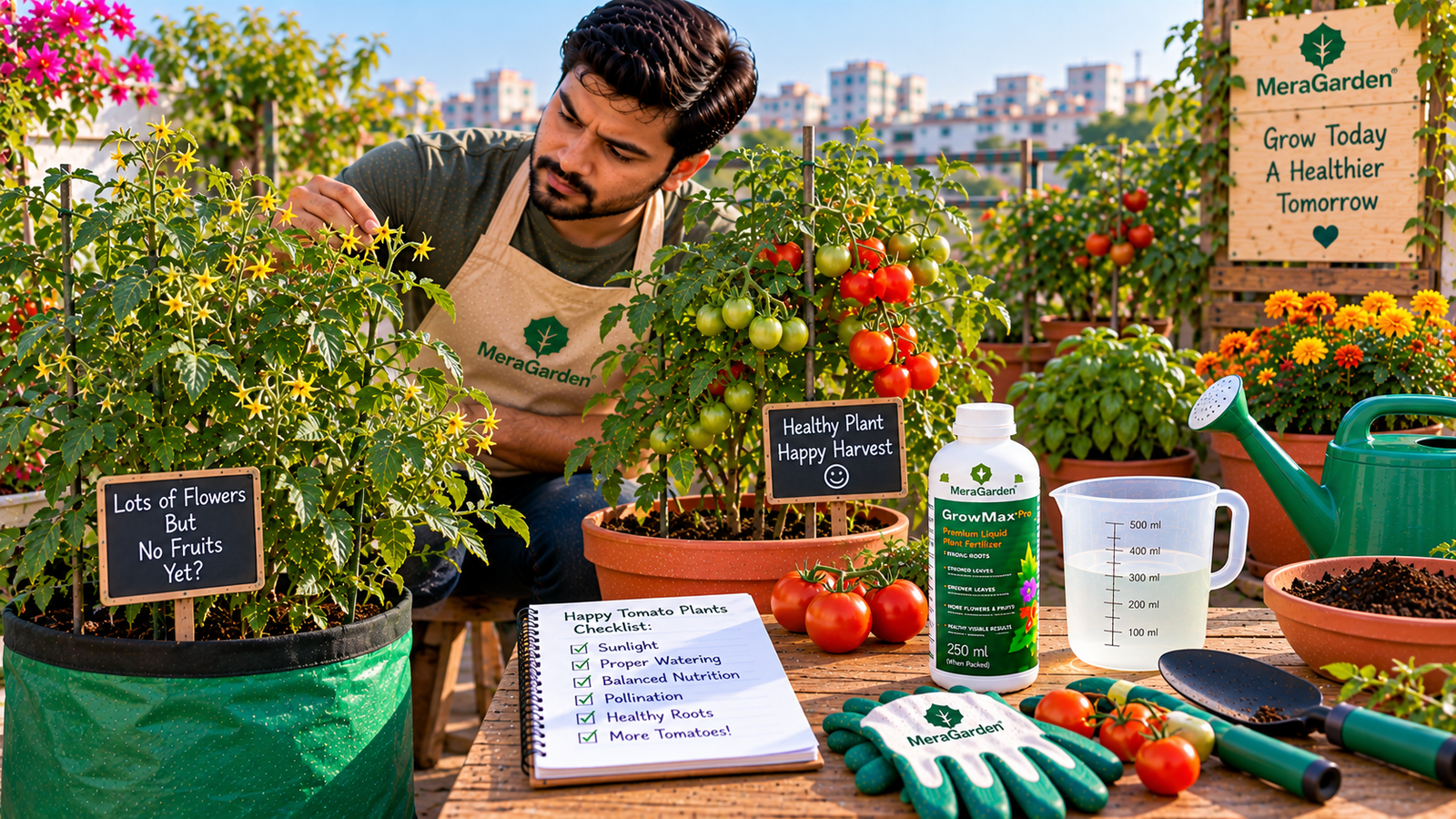
One of the first things to check when tomato plants are flowering but not producing fruit is sunlight.
Tomatoes are sun-loving plants. A plant growing in a location with insufficient direct sunlight may still produce leaves and even some flowers, but its overall growth and fruit production can be disappointing.
This is especially common on balconies or terraces where nearby walls, buildings, shade nets or other plants block sunlight for part of the day.
What should you check?
Look at your tomato plant throughout the day.
Ask yourself:
- Does the plant receive enough direct sunlight?
- Is a building blocking the morning or afternoon sun?
- Have taller plants started shading the tomato?
- Is the plant receiving mostly bright shade instead of direct sunlight?
RHS guidance recommends growing tomatoes in a warm, sunny and sheltered position.
If your tomato plant receives poor light, adding fertilizer alone is unlikely to solve the problem. First improve the growing location if possible.
For terrace gardeners, place tomato containers where they can receive strong natural light while still protecting the plant from extreme environmental stress.
2. The Plant Is Flowering but Pollination Is Not Successful
This is one of the most important answers to the question: why are my tomato plants not producing fruits?
A flower needs successful pollen transfer before a tomato can develop.
Tomatoes have both male and female parts within the same flower, and their flowers can often be pollinated through movement of the flower and pollen. In outdoor conditions, natural air movement and insects can help. In enclosed growing areas, gently shaking or tapping fully open flowers can sometimes assist pollen transfer.
You may therefore see:
Flowers → flowers dry up → flowers fall → no tomatoes
This does not necessarily mean your fertilizer is wrong.
What can help?
If your tomato plants are growing in a protected balcony, greenhouse or enclosed terrace area with little air movement:
- Gently shake flowering stems.
- Avoid keeping flowers constantly wet.
- Encourage a healthy growing environment.
- Avoid unnecessary disturbance of flowers.
- Watch for environmental stress.
Pollination is especially important during flowering. If the flowers are repeatedly dropping before fruit formation, investigate environmental conditions before simply adding more fertilizer.
3. Excessive Heat Is Causing Flowers to Drop
Indian gardeners need to pay particular attention to temperature.
Tomatoes can struggle when temperatures remain excessively high, especially when hot days are combined with warm nights.
A plant may look green and vigorous while its flowers fail to develop into tomatoes.
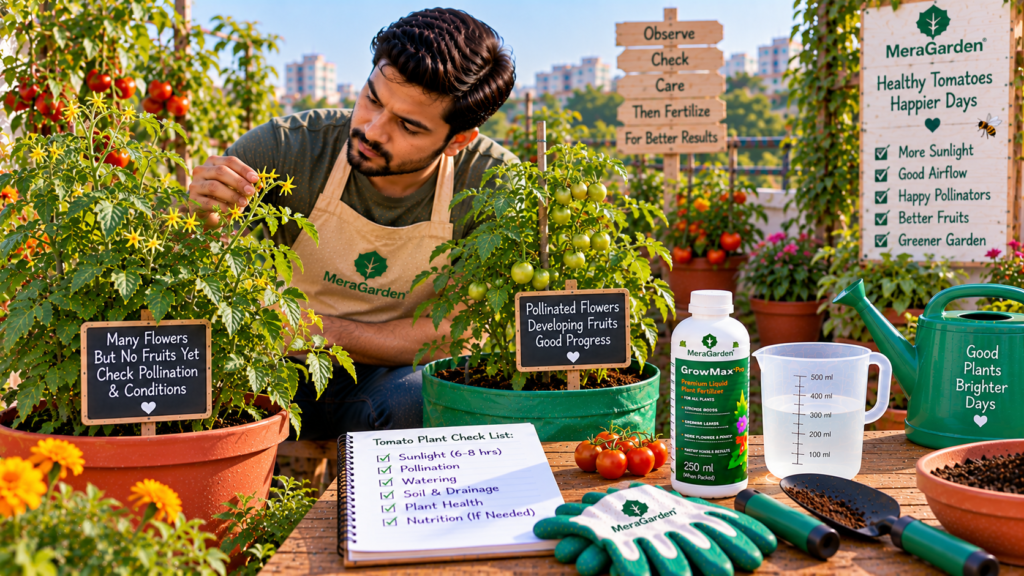
During prolonged heat, tomato flowers can become less effective at pollination and may wither or drop. University of Minnesota Extension notes that sustained high temperatures can contribute to flower abortion in tomatoes, resulting in flowers falling before fruit develops.
What can you do?
During very hot weather:
- Keep the growing medium consistently moist without making it waterlogged.
- Avoid unnecessary root disturbance.
- Protect containers from excessive heat where practical.
- Avoid placing pots against surfaces that become extremely hot.
- Provide good airflow.
- Monitor flowers closely.
Do not assume that every flower that falls is caused by fertilizer deficiency.
Sometimes the plant simply needs better environmental conditions.
4. Watering Is Too Irregular
Tomato plants need a reliable supply of moisture.
A common mistake is allowing the growing medium to become extremely dry and then giving the plant a large amount of water at once.
This creates fluctuating moisture conditions.
RHS guidance recommends watering tomatoes regularly so the compost remains evenly moist. Container-grown tomatoes can dry out particularly quickly during hot weather.
Signs your watering routine may need improvement
You may notice:
- Wilting leaves
- Very dry growing media
- Sudden recovery after watering
- Flower drop
- Poor overall growth
- Problems with developing fruits
For tomatoes growing in containers or grow bags, check the moisture level regularly rather than following a rigid watering schedule.
The amount of water required will change with:
- Container size
- Temperature
- Sunlight
- Plant size
- Growing medium
- Weather
- Drainage
The goal is consistent moisture, not permanently wet soil.
5. Too Much Nitrogen Is Encouraging Leaves Instead of Fruit
Sometimes the tomato plant looks exceptionally healthy—but it has very few tomatoes.
You may see:
Lots of leaves + strong stems + very few fruits
One possible reason is excessive nitrogen.
Nitrogen encourages vegetative growth. When supplied excessively, it can contribute to lush leafy growth without giving you the balanced growth needed for good fruit production. University of Minnesota Extension specifically notes that excessive nitrogen can result in lush green vegetable plants with poor harvests.
This is why blindly increasing fertilizer whenever your tomato plant does not fruit can be counterproductive.
Instead, consider the complete picture
Check:
- Sunlight
- Plant maturity
- Pollination
- Temperature
- Watering
- Root health
- Growing medium
- Existing fertilizer use
Fertilizer should support good plant care—not replace it.
6. The Root System Is Stressed
Healthy fruit production starts below the soil.
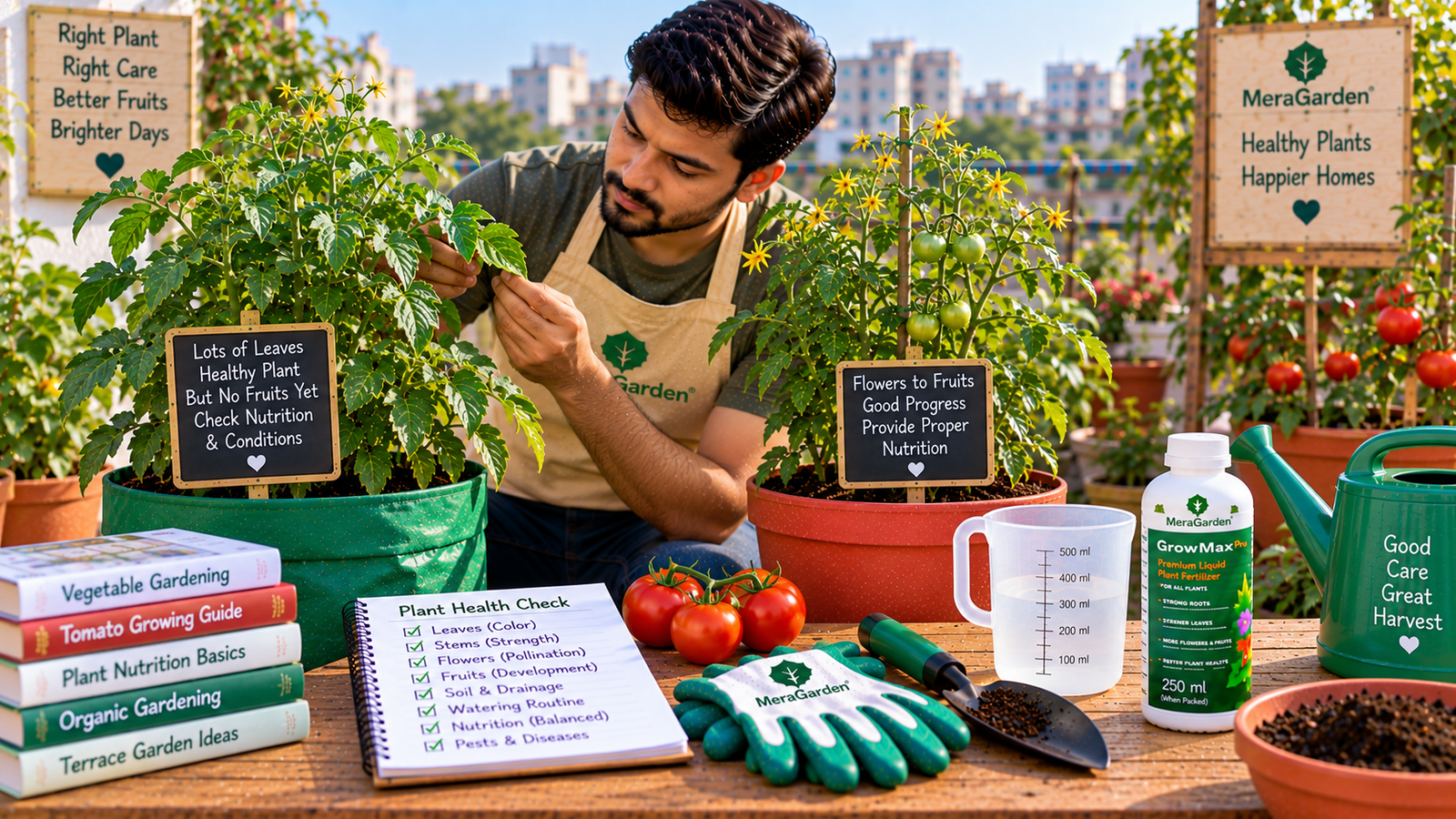
If tomato roots are restricted, waterlogged, damaged or growing in poor-quality growing media, the plant may struggle even if its leaves look reasonably healthy.
This is particularly important for tomato plants growing in pots.
RHS recommends large containers for tomatoes and notes that a single tomato plant can be grown in a container around 30–45 cm in size. Good drainage is also important.
Check your container
Look for:
- Drainage holes
- Water escaping after irrigation
- Roots becoming severely restricted
- Compacted growing media
- Water remaining around the root zone
- A container that is too small for the plant
A tomato plant growing in a small container may require much closer attention to water and nutrition.
If you are growing tomatoes on a terrace, using a suitable pot or grow bag can make routine care much easier.
7. The Plant Needs Balanced Nutrition
Tomatoes are productive plants, so they require adequate nutrition throughout their growing cycle.
However, more fertilizer does not automatically mean more tomatoes.
The objective is balanced nutrition appropriate for the plant’s growth stage.
RHS guidance recommends regular feeding for container tomatoes once fruits begin to form, using a suitable liquid tomato feed according to the manufacturer’s instructions.
A useful approach is to distinguish between:
Vegetative growth
The plant is developing:
- Leaves
- Stems
- Roots
- Overall structure
Flowering and fruit development
The plant is developing:
- Flower buds
- Flowers
- Small fruits
- Developing tomatoes
Your feeding routine should therefore be based on the product instructions and the plant’s current stage rather than simply applying fertilizer whenever the plant looks slow.
8. Pruning or Training May Be Poorly Managed
Tomatoes can be grown in different forms, including bush and cordon types.
This matters because pruning requirements differ.
RHS guidance distinguishes between bush and cordon tomato varieties, with cordon varieties generally trained to grow along a main stem.
If you are growing a cordon variety, removing appropriate side shoots can help maintain the intended plant structure.
However, aggressive or unnecessary pruning can also stress the plant.
Before pruning, identify your tomato variety
Ask:
- Is it a bush variety?
- Is it a cordon/indeterminate type?
- Does the variety require support?
- Are you removing genuine side shoots or productive growth?
Do not copy a pruning routine from another tomato variety without understanding the plant type.
9. Pests, Diseases or General Plant Stress Are Interfering
The final major cause is general plant stress.
A tomato plant may fail to fruit properly when it is dealing with:
- Pest pressure
- Fungal or disease problems
- Poor airflow
- Root problems
- Environmental stress
- Severe water fluctuations
- Excessive heat
- Nutritional imbalance
Regularly inspect the underside of leaves, new growth, stems and flowers.
Look for:
- Discoloured leaves
- Spots
- Distorted new growth
- Visible insects
- Damaged flowers
- Sudden wilting
- Unusual leaf curling
RHS notes that tomato plants require attention to watering, feeding and protection from problems such as blight.
The important lesson is simple:
Do not treat every fruiting problem as a fertilizer problem.
First identify the cause.
Quick Checklist: Why Are My Tomato Plants Not Producing Fruits?
Before adding fertilizer, check these nine factors:
| Problem | What to Check |
|---|---|
| 1. Poor sunlight | Is the plant getting enough direct light? |
| 2. Poor pollination | Are flowers developing but falling without fruit? |
| 3. Excessive heat | Are flowers drying or dropping during hot weather? |
| 4. Irregular watering | Is the growing medium repeatedly becoming very dry? |
| 5. Excess nitrogen | Lots of leaves but very few fruits? |
| 6. Root stress | Is the pot too small or poorly drained? |
| 7. Nutrition | Is the plant receiving appropriate feeding? |
| 8. Pruning | Is the pruning method suitable for the variety? |
| 9. Pests/disease | Are leaves, flowers or stems showing problems? |
Give Your Tomato Plants the Nutrition They Need
If your tomato plants have suitable sunlight, regular watering, healthy roots and good growing conditions but still need nutritional support, a suitable liquid plant fertilizer can be part of your routine.
Looking for a convenient liquid fertilizer for your home garden?
👉 Explore MeraGarden GrowMax Pro and support your plants with a simple liquid feeding routine.
Always use the product according to the current label instructions.
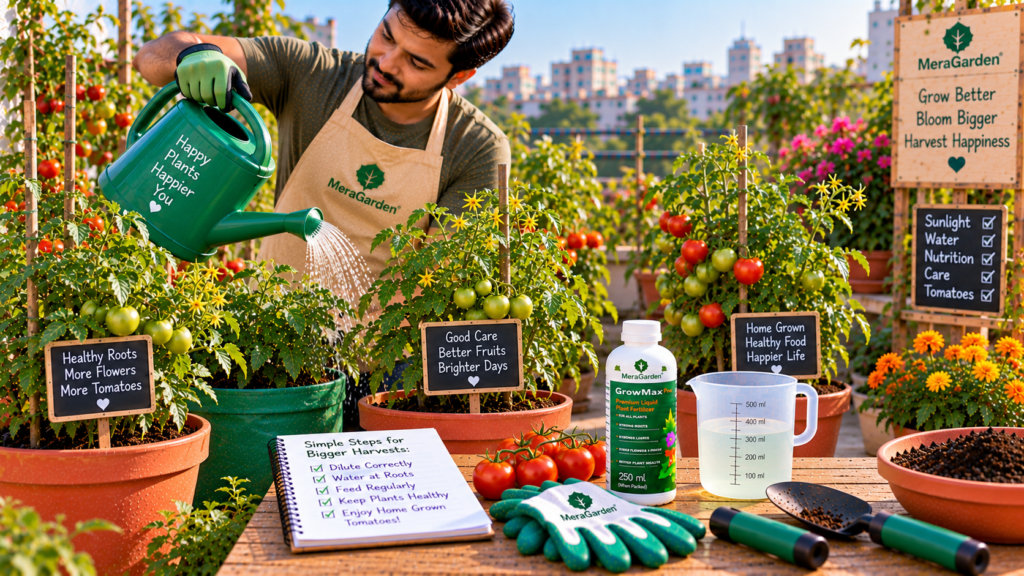
How to Use Liquid Fertilizer for Tomato Plants
Using liquid fertilizer correctly is just as important as choosing the product.
A common mistake is thinking that concentrated fertilizer will produce faster results.
It can instead cause problems if applied incorrectly.
Follow these general principles:
Step 1: Check the plant first
Before feeding, inspect:
- Leaves
- Stems
- Flowers
- Soil moisture
- Root-zone condition
- Signs of pests or disease
If the plant is severely stressed, identify and address the underlying issue first.
Step 2: Read the product label
Different fertilizers have different concentrations.
Do not use a generic dosage copied from another fertilizer.
For MeraGarden GrowMax Pro, follow the dosage and dilution instructions printed on the current product label.
Step 3: Measure accurately
Use a suitable measuring container rather than estimating the quantity by eye.
Accurate measurement makes your feeding routine more consistent.
Step 4: Dilute correctly
Add the measured fertilizer to the appropriate amount of water according to the product label.
Never assume that using a stronger concentration will give better results.
Step 5: Apply to the growing medium
Apply the properly diluted solution as directed on the product label.
Avoid unnecessary application directly onto flowers or foliage unless the product instructions specifically recommend foliar use.
Step 6: Maintain a consistent routine
Tomato plants benefit more from sensible, consistent care than from occasional heavy feeding.
Combine nutrition with:
- Adequate sunlight
- Proper watering
- Good drainage
- Suitable support
- Pest monitoring
- Appropriate pruning
Step 7: Observe the plant
After feeding, continue monitoring the plant.
Look for healthy new growth, flower development and fruit formation rather than expecting an immediate transformation.
Liquid Fertilizer vs Granular Fertilizer for Tomato Plants
Both liquid and granular fertilizers can have a place in gardening, but they work differently.
Liquid Fertilizer
Liquid fertilizer is mixed with water and applied as a solution.
Advantages
- Convenient for container gardening
- Easy to incorporate into a regular watering routine
- Useful when plants need feeding during active growth
- Can be measured and diluted according to the label
- Practical for terrace and balcony gardens
This makes liquid fertilizer particularly convenient for gardeners growing tomatoes in pots and grow bags.
Granular Fertilizer
Granular fertilizers are applied to the growing medium and generally release nutrients differently depending on the formulation.
Advantages
- Can be convenient for longer-term feeding
- Some formulations are slow-release
- Useful for gardeners who prefer less frequent applications
However, application rates still need to be followed carefully.
Which is better?
There is no universal winner.
For a home gardener growing tomatoes in containers, liquid fertilizer can be particularly convenient because it fits easily into a regular watering and feeding routine.
RHS guidance also recommends liquid feeding for container tomatoes during fruit development, while emphasizing following the manufacturer’s instructions.
The most important factor is not simply liquid versus granular.
It is:
Correct product + correct dilution + suitable timing + good overall plant care.
MeraGarden GrowMax Pro for Tomato Plants
For Indian home gardeners growing tomatoes in pots, grow bags, balconies or terrace gardens, MeraGarden GrowMax Pro Liquid Plant Fertilizer can be incorporated into a plant-feeding routine when nutritional support is appropriate.
GrowMax Pro is a concentrated chemical-based liquid plant fertilizer designed for use across different types of plants. Its product positioning focuses on supporting strong roots, greener leaves, flowers and fruits, and convenient liquid application.
However, fertilizer should not be treated as a magic solution for every tomato fruiting problem.
If your tomato plant is not producing fruits because of:
- Insufficient sunlight
- Extreme heat
- Poor pollination
- Irregular watering
- Poor drainage
- Root stress
- Pests or diseases
then simply adding more fertilizer may not solve the problem.
First correct the underlying growing condition.
When nutrition is genuinely needed, use GrowMax Pro according to the current product label instructions and avoid guessing the dosage.
For container tomatoes, a sensible feeding routine should always work together with proper sunlight, watering, drainage and plant support.
Help Your Tomato Plants Grow Better
Healthy tomato production starts with the basics.
Give your plants suitable sunlight, consistent moisture, healthy roots and appropriate nutrition.
🌱 Ready to add liquid plant nutrition to your gardening routine?
👉 Shop MeraGarden GrowMax Pro and support healthier plant growth at home.
Grow Better. Bloom Bigger.
Conclusion
If you are asking, “Why are my tomato plants not producing fruits?”, the answer may not be as simple as a lack of fertilizer.
Tomato fruit production depends on several factors working together.
Start by checking sunlight. Then look at pollination, temperature, watering, nutrition, root health, pruning and pest or disease problems.
One of the most common mistakes is immediately reaching for fertilizer whenever a tomato plant fails to produce fruit. But if the real problem is extreme heat, poor pollination or inadequate sunlight, extra fertilizer may not address the cause.
Likewise, excessive nitrogen can encourage impressive green growth while leaving you disappointed by the number of tomatoes.
For container and terrace gardeners, pay particular attention to watering and root conditions because pots and grow bags can dry out faster than plants growing in the ground.
Once the basic growing conditions are right, appropriate plant nutrition can become a useful part of your routine. A suitable liquid fertilizer such as MeraGarden GrowMax Pro can be used according to its label instructions when your plants need nutritional support.
The goal is not simply to make the plant produce more leaves.
The goal is to create a balanced growing environment where the plant can grow, flower, set fruit and continue producing healthy tomatoes.
With patience, observation and consistent care, your tomato plants can become much more productive.
FAQs
1. Why are my tomato plants not producing fruits?
Common causes include insufficient sunlight, poor pollination, excessive heat, irregular watering, excessive nitrogen, root problems, nutritional imbalance, unsuitable pruning and pests or diseases.
2. Why does my tomato plant have flowers but no tomatoes?
The flowers may not be successfully pollinated, or environmental stress such as excessive heat may cause flowers to drop before fruit develops.
3. Why are my tomato flowers falling off?
High temperatures, especially prolonged hot weather, can cause tomato flowers to abort and fall before fruit develops. Water stress and other environmental problems can also contribute.
4. Can poor sunlight stop tomato plants from producing fruit?
Yes. Tomatoes perform best in a warm, sunny location. Insufficient light can reduce healthy growth and fruit production.
5. Can too much fertilizer stop tomato plants from producing tomatoes?
Excessive fertilizer, particularly excessive nitrogen, can encourage lush vegetative growth without improving fruit production.
6. What is the best fertilizer for tomato plants?
The appropriate fertilizer depends on the plant’s growing stage, growing medium and existing nutrition. For container tomatoes, a suitable liquid tomato fertilizer can be convenient during flowering and fruit development. Always follow the manufacturer’s instructions.
7. Is liquid fertilizer good for tomato plants in pots?
Liquid fertilizer can be very convenient for container tomatoes because it can be diluted and incorporated into a regular feeding routine. The product label should always determine the correct dosage and frequency.
8. Can I use MeraGarden GrowMax Pro on tomato plants?
GrowMax Pro is positioned as a liquid plant fertilizer suitable for all plants. If using it on tomato plants, follow the current product label for dilution and application instructions rather than using a guessed dosage.
9. How often should I fertilize tomato plants?
The appropriate frequency depends on the fertilizer formulation and label instructions, as well as the plant’s growing conditions. Do not assume that more frequent feeding will produce more tomatoes.
10. Do tomato plants need pollination to produce tomatoes?
Yes. Tomato flowers need successful pollen transfer for fruit development. Their flower structure allows pollen movement within the flower, and air movement can assist this process.
11. Can I pollinate tomato flowers by hand?
In protected growing areas with limited air movement, gently shaking or tapping fully open flowers can help move pollen. RHS recommends this as one way to aid pollen transfer.
12. Why are my tomato plants growing lots of leaves but no tomatoes?
One possible cause is excessive nitrogen, which can encourage leafy vegetative growth. However, also check sunlight, temperature, pollination, watering and plant maturity before changing your fertilizer routine.
13. Can a small pot affect tomato fruit production?
Yes. Tomato plants need sufficient root space, moisture and nutrition. RHS recommends relatively large containers for tomatoes, with around 30–45 cm being suitable for a single plant depending on the growing situation.
14. How often should I water tomato plants in pots?
Watering needs vary with temperature, sunlight, container size, plant size and growing medium. Check the moisture level regularly and aim to keep the growing medium evenly moist rather than allowing repeated extreme drying and saturation.
15. How can I get more tomatoes from my plants?
Start with adequate sunlight, good root conditions, consistent watering and successful pollination. Then provide appropriate nutrition, suitable support and regular pest and disease monitoring. Avoid excessive fertilizer and unnecessary pruning
Must Read
- How Often Should You Fertilize Plants? 7 Easy Rules for Healthy Growth
- How Often Should You Fertilize Plants? Complete Fertilizer Schedule
- What Is NPK Fertilizer? 7 Easy Tips for Healthy Plants
- Best Liquid Fertilizer for Plants: Complete Guide for Home Gardeners
- How to Use Liquid Fertilizer for Plants: 7 Easy Steps for Better Growth
- Best Organic Fertilizers for Plants: 7 Natural Options for Healthy Growth
- Best Fertilizer for Indoor Plants in India: 7 Easy Tips for Healthy Growth
- Best Fertilizer for Flowering Plants in India: 7 Top Options
- Best Fertilizer for Plants: 7 Smart Tips to Avoid Common Mistakes
- 5 Signs Your Plants May Need Fertilizer
- How Much Liquid Fertilizer Should You Use for Plants?
- 7 Benefits of Liquid Fertilizer for Plants: Grow Healthier Plants Faster
- 7 Benefits of Liquid Fertilizer for Plants: A Simple Guide for Healthy Growth
- Best Fertilizer for Peace Lily: 7 Powerful Tips for Beautiful Blooms and Avoiding Common Mistakes
- Best Fertilizer for Spider Plant: 7 Powerful Tips for Lush Growth and Avoiding Common Mistakes
- Liquid Fertilizer vs Granular Fertilizer: Which Is Better? 7 Key Differences for Home Gardeners
- Liquid Fertilizer vs Organic Fertilizer: 7 Powerful Pros, Cons & the Best Choice for Your Plants
- How to Choose the Right Fertilizer for Your Plants: 7 Smart Tips to Avoid Common Mistakes
- 5 Positive Signs Your Plants Need Fertilizer — Avoid These Warning Symptoms for Healthier Growth
- How to Grow Peace Lilies
- How To Grow Houseplants