how to make plants grow faster and healthier? Every gardener wants the same thing: healthy plants that grow strongly, produce fresh green leaves and eventually reward you with beautiful flowers, fruits or vegetables.
But if you are a beginner, plant growth can sometimes feel confusing.
You may provide water regularly but still see slow growth. You may place the plant near a window but notice pale leaves. Or you may buy a fertilizer hoping that it will make the plant grow faster, only to see little improvement.
So, how do you make plants grow faster and healthier?
The answer is not simply “use more fertilizer.”
Healthy plant growth depends on several factors working together. Plants need suitable light, appropriate watering, healthy roots, a suitable growing medium, adequate nutrition, the right temperature and protection from pests and diseases.
This becomes even more important when growing plants in pots, containers, grow bags, balconies and Indian terrace gardens. Container plants have limited growing space, and their growing media can dry out or lose available nutrients more quickly than plants growing in the ground.
The good news is that you do not need to be an expert gardener to improve plant growth.
By following a few basic principles consistently, you can create much better growing conditions for your plants.
In this beginner-friendly guide, we will cover 7 powerful ways to encourage healthier plant growth, explain when fertilizer can help, discuss common mistakes and show how a liquid fertilizer can fit into a sensible plant-care routine.
Table of Contents
1. Give Your Plants Enough Light
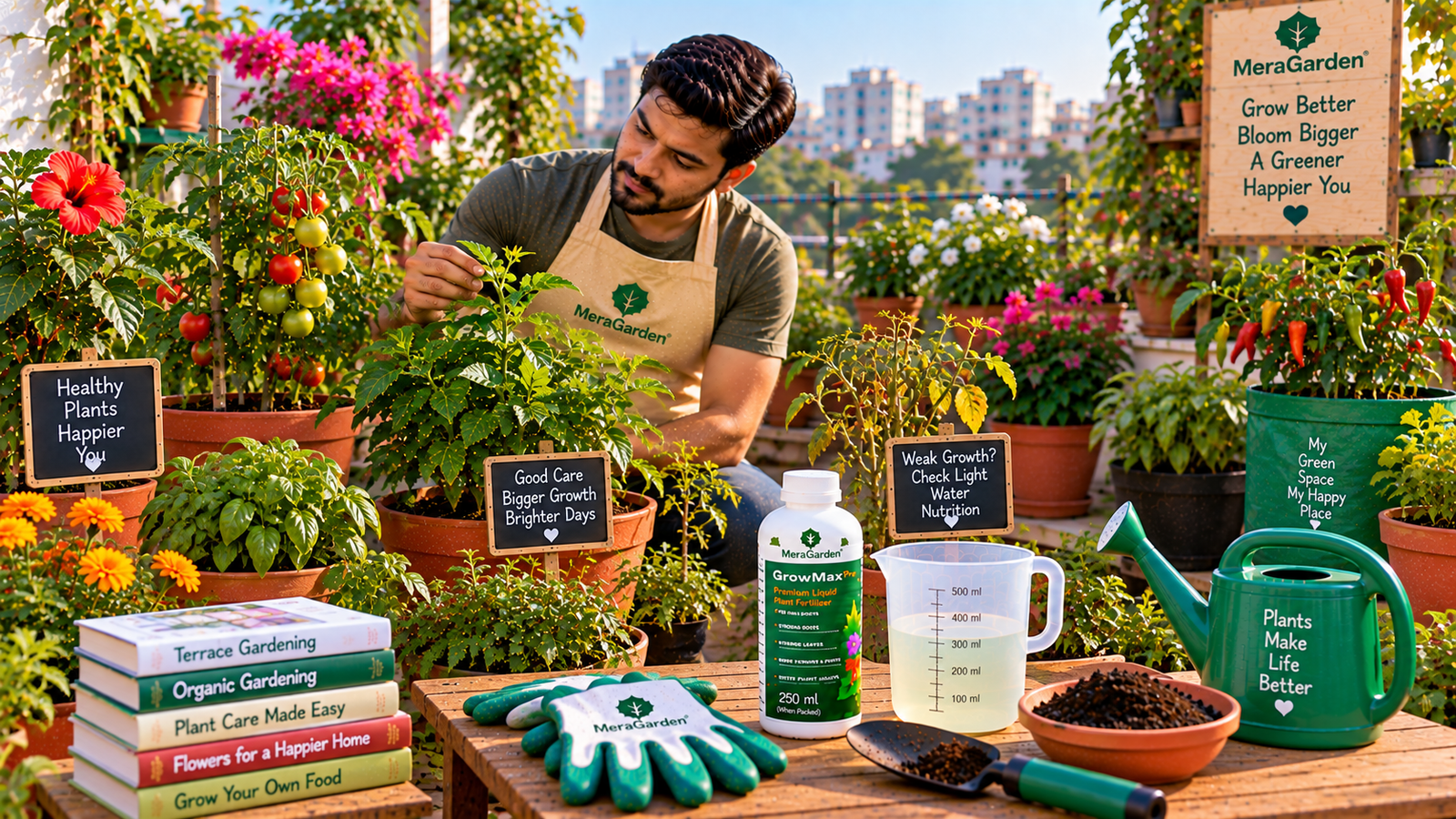
Light is one of the most important requirements for plant growth.
Plants use light to produce energy through photosynthesis. If a plant does not receive suitable light for its species, its growth can become slow, weak or stretched.
This is one reason why simply adding fertilizer may not make a plant grow faster.
If the plant does not have suitable light, its ability to use available nutrients and produce healthy new growth can be limited.
Check the location first
Look at where your plant is growing.
Ask:
- Is it receiving sufficient natural light?
- Is a nearby wall blocking sunlight?
- Is another plant creating too much shade?
- Is the plant suitable for indoor conditions?
- Has the season changed the amount of light reaching it?
Different plants have different light requirements.
Some plants prefer bright direct sunlight, while others perform better in bright indirect light.
For example, many flowering and vegetable plants need strong light to grow and produce flowers or fruits, while several indoor plants can tolerate lower-light conditions.
A simple beginner rule
Choose the plant according to the location rather than forcing the location to suit every plant.
If a terrace receives strong sunlight, select plants that can handle those conditions.
If your home has a bright indoor location, choose plants suited to indoor light.
This simple step can make a significant difference to long-term growth.
2. Water Correctly and Consistently
Water is essential for plant growth, but more water does not necessarily mean faster growth.
One of the most common beginner mistakes is overwatering.
Another is allowing a plant to become extremely dry and then suddenly giving it a large amount of water.
Both situations can create stress.
What happens with too much water?
Constantly wet growing media can reduce the amount of air around the roots. Poor drainage can also encourage root problems.
What happens with too little water?
A plant that repeatedly becomes severely dry may wilt and experience growth stress.
Container plants can be particularly sensitive because pots and grow bags may dry faster in hot weather.
What should beginners do?
Instead of following a fixed rule such as “water every day,” check the growing medium and consider:
- Plant type
- Pot size
- Weather
- Temperature
- Sunlight
- Growing medium
- Drainage
- Plant size
The goal is not to keep every plant permanently wet.
The goal is to provide appropriate and consistent moisture.
Good watering habits create a much better foundation for healthy roots and new growth.
3. Build a Healthy Root Environment
When beginners look at a plant, they usually focus on the leaves.
But healthy growth begins underground.
Roots absorb water and nutrients and provide the foundation for the plant’s overall development.
If the root environment is poor, the plant may struggle even when the leaves appear reasonably healthy.
Common root-zone problems include:
- Poor drainage
- Compacted growing media
- Extremely wet conditions
- Extremely dry conditions
- Insufficient growing space
- Damaged roots
- Unsuitable potting mix
For container gardening, drainage holes are especially important.
Water should not remain trapped around the root zone for long periods.
Choose a suitable container
The container should be appropriate for the plant’s size and growth habit.
A very small pot may restrict root development and make moisture management more difficult.
At the same time, simply moving every small plant into a huge container is not always necessary.
The objective is to create a suitable root environment with:
space + drainage + suitable growing medium + appropriate moisture.
When roots are healthy, the rest of the plant has a much stronger foundation for growth.
4. Use a Suitable Growing Medium
The growing medium provides physical support to the plant while also holding water, air and nutrients around the roots.
Poor-quality or heavily compacted growing media can make plant care difficult.
For container plants, beginners should avoid treating ordinary garden soil as the perfect medium for every pot.
A good container growing medium should provide appropriate:
- Drainage
- Moisture retention
- Air spaces
- Root support
- Nutrient availability
The exact composition depends on the type of plant.
Vegetables, flowering plants, succulents and indoor plants can have different requirements.
Watch your growing medium
If water sits on the surface for a long time, the medium may have drainage problems.
If the medium dries extremely quickly, moisture management may need improvement.
If it has become hard and compacted, root growth can also be affected.
Improving the root environment can therefore be more useful than immediately adding fertilizer.
5. Provide Appropriate Plant Nutrition
Once light, watering, roots and growing media are under control, nutrition becomes another important part of healthy plant growth.
Plants require several nutrients for normal development.
These nutrients support processes associated with:
- Leaf development
- Root growth
- New shoots
- Flowering
- Fruit development
- Overall plant health
However, there is an important difference between adequate nutrition and excessive fertilizer.
More fertilizer is not automatically better.
Applying fertilizer too frequently or at a concentration higher than recommended can damage plants and create nutritional problems.
Look at the whole plant first
Before feeding, ask:
- Is the plant actually growing?
- Are the leaves healthy?
- Is the plant receiving enough light?
- Is watering appropriate?
- Is drainage good?
- Are there pests or diseases?
- Has the plant recently been repotted?
- Does the product label recommend feeding at this stage?
If all basic conditions are suitable and the plant needs nutritional support, a suitable fertilizer can become a useful part of the care routine.
6. Maintain the Right Temperature and Growing Conditions
Plants respond to their surrounding environment.
Temperature, humidity, airflow and seasonal changes can all affect growth.
A plant that grows rapidly during one season may naturally slow down during another.
This is important for beginners because slow growth does not always indicate a fertilizer deficiency.
Watch for environmental stress
Depending on the plant, problems can develop when conditions become:
- Extremely hot
- Extremely cold
- Too dry
- Poorly ventilated
- Constantly exposed to harsh conditions
Indian gardeners need to pay particular attention to hot summer conditions.
A terrace garden can become much hotter than the surrounding environment because of direct sunlight and heated concrete surfaces.
During periods of extreme heat, monitor container plants carefully.
You may need to adjust watering and positioning while avoiding sudden environmental changes.
Remember
Healthy growth does not mean forcing the plant to grow at maximum speed every day.
The objective is to provide conditions in which the plant can grow naturally and consistently.
7. Protect Plants From Pests, Diseases and Care Mistakes
Even when sunlight, water and nutrition are correct, pests and diseases can slow plant growth.
A plant under continuous pest pressure may spend its energy responding to damage instead of producing strong new growth.
Diseases can also affect leaves, stems, roots or flowers.
Inspect your plants regularly
You do not need complicated equipment.
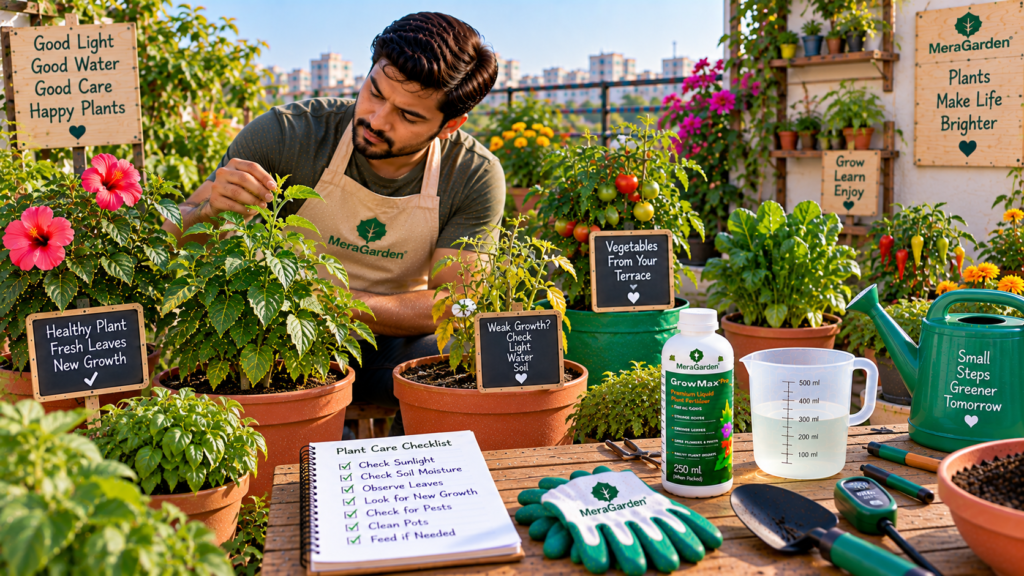
Once or twice a week, carefully look at:
- New leaves
- Older leaves
- Leaf undersides
- Stems
- Flower buds
- Growing points
- Soil surface
Look for unusual spots, insects, distorted leaves, wilting or sudden changes.
Early observation can make plant problems much easier to manage.
Also avoid common care mistakes
Do not:
- Add fertilizer every time growth looks slow
- Water automatically without checking the plant
- Move plants repeatedly between extreme conditions
- Use excessive fertilizer
- Ignore drainage
- Prune without knowing the plant
- Assume every yellow leaf means nutrient deficiency
Healthy plants are usually the result of consistent basic care, not one miracle treatment.
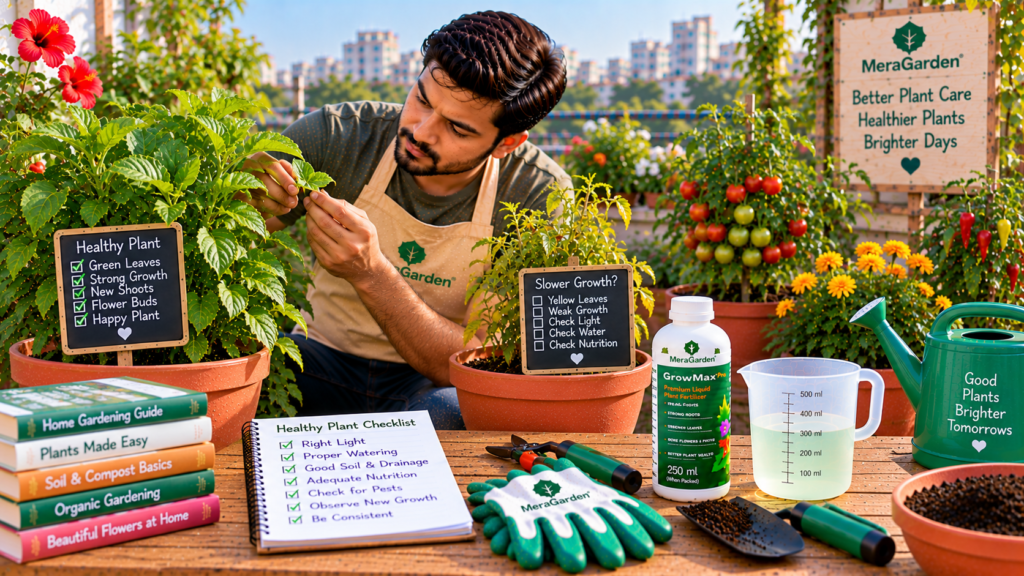
7 Simple Habits That Help Plants Grow Better
At this point, the seven major areas are:
- Give appropriate light
- Water correctly
- Maintain healthy roots
- Use a suitable growing medium
- Provide appropriate nutrition
- Manage environmental conditions
- Monitor pests, diseases and plant health
Think of these as a system.
If one major factor is missing, improving another factor may not completely solve the problem.
For example:
Poor light + more fertilizer = not necessarily faster growth
But:
Suitable light + proper watering + healthy roots + suitable nutrition + consistent care = much better growing conditions.
Give Your Plants a Better Growth Routine
Want healthier plants without making plant care unnecessarily complicated?
Start with the basics and build a consistent routine.
🌱 If your plants need nutritional support, explore MeraGarden GrowMax Pro Liquid Plant Fertilizer.
Use it according to the current product label instructions and combine feeding with proper light, watering, drainage and general plant care.
👉 Shop MeraGarden GrowMax Pro and support your home garden’s growth routine.
How to Use Liquid Fertilizer to Support Plant Growth
Liquid fertilizer can be convenient for home gardeners because it can be mixed with water and incorporated into a regular feeding routine.
But correct application is extremely important.
Step 1: Inspect the plant
Before feeding, check:
- Leaves
- New growth
- Stems
- Flowers
- Soil moisture
- Root-zone condition
- Pest or disease symptoms
Do not automatically fertilize a plant simply because it is growing slowly.
Find the possible cause first.
Step 2: Read the fertilizer label
Every fertilizer can have a different concentration.
Therefore, never assume that the dosage of one fertilizer applies to another product.
For MeraGarden GrowMax Pro, use the dosage and dilution instructions provided on the current product label.
Step 3: Measure the fertilizer
Use an appropriate measuring container.
Do not estimate concentrated fertilizer by simply pouring it directly from the bottle.
Accurate measurement helps create a consistent feeding routine.
Step 4: Dilute with water
Add the measured amount to the recommended amount of water according to the product label.
Do not make the solution stronger because you believe stronger fertilizer will make the plant grow faster.
Step 5: Apply as directed
Use the diluted fertilizer according to the product label.
For routine soil application, apply it as directed around the plant’s growing medium.
Avoid applying concentrated fertilizer directly to plants.
Step 6: Combine feeding with good care
Fertilizer works best as one part of a complete plant-care routine.
Continue providing:
- Suitable light
- Appropriate watering
- Good drainage
- Healthy growing media
- Suitable temperature
- Pest monitoring
Step 7: Observe the plant
Plant growth takes time.
Do not repeatedly increase fertilizer simply because you do not see a visible change immediately.
Observe new leaves, shoots, flower buds and overall plant condition over time.
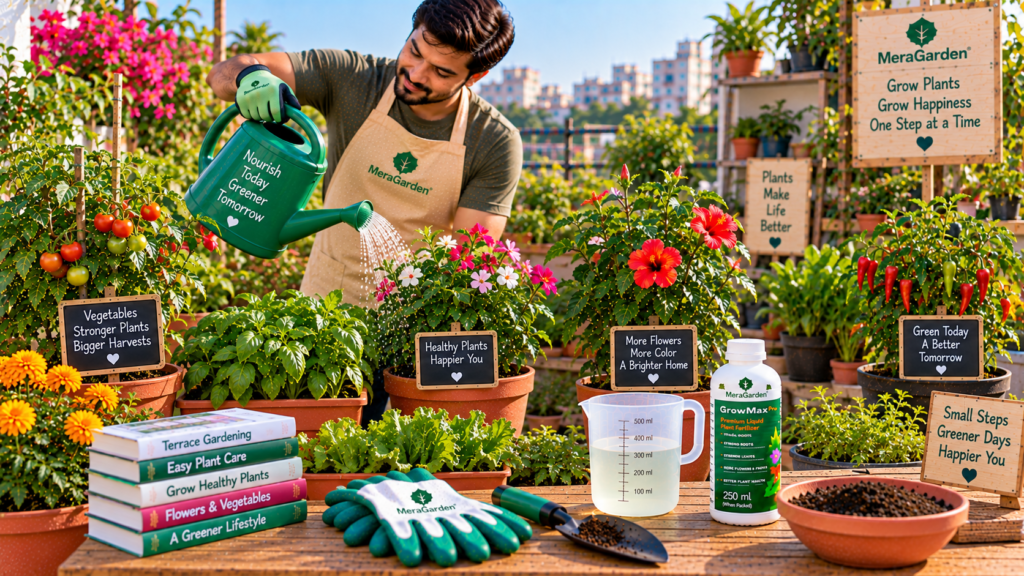
Liquid Fertilizer vs Granular Fertilizer for Plant Growth
Beginners often ask which fertilizer is better: liquid or granular?
There is no single answer for every plant and every garden.
Both types can provide nutrients, but their application methods are different.
Liquid Fertilizer
Liquid fertilizer is mixed with water before application.
Benefits
- Convenient for home gardeners
- Easy to measure
- Practical for container plants
- Can fit into a regular watering routine
- Useful for gardeners who prefer a simple feeding method
Liquid fertilizer can be particularly convenient for plants growing in pots, grow bags, balconies and terrace gardens.
However, correct dilution is essential.
Granular Fertilizer
Granular fertilizer is applied to the growing medium.
Depending on the formulation, granular products may be designed for relatively quick or slower nutrient release.
Benefits
- Convenient for certain long-term feeding routines
- Some formulations require less frequent application
- Easy to incorporate into certain gardening systems
But granular fertilizer must also be applied according to its instructions.
Which one should a beginner choose?
Instead of asking which type is universally better, ask:
Which application method is easier for me to use correctly and consistently?
For many container gardeners, liquid fertilizer offers a straightforward feeding routine.
But the correct product, application rate and timing are more important than choosing a fertilizer simply because it is liquid or granular.
MeraGarden GrowMax Pro for Healthy Plant Growth
If you are looking for a convenient liquid fertilizer for your home garden, MeraGarden GrowMax Pro Liquid Plant Fertilizer can be part of a balanced plant-care routine when nutritional support is appropriate.
GrowMax Pro is a chemical-based liquid plant fertilizer positioned for use on different types of plants, with product-label claims including support for strong roots, greener leaves and more flowers and fruits.
It is important to understand that fertilizer is not a replacement for proper gardening fundamentals.
If your plant is not growing because it has:
- Insufficient light
- Poor drainage
- Severe watering problems
- Root stress
- Pest infestation
- Disease
- Unsuitable temperature
then simply adding more fertilizer may not fix the underlying problem.
First improve the growing conditions.
When nutritional support is appropriate, GrowMax Pro can be included in your plant-care routine.
Most importantly:
Follow the current GrowMax Pro product label for dosage, dilution and application instructions.
Do not use a guessed dosage or copy a dosage from another fertilizer.
The aim should be healthy, sustainable plant growth—not forcing plants to grow unnaturally fast.
Help Your Plants Grow Better
Healthy plants start with simple habits.
☀️ Give them appropriate light.
💧 Water them correctly.
🌱 Maintain healthy roots.
🪴 Use suitable growing media.
🌿 Provide appropriate nutrition.
🔍 Check for pests and diseases.
📅 Stay consistent with plant care.
When your plants need nutritional support, MeraGarden GrowMax Pro can be a convenient addition to your routine.
👉 Shop GrowMax Pro and take a simple step toward healthier plant care.
Grow Better. Bloom Bigger.
Conclusion
Learning how to make plants grow faster and healthier does not require complicated gardening techniques.
For beginners, the most important thing is to understand that plant growth is a combination of several factors.
Start with light.
Make sure the plant is growing in a suitable location and receiving the type of light it needs.
Next, focus on watering.
Avoid both severe dryness and unnecessary overwatering.
Then look below the surface.
Healthy roots need suitable growing space, appropriate moisture, drainage and a suitable growing medium.
Once these basics are working well, consider plant nutrition.
Fertilizer can be useful when plants need additional nutrients, but it should never be treated as a cure for every plant problem. Excessive fertilizer can create its own problems.
Environmental conditions also matter. Temperature, airflow and seasonal changes can influence how quickly a plant grows.
Finally, inspect your plants regularly for pests, diseases and signs of stress.
The biggest secret to healthier plants is usually not a single product.
It is consistent care.
For gardeners growing plants in pots, grow bags, balconies and Indian terrace gardens, a simple routine can make plant care much easier.
If nutritional support is appropriate, a liquid fertilizer such as MeraGarden GrowMax Pro can be included according to its product label.
Remember:
Better growth comes from better conditions, not simply more fertilizer.
Give your plants what they need, observe them regularly and make changes gradually.
With patience and consistent care, even beginners can build a healthier and more productive home garden.
FAQs
1. How can I make my plants grow faster?
Start by providing appropriate light, consistent watering, healthy roots, suitable growing media and adequate nutrition. Also check temperature, pests and diseases before adding fertilizer.
2. Does fertilizer make plants grow faster?
Fertilizer can support growth when nutrients are limiting, but it cannot compensate for poor light, bad watering, root problems or disease. Excess fertilizer can also damage plants.
3. What is the best fertilizer for plant growth?
The best fertilizer depends on the plant, growing medium, growth stage and nutritional requirements. Choose a suitable product and follow its label instructions.
4. Is liquid fertilizer good for plants?
Yes, liquid fertilizer can be a convenient way to provide plant nutrients, particularly for plants growing in pots and containers. Always follow the product’s dilution and application instructions.
5. Can I use liquid fertilizer on all plants?
Some liquid fertilizers are formulated for broad plant use, while others are designed for specific plants. Check the product label before use. For GrowMax Pro, follow the current label instructions.
6. How often should I fertilize my plants?
There is no single frequency that works for every fertilizer and plant. Follow the fertilizer manufacturer’s instructions and consider the plant’s growth stage and growing conditions.
7. Can too much fertilizer slow plant growth?
Yes. Excessive fertilizer can create nutritional or salt-related stress and may damage plants. More fertilizer does not necessarily mean faster growth.
8. Why are my plants growing slowly?
Slow growth can result from insufficient light, incorrect watering, poor drainage, root problems, unsuitable growing media, nutrient issues, temperature stress, pests, diseases or the plant’s natural growth cycle.
9. Does sunlight make plants grow faster?
Suitable sunlight is essential for photosynthesis and healthy plant growth. However, different plants have different light requirements, so more sunlight is not always better.
10. Why are my plant leaves green but the plant is not growing?
The plant may have insufficient light, restricted roots, unsuitable temperature, watering problems, nutritional limitations or simply be in a naturally slow growth phase. Check the overall growing conditions before fertilizing.
11. Can I make indoor plants grow faster?
You can improve indoor growth by providing suitable light, appropriate watering, adequate humidity where needed, suitable growing media, enough root space and appropriate nutrition.
12. Do plants grow faster in bigger pots?
Not necessarily. Plants need an appropriate container size rather than simply the biggest possible pot. An excessively large container can make moisture management more difficult.
13. How do I know if my plant needs fertilizer?
Look at the overall plant condition and growing environment first. Slow growth alone does not prove a nutrient deficiency. Consider light, water, roots and pests before changing your feeding routine.
14. Can MeraGarden GrowMax Pro help plants grow healthier?
GrowMax Pro is a liquid plant fertilizer designed to provide plant nutrition. It can be incorporated into a suitable plant-care routine when nutritional support is appropriate. Use it according to the current product label.
15. How do I use GrowMax Pro on plants?
Follow the current dosage, dilution and application instructions printed on the GrowMax Pro label. Measure the product accurately and do not use a stronger concentration simply to try to accelerate growth.
16. How long does it take for plants to grow faster after fertilizing?
There is no universal timeframe. Plant response depends on species, age, light, water, temperature, root health and nutrient availability. Fertilizer should not be expected to produce an instant visible change.
17. What is the biggest mistake beginners make when trying to grow plants faster?
One of the biggest mistakes is focusing only on fertilizer while ignoring light, watering, drainage and root health.
18. Should I fertilize a sick plant?
Not automatically. First identify why the plant is unhealthy. If the problem is caused by pests, disease, poor watering or root stress, fertilizer may not address the actual cause.
Must Read
- How Often Should You Fertilize Plants? 7 Easy Rules for Healthy Growth
- How Often Should You Fertilize Plants? Complete Fertilizer Schedule
- What Is NPK Fertilizer? 7 Easy Tips for Healthy Plants
- Best Liquid Fertilizer for Plants: Complete Guide for Home Gardeners
- How to Use Liquid Fertilizer for Plants: 7 Easy Steps for Better Growth
- Best Organic Fertilizers for Plants: 7 Natural Options for Healthy Growth
- Best Fertilizer for Indoor Plants in India: 7 Easy Tips for Healthy Growth
- Best Fertilizer for Flowering Plants in India: 7 Top Options
- Best Fertilizer for Plants: 7 Smart Tips to Avoid Common Mistakes
- 5 Signs Your Plants May Need Fertilizer
- How Much Liquid Fertilizer Should You Use for Plants?
- 7 Benefits of Liquid Fertilizer for Plants: Grow Healthier Plants Faster
- 7 Benefits of Liquid Fertilizer for Plants: A Simple Guide for Healthy Growth
- Best Fertilizer for Peace Lily: 7 Powerful Tips for Beautiful Blooms and Avoiding Common Mistakes
- Best Fertilizer for Spider Plant: 7 Powerful Tips for Lush Growth and Avoiding Common Mistakes
- Liquid Fertilizer vs Granular Fertilizer: Which Is Better? 7 Key Differences for Home Gardeners
- Liquid Fertilizer vs Organic Fertilizer: 7 Powerful Pros, Cons & the Best Choice for Your Plants
- How to Choose the Right Fertilizer for Your Plants: 7 Smart Tips to Avoid Common Mistakes
- 5 Positive Signs Your Plants Need Fertilizer — Avoid These Warning Symptoms for Healthier Growth
- How to Grow Peace Lilies
- How To Grow Houseplants