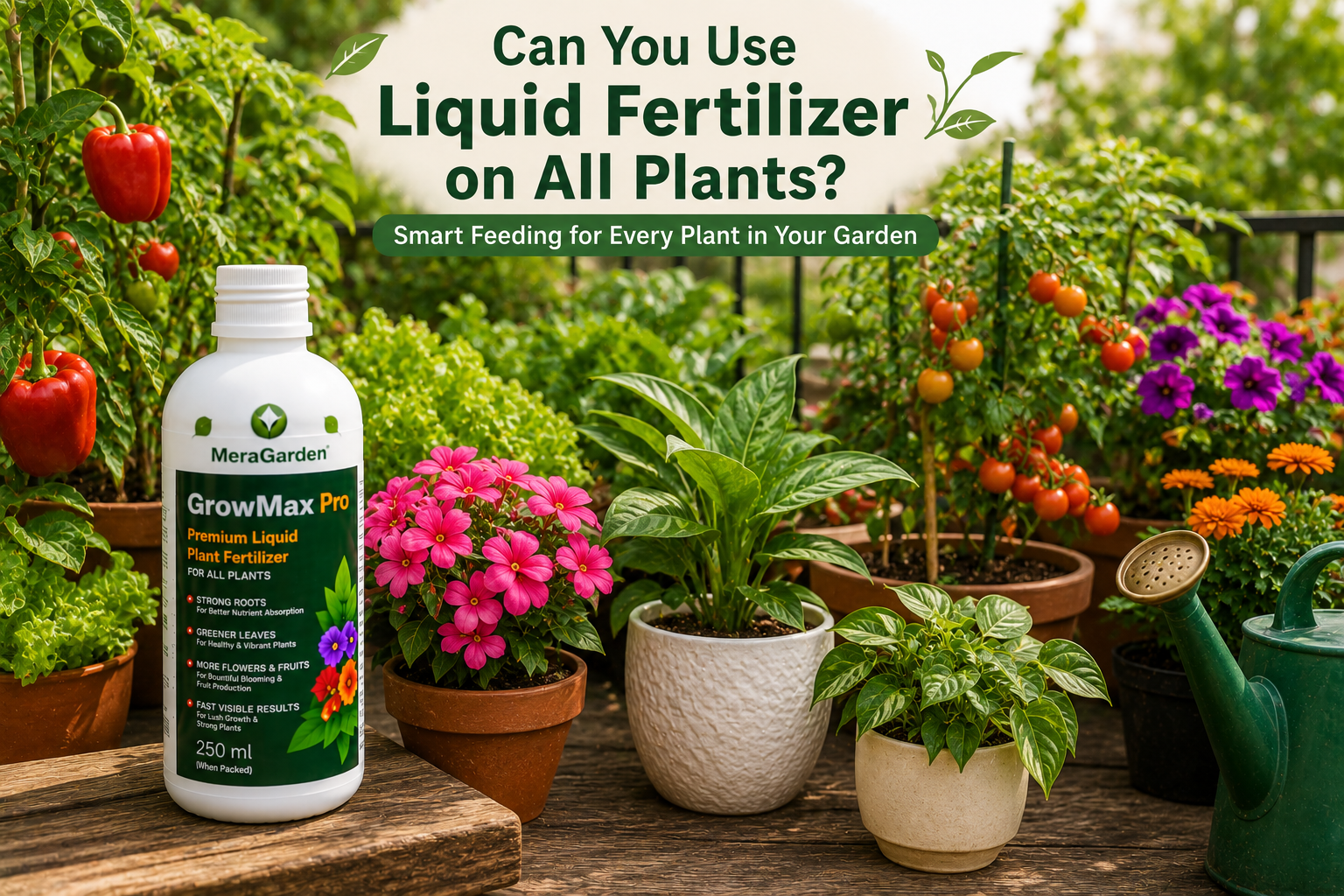
Liquid fertilizer is one of the most convenient ways to provide nutrients to plants. Unlike many dry fertilizers, liquid products can be measured, diluted and applied as part of a regular gardening routine. This makes them particularly attractive to home gardeners growing vegetables, flowering plants, herbs and indoor plants.
But an important question remains:
Can you use liquid fertilizer on all plants?
The short answer is not necessarily.
Many liquid fertilizers can be used on a wide range of plants, but that does not mean every liquid fertilizer is suitable for every plant. Different plants can have different nutritional requirements, while fertilizer formulations can also vary significantly.
For example, the fertilizer routine for a tomato plant may not be exactly the same as the routine for a small indoor plant. Similarly, seedlings can be more sensitive to fertilizer than mature plants, and plants growing in containers may require more careful feeding because the amount of growing medium is limited.
There is another important point: liquid fertilizer itself is not automatically better or safer simply because it is liquid. Correct product selection, dilution and application are what matter.
In this guide, we will explain 7 important things you should know before using liquid fertilizer on different plants. We will also discuss common mistakes, how to dilute liquid fertilizer correctly, how to compare liquid and granular fertilizers, and where MeraGarden GrowMax Pro can fit into a practical home-gardening routine.
The goal is not to use fertilizer on every plant simply because you have it available.
The goal is to understand which plants can use it, when they may need it, and how to apply it correctly.
Table of Contents
Benefits 1–2: Why Liquid Fertilizer Can Be Useful
1. Liquid Fertilizer Can Be Convenient to Measure and Apply
One of the biggest advantages of liquid fertilizer is convenience.
When a concentrated liquid fertilizer is designed to be diluted with water, gardeners can measure a specific amount before preparing the fertilizer solution.
This can make the feeding process easier for:
- Balcony gardens
- Terrace gardens
- Vegetable gardens
- Flower pots
- Indoor plants
- Container gardens
- Small home gardens
For example, instead of spreading dry fertilizer around individual pots, a gardener can prepare the recommended diluted solution and apply it according to the product instructions.
This is especially useful when you have several plants growing in containers.
However, convenience should not lead to careless application.
The fact that liquid fertilizer is easy to mix does not mean that you should use a stronger concentration.
Always follow the manufacturer’s recommended dosage.
2. Liquid Fertilizer Can Fit Different Home-Gardening Needs
Another benefit is flexibility.
Depending on the formulation, liquid fertilizers can be incorporated into the feeding routines of different plant groups.
These may include:
- Flowering plants
- Vegetable plants
- Herbs
- Foliage plants
- Potted plants
- Indoor plants
- Balcony plants
But the word “different” does not mean “all.”
Before using a particular fertilizer, check its label and determine whether the manufacturer recommends it for your plant type.
A product designed for general-purpose plant nutrition may have broader use than a specialized fertilizer.
This is why reading the product label is one of the most important steps in choosing and using liquid fertilizer.
Benefits 3–5: 7 Important Things to Know Before Using Liquid Fertilizer
3. Not Every Plant Has the Same Nutritional Requirements
The first thing to understand is that plants are not nutritionally identical.
A tomato plant, rose, money plant, chilli plant and young seedling can have very different growth patterns.
Their nutritional needs can also change depending on:
- Plant age
- Growth stage
- Growing medium
- Pot size
- Light exposure
- Watering
- Temperature
- Flowering or fruiting stage
This means that you should not automatically assume that one fertilizer schedule works perfectly for every plant.
For example, a rapidly growing vegetable plant may require a different feeding routine from a slow-growing indoor plant.
A young seedling may also be more sensitive to fertilizer than a mature plant.
What should you do?
Start by identifying the plant.
Then check whether your liquid fertilizer is recommended for that type of plant.
Finally, follow the recommended dilution and frequency.
This simple approach can prevent many fertilizer-related mistakes.
4. Always Consider the Fertilizer Formulation
The second important point is that not all liquid fertilizers have the same formulation.
Two bottles can both say “liquid fertilizer” while providing different nutrients or concentrations.
When comparing products, look at:
- NPK analysis
- Nutrient sources
- Micronutrients, if listed
- Recommended plants
- Dilution instructions
- Application frequency
- Manufacturer information
NPK refers to nitrogen, phosphorus and potassium.
Nitrogen is strongly associated with vegetative growth and green plant tissues. Phosphorus is involved in energy-related processes and root and reproductive development. Potassium participates in numerous physiological processes and contributes to overall plant function.
However, the presence of NPK does not mean every fertilizer is appropriate for every plant.
The ratio and concentration matter.
A fertilizer should therefore be selected based on plant requirements rather than simply choosing the product with the largest numbers on the label.
5. Liquid Fertilizer Can Be Useful for Vegetables and Flowering Plants—When Appropriate
Home gardeners commonly use liquid fertilizer for vegetables and flowering plants.
For vegetable plants such as tomatoes, chillies and cucumbers, appropriate nutrition can support normal plant development when combined with sufficient sunlight, water and suitable growing conditions.
Flowering plants can also benefit from appropriate nutrition as part of an overall care routine.
But remember:
Fertilizer does not replace sunlight, water, healthy roots or good soil.
If a tomato plant is not receiving enough sunlight, adding extra fertilizer will not solve the light problem.
If a flowering plant is sitting in waterlogged soil, fertilizer is not the first issue to fix.
Similarly, if an indoor plant is suffering from pest damage, fertilizer alone will not eliminate the pests.
Think of fertilizer as one component of complete plant care.
Benefits 6–7: Important Precautions for Safe Fertilizer Use
6. Correct Dilution Is More Important Than Using More Fertilizer
One of the most common fertilizer mistakes is applying too much.
Some gardeners believe that if a little fertilizer is beneficial, a stronger solution will produce faster growth.
That assumption can be harmful.
Concentrated fertilizer can contribute to excessive salt levels in the growing medium and may stress plant roots when incorrectly applied.
Potential signs of fertilizer-related stress can include:
- Brown leaf tips
- Scorched leaf margins
- Wilting
- Poor growth
- Salt buildup on the soil surface
- Root stress
This is why correct dilution matters.
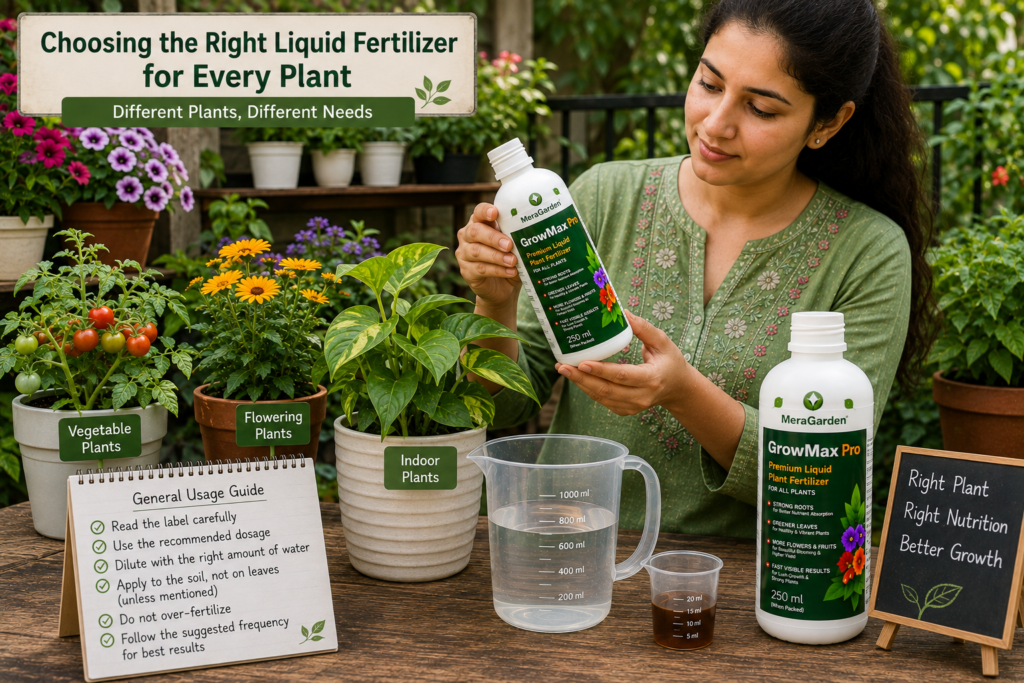
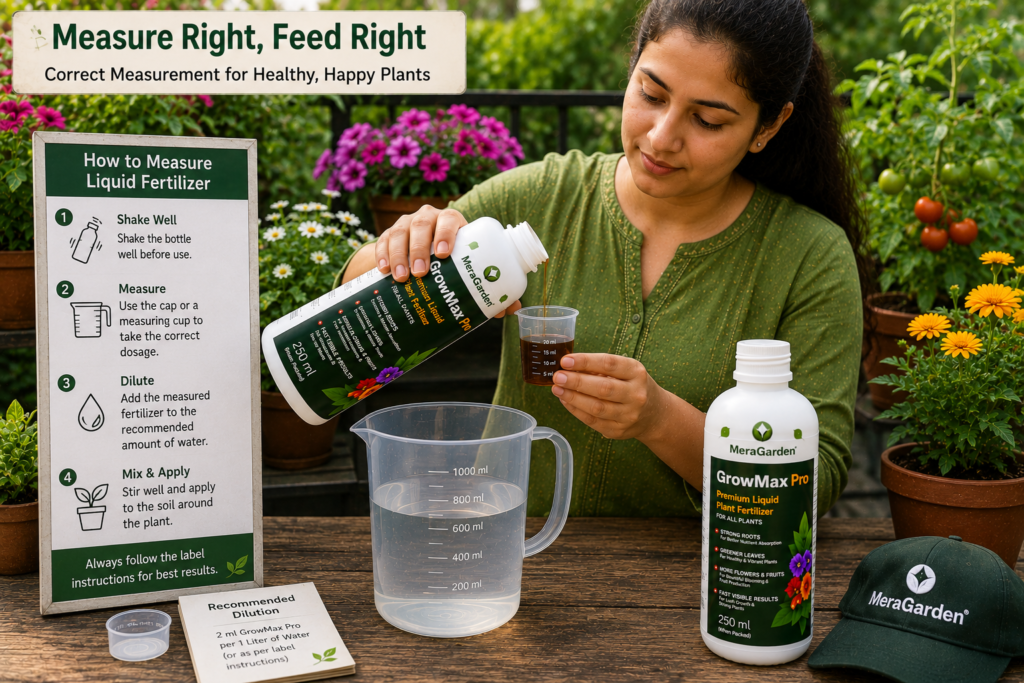
How should you dilute liquid fertilizer?
First, read the manufacturer’s instructions.
Then:
- Measure the recommended quantity.
- Add it to the recommended amount of water.
- Mix properly.
- Apply according to the product directions.
Do not guess the amount.
Do not increase the concentration because the plant appears weak.
And do not copy the dosage from another fertilizer because different products can have different concentrations.
7. Young, Stressed and Newly Transplanted Plants Need Extra Care
Not every plant should be treated the same way.
Young seedlings, newly transplanted plants and severely stressed plants may require more careful fertilizer management.
A recently transplanted plant may already be experiencing root disturbance. A plant suffering from drought or waterlogging may have another underlying problem that should be addressed first.
Before applying fertilizer, check:
Is the plant newly transplanted?
Give it appropriate time to establish according to its growing conditions and plant type.
Is the soil extremely dry?
Correct the watering problem before assuming fertilizer is needed.
Is the soil constantly wet?
Improve drainage and address overwatering.
Are there visible pests?
Identify and manage the pest problem.
Is the plant receiving sufficient light?
Correct the light conditions where possible.
Fertilizer should support a healthy growing system rather than be used as a universal treatment for every plant problem.
Give Your Plants the Right Nutrition
Want a convenient liquid fertilizer option for your home garden?
MeraGarden GrowMax Pro can be considered as part of your regular plant-care routine when used according to its product label.
How to Use Liquid Fertilizer on Different Plants
Once you have confirmed that the product is suitable for your plant, the next step is correct application.
Here is a simple process.
Step 1: Identify the Plant
Determine whether you are feeding:
- Vegetables
- Flowering plants
- Indoor plants
- Herbs
- Potted plants
- Other garden plants
Then confirm that the fertilizer is appropriate for that plant group.
Step 2: Check the Plant’s Condition
Before feeding, inspect the plant.
Look for:
- Yellow leaves
- Wilting
- Pest damage
- Disease symptoms
- Poor drainage
- Very dry soil
- Weak growth
If you find an obvious environmental problem, address that problem first.
Step 3: Read the Fertilizer Label
Read the current label on MeraGarden GrowMax Pro before preparing the solution.
Pay attention to:
- Recommended dosage
- Water quantity
- Suitable plants
- Application frequency
- Application method
- Storage instructions
Product formulations can change, so the current label should always take priority over generic advice.
Step 4: Measure the Correct Quantity
Use a measuring container.
Do not estimate the quantity by simply pouring fertilizer into a watering can.
Accurate measurement helps you maintain the recommended concentration.
Step 5: Dilute With Water
Add the measured fertilizer to the recommended amount of water.
Mix thoroughly.
The objective is to prepare the concentration specified by the manufacturer.
Step 6: Apply According to the Instructions
Apply the prepared solution according to the product label.
For soil applications, avoid deliberately concentrating fertilizer directly against the stem unless the product specifically instructs you to do so.
Step 7: Monitor Your Plants
After application, continue observing the plants.
Look at:
- New growth
- Leaf color
- Flower production
- Overall plant vigor
- Any signs of stress
If problems appear, do not automatically increase fertilizer.
Investigate watering, light, drainage, pests and other possible causes.
Liquid Fertilizer vs Granular Fertilizer
Both liquid and granular fertilizers can have a place in home gardening.
The better choice depends on your plants, product formulation and preferred application method.
| Feature | Liquid Fertilizer | Granular Fertilizer |
|---|---|---|
| Form | Liquid | Dry granules |
| Measurement | Usually measured before dilution | Measured according to product instructions |
| Application | Often diluted with water | Applied directly to growing medium as directed |
| Convenience | Convenient for many container plants | Convenient for dry applications |
| Concentration control | Can be controlled through dilution | Depends on application rate |
| Indoor plants | Can be convenient when suitable | May be less convenient in some indoor settings |
| Vegetable plants | Suitable products are available | Suitable products are available |
| Flowering plants | Suitable products are available | Suitable products are available |
| Risk of overapplication | Possible if incorrectly diluted | Possible if excessive amounts are applied |
| Best choice | Depends on plant and formulation | Depends on plant and formulation |
Neither format should automatically be considered superior.
The most important factors are correct nutrients, appropriate dosage and proper application.
MeraGarden GrowMax Pro: A Convenient Liquid Fertilizer Option
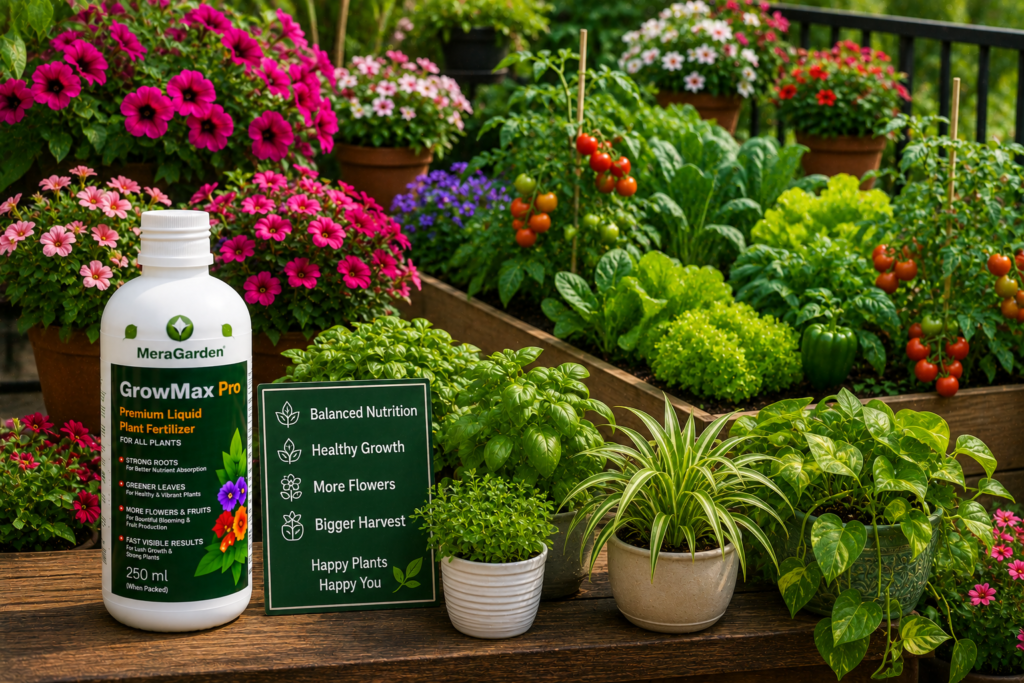
If you prefer liquid fertilizer for your home garden, MeraGarden GrowMax Pro can be considered as part of a regular plant-nutrition routine.
Its liquid format can be convenient for gardeners who want to measure and dilute fertilizer before application.
This can be useful when caring for a mixed home garden containing:
- Vegetable plants
- Flowering plants
- Indoor plants
- Balcony plants
- Potted plants
- Terrace-garden plants
However, it is important not to interpret “for all plants” as permission to ignore product instructions.
Different plants can have different needs, and the appropriate application depends on the product’s formulation and label directions.
Before using GrowMax Pro on a particular plant, check the current product information and confirm that the plant is included among the recommended uses.
Why correct dosage matters
A concentrated liquid fertilizer must be diluted according to the manufacturer’s instructions.
Using a higher concentration does not automatically provide better nutrition.
A good fertilizer routine is based on:
Correct Product → Correct Plant → Correct Dosage → Correct Dilution → Correct Frequency
This approach is much better than simply fertilizing whenever a plant looks unhealthy.
Make Your Fertilizer Routine Simple
Looking for a convenient liquid fertilizer for your home garden?
Explore MeraGarden GrowMax Pro and follow the recommended product instructions for proper dilution and application.
Conclusion
So, can you use liquid fertilizer on all plants?
Not automatically.
Many liquid fertilizers can be used on a broad range of plants, but suitability depends on the specific formulation, plant type, growth stage and manufacturer’s instructions.
Before using liquid fertilizer, remember these important points:
- Identify your plant first.
- Check the fertilizer formulation.
- Understand the plant’s nutritional requirements.
- Consider the growing environment.
- Measure the correct amount.
- Dilute according to the product label.
- Monitor plants instead of assuming more fertilizer is better.
Liquid fertilizer can be a convenient choice for home gardeners because it can be measured and diluted before application. It can fit into routines for vegetables, flowering plants and potted plants when the product is suitable.
MeraGarden GrowMax Pro can be considered as a liquid fertilizer option for your home-garden routine, provided you follow the current product label and recommended application instructions.
Remember that fertilizer is only one part of plant care.
Healthy plants also need appropriate sunlight, water, drainage, growing medium, temperature and protection from pests and diseases.
The smartest fertilizer routine is not about feeding every plant more. It is about giving suitable plants the right nutrition in the right amount at the right time.
FAQs
1. Can you use liquid fertilizer on all plants?
Not necessarily. Some liquid fertilizers are formulated for broad plant use, while others may be designed for specific plants or purposes. Always check the product label before application.
2. Is liquid fertilizer safe for indoor plants?
A liquid fertilizer can be suitable for indoor plants if the product is recommended for them. Follow the manufacturer’s dosage and dilution instructions carefully.
3. Can I use liquid fertilizer on vegetables?
Many liquid fertilizers can be used on vegetable plants when they are specifically suitable for vegetables. Always follow the product label.
4. Can liquid fertilizer be used on flowering plants?
Yes, suitable liquid fertilizers can be incorporated into the feeding routine of flowering plants. However, fertilizer alone does not guarantee more flowers.
5. Can liquid fertilizer harm plants?
Incorrect use, including excessive concentration or application, can potentially cause plant stress. Follow the recommended dosage and dilution.
6. Should I use more liquid fertilizer if my plant is growing slowly?
No. First investigate other causes such as insufficient light, watering problems, poor drainage, pests, disease or root issues.
7. Can I use the same liquid fertilizer for vegetables and flowers?
It depends on the product formulation. If the manufacturer recommends the product for both plant groups, it may be suitable when used according to the specified instructions.
8. Is liquid fertilizer better than granular fertilizer?
Neither is universally better. Liquid fertilizer can be convenient for measuring and dilution, while granular fertilizer can be convenient for dry applications. The appropriate choice depends on your plants and gardening routine.
9. How often should liquid fertilizer be applied?
Application frequency depends on the specific fertilizer and plant. Follow the manufacturer’s recommended schedule instead of applying fertilizer based on guesswork.
10. Should I fertilize newly transplanted plants?
Newly transplanted plants can be sensitive because their roots may be disturbed. Follow the fertilizer and plant-care recommendations for the particular plant rather than immediately applying a strong fertilizer solution.
11. Can I use MeraGarden GrowMax Pro on every plant?
Check the current MeraGarden GrowMax Pro product label for recommended plants and application instructions. Do not assume that one dosage is appropriate for every plant.
12. What is the biggest mistake when using liquid fertilizer?
One of the biggest mistakes is using too much fertilizer or making the solution stronger than recommended. Always measure the product and follow the manufacturer’s dilution instructions.
Recommended Internal Links
- How Often Should You Fertilize Plants? 7 Easy Rules for Healthy Growth
- How Often Should You Fertilize Plants? Complete Fertilizer Schedule
- What Is NPK Fertilizer? 7 Easy Tips for Healthy Plants
- Best Liquid Fertilizer for Plants: Complete Guide for Home Gardeners
- How to Use Liquid Fertilizer for Plants: 7 Easy Steps for Better Growth
- Best Organic Fertilizers for Plants: 7 Natural Options for Healthy Growth
- Best Fertilizer for Indoor Plants in India: 7 Easy Tips for Healthy Growth
- Best Fertilizer for Flowering Plants in India: 7 Top Options
- Best Fertilizer for Plants: 7 Smart Tips to Avoid Common Mistakes
- 5 Signs Your Plants May Need Fertilizer
- How Much Liquid Fertilizer Should You Use for Plants?
- 7 Benefits of Liquid Fertilizer for Plants: Grow Healthier Plants Faster
- 7 Benefits of Liquid Fertilizer for Plants: A Simple Guide for Healthy Growth
- Best Fertilizer for Peace Lily: 7 Powerful Tips for Beautiful Blooms and Avoiding Common Mistakes
- Best Fertilizer for Spider Plant: 7 Powerful Tips for Lush Growth and Avoiding Common Mistakes
- Liquid Fertilizer vs Granular Fertilizer: Which Is Better? 7 Key Differences for Home Gardeners
- Liquid Fertilizer vs Organic Fertilizer: 7 Powerful Pros, Cons & the Best Choice for Your Plants
- How to Choose the Right Fertilizer for Your Plants: 7 Smart Tips to Avoid Common Mistakes
- 5 Positive Signs Your Plants Need Fertilizer — Avoid These Warning Symptoms for Healthier Growth
- How to Grow Peace Lilies
- How To Grow Houseplants