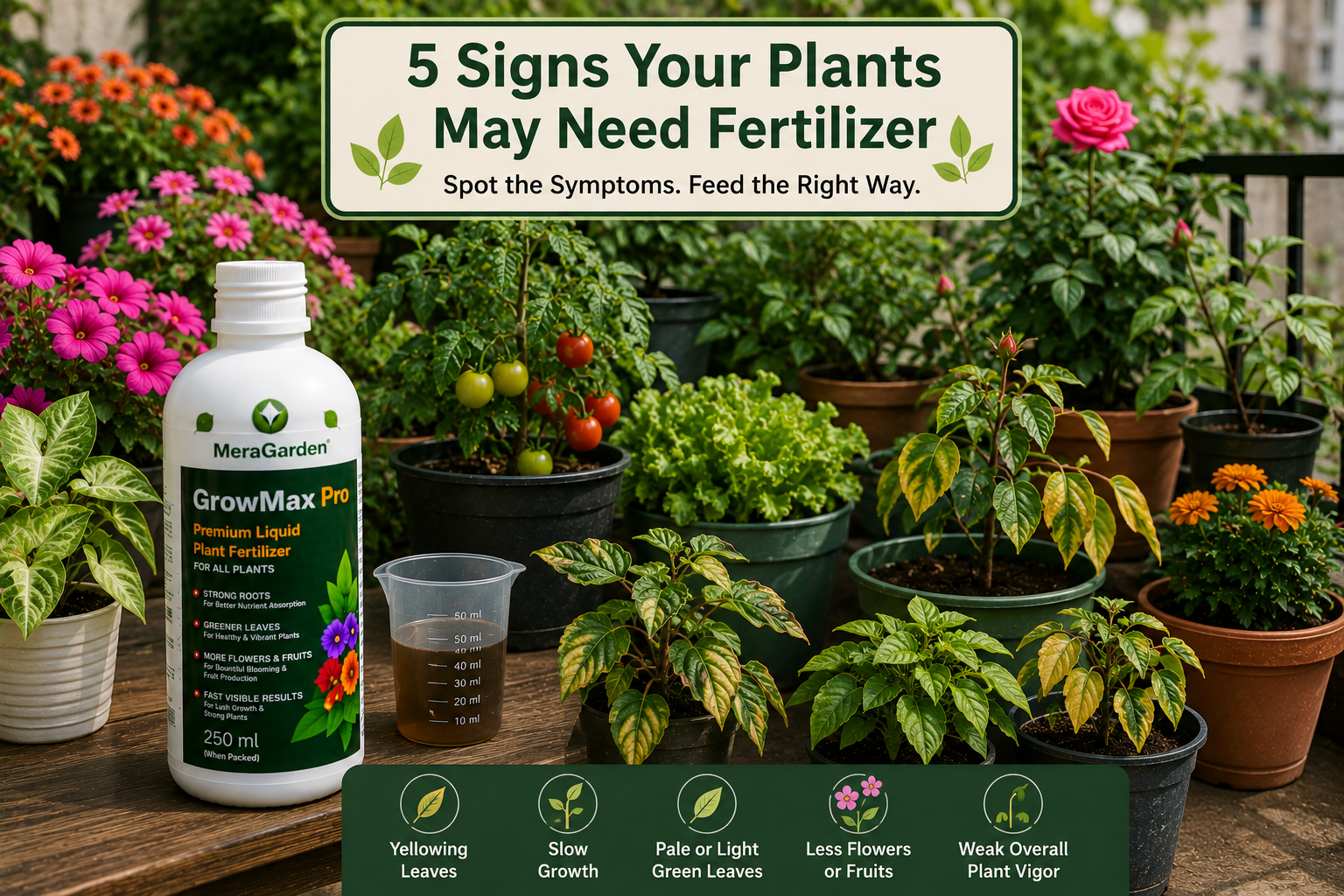
Healthy plants need more than sunlight and water. They also require a balanced supply of essential nutrients to produce new leaves, develop strong roots, support flowering and, in the case of vegetables and fruit plants, produce healthy harvests.
However, knowing when your plants need fertilizer can be difficult. Many gardeners either fertilize too frequently or wait until their plants are already showing serious problems. Both approaches can create unnecessary problems.
Plants communicate their condition through their leaves, stems, growth rate and overall appearance. Slow growth, pale foliage, weak flowering and poor development can sometimes indicate that the plant is not receiving enough nutrients. But these symptoms can also have other causes, such as insufficient light, watering problems, pests, diseases or poor soil conditions.
That is why it is important to look at several signs together rather than assuming that every yellow leaf means the plant needs fertilizer.
In this guide, we will discuss 5 important signs your plants may need fertilizer, explain what they can mean, and show you how to use fertilizer more carefully. We will also look at liquid fertilizer, different fertilizer options and how MeraGarden GrowMax Pro can fit into a regular home-garden feeding routine.
The objective is simple: identify potential nutrient problems early and avoid common fertilizer mistakes.
Table of Contents
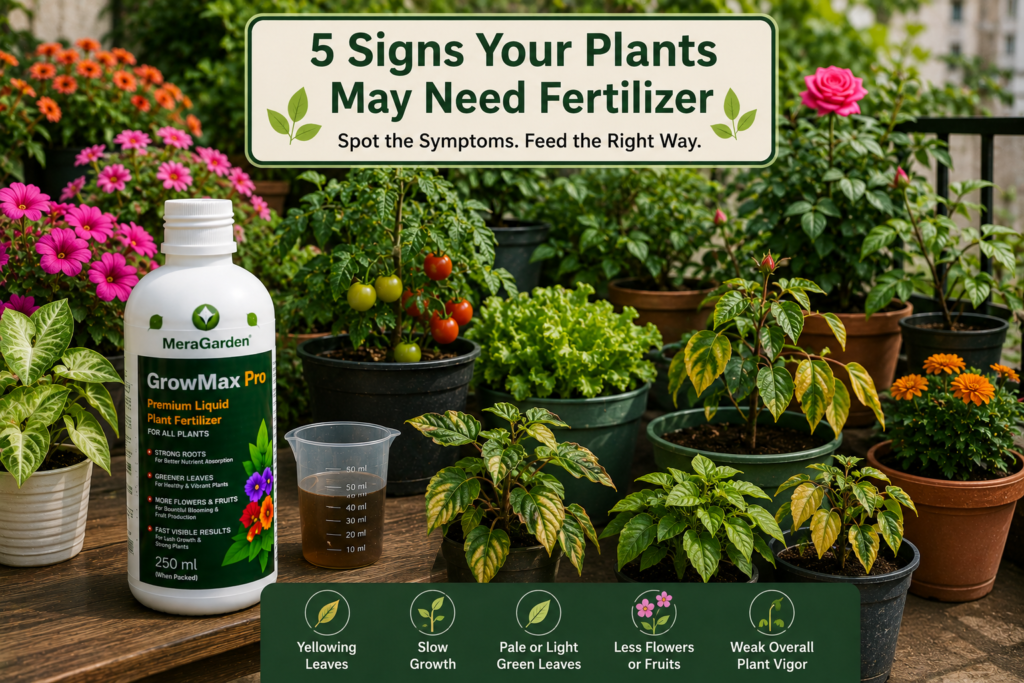
Benefits 1–2: Why Recognizing Fertilizer Needs Early Matters
1. Early Recognition Can Help Maintain Healthy Plant Growth
One of the biggest advantages of paying attention to your plants is that you can notice changes before they become severe.
A healthy plant generally produces new growth according to its species and growing conditions. If growth becomes unusually slow despite suitable light, watering and temperature, nutrition may be one factor worth checking.
Plants use nutrients continuously as they grow. Nutrients are involved in processes such as:
- Leaf development
- Root development
- Energy metabolism
- Flower production
- Fruit development
- General plant growth
When available nutrients are insufficient, growth may slow down.
However, gardeners should not immediately assume that adding more fertilizer will solve the problem. Before feeding, inspect the growing conditions.
Ask:
- Is the plant receiving enough light?
- Is the soil staying too wet?
- Is the plant getting enough water?
- Is the pot large enough?
- Are there insects on the leaves?
- Is the plant showing signs of disease?
- Has the plant recently been transplanted?
If these conditions appear suitable, nutrition can then be considered as one possible factor.
2. Proper Nutrition Can Support Stronger Overall Plant Development
Plants require a range of essential nutrients. Nitrogen, phosphorus and potassium are among the nutrients most commonly discussed in fertilizers, but plants also require several secondary and micronutrients.
A suitable fertilizer can provide nutrients that support normal plant development when applied correctly.
For example, nitrogen is closely associated with vegetative growth and green plant tissues. Potassium is involved in several physiological processes, while phosphorus has important roles in energy-related processes and root and reproductive development.
This is why choosing a fertilizer should involve more than simply looking for the highest number on the package.
A fertilizer should match:
- Plant type
- Growth stage
- Growing medium
- Nutritional requirements
- Application method
More fertilizer does not mean more growth. Correct nutrition is more important than excessive nutrition.
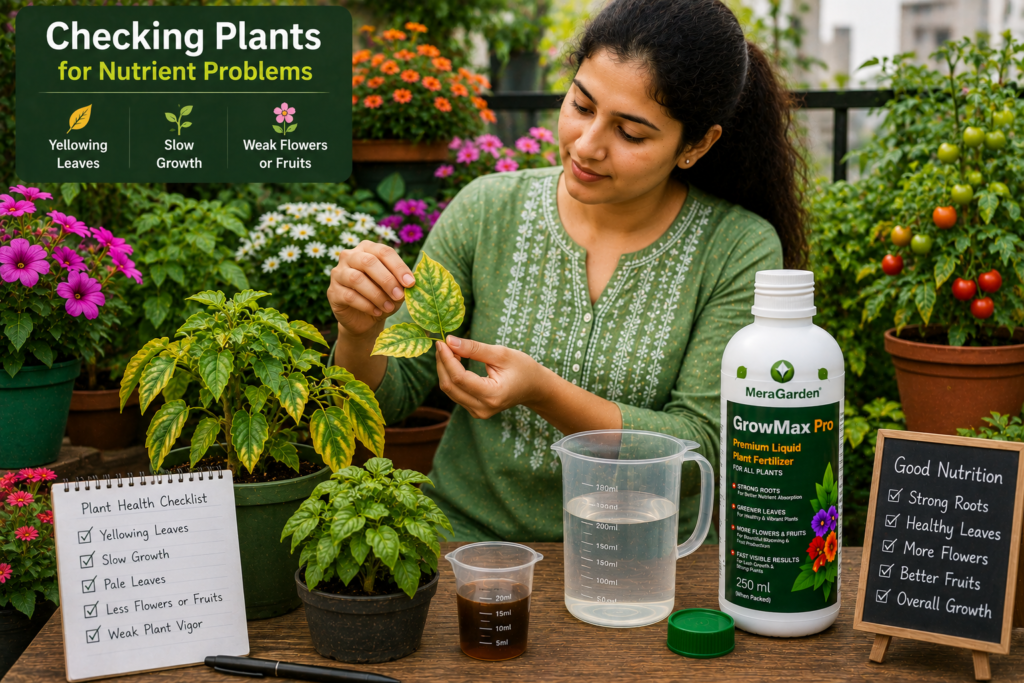
Benefits 3–5: 5 Warning Signs Your Plants May Need Fertilizer
3. Sign #1 — Older Leaves Become Pale or Yellow
One of the most noticeable changes gardeners see is a change in leaf color.
If normally green leaves gradually become pale or yellow, nutrient availability may be one possible explanation.
Nitrogen deficiency is commonly associated with chlorosis, particularly in older leaves, because nitrogen is mobile within plants. However, yellowing leaves can have many other causes.
For example:
- Overwatering
- Poor drainage
- Root damage
- Insufficient light
- Pest infestation
- Natural aging
- Temperature stress
Therefore, yellow leaves alone are not enough evidence to conclude that fertilizer is required.
Look at the overall plant.
If the plant has generally poor growth along with pale foliage and other conditions appear appropriate, nutritional deficiency becomes more worth investigating.
What should you do?
First inspect the soil moisture and drainage. Check the underside of leaves for pests and consider whether the plant receives suitable light.
If everything else appears appropriate, check the fertilizer label and determine whether the product is suitable for the plant.
Avoid immediately applying a concentrated fertilizer.
4. Sign #2 — New Growth Is Smaller or Growth Has Become Unusually Slow
Another possible sign is noticeably slow growth.
For many actively growing plants, healthy conditions should result in the production of new leaves, shoots or other growth.
If a plant appears healthy but suddenly stops developing normally, consider its basic growing conditions first.
A lack of nutrients can contribute to poor growth, but it is not the only possibility.
Common causes include:
- Poor light
- Incorrect watering
- Compacted growing medium
- Root-bound conditions
- Temperature problems
- Pests
- Disease
- Nutrient deficiency
If the plant has been growing in the same container for a long period, the growing medium may also need attention.
A balanced plant-care routine includes proper sunlight, watering, drainage, suitable growing medium and appropriate nutrition.
Why fertilizer can matter
Nutrients are raw materials plants use for normal growth. When nutrients are insufficient, providing appropriate nutrition can help support normal development.
But fertilizer works best when the plant’s other requirements are also being met.
5. Sign #3 — Leaves Look Pale Even Though the Plant Is Getting Suitable Light
Sometimes gardeners notice that a plant is receiving sufficient light but its foliage still looks unusually pale.
This can be a useful clue to investigate nutrition.
Healthy green foliage depends on several factors, including light, water, plant health and nutrient availability.
If the plant has:
- Appropriate light
- Reasonable watering
- Good drainage
- No obvious pest infestation
but still shows persistent pale foliage and weak growth, nutritional issues may deserve attention.
Do not diagnose a specific deficiency simply by looking at one symptom.
Different nutrient deficiencies can produce different patterns, and several environmental problems can look similar.
For a home gardener, the practical approach is to first correct obvious environmental problems and then use a suitable fertilizer according to its instructions.
6. Sign #4 — Flowering or Fruit Production Becomes Weak
Flowering and fruiting plants have nutritional requirements that can change during their development.
If a normally productive plant is growing leaves but producing very few flowers or fruits, several factors should be considered.
These can include:
- Plant maturity
- Light availability
- Temperature
- Pollination
- Watering
- Pruning
- Nutritional balance
- Pest or disease pressure
Nutrition is therefore only one piece of the puzzle.
For flowering plants such as roses, the plant needs appropriate growing conditions as well as suitable nutrition.
Likewise, tomato and chilli plants need appropriate sunlight, water, temperature and nutrition to perform well.
Instead of automatically using a high-phosphorus fertilizer, first understand the actual product and the plant’s requirements.
7. Sign #5 — Overall Plant Vigor Appears Weak
The fifth major sign is a general decline in plant vigor.
A plant may look less vigorous than expected, produce weak new growth or fail to develop normally.
This can sometimes indicate inadequate nutrition, especially when other growing conditions are appropriate.
Look at the whole plant rather than focusing on one leaf.
A potentially nutrient-related problem becomes more plausible when you notice several symptoms together, such as:
- Slow growth
- Pale foliage
- Reduced new growth
- Poor flowering
- Weak overall development
If several symptoms appear at the same time, review your fertilizer routine and growing conditions.
At this stage, it is better to investigate the cause rather than simply increasing the fertilizer dose.
Give Your Plants the Nutrition They Need
If your plants are showing possible signs of nutritional stress and their basic growing conditions are suitable, consider adding an appropriate fertilizer to your plant-care routine.
MeraGarden GrowMax Pro is a liquid plant fertilizer that can be considered for home-garden feeding when used according to its product instructions.
How to Use Liquid Fertilizer Correctly
Once you decide that fertilizer may be appropriate, the next step is using it correctly.
A common mistake among home gardeners is thinking that a weak-looking plant needs a very strong fertilizer solution.
This can be counterproductive.
Always follow the fertilizer manufacturer’s recommended dilution and frequency.
Step 1: Check the Plant First
Before applying fertilizer, inspect the plant.
Look for:
- Yellowing leaves
- Pest activity
- Disease symptoms
- Waterlogging
- Dry soil
- Poor drainage
- Insufficient sunlight
If the actual problem is overwatering or lack of sunlight, fertilizer may not solve it.
Step 2: Read the Product Label
Before using MeraGarden GrowMax Pro, read the current product label carefully.
Check the recommended:
- Dilution
- Dosage
- Application method
- Frequency
- Suitable plants
Do not rely on a generic fertilizer dosage from another product because formulations can differ.
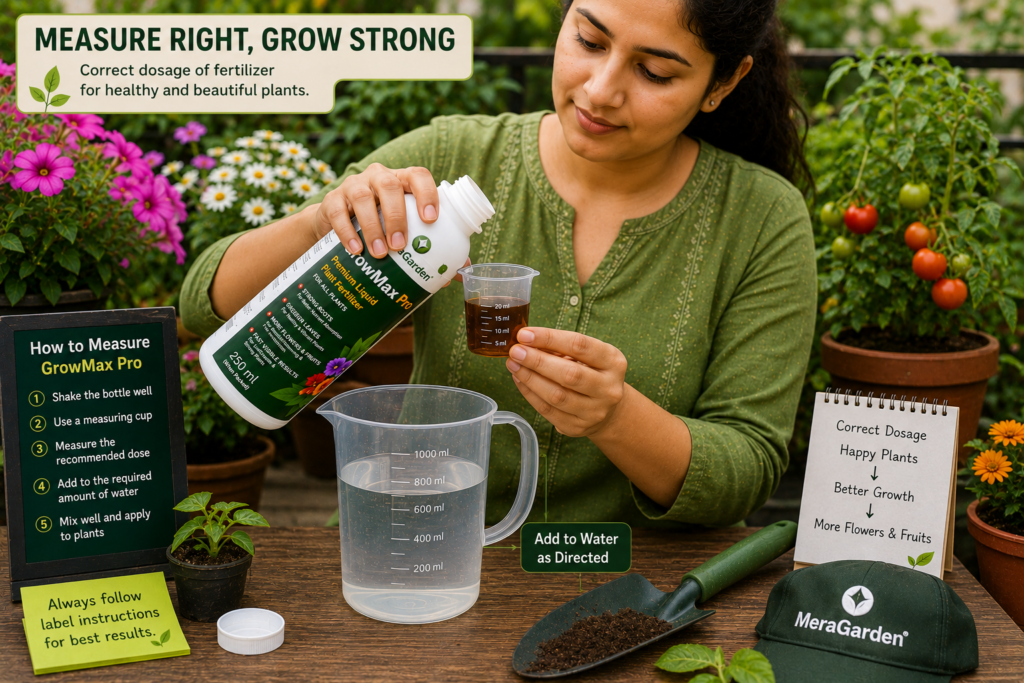
Step 3: Measure the Fertilizer
Use a suitable measuring container.
Measuring is especially important when using a concentrated liquid fertilizer.
Do not estimate the quantity by simply pouring directly into the watering can.
Step 4: Dilute With Water
Add the measured amount of fertilizer to the recommended quantity of water.
Mix thoroughly according to the product instructions.
The final concentration should match the manufacturer’s recommended application rate.
Step 5: Apply Around the Plant as Directed
For soil application, distribute the fertilizer solution appropriately around the root zone according to the product instructions.
Avoid deliberately concentrating fertilizer directly against the plant stem.
Step 6: Follow the Recommended Schedule
Do not apply fertilizer every day unless the product label specifically instructs you to do so.
A regular but appropriate feeding schedule is preferable to excessive applications.
Step 7: Monitor the Plant
After applying fertilizer, continue observing the plant.
Look for normal new growth and overall improvement.
If symptoms continue or become worse, investigate other causes rather than automatically increasing the fertilizer concentration.
Liquid Fertilizer vs Other Fertilizer Options
When choosing fertilizer, gardeners commonly encounter liquid, granular and organic options.
Each has different characteristics.
| Feature | Liquid Fertilizer | Granular Fertilizer | Organic Fertilizer |
|---|---|---|---|
| Form | Liquid concentrate or ready-to-use liquid | Dry granules | Liquid or solid |
| Measurement | Usually measured before dilution | Measured according to label | Depends on product |
| Application | Usually diluted with water | Applied to soil/media | Depends on product |
| Convenience | Convenient for many home gardeners | Convenient for dry application | Varies by formulation |
| Nutrient release | Depends on formulation | Depends on formulation | Depends on ingredients |
| Indoor use | Can be convenient when appropriately formulated | Can be messy if over-applied | Depends on product |
| Vegetable gardens | Suitable products are available | Suitable products are available | Suitable products are available |
| Flowering plants | Suitable products are available | Suitable products are available | Suitable products are available |
The important point is that liquid does not automatically mean better, and organic does not automatically mean better.
The best option depends on your plants, growing conditions and fertilizer formulation.
Why Consider MeraGarden GrowMax Pro?
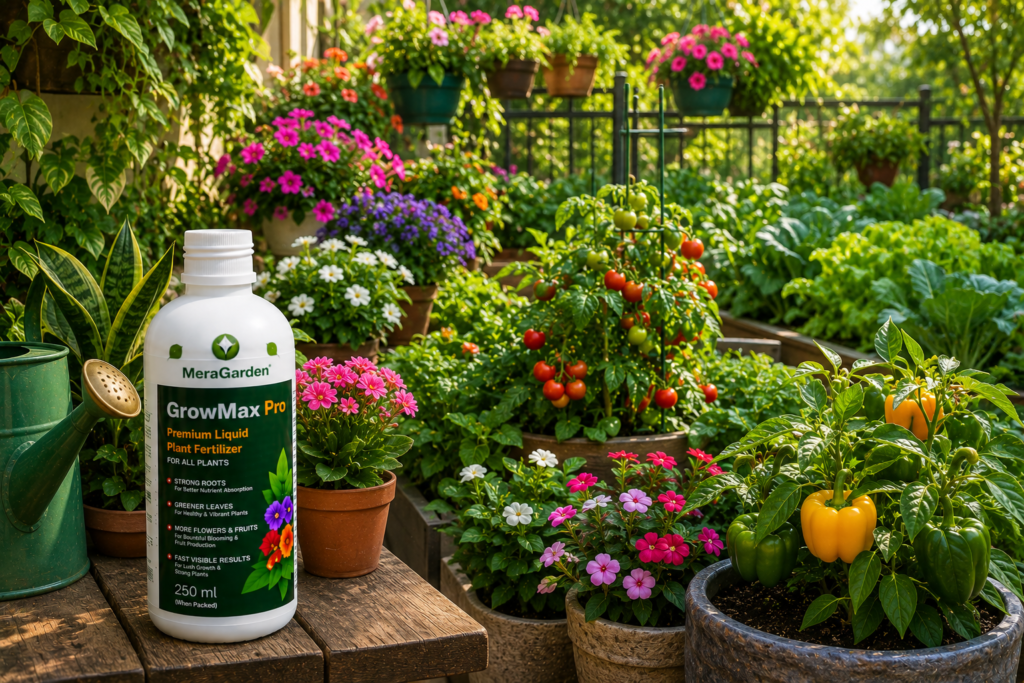
For home gardeners who prefer a liquid fertilizer, MeraGarden GrowMax Pro can be incorporated into a regular plant-care routine according to its product instructions.
A liquid format can be practical because the gardener can measure the required amount and dilute it before application.
This can be useful for gardens containing different types of plants, including:
- Flowering plants
- Vegetable plants
- Potted plants
- Indoor plants
- Balcony plants
- Terrace-garden plants
The important thing is to use the product according to its label rather than treating fertilizer as a quick solution for every plant problem.
If your plant has yellow leaves because of overwatering, for example, adding additional fertilizer will not correct the underlying drainage issue.
Likewise, if a plant is suffering from pests, fertilizer alone will not address the infestation.
Good gardening combines:
Nutrition + Light + Water + Drainage + Healthy Roots + Pest Management + Suitable Growing Conditions
GrowMax Pro can be one part of that overall routine.
Support Healthier Plant Growth
Want to make liquid fertilizer application simple and measurable?
Consider MeraGarden GrowMax Pro for your home garden and always follow the product’s recommended dosage and application instructions.
Conclusion
Knowing the 5 signs your plants may need fertilizer can help you become a more observant and confident gardener.
The most useful warning signs include:
- Older leaves becoming pale or yellow
- Unusually slow or weak new growth
- Persistent pale foliage despite suitable growing conditions
- Reduced flowering or fruit production
- Weak overall plant vigor
However, remember that these symptoms do not automatically prove that a plant has a fertilizer deficiency.
Yellow leaves can result from overwatering. Slow growth can result from insufficient light. Poor flowering can result from temperature, pollination or pruning problems. Weak plants can also be affected by pests or disease.
Therefore, always investigate the complete growing environment before increasing fertilizer.
When fertilizer is appropriate, select a product that matches your plant and follow its recommended dosage carefully.
For gardeners who prefer a liquid fertilizer, MeraGarden GrowMax Pro can be considered as part of a regular home-garden nutrition routine, provided it is used according to the product label.
The goal is not to give plants the maximum amount of fertilizer.
The goal is to give them the right nutrition at the right time and in the right amount.
FAQs
1. What are the signs that plants need fertilizer?
Common possible signs include pale or yellowing leaves, slow growth, weak new growth, reduced flowering or fruiting, and generally poor plant vigor. However, these symptoms can also have environmental or pest-related causes.
2. Does yellow leaves always mean a plant needs fertilizer?
No. Yellow leaves can result from several problems, including overwatering, poor drainage, insufficient light, natural aging, pests and nutrient issues.
3. How do I know if slow plant growth is caused by fertilizer deficiency?
Check other growing conditions first. Light, water, temperature, root health, pot size and pests can all affect growth. If these conditions are appropriate, nutrition may be one factor to investigate.
4. What is the best fertilizer for plants?
There is no single best fertilizer for every plant. Choose a product according to the plant type, growth stage, nutrient requirements, growing medium and manufacturer’s instructions.
5. Is liquid fertilizer good for vegetables?
A liquid fertilizer can be suitable for vegetables when the product is appropriate for them and is applied according to its label instructions.
6. Can flowering plants need fertilizer?
Yes. Flowering plants require nutrients for normal growth and development. However, poor flowering can have many causes, so fertilizer should not be the only factor considered.
7. Can I use liquid fertilizer for indoor plants?
Some liquid fertilizers are suitable for indoor plants. Always check the product label to confirm suitability and follow the recommended dilution and frequency.
8. Can too much fertilizer damage plants?
Yes. Excess fertilizer can contribute to salt accumulation and root stress and may cause problems such as leaf-tip burn. Always follow the recommended dosage.
9. How often should I fertilize my plants?
The appropriate frequency depends on the fertilizer formulation, plant and growing conditions. Follow the manufacturer’s recommended application schedule.
10. Is MeraGarden GrowMax Pro suitable for all plants?
Check the current GrowMax Pro product label for the plants listed as suitable and follow the specified application instructions. Avoid assuming that every fertilizer is suitable for every plant.
11. Should I fertilize a sick plant?
First determine the cause of the problem. If the plant is suffering from pests, disease, overwatering or poor light, fertilizer may not address the underlying issue.
12. Is more fertilizer better for faster growth?
No. Increasing the fertilizer dose beyond the recommended amount can create problems. Correct dosage and consistent plant care are more important than using excessive fertilizer.
Recommended Articles
- How Often Should You Fertilize Plants? 7 Easy Rules for Healthy Growth
- How Often Should You Fertilize Plants? Complete Fertilizer Schedule
- What Is NPK Fertilizer? 7 Easy Tips for Healthy Plants
- Best Liquid Fertilizer for Plants: Complete Guide for Home Gardeners
- How to Use Liquid Fertilizer for Plants: 7 Easy Steps for Better Growth
- Best Organic Fertilizers for Plants: 7 Natural Options for Healthy Growth
- Best Fertilizer for Indoor Plants in India: 7 Easy Tips for Healthy Growth
- Best Fertilizer for Flowering Plants in India: 7 Top Options
- Best Fertilizer for Plants: 7 Smart Tips to Avoid Common Mistakes
- 5 Signs Your Plants May Need Fertilizer
- How Much Liquid Fertilizer Should You Use for Plants?
- 7 Benefits of Liquid Fertilizer for Plants: Grow Healthier Plants Faster
- 7 Benefits of Liquid Fertilizer for Plants: A Simple Guide for Healthy Growth
- Best Fertilizer for Peace Lily: 7 Powerful Tips for Beautiful Blooms and Avoiding Common Mistakes
- Best Fertilizer for Spider Plant: 7 Powerful Tips for Lush Growth and Avoiding Common Mistakes
- Liquid Fertilizer vs Granular Fertilizer: Which Is Better? 7 Key Differences for Home Gardeners
- Liquid Fertilizer vs Organic Fertilizer: 7 Powerful Pros, Cons & the Best Choice for Your Plants
- How to Choose the Right Fertilizer for Your Plants: 7 Smart Tips to Avoid Common Mistakes
- 5 Positive Signs Your Plants Need Fertilizer — Avoid These Warning Symptoms for Healthier Growth
- How to Grow Peace Lilies
- How To Grow Houseplants