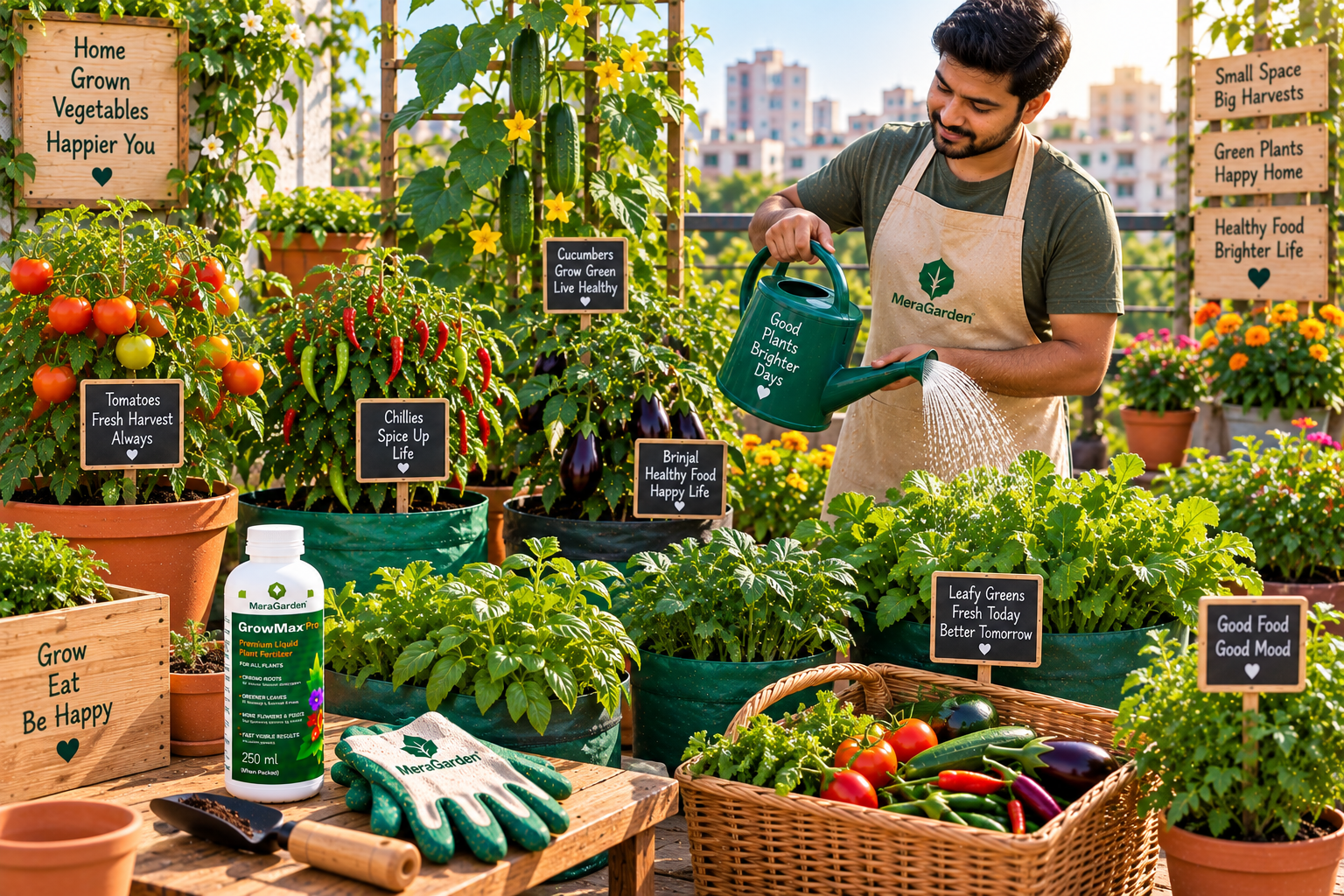
Growing vegetables in containers is an excellent solution for people who have limited gardening space. You do not need a large backyard to grow tomatoes, chillies, cucumbers, brinjal, okra, spinach, coriander and other vegetables. A sunny balcony, terrace, patio or even a suitable outdoor corner can become a productive vegetable garden with the right containers and growing conditions.
However, container gardening has one important difference from growing vegetables directly in the ground: the root system has limited space.
A plant growing in a pot or grow bag cannot continuously spread its roots through a large area of soil looking for nutrients. Watering can also gradually move soluble nutrients through the growing medium. Because of this, container vegetables often require more careful feeding than plants growing in the ground. The RHS notes that container plants generally need more watering and feeding because they have only a limited amount of compost available to them.
This makes choosing the best fertilizer for container vegetable plants an important part of successful container gardening.
But choosing a fertilizer is not simply about finding the strongest product. Different vegetables have different nutritional needs, and those needs can change as a plant moves from leafy growth to flowering and fruit production.
In this guide, we will cover 7 useful fertilizer tips for container vegetable plants, how to choose the right type of fertilizer, how to use liquid fertilizer correctly, common mistakes to avoid and how MeraGarden GrowMax Pro can fit into a container vegetable gardening routine.
Important: Always follow the current dosage, dilution and application instructions printed on your fertilizer product label. Never assume that the dosage of one fertilizer is suitable for another fertilizer.
Table of Contents
Why Container Vegetables Need Proper Nutrition
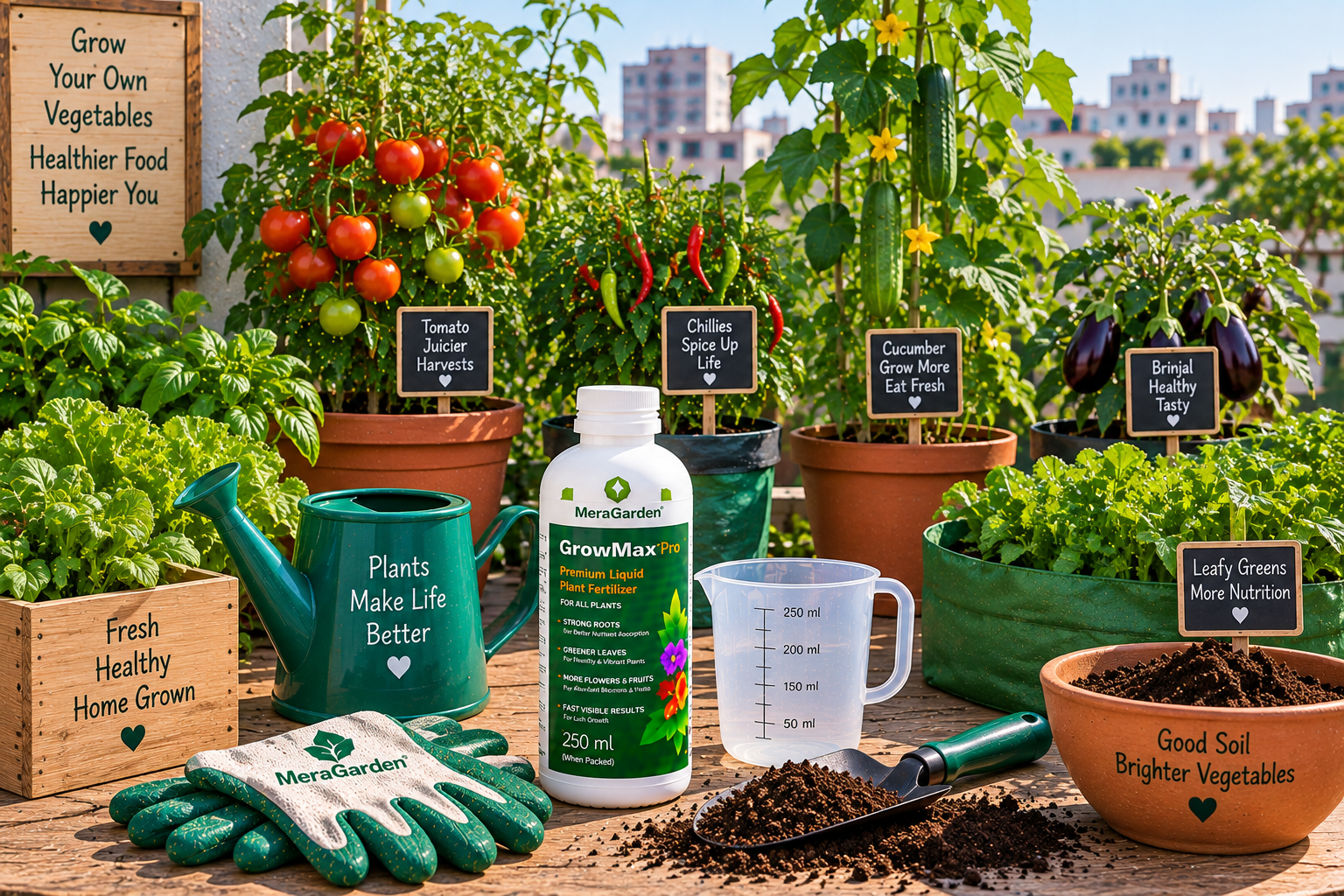
Before discussing the best fertilizer for container vegetable plants, it is important to understand why fertilizer management matters in pots and grow bags.
A container provides only a limited volume of growing medium. As a vegetable plant grows, its roots use available nutrients. Regular watering can also move soluble nutrients away from the root zone.
The RHS explains that container plants have restricted root space and therefore need regular watering and occasional feeding.
This becomes particularly important with productive vegetables such as tomatoes, cucumbers, chillies and brinjal because these plants continue growing and producing flowers or fruits during their productive period.
Let’s look at the first two major benefits.
Benefit 1: Supports Healthy Leaf and Stem Growth
Healthy leaves are essential for vegetable plants because leaves capture light and support photosynthesis.
Nitrogen is one of the three major plant nutrients, along with phosphorus and potassium. Plants also need several other nutrients, including magnesium, calcium and sulphur.
Adequate nutrition can help support healthy vegetative growth when the plant is actively growing.
This is particularly relevant for:
- Spinach
- Amaranth
- Coriander
- Fenugreek
- Lettuce
- Other leafy vegetables
For leafy vegetables, the goal is usually strong, healthy foliage rather than simply pushing the plant toward flowering.
However, avoid assuming that more nitrogen is always better. Excessive fertilizer can create an imbalance and may encourage excessive leafy growth in situations where the plant should also be developing flowers and fruit.
The objective should be balanced plant nutrition, not maximum fertilizer application.
Benefit 2: Supports Flowering and Fruit Development
Many container vegetables produce a harvest only after successful flowering.
Tomatoes, chillies, cucumbers, brinjal and beans all need good overall plant health before they can provide a useful harvest.
Once a plant begins flowering and fruiting, nutrition remains important. The nutritional priorities of a fruiting crop can differ from those of a young leafy plant.
For example, the RHS notes that leafy crops can use a balanced feed, while fruiting crops may benefit from a fertilizer higher in potash during the fruiting stage.
This is one reason why there is no single “magic” fertilizer ratio that is perfect for every container vegetable at every stage.
A better approach is to consider:
Vegetable type + plant age + growth stage + fertilizer formulation + growing conditions.
7 Powerful Benefits and Tips for Container Vegetable Fertilization
Benefit 3: Liquid Fertilizer Can Be Convenient for Containers
Liquid fertilizer can be a convenient choice for container vegetable gardening.
Unlike many granular products that are applied directly to the growing medium, liquid fertilizers are generally diluted with water and applied according to their product instructions.
The RHS describes liquid fertilizers as generally fast acting and particularly suitable for container-grown plants.
This can be useful when you have several pots or grow bags that need feeding.
For example, a small terrace garden might contain:
- 4 tomato plants
- 3 chilli plants
- 2 cucumber plants
- 2 brinjal plants
- 3 grow bags of leafy vegetables
Managing a large number of containers becomes easier when you have a simple, consistent feeding routine.
However, convenience does not mean you can guess the dosage.
Always measure the fertilizer accurately.
Benefit 4: Helps Replace Nutrients in Limited Growing Media
Container vegetables have a restricted root environment.
Imagine a tomato plant growing in a large garden bed. Its roots have access to a much larger volume of growing medium.
Now compare that with a tomato plant growing inside a grow bag.
The grow-bag plant has access only to the nutrients available within that relatively small volume.
As the plant grows and watering continues, nutrients can become depleted.
The RHS states that container plants quickly use nutrients in their compost and that most benefit from some feeding to maintain good growth.
This is why fertilizer can be an important part of container vegetable care.
But fertilizer should complement a good growing medium rather than compensate for poor soil preparation.
A healthy container setup should include:
- Suitable growing medium
- Adequate drainage
- Appropriate container size
- Good sunlight
- Correct watering
- Proper nutrition
Benefit 5: Supports Different Stages of Vegetable Growth
One of the most useful fertilizer habits is to consider the plant’s growth stage.
A newly established vegetable plant does not have exactly the same needs as a mature plant producing fruits.
Early Growth
During early growth, the plant is developing:
- Roots
- Leaves
- Stems
- New branches
The main focus should be establishing healthy growth.
Flowering Stage
The plant begins producing buds and flowers.
At this stage, sunlight, watering, pollination and appropriate nutrition all matter.
Fruiting Stage
The plant begins producing vegetables.
Tomatoes, chillies, cucumbers and brinjal need continued care during this stage.
The RHS recommends regular feeding for container vegetables and gives examples of liquid feeding during active growth.
Therefore, instead of asking only:
“What is the best fertilizer?”
also ask:
“What does my plant need at this stage?”
That small change in thinking can make your fertilizer routine much more effective.
Benefit 6: Can Support Productive Container Vegetable Plants
Some container vegetables are relatively demanding because they grow quickly and produce flowers and fruits.
Tomatoes and cucumbers, for example, can develop substantial foliage and produce multiple fruits during their productive period.
The RHS specifically describes tomatoes, cucumbers and similar crops as plants that can benefit from regular feeding when grown in containers.
Appropriate nutrition can therefore be part of maintaining productive plants.
However, remember that fertilizer is not a guarantee of a large harvest.
A vegetable plant also needs:
- Sufficient sunlight
- Correct watering
- Good drainage
- Adequate root space
- Suitable temperature
- Pollination where required
- Healthy roots
- Pest and disease management
If any of these factors are poor, adding more fertilizer may not solve the underlying problem.
Benefit 7: Creates a Simple and Repeatable Gardening Routine
A feeding routine makes container gardening easier to manage.
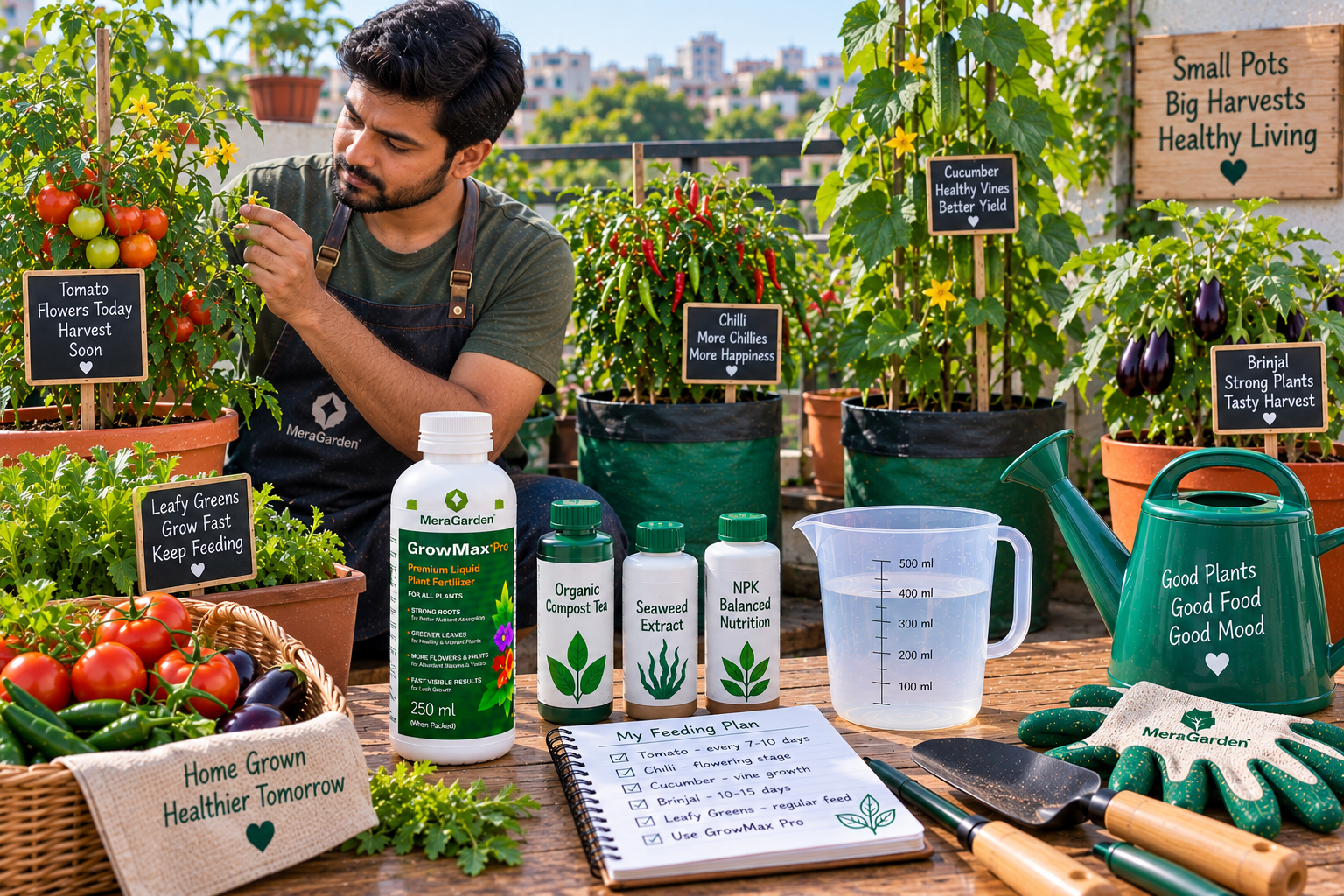
Instead of fertilizing whenever you remember, keep a simple record.
For example:
| Vegetable | What to Observe | Feeding Consideration |
|---|---|---|
| Tomato | New leaves, flowers and fruits | Adjust according to growth stage |
| Chilli | Leaves, flowers and chillies | Monitor growth and fruiting |
| Cucumber | Vine growth, flowers and fruits | Needs consistent care |
| Brinjal | New shoots and developing fruits | Watch overall plant health |
| Spinach | Leaf colour and new leaves | Avoid unnecessary overfeeding |
| Coriander | Leaf growth | Focus on healthy vegetative growth |
| Okra | New leaves, flowers and pods | Monitor active production |
The purpose of this table is not to create one universal fertilizer schedule.
Instead, it helps you observe before feeding.
A good routine is:
Check the plant → Check the growing medium → Identify growth stage → Measure fertilizer → Dilute according to label → Apply correctly → Observe the plant.
This is much safer than blindly increasing fertilizer whenever growth appears slow.
🌱 Give Your Container Vegetable Plants Better Care
Your vegetable plants need more than just water.
Good growing media, sunlight, appropriate containers and balanced nutrition all contribute to healthy growth.
If you are looking for a convenient liquid fertilizer for your container garden, MeraGarden GrowMax Pro can be included in your plant-feeding routine.
Always use GrowMax Pro according to the current product label and recommended dosage.
How to Use Liquid Fertilizer for Container Vegetable Plants
Correct application is just as important as choosing the right fertilizer.
Follow these practical steps.
Step 1: Identify the Vegetable
First identify what you are growing.
Is it:
- Tomato?
- Chilli?
- Cucumber?
- Brinjal?
- Okra?
- Spinach?
- Coriander?
- Another vegetable?
Different vegetables can have different growth habits and nutritional requirements.
Step 2: Check the Growth Stage
Look closely at the plant.
Is it:
- A young plant?
- Producing new leaves?
- Flowering?
- Producing fruits?
- Recovering from transplanting?
This helps you decide whether feeding is appropriate.
Do not automatically assume that slow growth means fertilizer deficiency.
Step 3: Check the Growing Medium
Before applying fertilizer, check the moisture of the potting mix.
Avoid applying concentrated fertilizer to completely dry growing media.
The RHS specifically advises against feeding houseplants and container plants when the compost is dry.
If the container is extremely dry, address the watering issue first.
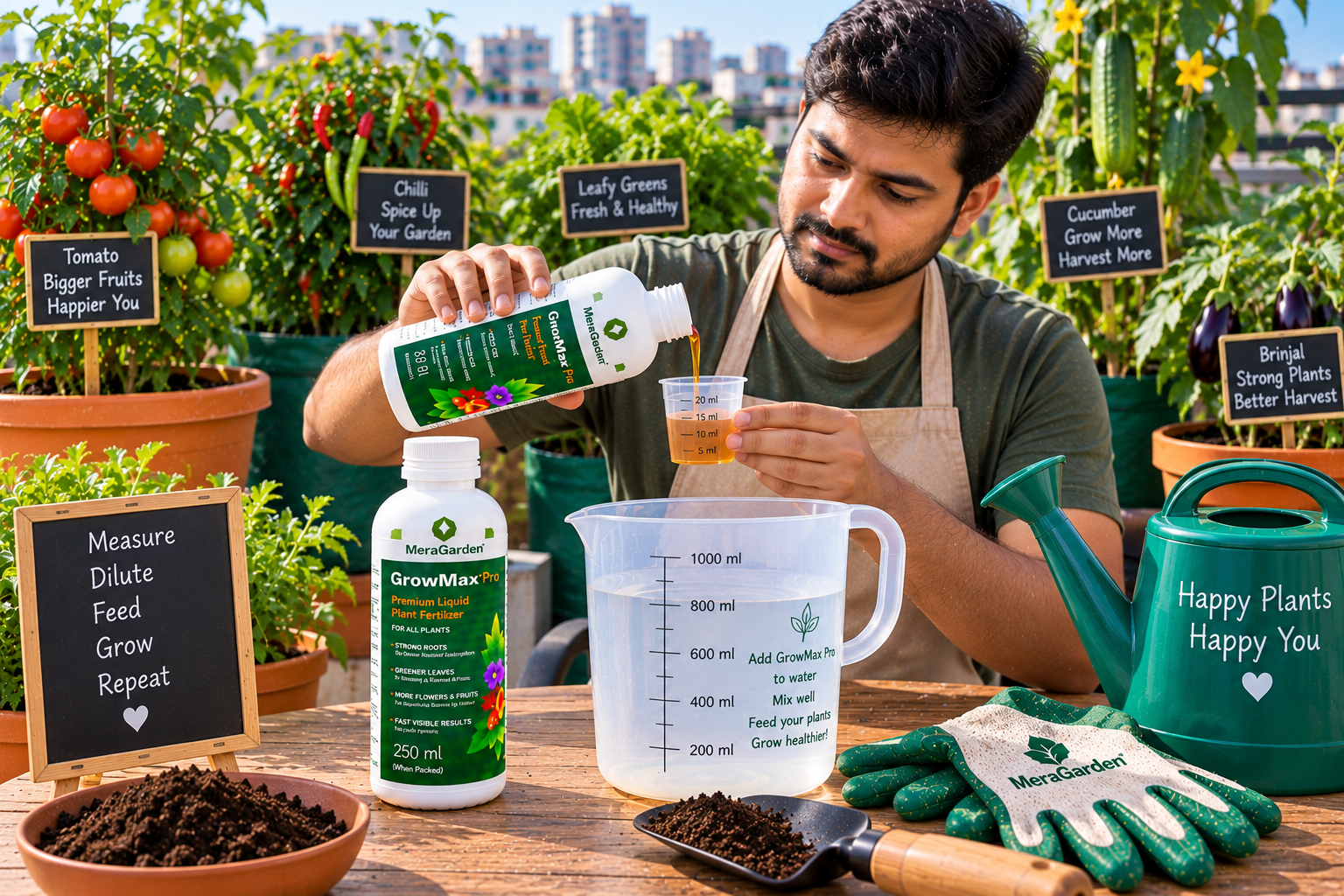
Step 4: Measure the Fertilizer
Never estimate liquid fertilizer by simply pouring it into the watering can.
Use a proper measuring container.
This is particularly important with concentrated liquid fertilizers.
For MeraGarden GrowMax Pro, follow the dosage and dilution instructions printed on the current product label.
Do not use a dosage copied from another fertilizer.
Step 5: Dilute With Water
Add the measured amount of GrowMax Pro to the recommended quantity of water according to the product label.
Mix properly before application.
Never make the solution stronger simply because you want faster growth.
More fertilizer is not necessarily better fertilizer.
Step 6: Apply to the Growing Medium
Apply the prepared fertilizer solution around the root zone according to the product instructions.
Avoid unnecessary fertilizer contact with foliage unless the product label specifically recommends foliar application.
For vegetables, following the product’s instructions is particularly important.
Step 7: Continue Normal Plant Care
After feeding, continue with your normal gardening routine.
Monitor:
- Leaf colour
- New growth
- Flowers
- Fruits
- Soil moisture
- Overall plant appearance
If you notice unusual symptoms, do not immediately add more fertilizer.
First investigate possible causes such as watering problems, pests, insufficient sunlight, poor drainage or root stress.
Liquid Fertilizer vs Granular Fertilizer for Container Vegetables
Both liquid and granular fertilizers have a place in gardening.
The better option depends on the crop, container setup, fertilizer formulation and your preferred gardening routine.
| Feature | Liquid Fertilizer | Granular Fertilizer |
|---|---|---|
| Application | Diluted with water | Applied to growing medium |
| Nutrient availability | Generally quick | Depends on formulation |
| Container use | Very convenient | Suitable for many containers |
| Measuring | Requires accurate dilution | Requires accurate application |
| Feeding routine | Easy to incorporate into watering | Can be less frequent depending on product |
| Release pattern | Usually relatively quick | Can be gradual |
| Best suited for | Convenient container feeding | Controlled/longer-lasting feeding options |
| Main caution | Avoid excessive concentration | Avoid over-application |
The RHS describes liquid fertilizers as generally faster acting and particularly useful for container plants, while granular and other dry fertilizer forms are also available.
For gardeners managing many pots and grow bags, liquid fertilizer can be particularly convenient because it can be measured and diluted as required.
Why MeraGarden GrowMax Pro Can Be Useful for Container Vegetable Plants
MeraGarden GrowMax Pro is a chemical-based liquid plant fertilizer designed for plant nutrition.
Its liquid format makes it convenient for gardeners who prefer a fertilizer that can be measured and diluted with water before application.
GrowMax Pro is marketed as suitable for all plants, with product-label benefits including:
- Strong roots
- Greener leaves
- More flowers and fruits
- Fast visible results
For container vegetable plants, the biggest advantage of a liquid feeding routine is convenience.
You can maintain a consistent approach across different pots while still considering each plant’s growth stage.
However, GrowMax Pro should be used as one part of complete vegetable care, not as a replacement for good gardening practices.
Your container vegetable checklist should include:
1. Good sunlight
Place vegetables where they receive the amount of light appropriate for the crop.
2. Correct container size
Choose a suitable pot or grow bag for the mature plant.
3. Good drainage
Containers need proper drainage. The RHS states that drainage holes at the base of a container are essential.
4. Suitable growing medium
Use a growing medium that provides appropriate moisture retention and drainage.
5. Correct watering
Do not keep the growing medium permanently waterlogged.
6. Proper nutrition
Feed according to plant needs and the fertilizer label.
7. Pest monitoring
Inspect leaves, stems, flowers and fruits regularly.
🌱 Ready to Improve Your Container Vegetable Garden?
Healthy container vegetables require consistent care, and proper nutrition is an important part of that routine.
If you want a convenient liquid fertilizer for your home vegetable garden, MeraGarden GrowMax Pro is designed to make plant feeding simple.
Remember: measure carefully, dilute correctly and always follow the current product label.
Conclusion
Finding the best fertilizer for container vegetable plants does not mean choosing the strongest fertilizer available.
The best approach is to understand the limitations of container gardening and provide plants with the right combination of growing medium, sunlight, water, root space and nutrition.
Because pots and grow bags have limited root space, nutrients can become depleted more quickly than in larger areas of soil. This is why container vegetables can benefit from appropriate feeding.
Liquid fertilizer can be especially convenient for container gardening because it can be measured and diluted before application.
Whether you are growing tomatoes, chillies, cucumbers, brinjal, okra or leafy greens, avoid one of the most common fertilizer mistakes: assuming that more fertilizer will automatically produce more vegetables.
Instead, follow a simple approach:
Observe the plant → Check the growing medium → Understand the growth stage → Measure accurately → Dilute according to the label → Apply correctly → Monitor the results.
With a consistent routine and good overall plant care, even a small balcony or terrace can become a productive container vegetable garden.
FAQs About the Best Fertilizer for Container Vegetable Plants
1. What is the best fertilizer for container vegetable plants?
The best fertilizer depends on the vegetable, growth stage, growing medium and fertilizer formulation. A suitable balanced or crop-appropriate fertilizer can provide important nutrients. Liquid fertilizer can be particularly convenient for container gardening.
2. Is liquid fertilizer good for vegetables grown in pots?
Yes. Liquid fertilizer can be convenient for container vegetables because it can be measured, diluted and applied around the root zone according to the product instructions. The RHS considers liquid fertilizers particularly useful for container plants.
3. How often should I fertilize container vegetables?
There is no single frequency that applies to every fertilizer and vegetable. Feeding frequency depends on the fertilizer formulation, crop, growth stage and growing conditions. Always follow the product label.
4. Can I use liquid fertilizer for tomato plants in containers?
Yes, when the fertilizer is suitable for the plant and used according to its label. Tomatoes grown in containers can require regular feeding because of their restricted root environment.
5. Can I use the same fertilizer for tomatoes and chillies?
A general-purpose fertilizer may be suitable for both, but their feeding requirements can change according to growth stage. Always check the fertilizer label and observe the plants.
6. Do container vegetable plants need more fertilizer than plants in the ground?
Container plants often require more careful feeding because they have limited root space and a smaller volume of growing medium. Nutrients can become depleted more quickly.
7. Can too much fertilizer damage vegetable plants?
Yes. Excessive fertilizer can create nutrient or salt-related problems and may damage roots. Increasing the fertilizer concentration does not guarantee faster or healthier growth.
8. Should I fertilize a completely dry pot?
It is better to avoid feeding completely dry growing media. Check the moisture condition first and follow the fertilizer instructions. The RHS advises against applying feed to dry compost.
9. What NPK ratio is best for container vegetables?
There is no single NPK ratio that is perfect for every vegetable. Leafy vegetables and fruiting vegetables can have different nutritional requirements. The fertilizer should be selected according to the crop and its growth stage.
10. Is liquid fertilizer better than granular fertilizer?
Neither is automatically better for every situation. Liquid fertilizer is generally fast acting and convenient for containers, while granular fertilizers can offer different release patterns depending on their formulation.
11. Can I use MeraGarden GrowMax Pro for container vegetables?
GrowMax Pro is a chemical-based liquid plant fertilizer marketed as suitable for all plants. When using it on container vegetables, follow the current product label for dosage, dilution and application instructions.
12. Can fertilizer alone increase my vegetable harvest?
No. Fertilizer is only one part of successful vegetable gardening. Sunlight, watering, drainage, container size, growing medium, pollination, temperature and pest management can all influence plant performance.
13. Which vegetables can I grow in containers?
Many vegetables can be grown in containers, including tomatoes, chillies, cucumbers, brinjal, leafy greens, beans, radishes and others. The container should be appropriate for the crop. The RHS notes that most vegetables can be grown in containers when the correct container is chosen.
14. What is the biggest fertilizer mistake in container gardening?
One of the biggest mistakes is overfeeding. Gardeners sometimes believe that stronger fertilizer will produce faster growth. In reality, excessive fertilizer can harm plants. Accurate measurement and following the product label are safer approaches.
15. Can I use fertilizer every time I water my vegetables?
Not necessarily. Feeding frequency depends on the fertilizer and crop. Do not automatically add fertilizer to every watering unless the product instructions specifically recommend that method.
Must Read
- How Often Should You Fertilize Plants? 7 Easy Rules for Healthy Growth
- How Often Should You Fertilize Plants? Complete Fertilizer Schedule
- What Is NPK Fertilizer? 7 Easy Tips for Healthy Plants
- Best Liquid Fertilizer for Plants: Complete Guide for Home Gardeners
- How to Use Liquid Fertilizer for Plants: 7 Easy Steps for Better Growth
- Best Organic Fertilizers for Plants: 7 Natural Options for Healthy Growth
- Best Fertilizer for Indoor Plants in India: 7 Easy Tips for Healthy Growth
- Best Fertilizer for Flowering Plants in India: 7 Top Options
- Best Fertilizer for Plants: 7 Smart Tips to Avoid Common Mistakes
- 5 Signs Your Plants May Need Fertilizer
- How Much Liquid Fertilizer Should You Use for Plants?
- 7 Benefits of Liquid Fertilizer for Plants: Grow Healthier Plants Faster
- 7 Benefits of Liquid Fertilizer for Plants: A Simple Guide for Healthy Growth
- Best Fertilizer for Peace Lily: 7 Powerful Tips for Beautiful Blooms and Avoiding Common Mistakes
- Best Fertilizer for Spider Plant: 7 Powerful Tips for Lush Growth and Avoiding Common Mistakes
- Liquid Fertilizer vs Granular Fertilizer: Which Is Better? 7 Key Differences for Home Gardeners
- Liquid Fertilizer vs Organic Fertilizer: 7 Powerful Pros, Cons & the Best Choice for Your Plants
- How to Choose the Right Fertilizer for Your Plants: 7 Smart Tips to Avoid Common Mistakes
- 5 Positive Signs Your Plants Need Fertilizer — Avoid These Warning Symptoms for Healthier Growth
- How to Grow Peace Lilies
- How To Grow Houseplants