
Introduction
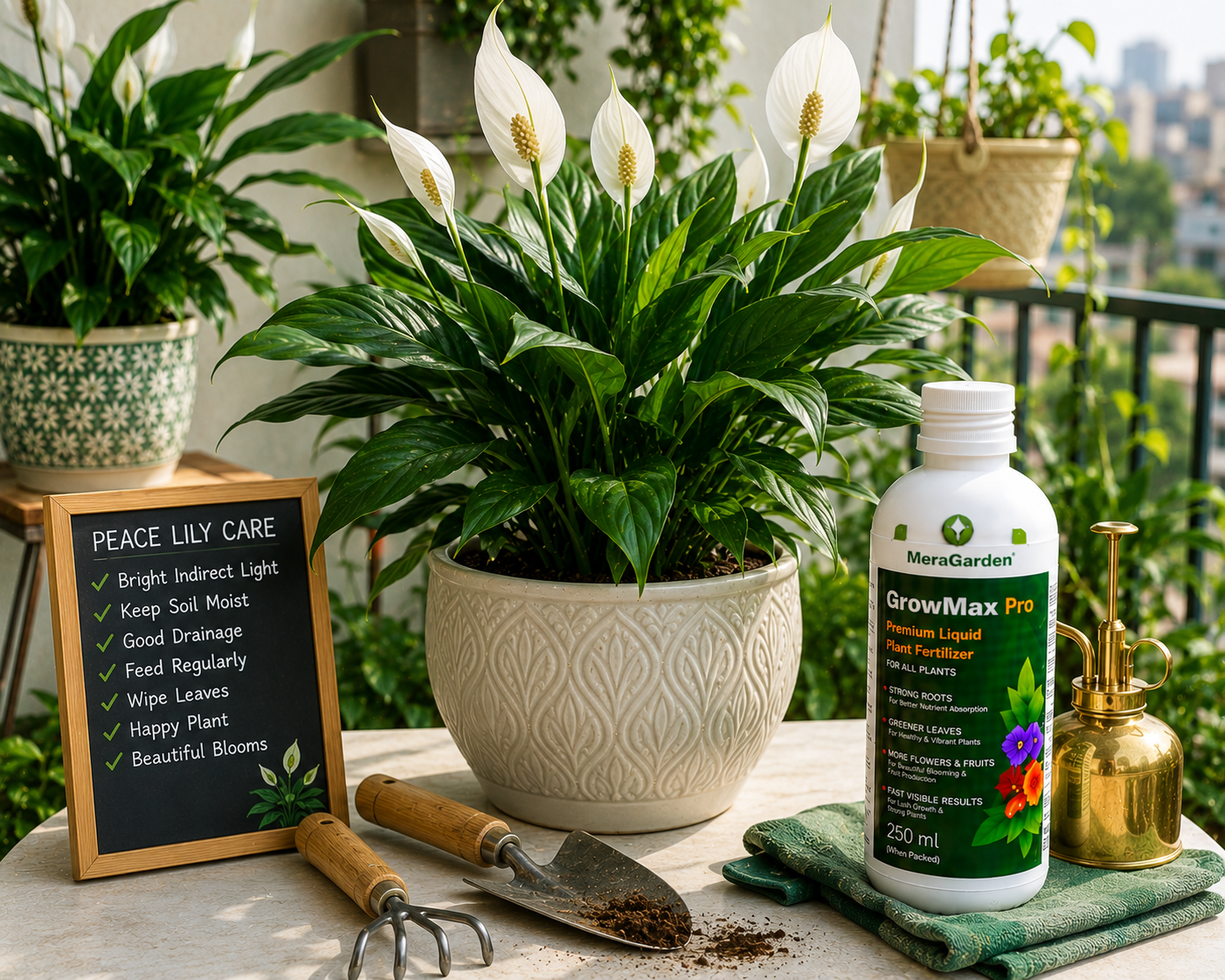
Peace lilies are among the most popular indoor plants in Indian homes because they combine attractive dark-green foliage with elegant white flower-like blooms. They can look beautiful in bedrooms, living rooms, balconies, offices and other bright indoor spaces. However, even a healthy-looking peace lily may eventually show slower growth, smaller leaves or fewer flowers if its growing conditions are not suitable.
One important part of peace lily care is plant nutrition.
Choosing the best fertilizer for peace lily does not simply mean using the strongest fertilizer available. Peace lilies are relatively easy-care tropical houseplants, and they generally respond better to sensible feeding than excessive fertilization. Light, watering, drainage, temperature, humidity and the condition of the potting mix all work together.
According to the Royal Horticultural Society (RHS), peace lilies (Spathiphyllum) prefer warm conditions, moderate humidity and bright indirect light. The RHS also recommends applying a general liquid fertilizer every few weeks during the growing season to support leaf production and flowering.
This guide explains 7 practical benefits of proper fertilization, how to choose a fertilizer, how to use liquid fertilizer safely, common feeding mistakes and where a product such as MeraGarden GrowMax Pro can fit into a peace lily care routine.
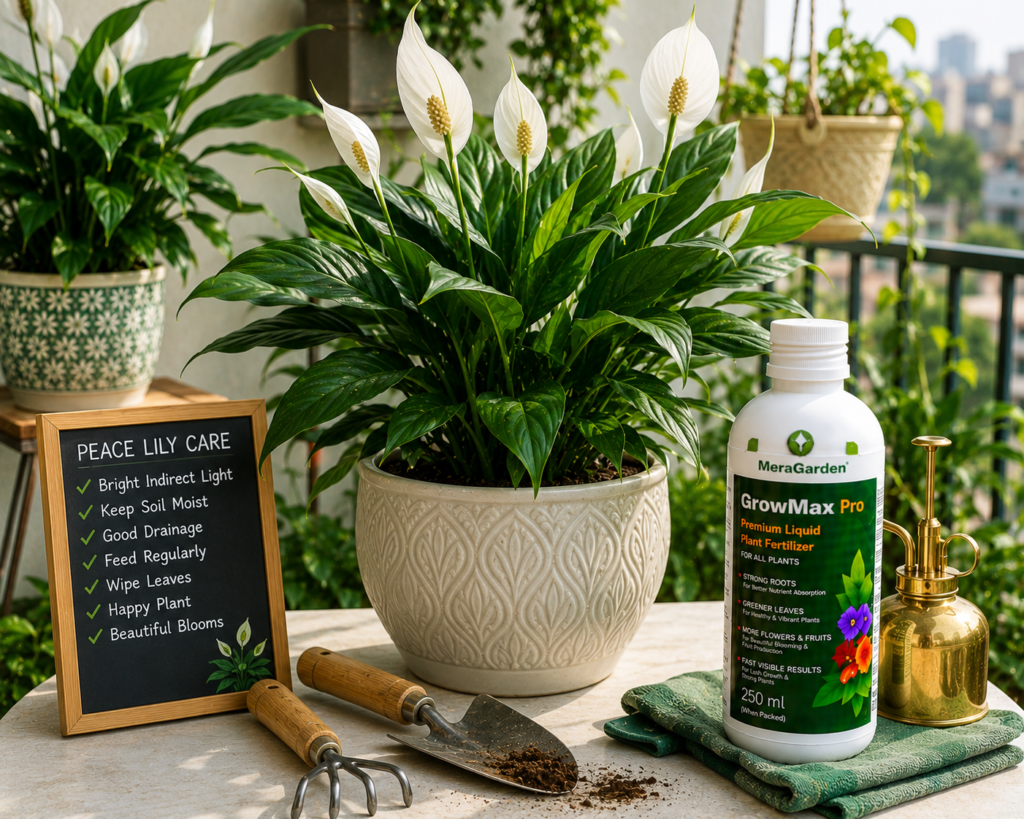
Table of Contents
7 Benefits of Using the Right Fertilizer for Peace Lily
Fertilizer should not be treated as a quick fix for every peace lily problem. However, when a plant is actively growing and needs additional nutrients, the right feeding routine can support healthy development.
Here are seven important benefits of using an appropriate fertilizer for peace lilies.
1. Supports Healthy Green Leaf Growth
The leaves are one of the most attractive features of a peace lily. A healthy plant develops broad, glossy green foliage that gives it a full and vibrant appearance.
Plants require several nutrients for normal growth, including nitrogen, phosphorus and potassium. These nutrients perform different functions, and plants also require secondary and micronutrients.
For foliage development, adequate nutrition is particularly important because peace lilies produce new leaves throughout periods of active growth.
However, more fertilizer does not automatically mean more leaves.
Excessive feeding can create problems and may cause nutrient imbalance or fertilizer injury. The RHS recommends keeping fertilizer use to the minimum necessary and following the product instructions.
Therefore, the goal should be balanced nutrition rather than maximum fertilizer.
If your peace lily is growing in a container, nutrients in the potting mix can gradually become limited because the plant has a relatively small amount of growing medium available.
A sensible feeding routine can help maintain nutrient availability while your plant is actively growing.
2. Helps Support Better Flowering
Peace lilies are famous for their white, sail-like flower structures. Technically, the white structure is a spathe surrounding the spadix, but most home gardeners simply call them flowers.
Proper nutrition can support the plant while it is producing new growth and flowering.
However, fertilizer is not the only factor responsible for flowering.
Light is extremely important.
The RHS notes that peace lilies can survive in deeper shade, but plants grown in insufficient light may grow slowly and rarely flower. Bright, indirect light is recommended for stronger growth and flowering.
So, if your peace lily has healthy leaves but refuses to flower, don’t immediately assume it needs more fertilizer.
First check:
- Is it receiving enough bright indirect light?
- Is the potting mix draining properly?
- Are you watering appropriately?
- Is the plant rootbound?
- Is it receiving too much direct sunlight?
- Has the plant recently been repotted or stressed?
Once the basic growing conditions are right, appropriate feeding can become a useful part of the overall care routine.
3. Supports Stronger Overall Plant Development
A peace lily needs more than one nutrient to maintain healthy growth.
Nitrogen, phosphorus and potassium are the three major nutrients commonly listed on fertilizer labels, but plants also require other nutrients in smaller quantities.
A good fertilizer routine should therefore focus on providing appropriate nutrition rather than concentrating on a single nutrient without understanding the plant’s needs.
This is especially important for potted peace lilies.
A container plant has limited access to nutrients compared with a plant growing in a large volume of soil. Watering can also gradually move soluble nutrients through the potting mix.
That does not mean you should fertilize every time you water.
Instead, use a product according to its label and adjust your routine according to the plant’s growth, season and growing conditions.
The RHS recommends feeding peace lilies with a general liquid fertilizer every few weeks during the growing season to boost leaf production and flowering.
4. Helps Maintain Attractive Foliage
A peace lily is often purchased primarily for its beautiful foliage.
If nutrition, light and watering are managed properly, the plant can maintain attractive green leaves and continue producing new growth.
But remember that yellow or brown leaves do not automatically mean the plant needs fertilizer.
Leaf discoloration can have many causes.
For example:
- Overwatering
- Underwatering
- Poor drainage
- Excessive direct sunlight
- Dry air
- Natural ageing of older leaves
- Root problems
- Nutrient deficiency
- Temperature stress
Adding fertilizer to a stressed plant without identifying the actual problem can sometimes make matters worse.
This is why fertilizer should be considered one part of peace lily care, not the entire solution.
Before feeding, inspect the soil, leaves, roots, light conditions and watering routine.
5. Provides Convenient Nutrition for Container Plants
Liquid fertilizers can be particularly convenient for indoor plants.
They can be measured and diluted before application, making it easier for home gardeners to control the amount being supplied.
The RHS explains that liquid fertilizers are useful for container plants and should be used according to their label instructions.
This is one reason many indoor gardeners prefer a liquid fertilizer for peace lily rather than handling larger quantities of granular fertilizer.
A liquid feeding routine can be especially convenient when you have several indoor plants such as:
- Peace lily
- Money plant
- Snake plant
- Areca palm
- Spider plant
- Philodendron
- Rubber plant
- Other decorative houseplants
The important point is still correct dilution and application.
Never assume that a more concentrated solution will produce faster growth.
6. Supports Regular Growth During the Active Season
Peace lilies are tropical plants and generally grow more actively when they receive suitable warmth, light and moisture.
During active growth, plants can use nutrients more readily.
The RHS houseplant guidance recommends feeding during the growing season and notes that liquid fertilizer can be applied once or twice a month, depending on the product and feeding approach. It also warns against applying fertilizer to dry soil because concentrated fertilizer can damage roots.
For Indian gardeners, seasonal conditions can vary considerably between regions.
A peace lily kept indoors in a warm, bright environment may continue growing for much of the year, while another plant may slow down during cooler or lower-light periods.
Therefore, don’t follow a feeding schedule blindly.
Observe your plant.
If growth is active, conditions are suitable and the fertilizer label recommends feeding, fertilizer can be incorporated into the care routine.
7. Helps You Build a Consistent Peace Lily Care Routine
Perhaps one of the biggest advantages of using a liquid fertilizer correctly is that it can make plant care more systematic.
Instead of randomly adding fertilizer whenever the leaves appear slightly pale, you can create a simple routine:
Check → Water → Feed when appropriate → Observe → Adjust
This approach helps prevent two common extremes:
Underfeeding: The plant may not receive enough additional nutrients when the potting mix becomes depleted.
Overfeeding: Too much fertilizer can result in excess salts and potential root or foliage problems.
The RHS specifically advises using the minimum amount of fertilizer necessary and following product directions.
A consistent routine is therefore more useful than simply trying to find the strongest fertilizer.
Give Your Peace Lily the Nutrition It Needs
If you’re looking for a convenient liquid fertilizer for your indoor plants, MeraGarden GrowMax Pro is designed as a concentrated liquid plant fertilizer suitable for all plants.
Use it according to the instructions on the product label and make it part of a balanced plant-care routine.
How to Use Liquid Fertilizer for Peace Lily
Using the best fertilizer for peace lily is only part of the process. How you apply it is equally important.
A simple and careful approach can help reduce the risk of overfeeding.
Step 1: Check the Plant First
Before fertilizing, inspect your peace lily.
Look at:
- Leaf colour
- New growth
- Soil moisture
- Drainage
- Overall plant condition
- Signs of pests or disease
If the plant is severely stressed, recently repotted or suffering from root problems, solve the underlying issue first.
Step 2: Do Not Fertilize Dry Soil
This is an important point for indoor gardeners.
Avoid applying concentrated fertilizer to completely dry potting mix.
The RHS specifically advises against applying fertilizer to dry soil because it can burn the roots.
If the plant needs watering, water appropriately first and follow the fertilizer product’s application instructions.
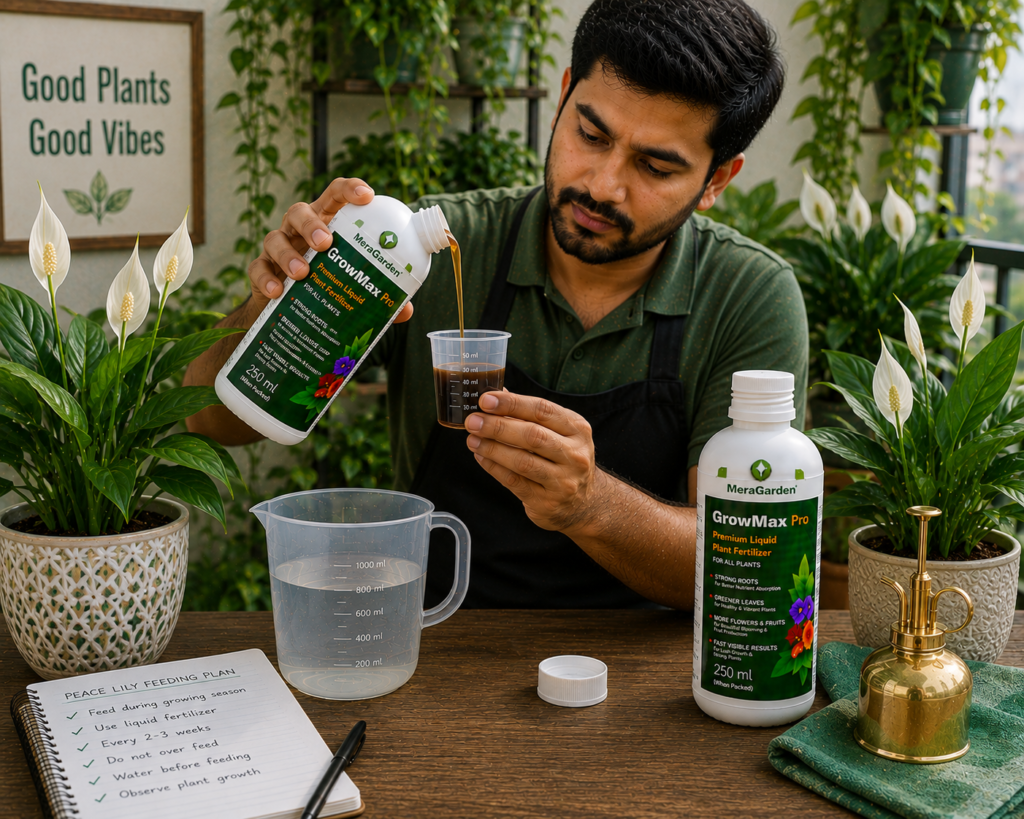
Step 3: Measure the Fertilizer Carefully
If you’re using a concentrated liquid fertilizer such as GrowMax Pro, don’t estimate the amount by simply pouring it directly into the pot.
Use a measuring cup or another suitable measuring container.
Always follow the dosage and dilution instructions printed on the product label.
Different liquid fertilizers have different concentrations, so there is no universal amount that is safe for every product.
Step 4: Dilute According to the Label
Add the measured fertilizer to the recommended amount of water.
Mix it properly before applying.
Do not increase the concentration because you want faster growth.
More fertilizer is not necessarily better.
In fact, overfeeding can cause fertilizer-related problems and may stress the plant.
Step 5: Apply to the Growing Medium
Apply the diluted fertilizer to the potting medium around the plant rather than deliberately pouring concentrated fertilizer onto the foliage.
Keep the application controlled and avoid unnecessary splashing.
If fertilizer accidentally gets onto leaves, follow the product instructions for cleaning or rinsing if appropriate.
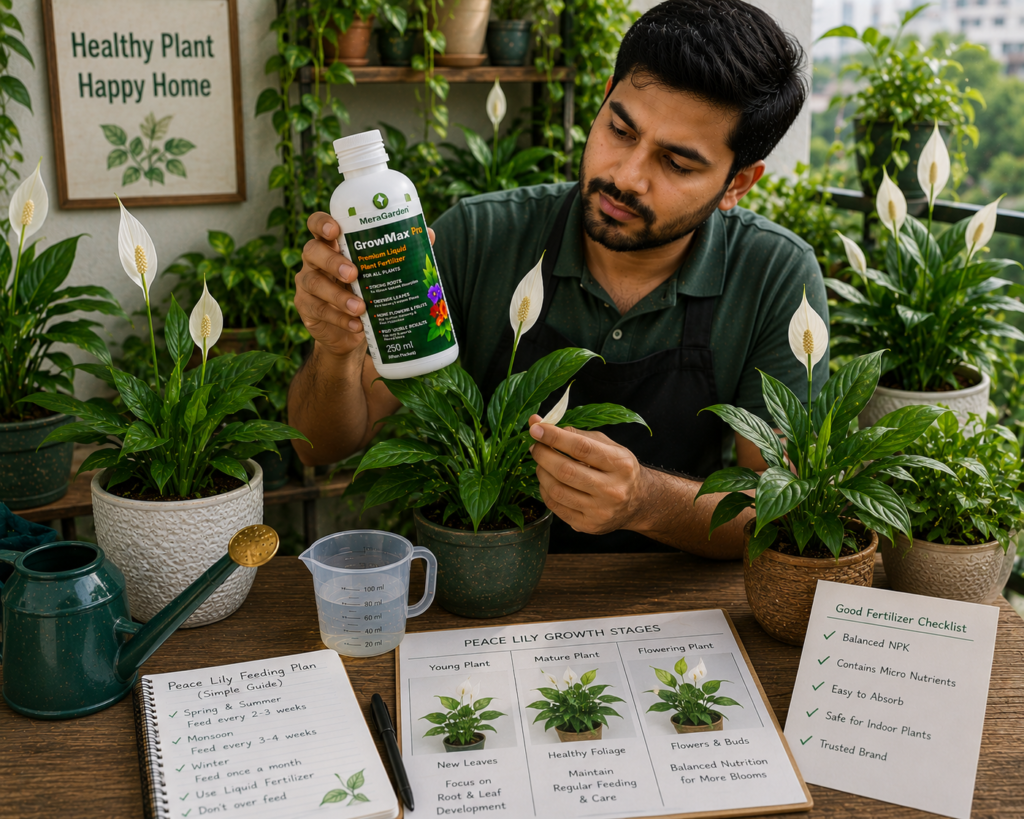
Step 6: Follow a Sensible Feeding Frequency
For peace lilies, feeding should generally be concentrated during active growth.
The RHS recommends a general liquid fertilizer every few weeks during the growing season for peace lilies.
However, the exact frequency should also depend on:
- Your fertilizer’s label
- Plant size
- Pot size
- Growing medium
- Light levels
- Temperature
- Growth rate
- Season
Never copy another plant owner’s dosage without checking the fertilizer concentration.
Step 7: Observe the Plant After Feeding
Plant care should be adjusted based on observation.
After feeding, watch for:
- New leaf development
- Healthy green foliage
- Improved overall growth
- Flower development
- Leaf-tip browning
- Yellowing
- Wilting
- Salt buildup on the soil surface
If you notice signs that suggest overfertilization, don’t keep increasing the feeding frequency.
Liquid Fertilizer vs Granular Fertilizer vs Organic Fertilizer for Peace Lily
Which type is best?
There isn’t one universal answer because different gardeners have different preferences and growing conditions.
| Fertilizer Type | Main Advantage | Consideration for Peace Lily |
|---|---|---|
| Liquid fertilizer | Easy to measure and dilute | Must be diluted correctly |
| Granular fertilizer | Can provide longer-lasting nutrition depending on type | Requires careful application around the plant |
| Organic fertilizer | Can be useful as part of a broader soil-care approach | Indoor products may have odour and nutrient release can vary |
| Slow-release fertilizer | Convenient and reduces frequent feeding | Must follow product-specific instructions |
For many indoor gardeners, liquid fertilizer is convenient because it can be measured and diluted before application.
The RHS also notes that liquid fertilizer is suitable for houseplants, while granular fertilizers can be used less frequently depending on the product.
The best choice ultimately depends on your plant, growing medium and the instructions provided by the fertilizer manufacturer.
MeraGarden GrowMax Pro for Peace Lily
If you are searching for a convenient liquid fertilizer for peace lily, MeraGarden GrowMax Pro can be considered as part of your regular indoor plant-care routine.
GrowMax Pro is a concentrated liquid plant fertilizer from MeraGarden and is labelled for use with all plants.
Its liquid format makes it convenient for gardeners who prefer measuring and diluting fertilizer before application.
For a peace lily, however, the product should be used responsibly.
Why Consider GrowMax Pro?
1. Liquid Format
Liquid fertilizer is convenient for container plants because it can be measured and diluted before application.
2. Suitable for All Plants
GrowMax Pro is labelled as a liquid plant fertilizer for all plants, making it useful for gardeners caring for multiple plant varieties.
3. Easy to Incorporate Into a Routine
A measured liquid feeding routine can be easier to manage than randomly adding fertilizer whenever the plant appears unhealthy.
4. Suitable for Indoor Gardening
Peace lilies are commonly grown in containers indoors, making a convenient liquid fertilizer format practical for home gardeners.
5. Easy to Pair With Regular Plant Care
Fertilizing can be included alongside other important tasks such as checking soil moisture, cleaning leaves, monitoring light and removing damaged foliage.
Remember, fertilizer cannot compensate for poor light, overwatering, poor drainage or root problems.
For best results, treat nutrition as one part of complete peace lily care.
Important: Follow the Product Label
Do not use a guessed dosage for GrowMax Pro.
Because fertilizer concentrations differ between products, always follow the dosage and dilution instructions printed on the current GrowMax Pro packaging.
Also avoid overfeeding. The RHS recommends using fertilizer sparingly and following the manufacturer’s instructions.
Help Your Peace Lily Grow Better
Give your indoor plants a simple and consistent nutrition routine with MeraGarden GrowMax Pro.
Grow Better. Bloom Bigger.
Conclusion
Finding the best fertilizer for peace lily is not about choosing the strongest product or feeding the plant as often as possible.
A healthy peace lily needs a combination of suitable light, correct watering, good drainage, appropriate temperature, humidity and balanced nutrition.
A suitable liquid fertilizer can be useful when the plant is actively growing and needs additional nutrients. Proper feeding can support healthy foliage, new growth and flowering, while also making your plant-care routine more consistent.
For the best results, remember these seven points:
- Support healthy green leaf growth.
- Provide nutrition that supports flowering.
- Maintain balanced overall plant development.
- Support attractive foliage.
- Use convenient liquid nutrition for container plants.
- Feed appropriately during active growth.
- Build a consistent feeding routine instead of overfertilizing.
Most importantly, don’t use fertilizer as a solution for every peace lily problem. If your plant has yellow leaves, brown tips, wilting or no flowers, first investigate light, water, drainage, humidity and root health.
When those fundamentals are right, appropriate fertilization can help your peace lily maintain the healthy, attractive appearance that makes it such a popular indoor plant.
Frequently Asked Questions About the Best Fertilizer for Peace Lily
1. What is the best fertilizer for peace lily?
A suitable general liquid fertilizer can be a practical option for peace lilies. The RHS recommends a general liquid fertilizer every few weeks during the growing season to support leaf production and flowering.
Always follow the dosage and frequency printed on the fertilizer label.
2. Is liquid fertilizer good for peace lily?
Yes. Liquid fertilizer can be convenient for potted peace lilies because it can be measured and diluted before application. The RHS recommends liquid feeding for peace lilies during their growing season.
3. How often should I fertilize a peace lily?
The frequency depends on the fertilizer and growing conditions. The RHS recommends applying a general liquid fertilizer every few weeks during the growing season.
For any commercial product, follow its specific label instructions.
4. Can I use GrowMax Pro on a peace lily?
GrowMax Pro is labelled as a liquid plant fertilizer for all plants, so it can be considered for peace lily care. Use it according to the current dosage and dilution instructions printed on the product label.
5. Can too much fertilizer damage a peace lily?
Yes. Excess fertilizer can create nutrient and salt-related problems and may damage roots or foliage. This is why using more fertilizer than recommended is not a good strategy.
The RHS recommends keeping fertilizer use to the minimum necessary and following product instructions.
6. Why does my peace lily have green leaves but no flowers?
Insufficient light is one possible reason. The RHS notes that peace lilies grown in deeper shade may survive but often grow slowly and rarely flower. Bright, indirect light is better for flowering.
Check the plant’s lighting before simply increasing fertilizer.
7. Should I fertilize a newly repotted peace lily?
It is usually better to avoid immediately adding unnecessary fertilizer to a freshly repotted plant unless the fertilizer and growing-medium instructions specifically recommend it.
Give the plant time to settle and follow the instructions for both the potting mix and fertilizer.
8. Can I use fertilizer when the soil is completely dry?
Avoid applying fertilizer to completely dry soil. The RHS warns that fertilizer applied to dry soil can burn plant roots.
Check the plant’s watering needs first.
9. Does fertilizer alone make peace lilies flower?
No. Fertilizer is only one part of flowering care. Peace lilies also need suitable light, watering, temperature and general growing conditions.
10. What is more important: fertilizer or light for a peace lily?
Both matter, but fertilizer cannot replace suitable light. A peace lily needs bright, indirect light for strong growth and better flowering.
If the plant is kept in very low light, adding extra fertilizer is unlikely to solve the underlying problem.
Must Read
- How Often Should You Fertilize Plants? 7 Easy Rules for Healthy Growth
- How Often Should You Fertilize Plants? Complete Fertilizer Schedule
- What Is NPK Fertilizer? 7 Easy Tips for Healthy Plants
- Best Liquid Fertilizer for Plants: Complete Guide for Home Gardeners
- How to Use Liquid Fertilizer for Plants: 7 Easy Steps for Better Growth
- Best Organic Fertilizers for Plants: 7 Natural Options for Healthy Growth
- Best Fertilizer for Indoor Plants in India: 7 Easy Tips for Healthy Growth
- Best Fertilizer for Flowering Plants in India: 7 Top Options
- Best Fertilizer for Plants: 7 Smart Tips to Avoid Common Mistakes
- 5 Signs Your Plants May Need Fertilizer
- How Much Liquid Fertilizer Should You Use for Plants?
- 7 Benefits of Liquid Fertilizer for Plants: Grow Healthier Plants Faster
- 7 Benefits of Liquid Fertilizer for Plants: A Simple Guide for Healthy Growth
- Best Fertilizer for Peace Lily: 7 Powerful Tips for Beautiful Blooms and Avoiding Common Mistakes
- Best Fertilizer for Spider Plant: 7 Powerful Tips for Lush Growth and Avoiding Common Mistakes
- Liquid Fertilizer vs Granular Fertilizer: Which Is Better? 7 Key Differences for Home Gardeners
- Liquid Fertilizer vs Organic Fertilizer: 7 Powerful Pros, Cons & the Best Choice for Your Plants
- How to Choose the Right Fertilizer for Your Plants: 7 Smart Tips to Avoid Common Mistakes
- 5 Positive Signs Your Plants Need Fertilizer — Avoid These Warning Symptoms for Healthier Growth
- How to Grow Peace Lilies
- How To Grow Houseplants