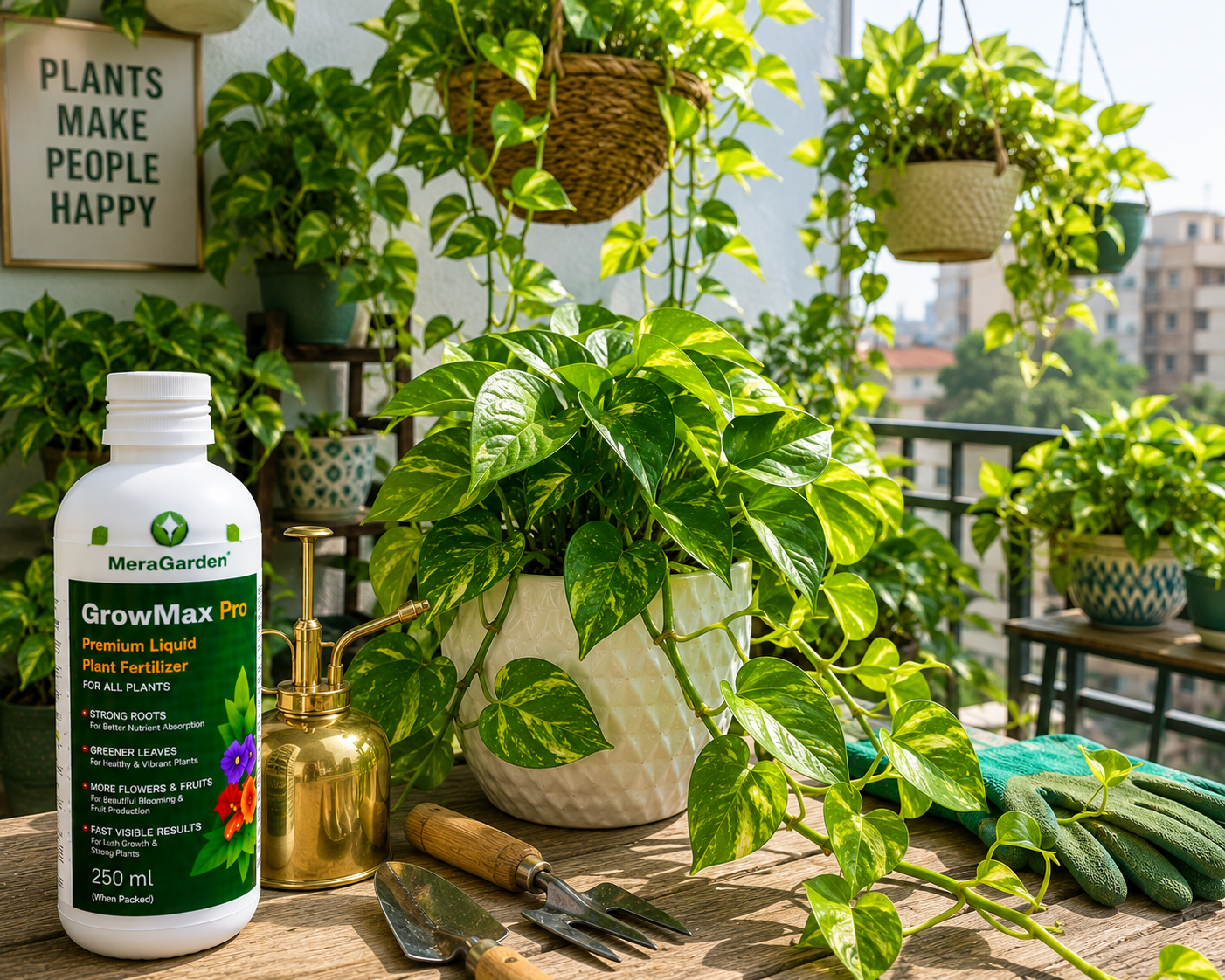
Money plant is one of the most popular plants found in Indian homes, offices, balconies and terraces. Its attractive green leaves, trailing stems and relatively easy-care nature make it a favourite among beginners as well as experienced gardeners.
The name money plant is commonly used in India for plants such as pothos, particularly Epipremnum aureum. These plants can grow in containers, hanging baskets, indoor spaces and outdoor areas with suitable conditions.
Although money plants are generally easy to maintain, they still need the right combination of light, water, growing medium and nutrients to maintain healthy growth.
This is where choosing the best fertilizer for money plant becomes important.
Many gardeners make two opposite mistakes. Some never feed their money plants even when the potting medium has become depleted of nutrients, while others apply fertilizer too frequently because they believe more fertilizer means faster and thicker growth.
Neither approach is ideal.
Houseplants have a limited amount of growing medium available to their roots. Over time, nutrients can be used by the plant or washed out during watering. The Royal Horticultural Society explains that foliage houseplants can benefit from liquid general-purpose or houseplant fertilizer during their active growing period.
The good news is that feeding a money plant does not have to be complicated.
In this guide, we will cover 7 powerful benefits of proper fertilization, how to choose an appropriate fertilizer, common mistakes to avoid, how liquid fertilizer can fit into your routine, and how MeraGarden GrowMax Pro can be incorporated according to its product instructions.
Table of Contents
7 Benefits of Choosing the Right Fertilizer for Money Plant
1. Supports Lush Green Growth
One of the main reasons gardeners use fertilizer for money plants is to support healthy vegetative growth.
Money plants are grown primarily for their attractive foliage. Healthy new leaves and stems can make the plant look fuller and more vibrant.
Plants require several nutrients for growth. Nitrogen, phosphorus and potassium are the three primary nutrients commonly listed on fertilizer labels, although plants also need other nutrients in smaller amounts.
For a foliage plant such as money plant, the goal should not be to provide excessive fertilizer. Instead, the aim is to provide appropriate nutrition when the plant actually needs it.
This distinction is important.
If a money plant already has healthy foliage and is growing well, adding more fertilizer simply because you want even faster growth may be unnecessary.
Before feeding, look at the complete plant.
Check:
- New leaf development
- Leaf colour
- Stem growth
- Root condition
- Potting medium
- Light availability
- Watering habits
If these factors are appropriate, a suitable feeding routine can complement the plant’s normal growth.
2. Helps Maintain Healthy-Looking Leaves
Healthy leaves are one of the easiest ways to judge the general condition of a money plant.
When a plant receives suitable light, water and nutrition, it can maintain attractive foliage and produce new growth.
However, remember that yellow leaves do not automatically mean fertilizer deficiency.
Yellowing can occur because of:
- Overwatering
- Poor drainage
- Root problems
- Low light
- Natural ageing of older leaves
- Pest issues
- Nutrient problems
- Environmental stress
This is why immediately adding fertilizer whenever a leaf turns yellow is not always the correct response.
The RHS recommends looking at plant symptoms and growing conditions before deciding whether fertilizer is required. Excessive fertilizer use can itself create problems.
A Better Approach
If your money plant looks unhealthy:
First inspect → identify the likely cause → correct the growing condition → then consider feeding if appropriate.
This approach is much safer than repeatedly increasing fertilizer.
3. Convenient for Container-Grown Money Plants
Most money plants grown indoors are kept in pots, hanging baskets or containers.
This makes fertilizer management slightly different from growing plants directly in a large garden bed.
A container provides a limited root environment. As the plant grows, it uses available nutrients, while regular watering can also move soluble nutrients through the growing medium.
The RHS specifically identifies container plants and houseplants as groups that can benefit from feeding.
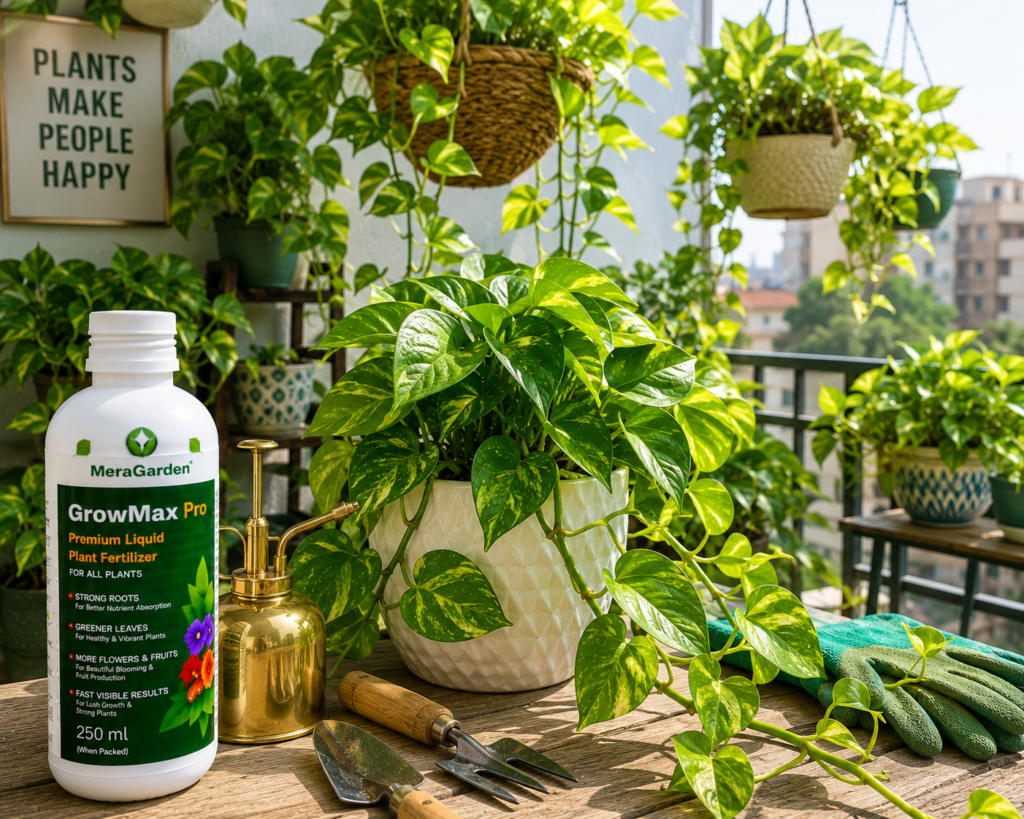
This is one reason liquid fertilizer can be convenient for money plant owners.
A liquid fertilizer can be measured and diluted according to the manufacturer’s instructions and then applied to the growing medium.
For someone with several money plants around the home, this can make the feeding process simple and organised.
However, convenience should never mean applying more fertilizer than recommended.
Always follow the specific fertilizer label.
Different products have different concentrations, so a dosage suitable for one fertilizer may be completely unsuitable for another.
4. Supports New Leaves and Longer Vines
One of the most attractive features of money plants is their ability to produce long trailing stems.
Some gardeners allow these stems to hang from baskets, while others train them around supports or poles.
Good growth requires more than fertilizer alone.
Money plants need suitable light, appropriate watering and a healthy growing medium. If one of these factors is significantly lacking, fertilizer may not solve the problem.
For example, if a money plant is kept in a very dark location, applying additional fertilizer is unlikely to compensate fully for inadequate light.
Similarly, continuously wet soil can create root problems that fertilizer cannot fix.
A balanced plant-care routine should therefore include:
Suitable Light
Provide the amount of light appropriate for your money plant and growing environment.
Good Drainage
The pot should allow excess water to drain away.
Appropriate Watering
Do not keep the growing medium constantly waterlogged.
Adequate Nutrition
Feed when appropriate and follow the fertilizer instructions.
Regular Observation
Look at new leaves, stems and the overall appearance of the plant.
The RHS guidance for Epipremnum also stresses avoiding excessively wet compost because persistent wetness can contribute to root rot.
5. Helps Maintain Consistent Plant Care
A good fertilizer is not simply about the product you buy. It is also about how consistently and carefully you use it.
Many home gardeners remember to water their money plant but completely forget about nutrition. Others remember fertilizer only when the plant starts looking weak.
Instead, create a simple plant-care routine.
You can maintain a small note containing:
| Check | What to Record |
|---|---|
| Plant location | Indoor / balcony / terrace |
| Pot size | Small / medium / large |
| Plant condition | Healthy / stressed / new growth |
| Last feeding | Record date |
| Fertilizer used | Product name |
| Next check | Record date |
This makes it easier to avoid accidental overfeeding.
It is particularly useful if you have several money plants and other indoor plants.
The RHS notes that houseplants can benefit from regular feeding during their active growth period, but fertilizer application should be appropriate for the particular plant and product.
6. Makes Liquid Feeding Easy to Measure
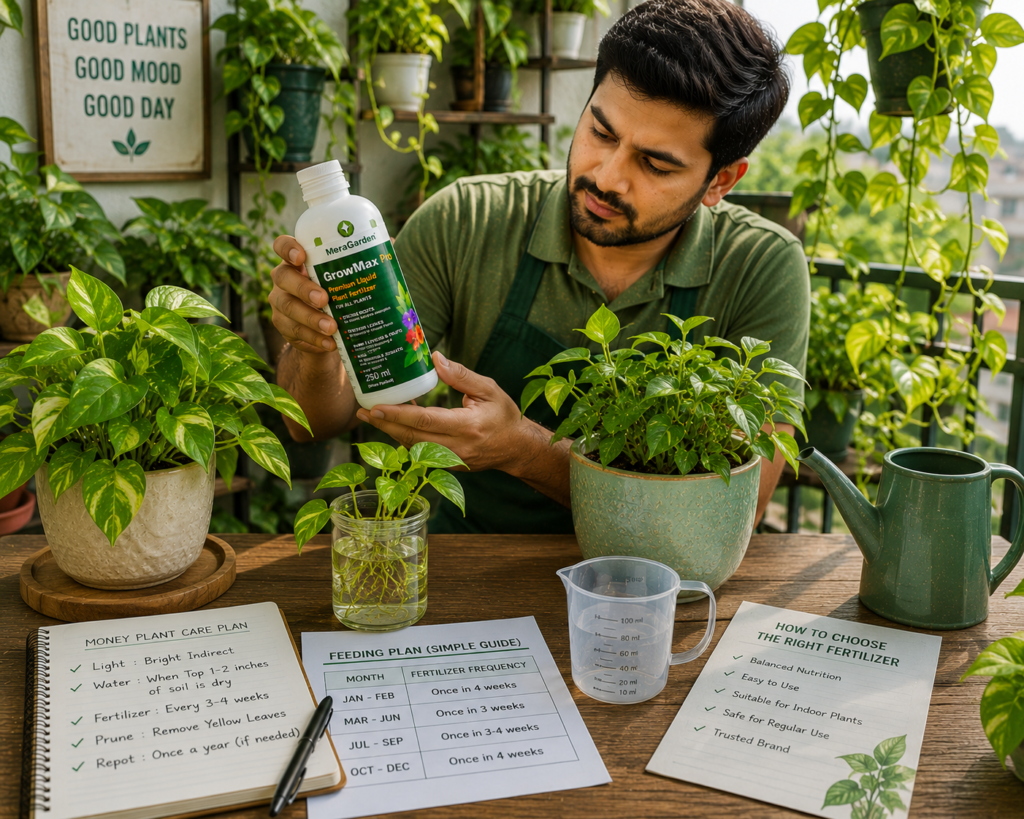
One important advantage of liquid fertilizer is the ability to measure the product before dilution.
This is especially useful for indoor plants because the growing containers are usually relatively small.
Instead of guessing, gardeners can use a suitable measuring container and follow the product label carefully.
The RHS explains that liquid fertilizers are diluted in water and applied to the growing medium, while also emphasising that fertilizer instructions should be followed for the correct dosage and application method.
Why Accurate Measurement Matters
Using too little may provide less nutrition than intended.
Using too much can increase the concentration around the roots and potentially cause fertilizer-related damage.
Therefore:
Measure → Dilute → Apply → Observe
is a much better routine than:
Guess → Apply → Repeat frequently.
Never assume that a stronger fertilizer solution will automatically make your money plant grow faster.
7. Helps Avoid Common Fertilizer Problems
The final and perhaps most important benefit of choosing the right fertilizer routine is that it can help you avoid unnecessary mistakes.
Fertilizer is concentrated plant nutrition. It should be used carefully.
The RHS warns that incorrect fertilizer application and overuse can cause problems, including pollution, and recommends using fertilizers only when needed.
Common Money Plant Fertilizer Mistakes
Mistake 1: Using Too Much Fertilizer
More fertilizer does not automatically mean more leaves.
Excess fertilizer can stress or damage plants.
Mistake 2: Applying Fertilizer to Very Dry Growing Medium
For many houseplants, fertilizer should not be applied to completely dry soil because concentrated fertilizer around roots can increase the risk of root damage.
The RHS specifically advises not applying fertilizer to dry soil because it can burn plant roots.
Mistake 3: Feeding Every Time You Water
Unless the product specifically instructs this method, do not automatically add fertilizer every time you water.
Follow the product’s recommended application schedule.
Mistake 4: Ignoring Poor Drainage
If the pot remains wet for long periods, solve the watering and drainage problem first.
Mistake 5: Using Multiple Fertilizers Together
Combining several fertilizer products without understanding their nutrient contents can unintentionally increase nutrient levels.
Mistake 6: Feeding a Severely Stressed Plant Without Diagnosis
First determine why the plant is stressed.
Mistake 7: Copying Another Product’s Dosage
This is one of the most common mistakes.
Fertilizer dosage is product-specific.
A dosage recommended for one liquid fertilizer cannot automatically be transferred to another.
Give Your Money Plant Better Nutrition
Healthy money plants need more than water. If you want a convenient liquid fertilizer for your home garden, MeraGarden GrowMax Pro can be included in your plant-care routine according to its current product instructions.
Remember: correct measurement and proper dilution are more important than using a stronger solution.
How to Use Fertilizer for Money Plant
Using fertilizer correctly is just as important as choosing the product.
Step 1: Inspect the Plant
Before feeding, check your money plant.
Look at:
- Leaves
- New growth
- Stems
- Soil moisture
- Drainage
- Visible pests
If the plant is severely stressed, investigate the cause before adding fertilizer.
Step 2: Check the Fertilizer Label
Read the current product label before preparing any fertilizer solution.
Pay attention to:
- Recommended dosage
- Dilution instructions
- Application method
- Frequency
- Suitable plants
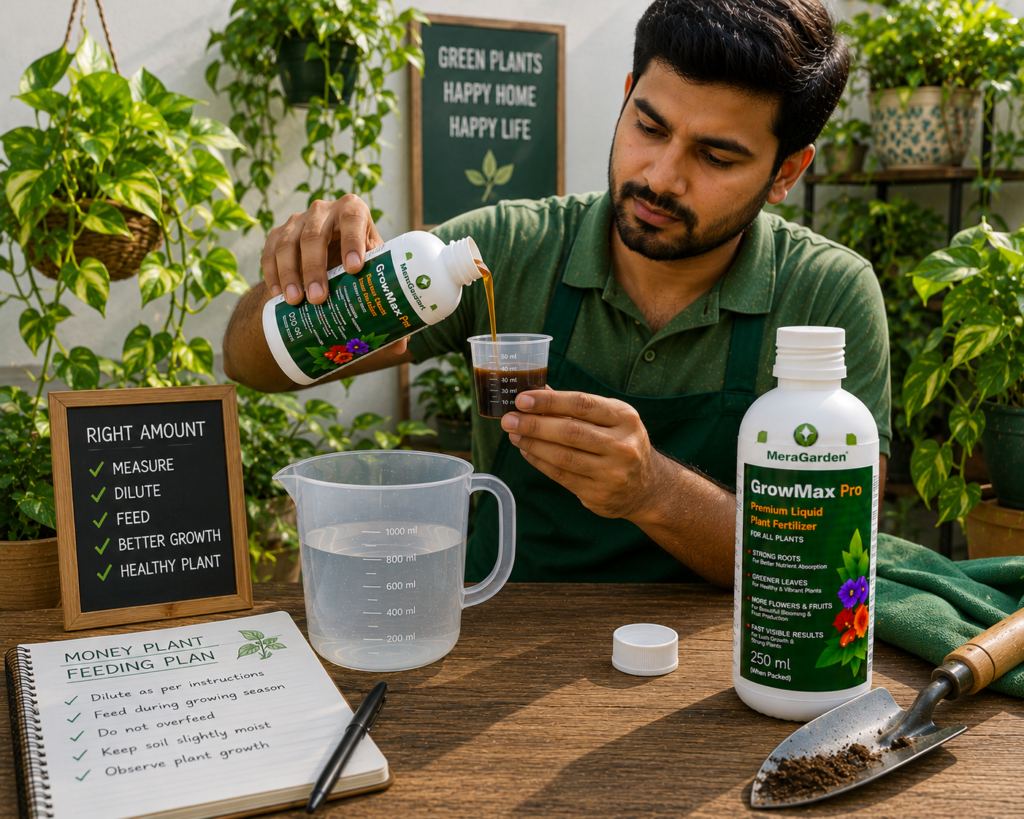
- Safety precautions
Do not use dosage instructions copied from another fertilizer.
Step 3: Measure the Fertilizer
Use a proper measuring container.
Do not estimate concentrated liquid fertilizer by simply pouring it into water.
Accurate measurement helps maintain consistency.
Step 4: Dilute Correctly
Add the measured fertilizer to the amount of water specified on the product label.
Mix the solution properly before application.
Never deliberately make the solution stronger because you want faster growth.
Step 5: Apply to the Growing Medium
For routine root feeding, apply the prepared solution to the growing medium around the plant.
Avoid careless application over furniture, flooring or other household surfaces when feeding indoor plants.
Step 6: Observe the Plant
After feeding, continue normal plant care.
Look for:
- New leaves
- Healthy-looking foliage
- New vine growth
- Changes in plant condition
Remember that plant response is influenced by many factors, not just fertilizer.
Step 7: Follow the Recommended Frequency
Do not repeatedly feed because the plant has not shown visible changes immediately.
Different products have different concentrations and application schedules.
Follow the current GrowMax Pro label when using GrowMax Pro.
For general houseplant guidance, the RHS notes that foliage houseplants can be fed with a liquid general-purpose or houseplant feed during their active growth period.
Liquid Fertilizer vs Granular Fertilizer for Money Plant
Both liquid and granular fertilizers are available for plant nutrition, but they are used differently.
For indoor money plants, liquid fertilizer can be particularly convenient because it can be measured and diluted before application.
| Feature | Liquid Fertilizer | Granular Fertilizer |
|---|---|---|
| Form | Liquid or concentrated liquid | Granules/pellets |
| Application | Diluted with water | Applied according to label |
| Indoor convenience | Very convenient | Requires careful placement |
| Measurement | Dilution needs accurate measurement | Application amount needs measurement |
| Container plants | Commonly suitable | Can also be suitable |
| Nutrient release | Depends on formulation | Depends on formulation |
| Main risk | Over-concentration | Over-application |
| Best approach | Follow label dosage | Follow label dosage |
The RHS identifies liquid, granular, pellet and powder fertilizers as different fertilizer forms and recommends selecting and applying them according to the plant and product instructions.
So, instead of asking:
“Which fertilizer is strongest?”
ask:
“Which fertilizer is appropriate for my money plant and easy for me to use correctly?”
For an indoor container plant, convenience and accurate application can be important considerations.
MeraGarden GrowMax Pro for Money Plant
MeraGarden GrowMax Pro is a liquid plant fertilizer that can be used as part of a home-gardening nutrition routine according to its product labeling.
For gardeners who have money plants along with roses, vegetables and other container plants, a liquid formulation can make feeding more convenient because the product can be measured and diluted according to its instructions.
But fertilizer should always remain only one part of the plant-care routine.
Your Money Plant Still Needs:
- Appropriate light
- Suitable growing medium
- Good drainage
- Correct watering
- Regular observation
- Pest monitoring
- Appropriate nutrition
If your money plant is struggling because of poor light or excessive watering, fertilizer alone will not correct the underlying problem.
Why Container Plants Need Attention
Money plants grown in pots have a restricted root environment. Over time, nutrients available in the growing medium can become limited.
The RHS notes that houseplants depend on feeding because they have limited compost from which to obtain nutrients, and that foliage houseplants can benefit from liquid general-purpose feeding during their growing period.
Use GrowMax Pro Correctly
When using MeraGarden GrowMax Pro:
- Read the current product label.
- Measure the recommended amount.
- Dilute exactly as instructed.
- Apply using the recommended method.
- Do not increase the concentration.
- Do not increase the frequency without a reason.
- Observe the plant’s condition.
The exact GrowMax Pro dosage and dilution should always come from the current product label, rather than from a generic money-plant fertilizer guide.
Give Your Money Plant the Right Care
A healthy money plant is the result of several good habits working together.
If you want a convenient liquid plant fertilizer for your home garden, MeraGarden GrowMax Pro can be part of your plant-care routine when used according to its instructions.
Grow Better. Bloom Bigger.
Conclusion
Finding the best fertilizer for money plant does not mean finding the strongest fertilizer available.
The better approach is to understand your plant, inspect its growing conditions and provide appropriate nutrition when needed.
The seven most important lessons from this guide are:
- Proper nutrition supports lush money plant growth.
- Appropriate feeding can help maintain healthy-looking foliage.
- Liquid fertilizer can be convenient for container-grown money plants.
- Good nutrition can support new leaves and vine growth when other growing conditions are suitable.
- A consistent feeding routine helps prevent accidental overfeeding.
- Accurate measurement makes liquid fertilizer application more controlled.
- Following the label helps reduce common fertilizer mistakes.
Remember that fertilizer is not a replacement for sunlight, water management, drainage or healthy roots.
If your money plant is not growing well, first check its light, watering, pot and growing medium. Once the basic conditions are right, appropriate fertilization can become a useful part of your regular care routine.
For liquid fertilizers such as MeraGarden GrowMax Pro, always use the current product label for the exact dosage, dilution and application frequency.
With the right balance of care and nutrition, your money plant can remain a beautiful green addition to your home for a long time.
FAQs — Best Fertilizer for Money Plant
1. What is the best fertilizer for money plant?
The best fertilizer depends on the plant’s growing conditions, potting medium and nutritional needs. For a money plant, an appropriate general-purpose or houseplant fertilizer can be used according to its label.
2. Is liquid fertilizer good for money plants?
Yes. Liquid fertilizer can be a convenient option for container-grown money plants because it can be measured and diluted before application. The RHS recommends liquid feeding for foliage houseplants during their active growth period.
3. Can I use MeraGarden GrowMax Pro for money plants?
MeraGarden GrowMax Pro is a liquid plant fertilizer intended for plants according to its product labeling. When using it for money plants, follow the current product label for dosage, dilution and application frequency.
4. How often should I fertilize a money plant?
There is no universal frequency for every fertilizer. The correct frequency depends on the product and growing conditions. Follow the instructions on the fertilizer label rather than copying a schedule designed for another product.
5. Can too much fertilizer damage a money plant?
Yes. Excessive fertilizer can cause fertilizer-related stress or root damage. Overuse of fertilizers can also contribute to nutrient pollution.
6. Should I fertilize a money plant when the soil is completely dry?
Avoid applying fertilizer to completely dry growing medium unless the product specifically instructs otherwise. The RHS warns that applying fertilizer to dry soil can increase the risk of root burn.
7. Why are my money plant leaves turning yellow?
Yellow leaves can have several causes, including overwatering, poor drainage, low light, ageing leaves, pests or nutrient issues. Do not automatically assume that fertilizer deficiency is the cause.
8. Does fertilizer make money plants grow faster?
Appropriate nutrition can support healthy growth when the plant needs nutrients, but fertilizer cannot compensate for poor light, overwatering, poor drainage or unhealthy roots.
9. Is liquid fertilizer better than granular fertilizer for money plants?
Neither is automatically better in every situation. Liquid fertilizer can be convenient for indoor container plants, while granular products can also be useful when applied correctly. The important factor is choosing an appropriate product and following its instructions.
10. Can I use fertilizer on a newly repotted money plant?
Be cautious after repotting. The fresh growing medium may already contain nutrients, depending on the product used. Check the fertilizer and potting-medium instructions before feeding.
11. Can I use rose fertilizer on a money plant?
Do not assume that a fertilizer formulated or marketed for roses is automatically appropriate for every houseplant. Check its label for suitable plants and application instructions before using it on a money plant.
12. Does a money plant need fertilizer in winter?
Fertilizer requirements can decrease when plant growth slows. The RHS advises limiting houseplant feeding during low-light winter conditions.
Must Read
- How Often Should You Fertilize Plants? 7 Easy Rules for Healthy Growth
- How Often Should You Fertilize Plants? Complete Fertilizer Schedule
- What Is NPK Fertilizer? 7 Easy Tips for Healthy Plants
- Best Liquid Fertilizer for Plants: Complete Guide for Home Gardeners
- How to Use Liquid Fertilizer for Plants: 7 Easy Steps for Better Growth
- Best Organic Fertilizers for Plants: 7 Natural Options for Healthy Growth
- Best Fertilizer for Indoor Plants in India: 7 Easy Tips for Healthy Growth
- Best Fertilizer for Flowering Plants in India: 7 Top Options
- Best Fertilizer for Plants: 7 Smart Tips to Avoid Common Mistakes
- 5 Signs Your Plants May Need Fertilizer
- How Much Liquid Fertilizer Should You Use for Plants?
- 7 Benefits of Liquid Fertilizer for Plants: Grow Healthier Plants Faster
- 7 Benefits of Liquid Fertilizer for Plants: A Simple Guide for Healthy Growth
- Best Fertilizer for Peace Lily: 7 Powerful Tips for Beautiful Blooms and Avoiding Common Mistakes
- Best Fertilizer for Spider Plant: 7 Powerful Tips for Lush Growth and Avoiding Common Mistakes
- Liquid Fertilizer vs Granular Fertilizer: Which Is Better? 7 Key Differences for Home Gardeners
- Liquid Fertilizer vs Organic Fertilizer: 7 Powerful Pros, Cons & the Best Choice for Your Plants
- How to Choose the Right Fertilizer for Your Plants: 7 Smart Tips to Avoid Common Mistakes
- 5 Positive Signs Your Plants Need Fertilizer — Avoid These Warning Symptoms for Healthier Growth
- How to Grow Peace Lilies
- How To Grow Houseplants