Growing tomatoes at home can be incredibly rewarding. A healthy tomato plant can produce fresh, flavorful tomatoes right from your balcony, terrace, backyard or kitchen garden.
But getting a good tomato harvest involves more than simply planting a seed and watering it.
Tomato plants need suitable sunlight, consistent moisture, good drainage, healthy roots and appropriate nutrients. Among these factors, fertilizer plays an important role in supporting healthy plant growth, especially when tomatoes are grown in containers where the available growing medium is limited.
This raises an important question:
What is the best fertilizer for tomato plants?
There is no single fertilizer that is automatically perfect for every tomato plant. The right choice depends on the plant’s growth stage, growing medium, nutrient requirements and the formulation of the fertilizer.
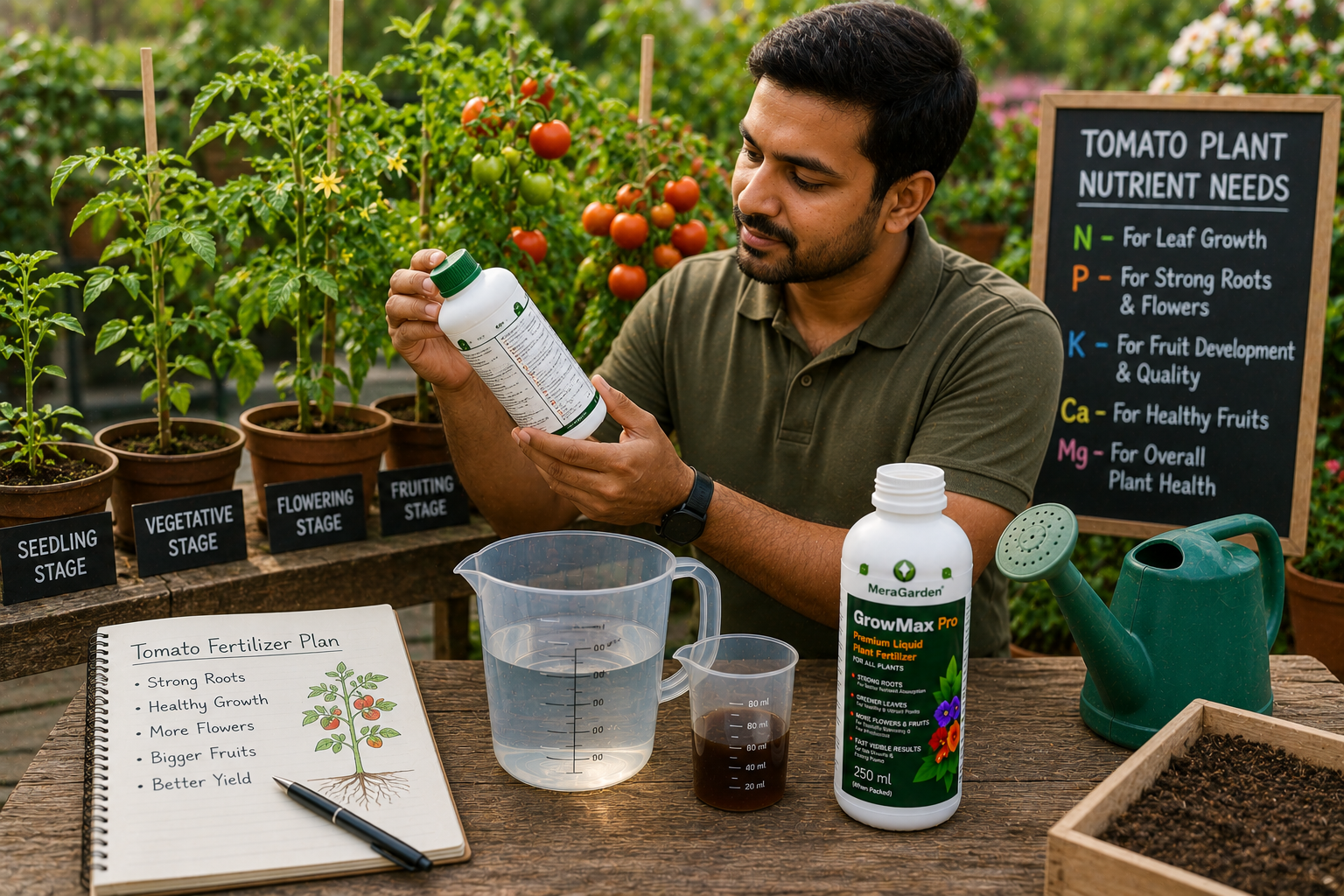
Tomatoes need several essential nutrients. Nitrogen supports vegetative growth, phosphorus is involved in root development and reproductive processes, while potassium plays an important role in many plant functions and fruit development. Other nutrients, including calcium and magnesium, can also be important for healthy plant growth.
However, more fertilizer does not mean more tomatoes.
One of the biggest mistakes home gardeners make is assuming that increasing fertilizer concentration will automatically make tomato plants grow faster or produce more fruit. Excessive fertilizer can create nutrient imbalances and may stress the plant.
The smarter approach is to select an appropriate fertilizer, use the recommended dosage and adjust your care routine according to the plant’s growth stage.
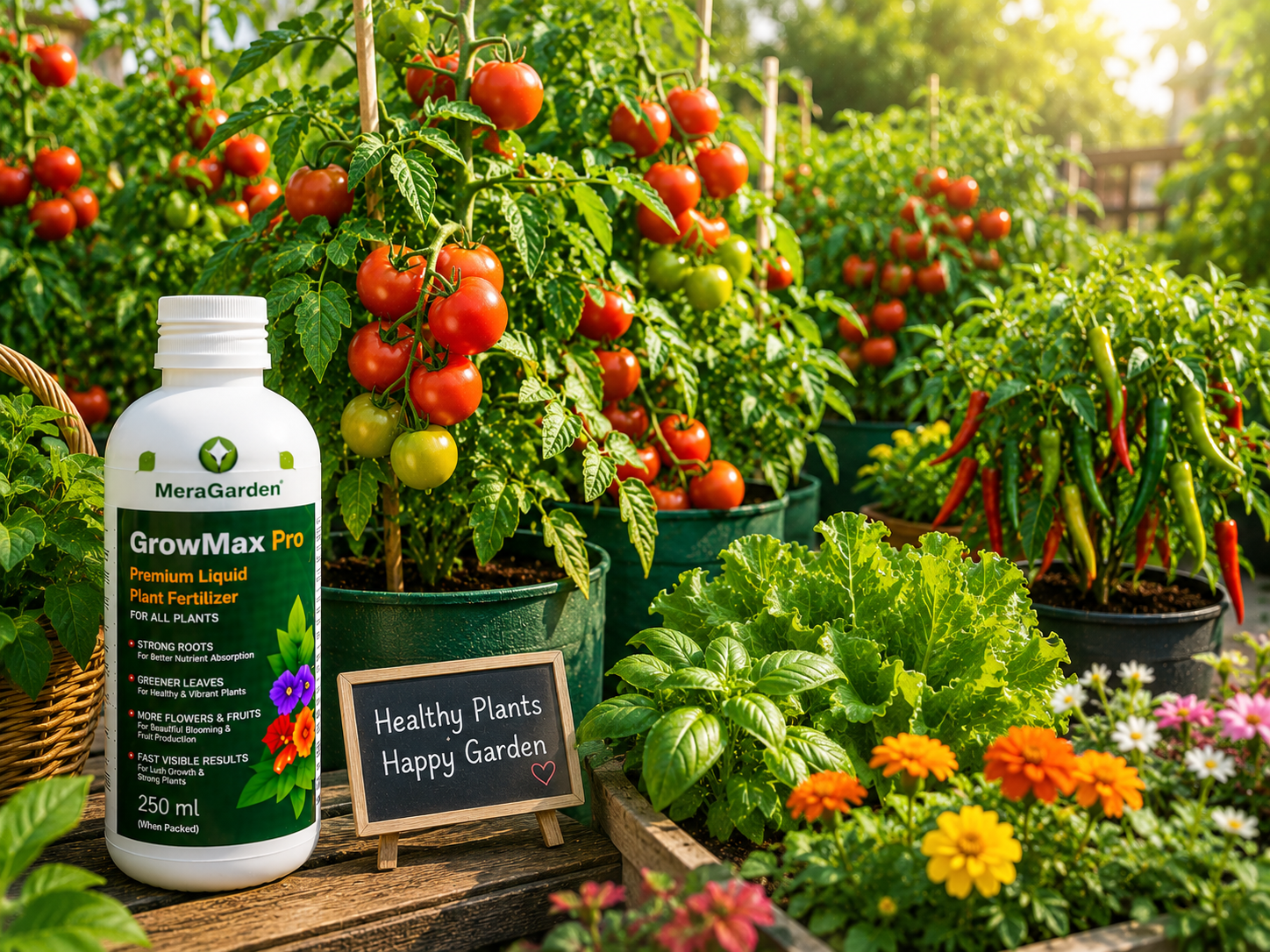
Liquid fertilizer can be particularly convenient for home gardeners because it can be measured and diluted before application. MeraGarden GrowMax Pro is one liquid fertilizer option that can be incorporated into a tomato-care routine according to its current product-label instructions.
In this guide, we will cover 7 proven tips for choosing and using fertilizer for tomato plants, including what tomatoes need during different growth stages, common mistakes to avoid, liquid versus granular fertilizer, and how GrowMax Pro can fit into your home vegetable garden.
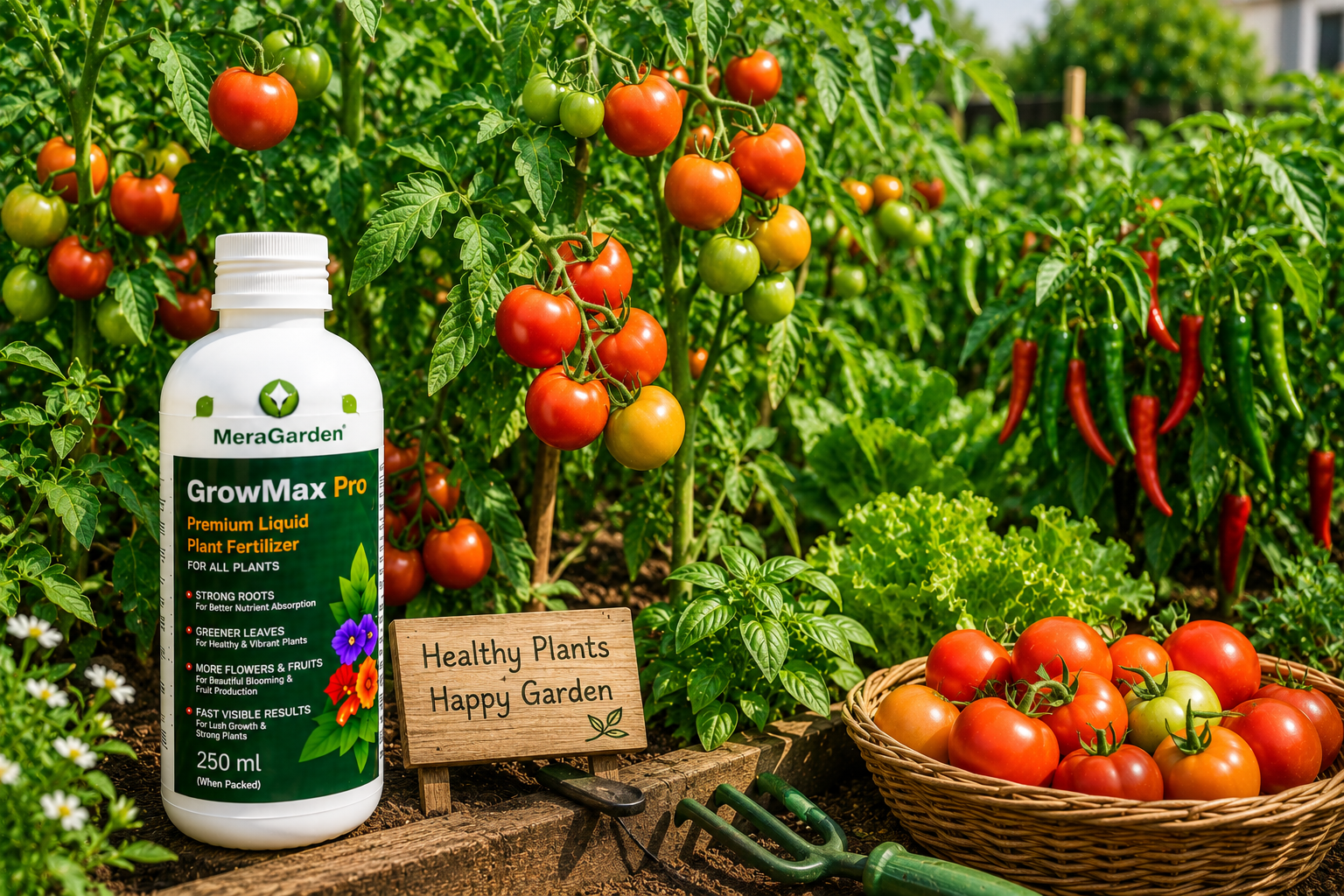
Table of Contents
Benefits 1–2: Why the Right Fertilizer Matters for Tomato Plants
1. Appropriate Nutrition Supports Strong Tomato Plant Growth
Tomato plants grow rapidly under favorable conditions.
From a small seedling, a tomato plant can develop stems, leaves, flowers and eventually fruit. This growth requires a continuous supply of essential nutrients.
A suitable fertilizer can become an important part of the nutrition routine, particularly when the growing medium does not provide enough nutrients by itself.
Nitrogen
Nitrogen is strongly associated with vegetative plant growth.
Tomato plants require nitrogen, particularly during the vegetative stage when they are developing leaves and stems.
However, excessive nitrogen is not necessarily beneficial.
Too much nitrogen can encourage excessive leafy growth at the expense of balanced flowering and fruit production.
This is why simply choosing a fertilizer with the highest nitrogen content is not a good strategy.
Phosphorus
Phosphorus is involved in important plant processes, including root development and reproductive growth.
A healthy root system helps the plant access water and nutrients from the growing medium.
Potassium
Potassium is another important nutrient for plants and is involved in numerous physiological processes.
For fruiting plants such as tomatoes, maintaining appropriate nutrition during flowering and fruit development is particularly important.
The goal is therefore not to maximize one nutrient.
It is to provide balanced nutrition appropriate for the plant and its growth stage.
2. Proper Fertilization Can Support Flowering and Fruit Development
Tomato production involves several stages.
The plant first establishes roots and vegetative growth. It then develops flower clusters, followed by fruit formation and maturation.
Nutritional requirements can change as the plant progresses through these stages.
A fertilizer routine should therefore not be based simply on:
“Tomatoes need fertilizer, so I will use as much as possible.”
Instead, consider:
Plant age → Growth stage → Growing conditions → Fertilizer formulation → Recommended dosage
During the early stage, healthy roots and vegetative growth are important.
As the plant matures, flowering and fruit development become increasingly important.
Good nutrition is only one part of successful fruit production. Tomato plants also require adequate sunlight, appropriate watering, support where necessary, and good airflow.
Don’t forget sunlight
Even an excellent fertilizer cannot compensate for inadequate light.
Tomatoes generally perform best when they receive sufficient direct sunlight. If a plant is growing in a very shaded location, adding more fertilizer may not solve the underlying problem.
This is why fertilizer should always be considered part of a complete tomato-care system.
Benefits 3–5: 7 Proven Fertilizer Tips for Better Tomatoes
3. Choose a Fertilizer Formulation Suitable for Tomatoes
When searching for the best fertilizer for tomato plants, don’t choose a product based only on its name.
Look at the fertilizer information and determine whether it is appropriate for vegetables or tomato plants.
Tomatoes require a range of nutrients rather than a single nutrient.
A suitable fertilizer should be used according to its intended purpose and label directions.
What should you check?
Before buying or using a tomato fertilizer, look at:
- Nutrient information
- NPK ratio, if provided
- Recommended plants
- Dosage
- Dilution instructions
- Application frequency
- Application method
If you are using a liquid fertilizer concentrate, the dilution instructions are particularly important.
Never assume that two liquid fertilizers with similar-looking bottles require the same dosage.
Their concentrations can be different.
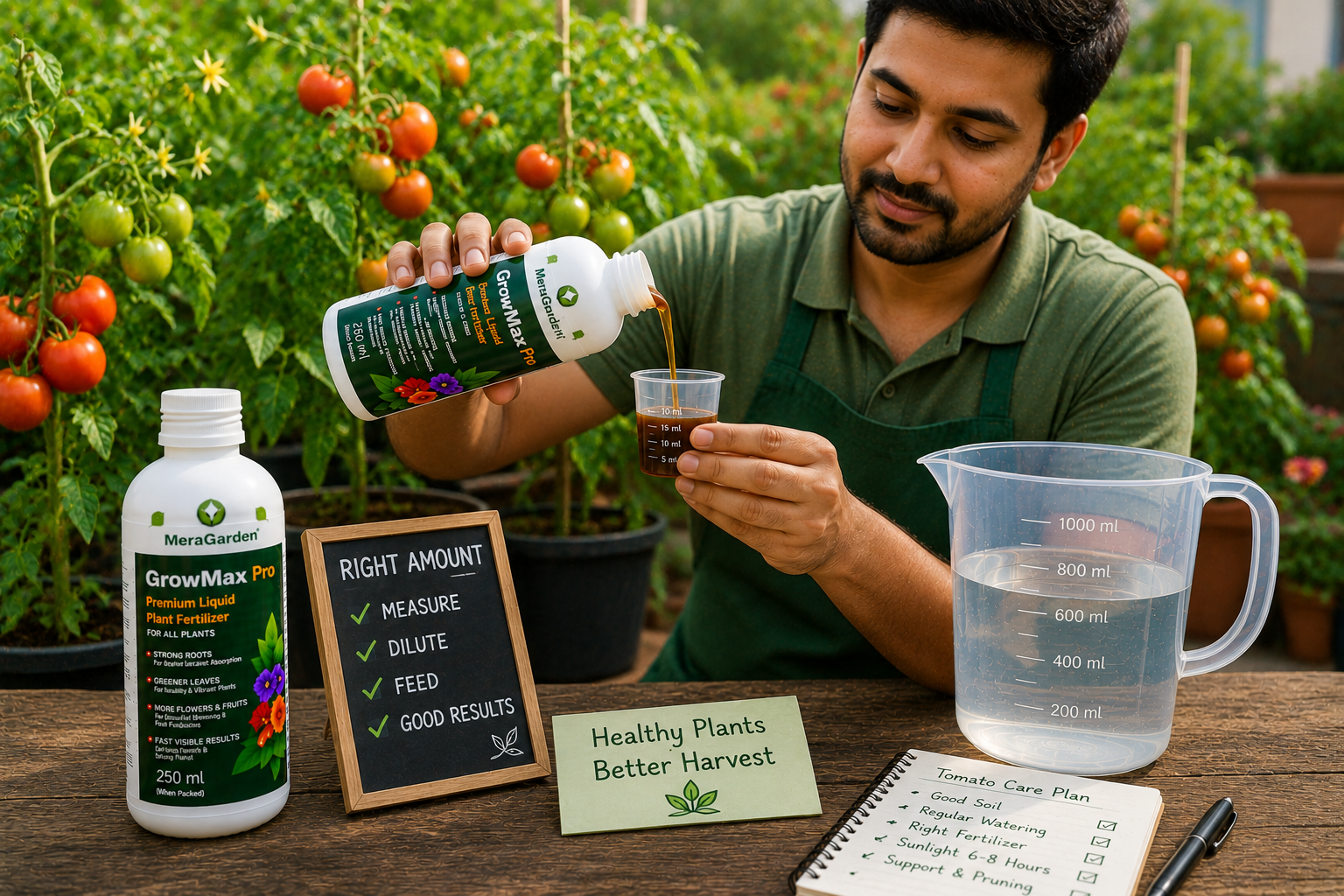
4. Use Less Guesswork and More Accurate Measurement
One of the easiest ways to improve your fertilizer routine is to stop measuring fertilizer by eye.
A small difference in the quantity of concentrated liquid fertilizer can change the final concentration of the solution.
Instead, use a suitable measuring container.
The process should be:
Read the label → Measure → Dilute → Mix → Apply
This is especially useful when growing tomatoes in containers.
Container-grown plants have a relatively limited amount of growing medium compared with plants growing in the ground. Therefore, gardeners should be particularly careful about fertilizer concentration and frequency.
Avoid the “more is better” mistake
Adding extra fertilizer may feel like you are giving the tomato plant additional nutrition.
But plants do not work that way.
If the recommended concentration is exceeded, the plant may experience unnecessary stress or nutrient imbalance.
The correct fertilizer amount is more important than the maximum possible amount.
5. Match Your Fertilizer Routine to the Tomato’s Growth Stage
A tomato plant does not remain in one growth stage throughout the season.
Understanding the basic stages makes fertilizer management easier.
Stage 1: Seedling
Young seedlings are developing their first leaves and roots.
They should not automatically receive the same fertilizer concentration as a large, mature plant.
Follow the product instructions for young plants if provided.
Stage 2: Vegetative growth
The plant begins producing more leaves and stems.
Adequate nutrition, sunlight and water support healthy development during this stage.
Stage 3: Flowering
The plant begins producing flowers.
This is a critical transition because successful flowering is necessary for fruit production.
Continue following the recommended fertilizer schedule rather than suddenly doubling the dosage.
Stage 4: Fruit development
Small tomatoes begin forming after successful pollination.
At this stage, the plant continues to require appropriate nutrition, water and sunlight.
Stage 5: Fruit maturation
The fruit grows and begins changing color as it matures.
Continue maintaining suitable growing conditions and avoid excessive fertilizer application.
The exact fertilizer schedule should always depend on the specific product and plant conditions.
6. Avoid Excessive Nitrogen When Your Tomato Plant Is Already Very Leafy
Nitrogen is essential for plant growth, but excessive nitrogen can encourage vigorous vegetative growth.
You may see:
- Very large leaves
- Strong leafy growth
- Long stems
- Delayed or reduced flowering in some circumstances
This does not mean nitrogen is bad for tomatoes.
It means the plant needs an appropriate nutrient balance.
If your tomato plant is already producing abundant foliage but has poor flowering, don’t automatically respond by adding more fertilizer.
First check:
- Sunlight
- Watering
- Plant variety
- Temperature
- Pollination conditions
- Existing fertilizer routine
A balanced approach is much better than repeatedly adding nutrients without identifying the cause.
7. Combine Fertilizer With Good Tomato Plant Care
Even the best fertilizer for tomato plants cannot replace basic gardening practices.
Tomato plants need a supportive environment.
Provide adequate sunlight
Tomatoes generally need plenty of sunlight for healthy growth and fruit production.
Maintain consistent moisture
Avoid extreme cycles of very dry soil followed by excessive watering.
Ensure good drainage
Tomato roots need access to air as well as water.
Poorly drained growing media can create root problems.
Provide support
Many tomato varieties benefit from stakes, cages or other support systems as the plant grows.
Monitor pests and diseases
Inspect leaves and stems regularly.
If you notice unusual spots, insects, wilting or sudden changes in growth, investigate the cause rather than assuming that fertilizer is the solution.
Maintain a suitable growing medium
Healthy roots are fundamental to nutrient uptake.
A fertilizer works best when the root environment is also suitable.
Give Your Tomato Plants the Right Nutrition
Growing healthy tomatoes starts with the right combination of sunlight, water, growing medium and nutrition.
If you prefer a convenient liquid fertilizer for your home vegetable garden, explore MeraGarden GrowMax Pro and follow the current product label for the correct dosage, dilution and application frequency.
How to Use Liquid Fertilizer for Tomato Plants
If you choose a liquid fertilizer, the way you prepare and apply it is just as important as the fertilizer itself.
Follow these practical steps.
Step 1: Check Your Tomato Plant
Before fertilizing, inspect the plant.
Look at:
- New growth
- Leaves
- Flowers
- Developing tomatoes
- Soil moisture
- Signs of pests
- Overall plant health
Don’t automatically fertilize a plant simply because it looks weak.
Step 2: Read the Product Label
Before preparing MeraGarden GrowMax Pro, check the current label.
Look specifically for:
- Recommended dosage
- Dilution ratio
- Application frequency
- Suitable crops
- Application method
Product-specific instructions should always take priority over generic online advice.
Step 3: Measure the Recommended Amount
Use a measuring container.
Do not estimate the amount by pouring directly from the bottle.
Accurate measurement helps you maintain consistency between applications.
Step 4: Dilute With the Recommended Amount of Water
Add the measured fertilizer to the appropriate quantity of water specified on the product label.
Mix thoroughly.
Do not intentionally make the solution stronger because you want faster growth.
Step 5: Apply Around the Plant as Directed
If the product instructions specify soil application, apply the diluted solution around the plant’s root zone as directed.
Avoid creating a concentrated pool directly against the stem.
Follow any specific application instructions provided by the manufacturer.
Step 6: Follow the Recommended Frequency
Do not repeat the application simply because the plant has not visibly changed after a short period.
Plant growth takes time.
Follow the recommended application interval.
Step 7: Observe the Plant
After application, monitor the tomato plant.
Look for:
- New healthy growth
- Flower development
- Fruit development
- Overall vigor
- Unusual leaf symptoms
If problems appear, investigate the growing environment before increasing fertilizer.
Liquid Fertilizer vs Granular Fertilizer for Tomato Plants
Both liquid and granular fertilizers can be useful for tomato plants.
The better choice depends on your gardening style, the fertilizer formulation and how accurately you can apply it.
| Feature | Liquid Fertilizer | Granular Fertilizer |
|---|---|---|
| Form | Liquid | Dry granules |
| Preparation | Often diluted with water | Usually applied directly as instructed |
| Measurement | Measured before dilution | Measured before application |
| Application | Often convenient for containers | Convenient for soil applications |
| Dosage control | Requires accurate dilution | Requires accurate dry measurement |
| Tomato plants | Suitable formulations available | Suitable formulations available |
| Balcony gardens | Can be convenient | Can also be used |
| Feeding routine | Easy to incorporate into scheduled applications | Often used according to product schedule |
| Main concern | Incorrect concentration | Excessive application |
Neither type should automatically be called the “best.”
The important thing is to choose a product suitable for tomatoes and use it correctly.
Why liquid fertilizer can be convenient
For home gardeners with several containers, liquid fertilizer can be practical because the concentrate can be measured and diluted.
This allows gardeners to prepare the required solution rather than applying a dry product directly.
However, convenience does not eliminate the need for accurate dosage.
MeraGarden GrowMax Pro for Tomato Plants
If you prefer liquid fertilizer, MeraGarden GrowMax Pro can be considered as part of a tomato plant nutrition routine, provided the product’s current label indicates that it is suitable for your intended use.
Its liquid format allows gardeners to measure and dilute the product before application.
This can be convenient for:
- Balcony tomato plants
- Terrace gardens
- Container tomatoes
- Kitchen gardens
- Mixed vegetable gardens
- Home vegetable plants
Use GrowMax Pro according to the label
The most important rule is simple:
Do not guess the dosage.
Before using GrowMax Pro, check the current product instructions for the appropriate:
Dosage → Dilution → Frequency → Application method
This is particularly important because fertilizer formulations and concentrations can vary.
Don’t use fertilizer as a shortcut
If your tomato plant is not producing fruit, don’t automatically assume that it needs more fertilizer.
Fruit production can be affected by:
- Insufficient sunlight
- Temperature
- Water stress
- Pollination
- Plant variety
- Pests
- Disease
- Nutritional imbalance
Fertilizer should be one part of a complete tomato-care strategy.
A simple tomato-care formula
Think of successful tomato growing as:
Good Soil + Sunlight + Water + Support + Nutrition + Monitoring
When these factors work together, your tomato plants have a much better foundation for healthy growth.
Choose a Smarter Tomato Fertilizer Routine
Want an easy way to include liquid fertilizer in your home vegetable garden?
MeraGarden GrowMax Pro can be incorporated into your tomato-care routine according to its current product instructions.
Measure carefully, dilute correctly and maintain a consistent feeding schedule.
Conclusion
So, what is the best fertilizer for tomato plants?
The answer isn’t simply the fertilizer with the highest nutrient numbers or the fertilizer that promises the fastest growth.
The best choice is a fertilizer that is appropriate for tomatoes, suitable for the plant’s growth stage and used according to the manufacturer’s recommended dosage and frequency.
Remember these 7 important tips:
- Choose a fertilizer formulation suitable for tomato plants.
- Provide appropriate nutrition during active growth.
- Measure liquid fertilizer accurately.
- Adjust your routine according to the tomato’s growth stage.
- Avoid excessive nitrogen and unnecessary overfeeding.
- Use the correct fertilizer-to-water dilution.
- Combine fertilizer with good sunlight, watering, drainage and plant care.
For gardeners who prefer liquid fertilizer, MeraGarden GrowMax Pro can be a convenient option when used according to the current product label.
Most importantly, don’t fall into the common trap of thinking that more fertilizer means more tomatoes.
Healthy tomato production comes from balance.
Give your plants enough sunlight, maintain suitable moisture, provide good drainage and support healthy roots. Then use fertilizer as part of a consistent nutrition routine.
Measure correctly. Feed responsibly. Monitor your plants.
That’s a much smarter approach to growing a productive home tomato garden.
FAQs
1. What is the best fertilizer for tomato plants?
The best fertilizer depends on the tomato plant’s growth stage, growing medium and nutritional requirements. Choose a fertilizer suitable for tomatoes and follow the manufacturer’s dosage and application instructions.
2. Do tomato plants need fertilizer?
Tomato plants require essential nutrients for healthy growth. Whether additional fertilizer is needed depends on the growing medium, existing nutrient availability and plant conditions.
3. Is liquid fertilizer good for tomato plants?
A liquid fertilizer formulated for suitable plants can be convenient for tomatoes, particularly in container and home gardens. Always check the product label before use.
4. Is NPK fertilizer good for tomatoes?
NPK fertilizers provide nitrogen, phosphorus and potassium, three essential plant nutrients. The appropriate NPK balance depends on the fertilizer formulation, plant stage and growing conditions.
5. Should tomato plants get more nitrogen?
Tomatoes require nitrogen, particularly for vegetative growth, but excessive nitrogen can encourage excessive foliage and may interfere with balanced flowering and fruit production. Avoid increasing nitrogen without a reason.
6. When should I fertilize tomato plants?
The appropriate timing depends on the tomato’s growth stage, fertilizer formulation and manufacturer instructions. Active growth periods may be relevant, but follow the product’s recommended schedule.
7. Can I use liquid fertilizer on tomato plants in containers?
A suitable liquid fertilizer can be used for container tomatoes when the product instructions permit it. Accurate measurement and dilution are particularly important for container-grown plants.
8. How often should tomato plants be fertilized?
There is no universal frequency for every fertilizer. Follow the manufacturer’s recommended application interval and consider the tomato plant’s growth stage and growing conditions.
9. Can too much fertilizer damage tomato plants?
Yes. Excessive fertilizer or overly concentrated solutions can stress plants and contribute to nutrient or salt-related problems. Always follow the recommended dosage.
10. Can fertilizer make tomato plants produce more fruit?
Appropriate nutrition can support healthy growth and reproductive development, but fertilizer alone does not guarantee more fruit. Sunlight, watering, pollination, temperature, variety and overall plant health also matter.
11. Is MeraGarden GrowMax Pro suitable for tomato plants?
Check the current MeraGarden GrowMax Pro product label for the intended crops and application instructions. If tomatoes are listed as a suitable crop, use the product according to the specified dosage and dilution.
12. How should I use MeraGarden GrowMax Pro for tomatoes?
Measure and dilute GrowMax Pro according to its current product-label instructions, then apply using the specified method and frequency. Do not substitute a generic fertilizer dosage for the manufacturer’s instructions.
You Must Read
- How Often Should You Fertilize Plants? 7 Easy Rules for Healthy Growth
- How Often Should You Fertilize Plants? Complete Fertilizer Schedule
- What Is NPK Fertilizer? 7 Easy Tips for Healthy Plants
- Best Liquid Fertilizer for Plants: Complete Guide for Home Gardeners
- How to Use Liquid Fertilizer for Plants: 7 Easy Steps for Better Growth
- Best Organic Fertilizers for Plants: 7 Natural Options for Healthy Growth
- Best Fertilizer for Indoor Plants in India: 7 Easy Tips for Healthy Growth
- Best Fertilizer for Flowering Plants in India: 7 Top Options
- Best Fertilizer for Plants: 7 Smart Tips to Avoid Common Mistakes
- 5 Signs Your Plants May Need Fertilizer
- How Much Liquid Fertilizer Should You Use for Plants?
- 7 Benefits of Liquid Fertilizer for Plants: Grow Healthier Plants Faster
- 7 Benefits of Liquid Fertilizer for Plants: A Simple Guide for Healthy Growth
- Best Fertilizer for Peace Lily: 7 Powerful Tips for Beautiful Blooms and Avoiding Common Mistakes
- Best Fertilizer for Spider Plant: 7 Powerful Tips for Lush Growth and Avoiding Common Mistakes
- Liquid Fertilizer vs Granular Fertilizer: Which Is Better? 7 Key Differences for Home Gardeners
- Liquid Fertilizer vs Organic Fertilizer: 7 Powerful Pros, Cons & the Best Choice for Your Plants
- How to Choose the Right Fertilizer for Your Plants: 7 Smart Tips to Avoid Common Mistakes
- 5 Positive Signs Your Plants Need Fertilizer — Avoid These Warning Symptoms for Healthier Growth
- How to Grow Peace Lilies
- How To Grow Houseplants