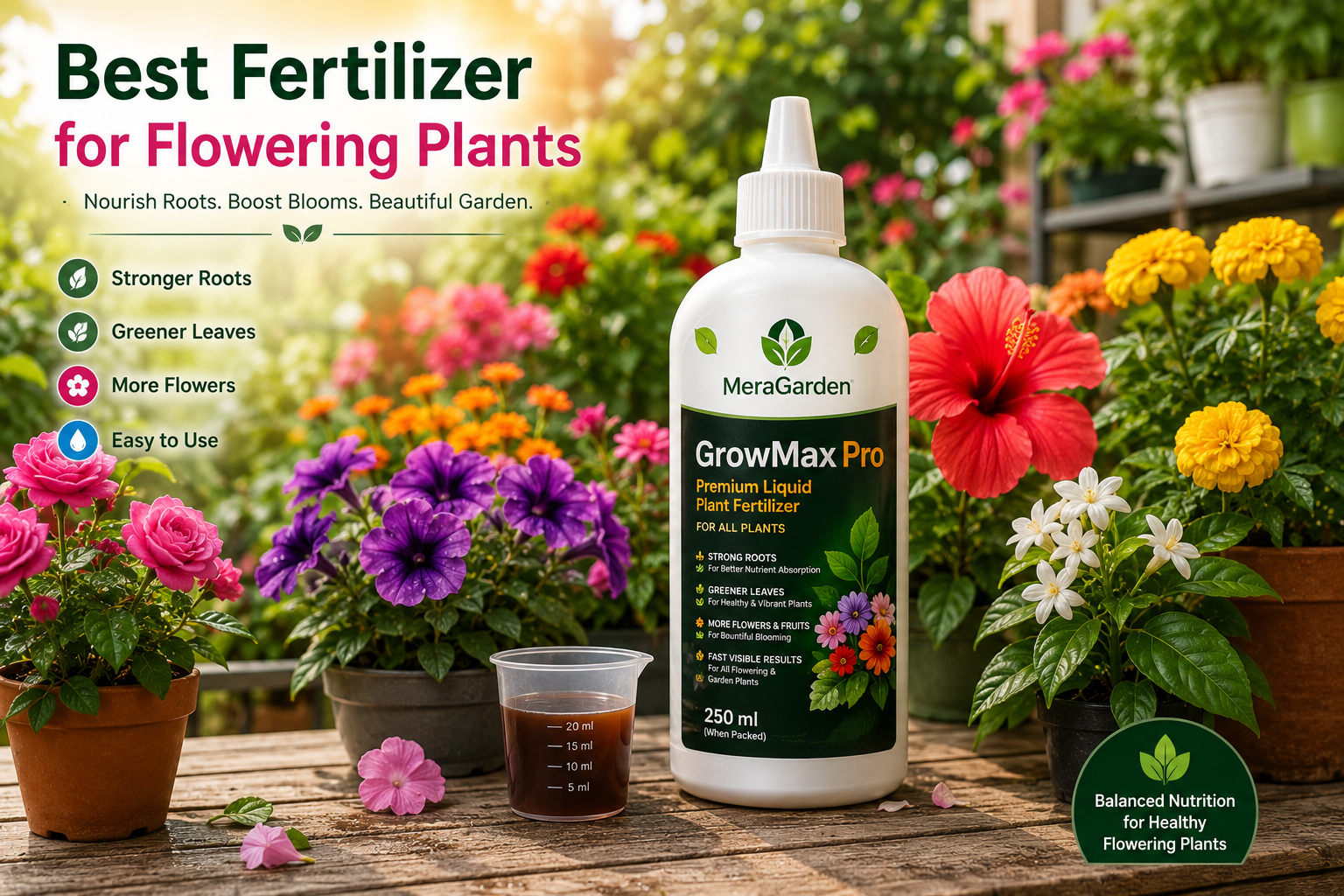
Getting more flowers from roses, hibiscus, jasmine, marigolds, bougainvillea, petunias, and other flowering plants is not only about sunlight and watering. Plant nutrition also plays an important role in healthy growth and flowering.
If your plant has plenty of leaves but very few flowers, the problem may be related to nutrition, light, watering, pruning, temperature, or the overall growing conditions.
Choosing the best fertilizer for flowering plants therefore starts with understanding what your particular plant needs rather than simply choosing the strongest fertilizer available.
In this guide, we will look at 7 useful fertilizer options for flowering plants, explain when each type can be useful, and share practical tips for feeding plants in home gardens and containers.
Table of Contents
What Makes a Good Fertilizer for Flowering Plants?
There is no single fertilizer that is automatically the best for every flowering plant.
Different plants have different nutrient requirements, and their needs can also change depending on their growth stage, pot size, soil condition, sunlight, temperature, and watering routine.
The three major nutrients commonly discussed on fertilizer labels are:
- Nitrogen (N) – supports leafy and vegetative growth.
- Phosphorus (P) – plays an important role in root development and reproductive growth.
- Potassium (K) – supports several plant functions and contributes to overall plant development.
This is why looking only at the highest NPK number is not a good way to choose fertilizer.
For flowering plants, the goal should be balanced and appropriate nutrition, rather than simply adding more fertilizer.
Research from ICAR has also shown that appropriate nutrient management can influence flowering and flower quality in different floricultural crops.
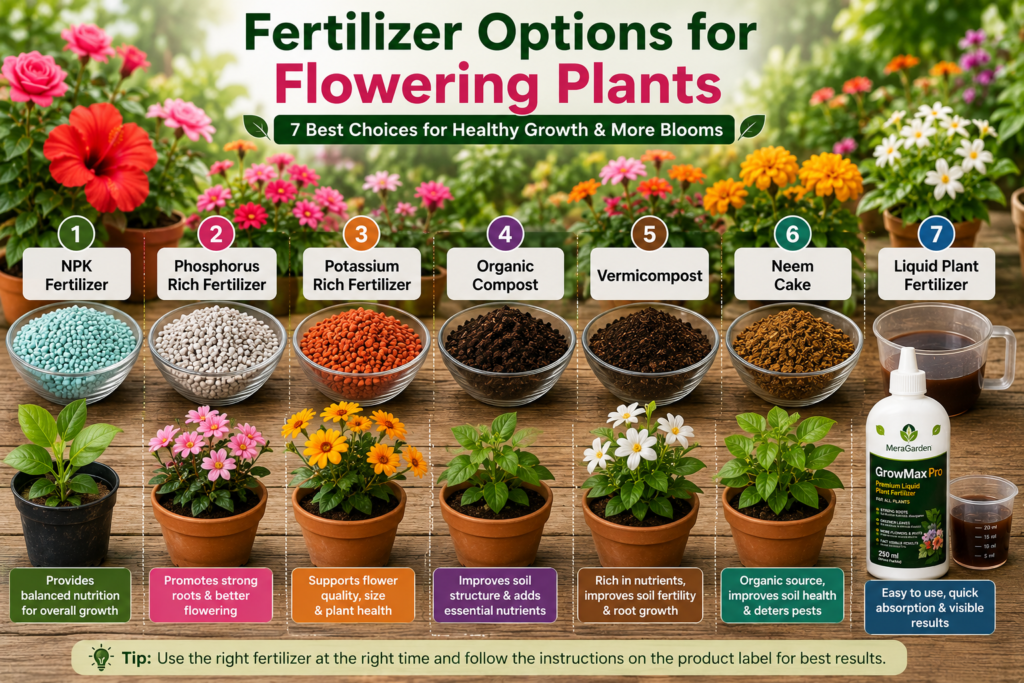
7 Best Fertilizer Options for Flowering Plants
Here are seven commonly useful fertilizer options that home gardeners can consider.
1. Balanced NPK Fertilizer
Balanced NPK fertilizers provide nitrogen, phosphorus, and potassium together.
They can be useful when a plant needs general nutrition rather than a single nutrient.
For example, an NPK fertilizer may be suitable during active growth when the plant is developing leaves, stems, roots, and flower buds.
However, the correct fertilizer ratio depends on the plant and growing conditions.
Always follow the product label rather than assuming that a higher number means better results.
If you want to understand NPK in more detail, read our guide:
What Is NPK Fertilizer? 7 Easy Tips for Healthy Plants
2. Phosphorus-Containing Fertilizer
Phosphorus is an important plant nutrient involved in energy transfer and reproductive processes.
Because of this, phosphorus is often discussed when gardeners are trying to improve flowering.
However, adding large amounts of phosphorus simply because a plant is not flowering is not necessarily the right solution.
A plant may fail to flower because of insufficient sunlight, incorrect pruning, excessive nitrogen, water stress, unsuitable temperature, pests, or other factors.
So phosphorus should be supplied according to the plant’s actual nutritional needs.
3. Potassium-Rich Fertilizer
Potassium is another major plant nutrient and is involved in numerous physiological processes.
A fertilizer containing potassium can be useful as part of a suitable nutrient-management program.
But again, more is not always better.
Excessive fertilizer can cause nutrient imbalances and may damage plants, particularly when concentrated products are applied incorrectly.
For flowering plants grown in containers, always pay attention to the product’s recommended dilution and application instructions.
4. Organic Compost
Compost is one of the simplest ways to add organic matter to garden soil.
Well-decomposed compost can improve soil structure while contributing nutrients and organic material.
It is especially useful when gardeners want to improve the overall growing medium instead of relying only on liquid or synthetic fertilizers.
You can use compost around established plants while keeping it away from direct contact with the main stem.
Compost can also be combined with other appropriate nutrient sources as part of an integrated approach.
5. Vermicompost
Vermicompost is produced through the breakdown of organic material by earthworms.
It is commonly used by home gardeners for container plants, flowering plants, vegetables, and other garden crops.
A major advantage of vermicompost is that it adds organic material while supplying nutrients in relatively mild form.
Research conducted by ICAR-IARI on gladiolus found that integrated nutrient management involving vermicompost and other nutrient sources significantly affected vegetative and flowering parameters.
That does not mean every flowering plant should receive the same quantity.
The appropriate amount depends on the plant, container, soil, and other inputs being used.
6. Neem Cake
Neem cake is an organic material obtained from neem seed after oil extraction.
Many Indian gardeners use neem cake as part of their soil-management routine.
It can be incorporated into the growing medium in appropriate quantities and may be useful alongside other organic inputs.
However, neem cake should not be treated as a complete replacement for every nutrient a flowering plant requires.
Think of it as one component of a broader plant-care program, rather than a magic solution for flowering.
7. Liquid Plant Fertilizer
Liquid fertilizers are popular with home gardeners because they are convenient to mix and apply.
They can be particularly useful for container plants where gardeners want to provide nutrients during active growth.
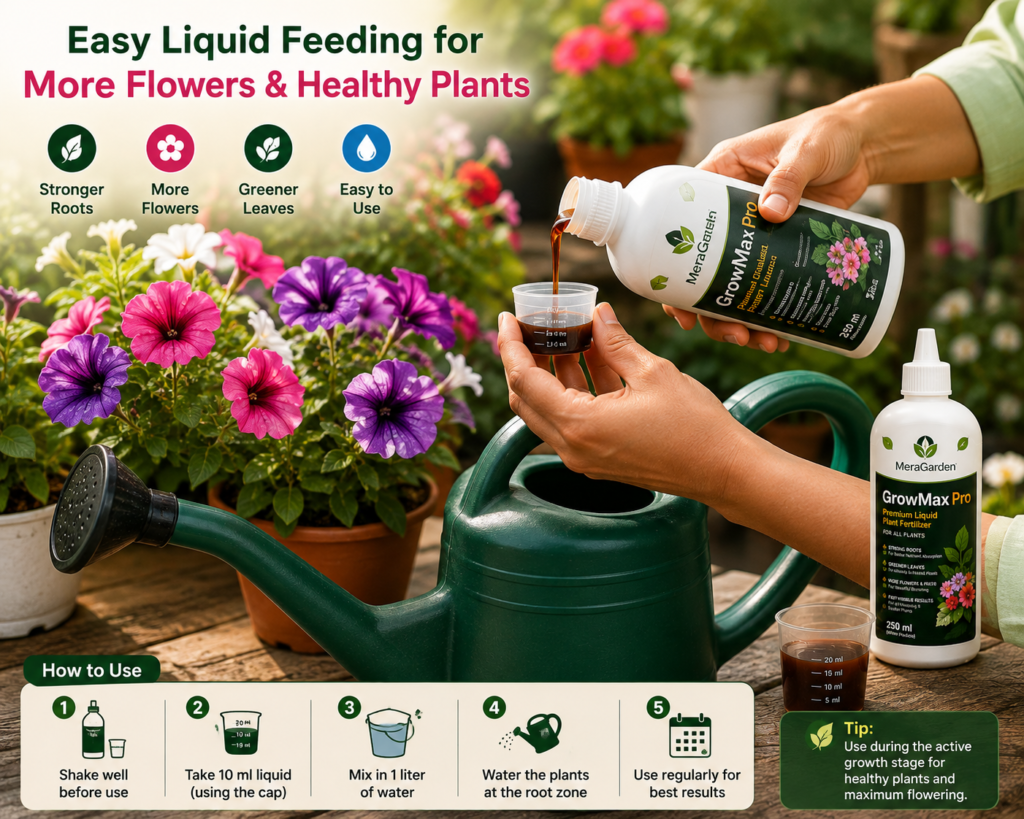
A liquid fertilizer is normally diluted with water according to the product instructions before application.
This makes it easy to incorporate feeding into a regular plant-care routine.
If you are new to liquid fertilizers, our detailed guide explains the basics:
Best Liquid Fertilizer for Plants: Complete Guide for Home Gardeners
Looking for a convenient liquid fertilizer for your flowering plants?
If you prefer a ready-to-use liquid plant nutrition option, you can also consider MeraGarden GrowMax Pro.
Which Fertilizer Is Best for Flowering Plants?
The best fertilizer depends on what your plant actually needs.
For example:
| Situation | Possible option |
|---|---|
| General plant nutrition | Balanced NPK fertilizer |
| Need for organic matter | Compost |
| Container gardening | Vermicompost |
| Organic soil supplementation | Neem cake |
| Convenient feeding | Liquid fertilizer |
| Nutrient-management program | Appropriate NPK combination |
| Regular liquid feeding | Suitable liquid plant fertilizer |
The important point is that fertilizer should complement good plant care, not replace it.
Even the best fertilizer cannot compensate for a flowering plant that receives inadequate sunlight or has serious pest, disease, watering, or root problems.
How Often Should You Fertilize Flowering Plants?
There is no universal feeding schedule for every flowering plant.
Fertilizer frequency depends on:
- Plant species
- Plant age
- Pot size
- Growing medium
- Fertilizer concentration
- Season
- Growth stage
- Weather
- Watering routine
Some products are designed for frequent diluted application, while others are intended for less frequent use.
The safest approach is simple:
- Read the fertilizer label.
- Follow the recommended dilution.
- Do not increase the concentration to get faster results.
- Observe the plant after feeding.
- Adjust only according to the product instructions and plant requirements.
For liquid fertilizers, proper dilution is particularly important.
You can read our step-by-step guide here:
How to Use Liquid Fertilizer for Plants: 7 Easy Steps for Better Growth
How to Fertilize Flowering Plants Correctly
Step 1: Check the Plant’s Growing Conditions
Before reaching for fertilizer, check the basics.
Ask yourself:
- Is the plant getting enough sunlight?
- Is the soil draining properly?
- Are the leaves healthy?
- Is the plant being overwatered?
- Are there pests?
- Has the plant recently been repotted?
- Is the plant actively growing?
If one of these factors is causing the problem, fertilizer alone may not solve it.
Step 2: Choose the Right Fertilizer
Choose fertilizer according to the plant and its current needs.
For example, a flowering container plant may benefit from a suitable liquid fertilizer during active growth, while compost or vermicompost may be useful for improving the growing medium.
Avoid choosing fertilizer purely because its package promises more flowers.
Step 3: Follow the Label
This is one of the most important steps.
Different fertilizers have different concentrations.
Two bottles that both say “liquid fertilizer” may require completely different dilution rates.
Therefore, never copy the dosage from another fertilizer product.
Use the manufacturer’s instructions for the exact product you have.
Step 4: Apply Around the Root Zone
When applying a soil-drench fertilizer, distribute the diluted solution around the root zone rather than pouring a concentrated solution directly against the stem.
This helps avoid unnecessarily concentrating fertilizer in one small area.
Step 5: Keep Monitoring the Plant
After fertilizing, continue normal plant care.
Look for:
- New growth
- Healthy leaves
- Flower bud development
- Changes in leaf color
- Signs of stress
- Soil moisture
If the plant shows signs of fertilizer stress, stop adding fertilizer and reassess the situation.
Common Fertilizer Mistakes to Avoid
Mistake 1: Using Too Much Fertilizer
More fertilizer does not automatically mean more flowers.
Overfertilization can damage roots and create nutrient problems.
Mistake 2: Fertilizing a Stressed Plant Without Checking the Cause
If a plant is wilting because of severe water stress, root problems, pests, or disease, simply adding fertilizer may not solve the underlying issue.
First identify the problem.
Mistake 3: Using Someone Else’s Fertilizer Dosage
This is particularly risky with concentrated liquid fertilizers.
A dosage suitable for one product may be completely inappropriate for another.
Always follow the label.
Mistake 4: Ignoring Sunlight
Many flowering plants need adequate light to produce flowers.
If a plant is growing in deep shade, adding more fertilizer may not fix poor flowering.
Mistake 5: Focusing Only on Phosphorus
A common gardening misconception is that adding large amounts of phosphorus automatically produces more flowers.
Flowering depends on the plant’s overall health and growing conditions, not one nutrient alone.
Can Liquid Fertilizer Help Flowering Plants?
Yes, liquid fertilizer can be a convenient way to provide nutrients when used correctly.
The key is choosing a suitable product and applying it according to its instructions.
Liquid fertilizers can be especially convenient for:
- Balcony gardens
- Terrace gardens
- Indoor plants
- Container flowers
- Home vegetable gardens
- Potted ornamental plants
Research on floricultural crops has demonstrated that appropriate nutrient application can influence flowering and flower quality, although the specific fertilizer program varies by crop.
Why GrowMax Pro Can Be a Convenient Option
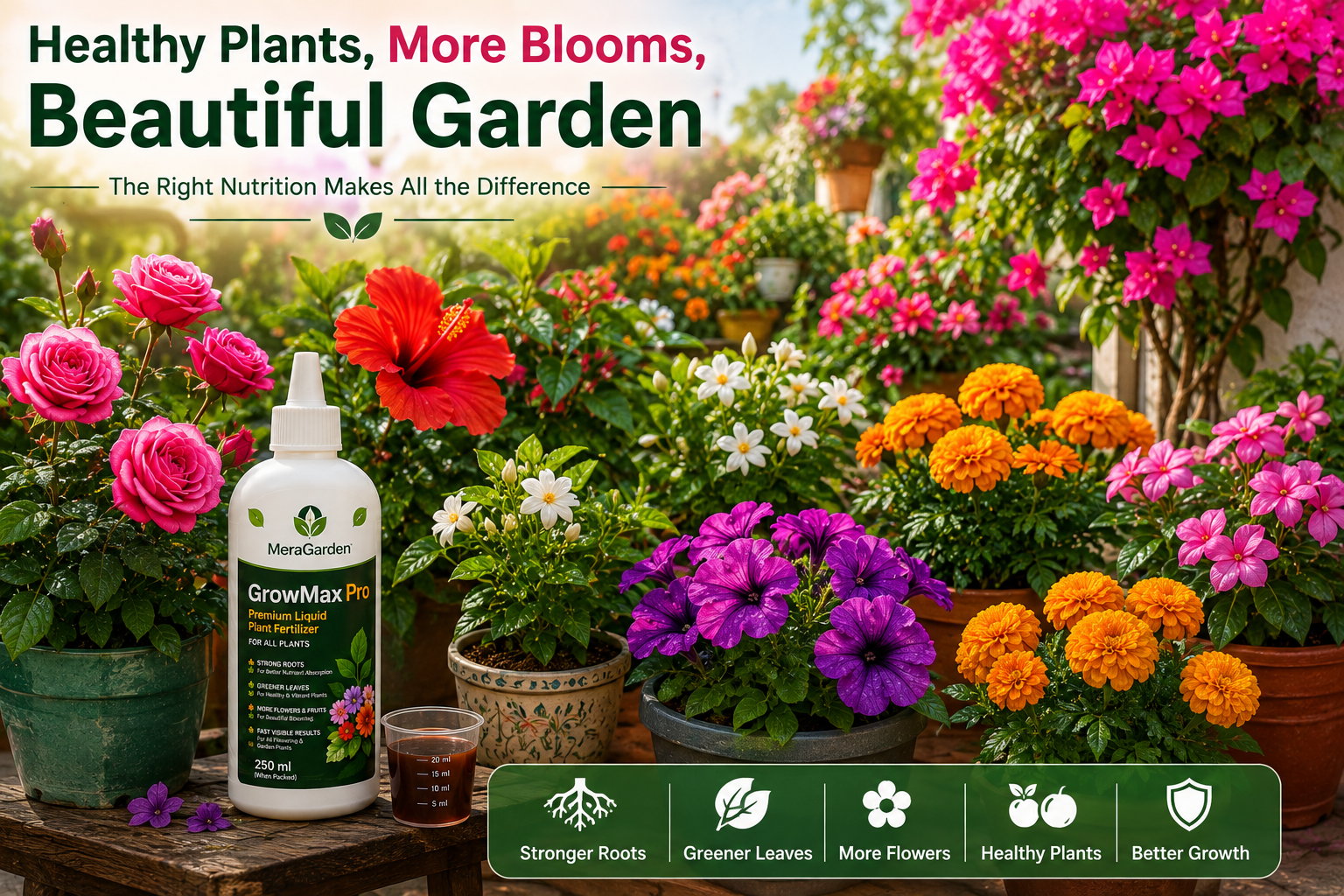
For home gardeners who prefer a liquid fertilizer format, MeraGarden GrowMax Pro is positioned as a premium liquid plant fertilizer for a range of plants.
The product presentation highlights uses such as:
- Stronger roots
- Greener leaves
- More flowers and fruits
- Convenient liquid application
The important thing is to use the product according to its own label instructions rather than applying a generic fertilizer dosage.
Want to try GrowMax Pro?
Shop MeraGarden GrowMax Pro
Whether you grow roses, hibiscus, jasmine, marigolds, balcony flowers, or other ornamental plants, remember that fertilizer works best when combined with appropriate sunlight, watering, soil, pruning, and pest management.
Frequently Asked Questions
What is the best fertilizer for flowering plants?
There is no single fertilizer that is best for every flowering plant. A suitable balanced fertilizer, organic amendment, or liquid fertilizer can be useful depending on the plant’s nutritional needs and growing conditions.
Is NPK fertilizer good for flowering plants?
Yes, NPK fertilizers can provide major plant nutrients, but the appropriate NPK ratio and application rate depend on the plant and its growing conditions.
Is liquid fertilizer good for flowering plants?
Liquid fertilizer can be a convenient option for flowering plants when diluted and applied according to the product label.
How often should flowering plants be fertilized?
It depends on the plant and fertilizer. Always follow the manufacturer’s recommended application frequency instead of using a universal schedule.
Can too much fertilizer stop flowering?
Excessive fertilizer can stress plants and create nutrient imbalances. More fertilizer does not necessarily produce more flowers.
Is compost good for flowering plants?
Well-decomposed compost can improve soil organic matter and contribute nutrients. It can be part of a healthy growing-medium management strategy.
Is vermicompost good for flowering plants?
Vermicompost is commonly used as an organic amendment for garden and container plants. It can be useful as part of an overall nutrient-management program.
Can I use liquid fertilizer on potted flowering plants?
Yes, liquid fertilizers are commonly used for container plants. Always dilute the specific product according to its label instructions.
Final Thoughts
The best fertilizer for flowering plants is not necessarily the strongest or most expensive product.
Healthy flowering depends on several factors working together: suitable light, proper watering, good drainage, healthy roots, appropriate pruning, pest management, and balanced nutrition.
Compost, vermicompost, neem cake, NPK fertilizers, and liquid plant fertilizers can all have a place in a gardener’s routine.
The most important rule is to choose the fertilizer according to the plant’s needs and follow the product instructions carefully.
For gardeners looking for a convenient liquid option, MeraGarden GrowMax Pro can be considered as part of a regular plant-care routine.
Recommended Articles
- How Often Should You Fertilize Plants? 7 Easy Rules for Healthy Growth
- How Often Should You Fertilize Plants? Complete Fertilizer Schedule
- What Is NPK Fertilizer? 7 Easy Tips for Healthy Plants
- Best Liquid Fertilizer for Plants: Complete Guide for Home Gardeners
- How to Use Liquid Fertilizer for Plants: 7 Easy Steps for Better Growth
- Best Organic Fertilizers for Plants: 7 Natural Options for Healthy Growth
- Best Fertilizer for Indoor Plants in India: 7 Easy Tips for Healthy Growth
- Best Fertilizer for Flowering Plants in India: 7 Top Options
- Best Fertilizer for Plants: 7 Smart Tips to Avoid Common Mistakes
- 5 Signs Your Plants May Need Fertilizer
- How Much Liquid Fertilizer Should You Use for Plants?
- 7 Benefits of Liquid Fertilizer for Plants: Grow Healthier Plants Faster
- 7 Benefits of Liquid Fertilizer for Plants: A Simple Guide for Healthy Growth
- Best Fertilizer for Peace Lily: 7 Powerful Tips for Beautiful Blooms and Avoiding Common Mistakes
- Best Fertilizer for Spider Plant: 7 Powerful Tips for Lush Growth and Avoiding Common Mistakes
- Liquid Fertilizer vs Granular Fertilizer: Which Is Better? 7 Key Differences for Home Gardeners
- Liquid Fertilizer vs Organic Fertilizer: 7 Powerful Pros, Cons & the Best Choice for Your Plants
- How to Choose the Right Fertilizer for Your Plants: 7 Smart Tips to Avoid Common Mistakes
- 5 Positive Signs Your Plants Need Fertilizer — Avoid These Warning Symptoms for Healthier Growth
- How to Grow Peace Lilies
- How To Grow Houseplants