Growing healthy plants is not only about watering them regularly. The quality of the soil and the nutrients available to the roots also play an important role in plant growth.
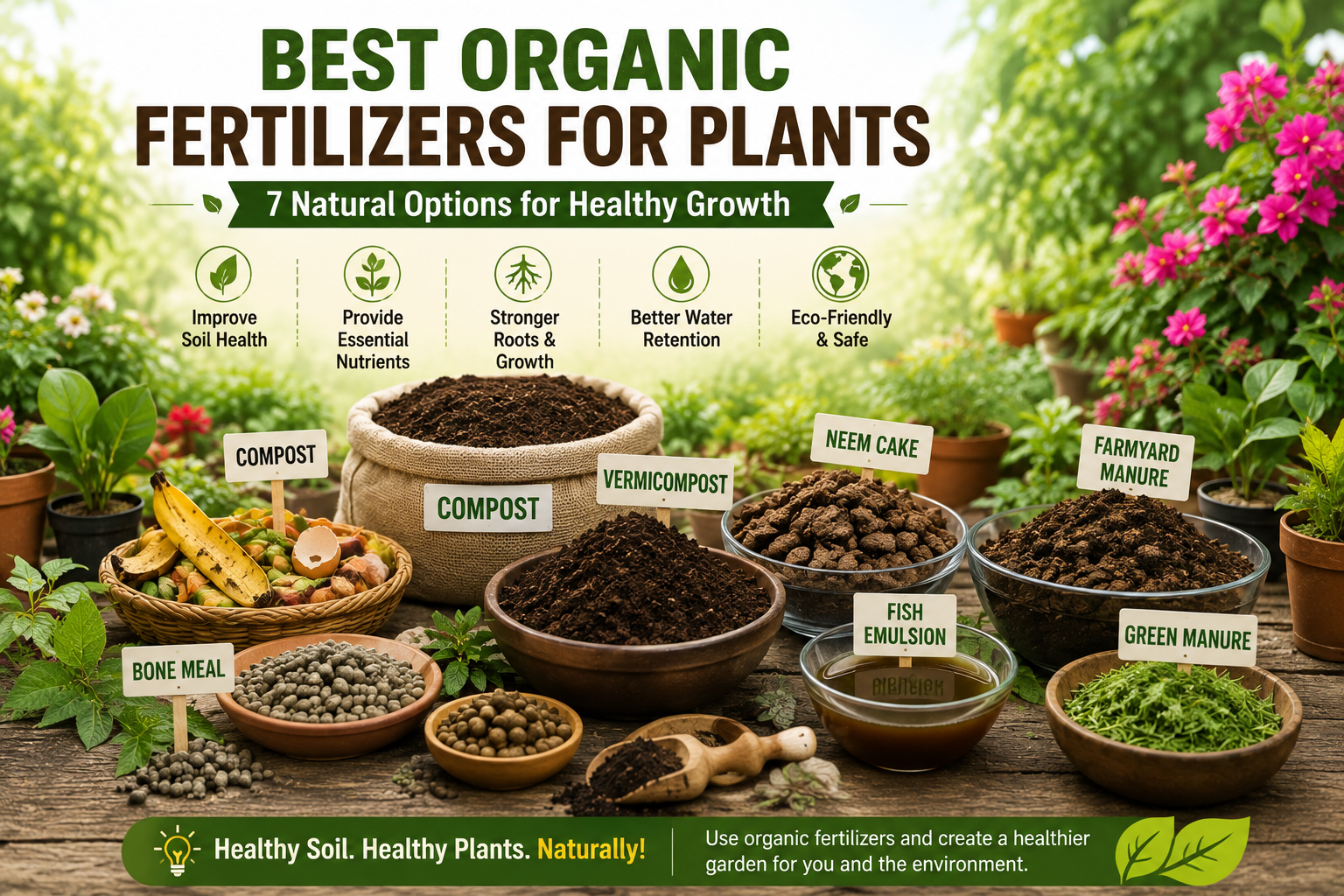
If you are looking for the best organic fertilizers for plants, there are several natural options you can use in a home garden. Compost, vermicompost, farmyard manure, neem cake and other organic nutrient sources can help improve soil quality while supplying nutrients to plants.
Organic nutrient management is also promoted as part of sustainable soil-health practices in India. ICAR guidance highlights inputs such as farmyard manure, compost, vermicompost, green manure and biofertilizers as useful components of nutrient management.
In this guide, we will look at the best organic fertilizers for plants, their benefits, how to use them and which option may be suitable for different types of plants.
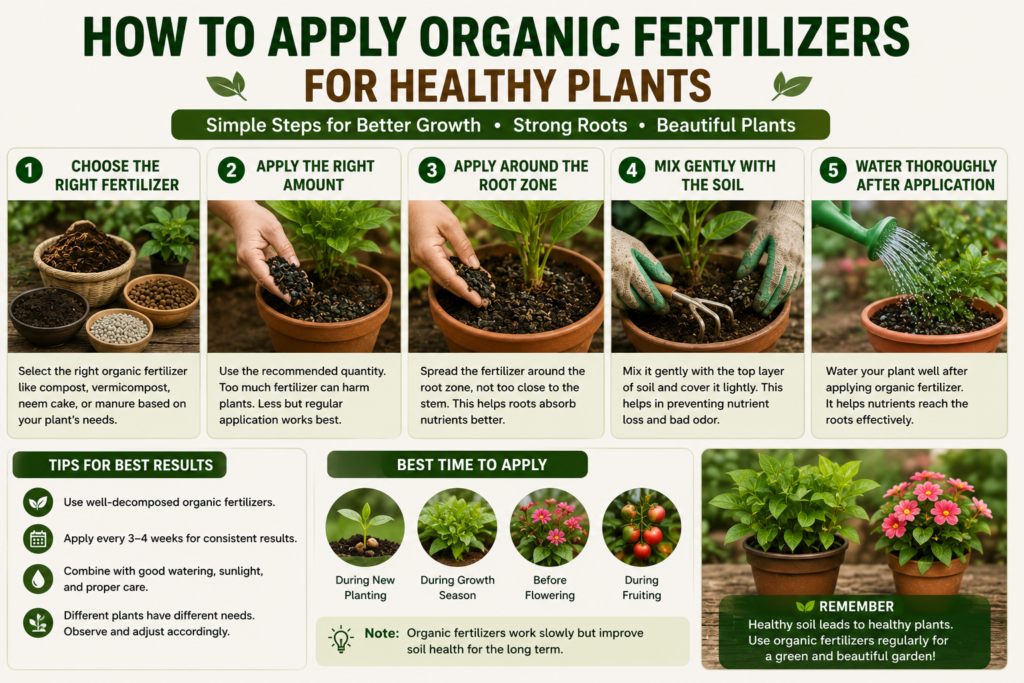
Table of Contents
What Are Organic Fertilizers?
Organic fertilizers are nutrient sources derived from natural materials such as plant residues, animal manure and other organic matter.
Common examples include compost, vermicompost, farmyard manure, neem cake and certain plant- or animal-based fertilizers.
Unlike many concentrated synthetic fertilizers, organic materials can also contribute to soil organic matter and improve physical properties of the soil. Their nutrient release can be slower and depends on the material, moisture, temperature and microbial activity.
This makes organic fertilizers particularly useful when your goal is not only to feed the plant but also to maintain healthy soil.
Why Use Organic Fertilizers for Plants?
There are several reasons home gardeners choose organic nutrient sources.
1. They Add Organic Matter to Soil
Materials such as compost and well-decomposed manure add organic matter to the growing medium.
This can help improve soil structure and create a better environment for plant roots.
2. They Can Support Soil Microbial Activity
Healthy soil contains microorganisms that participate in decomposition and nutrient cycling.
Organic inputs provide material that can support biological activity in the soil.
3. Nutrients Can Be Released Gradually
Many organic materials release nutrients more slowly than highly soluble fertilizers.
This can be useful for gardeners who prefer gradual nutrient availability.
4. They Can Improve Soil Condition
Organic amendments can help improve soil structure, water-holding capacity and nutrient availability when used appropriately. ICAR has highlighted compost, vermicompost and other organic inputs as components of soil-health management.
5. They Fit Well Into Home Gardening
Compost, vermicompost and neem cake are relatively common gardening inputs in India and can be used for many container and garden plants when applied correctly.
7 Best Organic Fertilizers for Plants
There is no single organic fertilizer that is best for every plant.
The right choice depends on the plant, soil condition, growth stage and nutrient requirement.
Here are seven useful options for home gardeners.
1. Compost
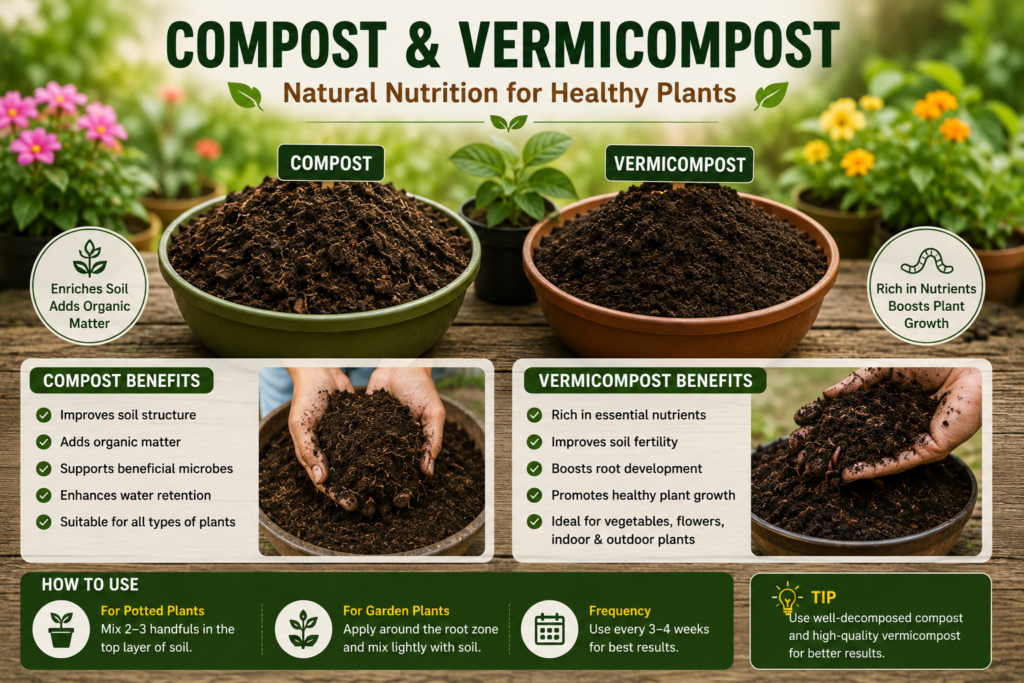
Compost is one of the simplest organic soil amendments for home gardens.
It is made from decomposed organic materials such as leaves, vegetable residues and other suitable biodegradable materials.
Benefits of Compost
- Adds organic matter to soil
- Helps improve soil structure
- Supports beneficial soil organisms
- Can improve moisture management
- Provides a range of nutrients in relatively small amounts
Best For
Compost can be useful for:
- Flowering plants
- Vegetable plants
- Herbs
- Outdoor plants
- Garden beds
- Container plants
How to Use Compost
Mix well-matured compost into the growing medium before planting or apply a small amount around established plants.
Avoid using fresh, undecomposed organic waste directly around plant roots.
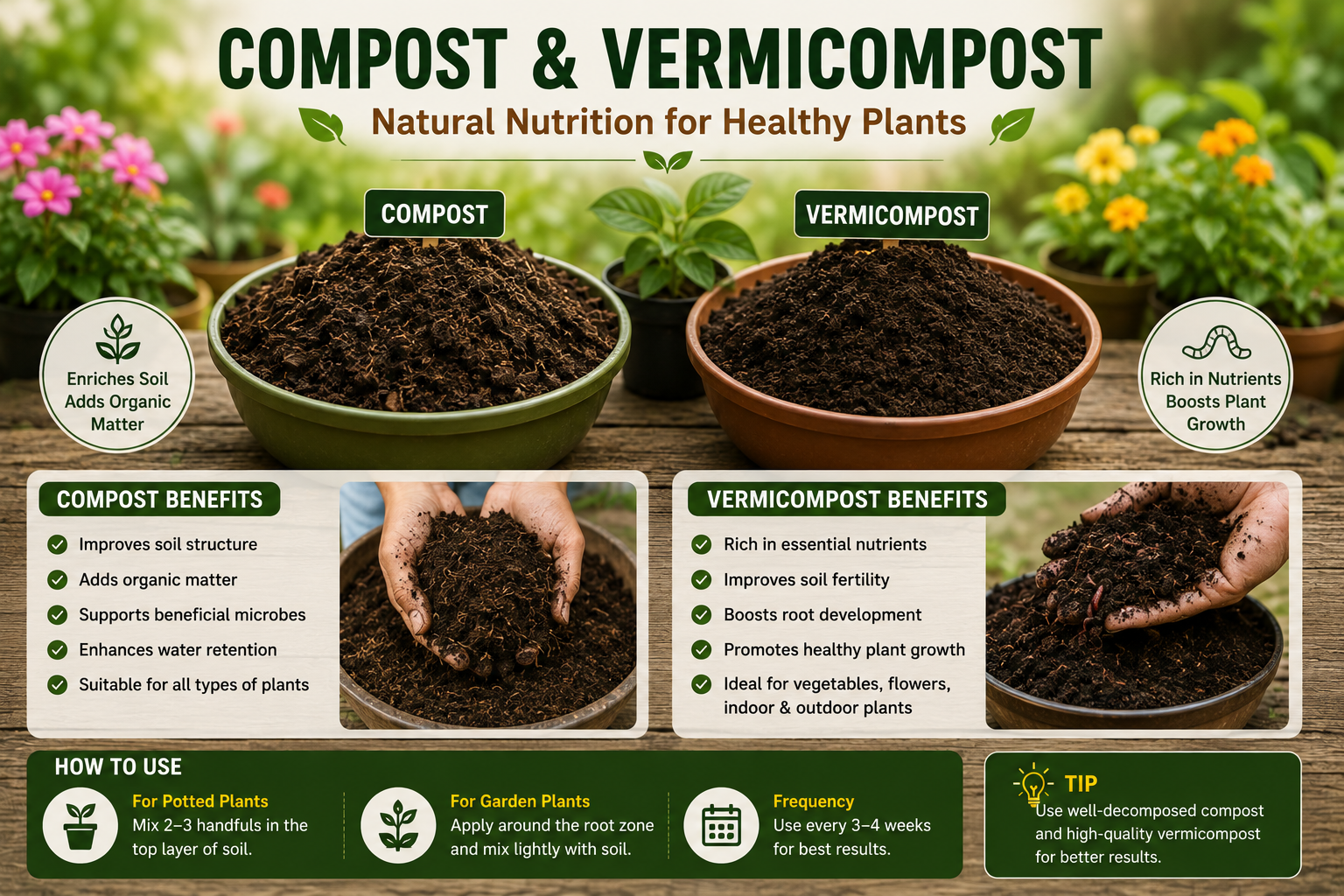
2. Vermicompost
Vermicompost is produced through the decomposition of organic material with the help of earthworms.
It is widely used by gardeners because it is easy to incorporate into potting mixes and garden soil.
ICAR has highlighted vermicompost as an organic input that can contribute to soil structure, microbial activity and nutrient availability.
Benefits of Vermicompost
- Adds organic matter
- Supplies several plant nutrients
- Supports biological activity
- Can improve soil condition
- Works well in container gardening
Best For
Vermicompost can be particularly useful for:
- Roses
- Hibiscus
- Money plants
- Vegetables
- Herbs
- Indoor plants
- Flowering plants
How to Use Vermicompost
For container plants, mix a moderate amount into the upper layer of soil or growing medium.
For established plants, apply it around the root zone rather than directly against the main stem.
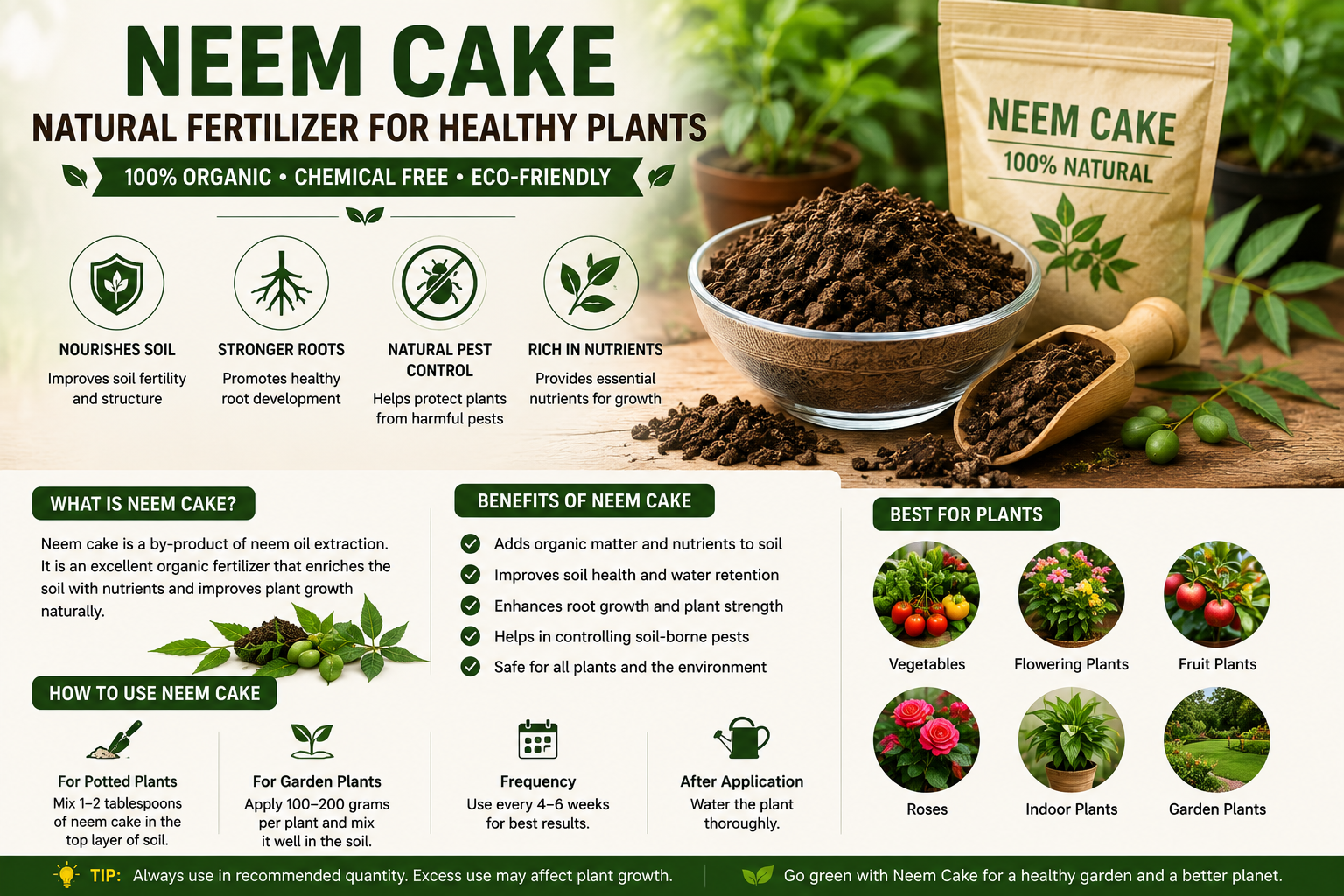
3. Neem Cake
Neem cake is made from neem seed residues left after oil extraction.
It is commonly used in Indian gardening and agriculture as an organic nutrient source and soil amendment.
Benefits of Neem Cake
Neem cake can:
- Add organic nutrients
- Contribute organic matter
- Support soil health
- Be useful as part of an integrated plant-care routine
ICAR publications and programmes have included neem cake among organic nutrient inputs used in soil and crop management.
Best For
Neem cake can be used around:
- Vegetable plants
- Flowering plants
- Fruit plants
- Ornamental plants
- Garden beds
Important Tip
Do not assume that more neem cake means better results.
Always follow the product instructions and use an appropriate quantity for the plant and growing medium.
4. Farmyard Manure
Farmyard manure, commonly called FYM, is an organic material derived primarily from livestock manure and associated bedding or farm residues after proper decomposition.
Well-decomposed manure can contribute organic matter and nutrients to soil.
Benefits of Farmyard Manure
- Adds organic matter
- Improves soil condition
- Provides nutrients gradually
- Can support long-term soil fertility
ICAR recommends properly managed organic nutrient sources such as farmyard manure and compost as part of soil-health and nutrient-management practices.
Important
Never use fresh manure directly around sensitive plant roots.
Properly decomposed material is much more suitable for gardening.
5. Banana Peel Fertilizer
Banana peels are often used by home gardeners to make homemade fertilizer or compost.
Banana residues contain nutrients, including potassium, but the actual nutrient concentration available to plants depends on how the material is processed.
Popular Ways to Use Banana Peels
You can:
- Compost banana peels
- Add them to a compost pile
- Make a properly prepared homemade liquid extract
- Dry and process them before adding them to soil
Best For
Banana-peel compost or processed banana residues can be incorporated into a broader nutrient-management routine for flowering and fruiting plants.
However, banana peel fertilizer should not be treated as a complete fertilizer because plants require several nutrients, not just one.
6. Fish-Based Fertilizer
Fish-based fertilizers are organic nutrient products made from fish or fish-processing materials.
They can provide nitrogen and other nutrients, depending on the formulation.
Benefits
- Provides organic nutrients
- Can support vegetative growth
- Useful for some outdoor plants
- Can complement other soil amendments
Because fish-based products vary considerably, always check the product label for nutrient content, dilution instructions and recommended application frequency.
Important
Do not use a homemade fish mixture without understanding how it has been prepared.
Poorly prepared organic mixtures can create unpleasant odors and may attract pests.
7. Green Manure
Green manure involves growing suitable plants and incorporating their biomass into the soil.
Leguminous crops are often used because they can contribute nitrogen through biological nitrogen fixation when associated with compatible microbes.
Green manuring is more common in agricultural and larger-scale gardening systems than in small indoor pots, but it is an important organic soil-management technique.
ICAR includes green manuring among practices used in integrated soil-health management.
Best Organic Fertilizer for Different Plants
Different plants can have different nutrient requirements.
Instead of looking for one universal fertilizer, choose the organic input according to the plant and soil condition.
| Plant Type | Useful Organic Options |
|---|---|
| Roses | Compost, vermicompost, neem cake |
| Hibiscus | Compost, vermicompost, neem cake |
| Vegetables | Compost, vermicompost, well-decomposed manure |
| Herbs | Compost, vermicompost |
| Indoor plants | Vermicompost, suitable organic liquid fertilizer |
| Flowering plants | Compost, vermicompost, plant-specific fertilizer |
| Fruit plants | Compost, well-decomposed manure, neem cake |
These are general options, not fixed prescriptions. Product labels and plant-specific recommendations should take priority.
How to Use Organic Fertilizers Correctly
Using an organic fertilizer does not mean you can apply unlimited quantities.
The application method matters.
Step 1: Understand Your Plant
First identify what you are growing.
A small indoor plant in a pot has very different nutrient requirements from a mature outdoor fruit plant.
Step 2: Check the Product
If you are using a packaged fertilizer, read the label carefully.
Look for:
- Nutrient information
- Recommended dosage
- Application frequency
- Suitable plants
- Dilution instructions
- Storage instructions
Step 3: Apply the Right Quantity
More fertilizer does not automatically mean faster growth.
Excessive fertilizer can create nutrient problems and may damage roots.
Step 4: Keep Fertilizer Away From the Stem
When using granular or solid organic materials, spread them around the root zone rather than placing a concentrated pile directly against the stem.
Step 5: Water Appropriately
After applying suitable solid organic fertilizer, water according to the plant’s normal requirements.
Avoid keeping the soil constantly waterlogged.
Organic Fertilizer vs Chemical Fertilizer
The choice does not always have to be “organic or chemical.”
Good nutrient management can involve selecting appropriate nutrient sources based on plant requirements and soil conditions.
| Feature | Organic Fertilizer | Synthetic Fertilizer |
|---|---|---|
| Source | Natural organic materials | Manufactured nutrient compounds |
| Nutrient release | Often slower | Often faster |
| Organic matter contribution | Usually yes | Usually little or none |
| Nutrient concentration | Often lower | Often higher |
| Soil benefits | Can improve soil condition | Primarily supplies nutrients |
| Application | Depends heavily on material | Usually precise by label |
| Best approach | Correct material and quantity | Correct product and quantity |
ICAR’s recent soil-health programmes emphasize balanced and judicious fertilizer use, soil testing and integrated nutrient management rather than simply maximizing one type of fertilizer.
If you prefer the convenience of a ready-to-use liquid plant fertilizer alongside organic soil amendments such as compost and neem cake, MeraGarden GrowMax Pro is another option to consider.
Can Organic Fertilizers Replace All Other Fertilizers?
Not necessarily.
This is one of the most important points for gardeners.
Organic materials differ greatly in nutrient concentration and nutrient release. Some may supply relatively small amounts of certain nutrients, while plants may have higher requirements at particular stages.
For this reason, nutrient management should be based on the plant, soil and fertilizer being used.
For larger gardens and agricultural crops, soil testing can provide much better information than guessing based on plant appearance alone.
Common Mistakes to Avoid
Mistake 1: Using Too Much Fertilizer
Organic does not automatically mean harmless in unlimited quantities.
Too much of any nutrient source can create problems.
Mistake 2: Using Fresh Manure
Fresh manure may be too strong for plant roots and can create sanitation or odor problems.
Use properly decomposed material.
Mistake 3: Expecting Instant Results
Many organic fertilizers release nutrients gradually.
Do not keep adding fertilizer every few days simply because you cannot see immediate changes.
Mistake 4: Using Only One Homemade Fertilizer
Banana-peel water, compost tea or another homemade preparation should not automatically be considered a complete fertilizer.
Plants need a range of nutrients.
Mistake 5: Ignoring Soil Condition
Yellow leaves, poor growth or weak plants are not always caused by a lack of fertilizer.
Problems can also result from:
- Overwatering
- Poor drainage
- Root damage
- Insufficient light
- Pests
- Diseases
- Incorrect soil pH
- Nutrient imbalance
Mistake 6: Applying Fertilizer Directly to the Stem
Concentrated fertilizer placed against the stem or roots can cause localized damage.
Spread solid fertilizers appropriately around the root zone.
Frequently Asked Questions
What is the best organic fertilizer for plants?
There is no single best organic fertilizer for every plant. Compost and vermicompost are good general-purpose options for many home gardens, while neem cake, farmyard manure and other organic inputs can be selected according to plant and soil requirements.
Is vermicompost better than compost?
Not necessarily. Both can be useful. Vermicompost is nutrient-rich organic material produced with earthworms, while compost is produced through controlled decomposition of organic materials. The better choice depends on the quality of the material and what your plants need.
Can I use organic fertilizer for indoor plants?
Yes. Organic fertilizers can be used for indoor plants, but the quantity should be appropriate for the small volume of soil in a container. Overapplication is a common mistake.
How often should I use organic fertilizer?
There is no universal schedule. Frequency depends on the fertilizer, plant species, growing medium and season. Follow the product label when using a packaged fertilizer.
Is banana peel fertilizer enough for plants?
No. Banana peel-based fertilizer should not be considered a complete source of plant nutrition. Plants require multiple macro- and micronutrients.
Can organic fertilizer burn plants?
Yes. Organic materials can still cause problems when used incorrectly or in excessive amounts. Fresh manure and concentrated fertilizer products should be handled carefully.
Can I mix compost and vermicompost?
They can generally be used together as organic amendments, provided both materials are mature and suitable for gardening. Use reasonable quantities rather than assuming that more is always better.
Final Thoughts
The best organic fertilizers for plants are not necessarily the most expensive products or the ones that promise the fastest growth.
For home gardeners, compost, vermicompost, neem cake, well-decomposed farmyard manure and other suitable organic nutrient sources can be valuable parts of a healthy soil-management routine.
The key is to use the right material, in the right quantity, at the right time.
Healthy plants depend on more than fertilizer. Proper light, watering, drainage, soil quality, temperature and pest management are equally important.
If you are growing plants in containers, start with good-quality growing media and use organic fertilizers conservatively. Observe your plants over time and adjust your care routine based on their actual needs.
Recommended Articles
- How Often Should You Fertilize Plants? 7 Easy Rules for Healthy Growth
- How Often Should You Fertilize Plants? Complete Fertilizer Schedule
- What Is NPK Fertilizer? 7 Easy Tips for Healthy Plants
- Best Liquid Fertilizer for Plants: Complete Guide for Home Gardeners
- How to Use Liquid Fertilizer for Plants: 7 Easy Steps for Better Growth
- Best Organic Fertilizers for Plants: 7 Natural Options for Healthy Growth
- Best Fertilizer for Indoor Plants in India: 7 Easy Tips for Healthy Growth
- Best Fertilizer for Flowering Plants in India: 7 Top Options
- Best Fertilizer for Plants: 7 Smart Tips to Avoid Common Mistakes
- 5 Signs Your Plants May Need Fertilizer
- How Much Liquid Fertilizer Should You Use for Plants?
- 7 Benefits of Liquid Fertilizer for Plants: Grow Healthier Plants Faster
- 7 Benefits of Liquid Fertilizer for Plants: A Simple Guide for Healthy Growth
- Best Fertilizer for Peace Lily: 7 Powerful Tips for Beautiful Blooms and Avoiding Common Mistakes
- Best Fertilizer for Spider Plant: 7 Powerful Tips for Lush Growth and Avoiding Common Mistakes
- Liquid Fertilizer vs Granular Fertilizer: Which Is Better? 7 Key Differences for Home Gardeners
- Liquid Fertilizer vs Organic Fertilizer: 7 Powerful Pros, Cons & the Best Choice for Your Plants
- How to Choose the Right Fertilizer for Your Plants: 7 Smart Tips to Avoid Common Mistakes
- 5 Positive Signs Your Plants Need Fertilizer — Avoid These Warning Symptoms for Healthier Growth
- How to Grow Peace Lilies
- How To Grow Houseplants