
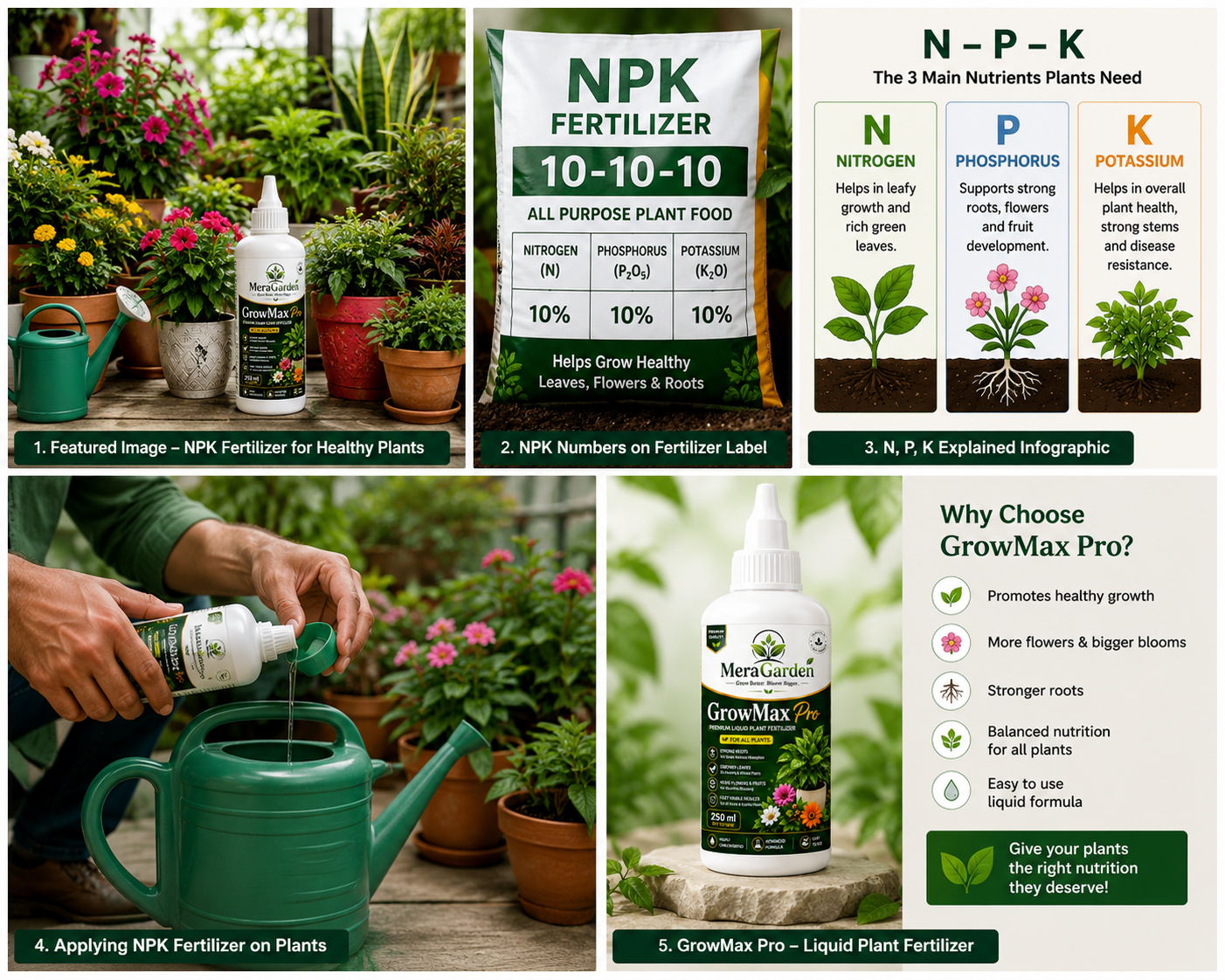
Plants need several nutrients to grow healthy roots, leaves, flowers, and fruits. When the soil cannot provide enough of a particular nutrient, fertilizer can help supply it.
One of the most common fertilizer labels you will see is N-P-K. You may have noticed numbers such as 10-10-10, 5-10-5, or 20-20-20 printed on fertilizer packages.
But what do these numbers actually mean?
NPK fertilizer refers to fertilizer that contains the three primary plant nutrients represented by N, P, and K: nitrogen, phosphorus, and potassium. These nutrients play different roles in plant growth, so understanding the numbers can help you make a more informed fertilizer choice.
In this guide, you will learn what NPK means, what each nutrient does, how to read an NPK ratio, when plants may need fertilizer, and how to avoid common mistakes.
Table of Contents
What Is NPK Fertilizer?
NPK fertilizer is a fertilizer labeled with the percentages of three primary nutrients: nitrogen (N), phosphorus (P), and potassium (K).
These three nutrients are essential for normal plant growth, but plants do not necessarily need them in equal amounts. The correct nutrient balance depends on the plant, growing conditions, soil, and other factors.
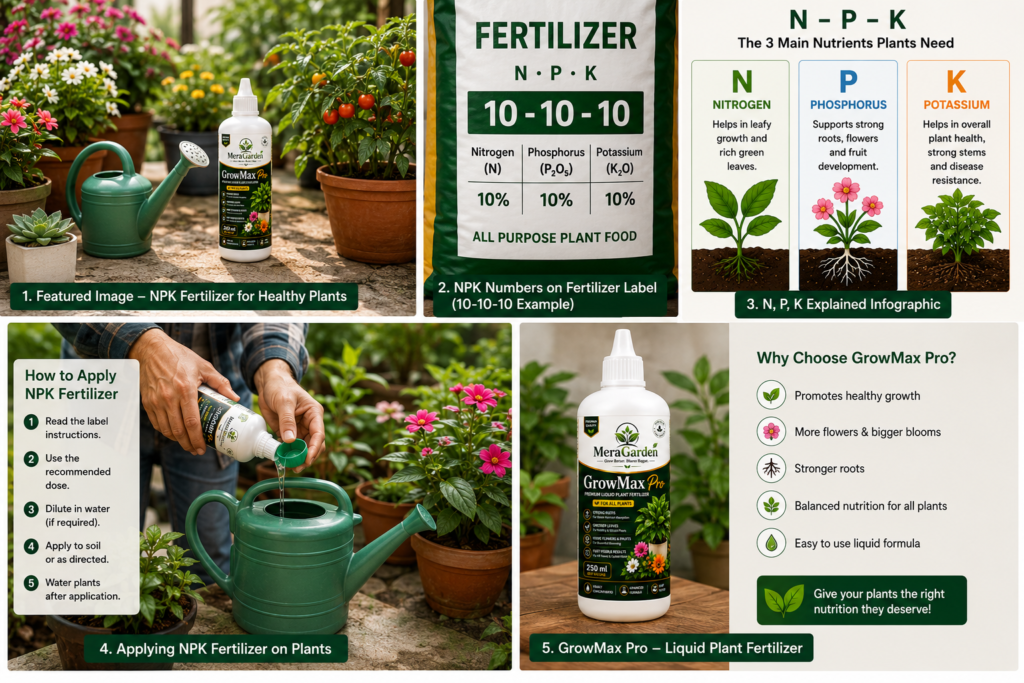
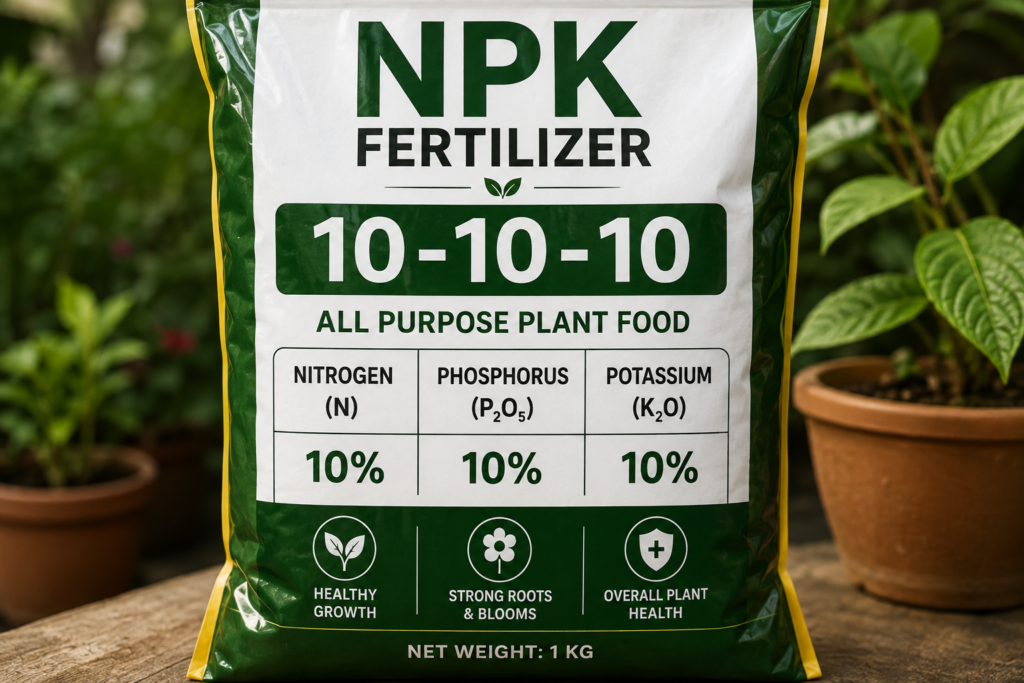
For example, a fertilizer labeled 10-10-10 contains 10% nitrogen, 10% phosphorus expressed in the fertilizer-label system, and 10% potassium expressed in the fertilizer-label system.
The remaining material may include other ingredients that help carry or deliver the nutrients.
The important thing to remember is that a higher NPK number does not automatically mean a better fertilizer.
The goal is to provide the nutrients a plant actually needs without unnecessarily applying too much.
What Does NPK Stand For?
NPK stands for:
- N = Nitrogen
- P = Phosphorus
- K = Potassium
Fertilizer labels list these nutrients in the order N-P-K. Reading the three numbers from left to right tells you the labeled nutrient analysis of the product.
For example:
10-5-8
means the fertilizer has:
- 10% nitrogen
- 5% phosphorus
- 8% potassium
The numbers are percentages by weight, not a simple statement that the plant needs those nutrients in exactly that ratio.
Fertilizer labels list nutrients in N-P-K order, so understanding the label can help you compare different fertilizer formulations.
What Does Nitrogen Do for Plants?
Nitrogen is closely associated with healthy leaf and shoot growth.
Plants use nitrogen to build important compounds involved in growth and development. When nitrogen is limited, plants may show slow growth and pale or yellowing older leaves.
However, more nitrogen is not always better.
Too much nitrogen can encourage excessive leafy growth and may not be appropriate for every plant or growth stage.
This is why choosing fertilizer based only on the highest nitrogen number is not a good strategy.
If your plant already has sufficient nitrogen, adding more may not solve the actual problem.
What Does Phosphorus Do for Plants?
Phosphorus is involved in important plant processes and is particularly associated with root development and reproductive growth.
A plant’s phosphorus requirement depends on the species, soil conditions, and nutrient availability.
It is a common mistake to assume that every flowering plant automatically needs a very high-phosphorus fertilizer.
In reality, fertilizer recommendations should be based on plant needs and available nutrients rather than simply choosing the product with the largest middle number.
Soil testing can help determine nutrient availability when a more precise fertilizer decision is needed.
What Does Potassium Do for Plants?
Potassium plays several important roles in plant growth and helps plants cope with different stresses.
It is associated with plant strength, water regulation, and overall plant health.
Adequate potassium can help plants remain hardy and better withstand certain stresses and diseases.
Like nitrogen and phosphorus, potassium should not simply be added in large amounts without considering the plant’s actual requirements.
A balanced fertilizer program aims to supply enough nutrients without unnecessary overapplication.
How to Read NPK Fertilizer Numbers
Understanding fertilizer numbers is easier once you know that they are written as:
N – P – K
Consider these examples:
| NPK Label | General Meaning |
|---|---|
| 10-10-10 | Equal labeled percentages of N, P, and K |
| 5-10-5 | Lower N, higher P relative to N and K |
| 20-20-20 | Higher concentration of all three compared with 10-10-10 |
| 10-5-10 | Equal N and K percentages with less P |
These numbers describe the fertilizer’s nutrient analysis. They do not mean that 20-20-20 is automatically twice as good as 10-10-10.
For example, if you use a more concentrated product, the amount of fertilizer needed may be different.
Always follow the product label rather than guessing the amount.
Common NPK Ratios Explained
10-10-10 Fertilizer
A 10-10-10 fertilizer is often described as a balanced fertilizer because the three labeled numbers are the same.
It may be useful in situations where a balanced nutrient supply is appropriate, but it is not automatically the best choice for every plant.
5-10-5 Fertilizer
This formulation has less nitrogen and potassium than phosphorus.
Whether it is appropriate depends on the crop, soil, and nutrient requirements.
20-20-20 Fertilizer
This is a higher-analysis balanced formulation.
Because it contains higher percentages of the three listed nutrients than 10-10-10, you should not assume that you can apply the same amount.
Always follow the manufacturer’s instructions.
10-5-10 Fertilizer
This formulation provides equal labeled percentages of nitrogen and potassium, with a lower phosphorus percentage.
Again, the correct choice depends on what your plants and soil actually need.
Which NPK Fertilizer Is Best for Plants?
There is no single best NPK fertilizer for every plant.
The right product depends on several factors:
- The type of plant
- Its growth stage
- Soil nutrient availability
- Growing conditions
- Existing fertilizer or compost use
- The manufacturer’s application recommendations
A common mistake is to select fertilizer based only on the biggest number on the package.
Instead, start by identifying what your plant actually needs.
For gardens where nutrient management matters, soil testing can provide useful information about nutrient availability. University of Minnesota Extension recommends soil testing as a way to determine nutrient status before making fertilizer decisions.
NPK Fertilizer for Flowering Plants
Flowering plants need adequate nutrients to support healthy leaves, roots, stems, and flowers.
However, flowering does not mean that a plant automatically needs a fertilizer with extremely high phosphorus.
A better approach is to:
- Choose a fertilizer appropriate for the plant
- Follow the product label
- Avoid excessive feeding
- Consider the soil or growing medium
- Observe the plant’s overall growth
- Adjust your care based on the plant’s needs
If you are growing flowering plants in containers, remember that nutrients can be lost through regular watering, so following the recommended feeding schedule is particularly important.
NPK Fertilizer for Vegetable Plants
Vegetable plants have changing nutrient requirements throughout their growth cycle.
Leafy vegetables may have significant nitrogen requirements, while fruiting crops have different nutrient needs depending on their growth stage and growing conditions.
This does not mean that you should automatically use a high-NPK fertilizer.
For edible crops, it is especially important to follow the product label and avoid excessive application.
If you are growing vegetables in containers, nutrients can also behave differently from nutrients in garden soil because the growing volume is smaller and watering can cause nutrient loss.
NPK Fertilizer for Indoor Plants
Indoor plants generally grow in containers with a limited amount of growing medium.
Their fertilizer needs can therefore be different from plants growing outdoors in garden soil.
A common approach is to fertilize indoor plants during active growth according to the fertilizer label and reduce or stop feeding when the plant is not actively growing, depending on the species and growing conditions.
University of Minnesota Extension notes that soluble fertilizers can be available to plants quickly, while slow-release fertilizers release nutrients over a longer period. It also warns that overfertilizing houseplants can cause problems such as stunting and leaf drop.
For indoor plants, more fertilizer is not necessarily better.
How to Use NPK Fertilizer Safely
Using fertilizer correctly is more important than simply choosing a particular NPK number.
Follow these steps:
Step 1: Identify Your Plant
Different plants have different nutritional requirements.
Know the plant species or at least its general type before selecting a fertilizer.
Step 2: Read the Fertilizer Label
Check:
- NPK analysis
- Recommended dosage
- Application frequency
- Dilution instructions
- Suitable plants
- Safety instructions
Step 3: Start With the Recommended Amount
Do not increase the dosage because you think more fertilizer will produce faster growth.
Overapplication can damage plants.
Step 4: Apply According to the Instructions
Some fertilizers are diluted in water, while others are applied directly to the soil.
Use the method specified on the product label.
Step 5: Monitor Your Plants
Watch for changes in:
- Leaf color
- New growth
- Flowering
- Root health
- Overall plant condition
If the plant continues to struggle, adding more fertilizer may not be the answer.
The problem could be related to watering, light, pests, disease, temperature, soil conditions, or another nutrient issue.
How Often Should You Use NPK Fertilizer?
There is no universal fertilizer schedule that works for every plant.
Application frequency depends on:
- Plant species
- Fertilizer concentration
- Growing medium
- Season
- Growth rate
- Watering frequency
- Product instructions
Some soluble fertilizers may be used more frequently at lower labeled rates, while slow-release products can provide nutrients over a longer period.
Always follow the specific product instructions.
For houseplants, overfertilizing can cause serious problems. University of Minnesota Extension recommends following fertilizer-label directions and notes that excessive fertilizer can contribute to stunting, leaf drop, and even plant death.
Common NPK Fertilizer Mistakes
Mistake 1: Choosing the Highest Numbers
A fertilizer with higher numbers is not automatically better.
Higher concentration simply means the product contains a higher percentage of the listed nutrients.
Mistake 2: Using Too Much Fertilizer
More fertilizer does not necessarily mean faster or healthier growth.
Overfertilization can damage plants and waste money.
Mistake 3: Ignoring the Soil
If the soil already contains sufficient nutrients, adding more may be unnecessary.
A soil test can provide useful information when you need to make a more informed fertilizer decision.
Mistake 4: Using the Same Fertilizer for Every Plant
A fertilizer that works well for one plant may not be ideal for another.
Consider the plant’s specific requirements.
Mistake 5: Guessing the Dosage
Never estimate fertilizer dosage by eye.
Use the measuring instructions provided by the manufacturer.
Mistake 6: Fertilizing a Stressed Plant Without Finding the Cause
Yellow leaves or poor growth do not always mean that the plant needs fertilizer.
Before feeding, check:
- Watering
- Drainage
- Light
- Pests
- Diseases
- Root condition
- Soil or potting mix
Solving the actual problem is often more useful than adding fertilizer.
NPK Fertilizer vs Liquid Fertilizer
These two terms describe different things.
NPK describes the nutrient analysis of a fertilizer.
Liquid fertilizer describes the physical form of the fertilizer.
Therefore, a liquid fertilizer can also be an NPK fertilizer.
For example, a liquid plant food might have an NPK analysis such as 10-10-10 or 5-10-5.
Likewise, an NPK fertilizer can be available in liquid, powder, granular, or other forms depending on the product.
If you want to learn more about choosing and using liquid products, see our guide to best liquid fertilizer for plants.
Can You Use NPK Fertilizer on All Plants?
Not necessarily.
Different plants have different nutrient requirements, and some plants may be sensitive to excessive fertilizer.
Before applying an NPK product, check the fertilizer label and the needs of the particular plant.
Is 10-10-10 a Good Fertilizer?
10-10-10 can be a useful balanced fertilizer in situations where that nutrient profile is appropriate.
However, it is not automatically the best fertilizer for every plant.
The right choice depends on the plant, soil, and growing conditions.
Is 20-20-20 Better Than 10-10-10?
Not necessarily.
20-20-20 contains higher labeled percentages of N, P, and K than 10-10-10, but that does not mean it is better for every plant.
A higher-analysis fertilizer may simply require a different application amount.
Always follow the product label.
Can NPK Fertilizer Burn Plants?
Yes.
Applying too much fertilizer can damage plants.
This is one reason you should always follow the recommended application rate and avoid assuming that extra fertilizer will improve growth.
Can I Use NPK Fertilizer for Indoor Plants?
Yes, some NPK fertilizers are suitable for indoor plants.
However, the product must be appropriate for the plant and used according to its label.
Indoor plants grown in containers have limited growing space, so excessive fertilizer can build up or contribute to plant problems.
Should I Use NPK Fertilizer Every Week?
Not automatically.
Weekly application may be appropriate for some products and plants, while other fertilizers are designed for less frequent application.
Always follow the product-specific instructions.
What Happens If You Use Too Much NPK Fertilizer?
Too much fertilizer can cause problems such as:
- Leaf damage
- Poor growth
- Leaf drop
- Root stress
- Salt buildup in container soil
If you suspect overfertilization, stop adding fertilizer and review the product’s instructions and the condition of the growing medium.
Final Thoughts
NPK fertilizer is easier to understand once you know what the three letters mean.
N stands for nitrogen, P stands for phosphorus, and K stands for potassium.
The numbers on a fertilizer package describe the labeled percentages of these nutrients. But the fertilizer with the highest numbers is not automatically the best choice.
For healthier plants, focus on the plant’s actual needs, read the fertilizer label carefully, avoid overapplication, and consider soil nutrient availability when appropriate.
Most importantly, remember that fertilizer is only one part of good plant care. Proper light, watering, drainage, temperature, soil, and pest management are also important for healthy growth.
Frequently Asked Questions About NPK Fertilizer
What does NPK mean in fertilizer?
NPK stands for nitrogen, phosphorus, and potassium. These are the three primary nutrients represented on many fertilizer labels.
What do the three numbers on fertilizer mean?
The three numbers are listed in N-P-K order and represent the labeled percentages of nitrogen, phosphorus, and potassium in the fertilizer.
Which NPK ratio is best for plants?
There is no single best NPK ratio for every plant. The appropriate fertilizer depends on the plant, soil, growing conditions, and product recommendations.
Is NPK fertilizer good for flowering plants?
NPK fertilizer can be useful for flowering plants when the nutrient formulation is appropriate and applied according to the product instructions.
Can NPK fertilizer be used for vegetables?
Some NPK fertilizers are suitable for vegetables. Always check the product label and follow its application instructions.
Can I use NPK fertilizer for indoor plants?
Yes, if the fertilizer is suitable for indoor plants. Use the recommended amount and avoid overfertilizing.
Is liquid fertilizer the same as NPK fertilizer?
No. Liquid describes the physical form, while NPK describes the fertilizer’s nitrogen, phosphorus, and potassium analysis. A liquid fertilizer can also be an NPK fertilizer.
Recommended Articles
- How Often Should You Fertilize Plants? 7 Easy Rules for Healthy Growth
- How Often Should You Fertilize Plants? Complete Fertilizer Schedule
- What Is NPK Fertilizer? 7 Easy Tips for Healthy Plants
- Best Liquid Fertilizer for Plants: Complete Guide for Home Gardeners
- How to Use Liquid Fertilizer for Plants: 7 Easy Steps for Better Growth
- Best Organic Fertilizers for Plants: 7 Natural Options for Healthy Growth
- Best Fertilizer for Indoor Plants in India: 7 Easy Tips for Healthy Growth
- Best Fertilizer for Flowering Plants in India: 7 Top Options
- Best Fertilizer for Plants: 7 Smart Tips to Avoid Common Mistakes
- 5 Signs Your Plants May Need Fertilizer
- How Much Liquid Fertilizer Should You Use for Plants?
- 7 Benefits of Liquid Fertilizer for Plants: Grow Healthier Plants Faster
- 7 Benefits of Liquid Fertilizer for Plants: A Simple Guide for Healthy Growth
- Best Fertilizer for Peace Lily: 7 Powerful Tips for Beautiful Blooms and Avoiding Common Mistakes
- Best Fertilizer for Spider Plant: 7 Powerful Tips for Lush Growth and Avoiding Common Mistakes
- Liquid Fertilizer vs Granular Fertilizer: Which Is Better? 7 Key Differences for Home Gardeners
- Liquid Fertilizer vs Organic Fertilizer: 7 Powerful Pros, Cons & the Best Choice for Your Plants
- How to Choose the Right Fertilizer for Your Plants: 7 Smart Tips to Avoid Common Mistakes
- 5 Positive Signs Your Plants Need Fertilizer — Avoid These Warning Symptoms for Healthier Growth
- How to Grow Peace Lilies
- How To Grow Houseplants